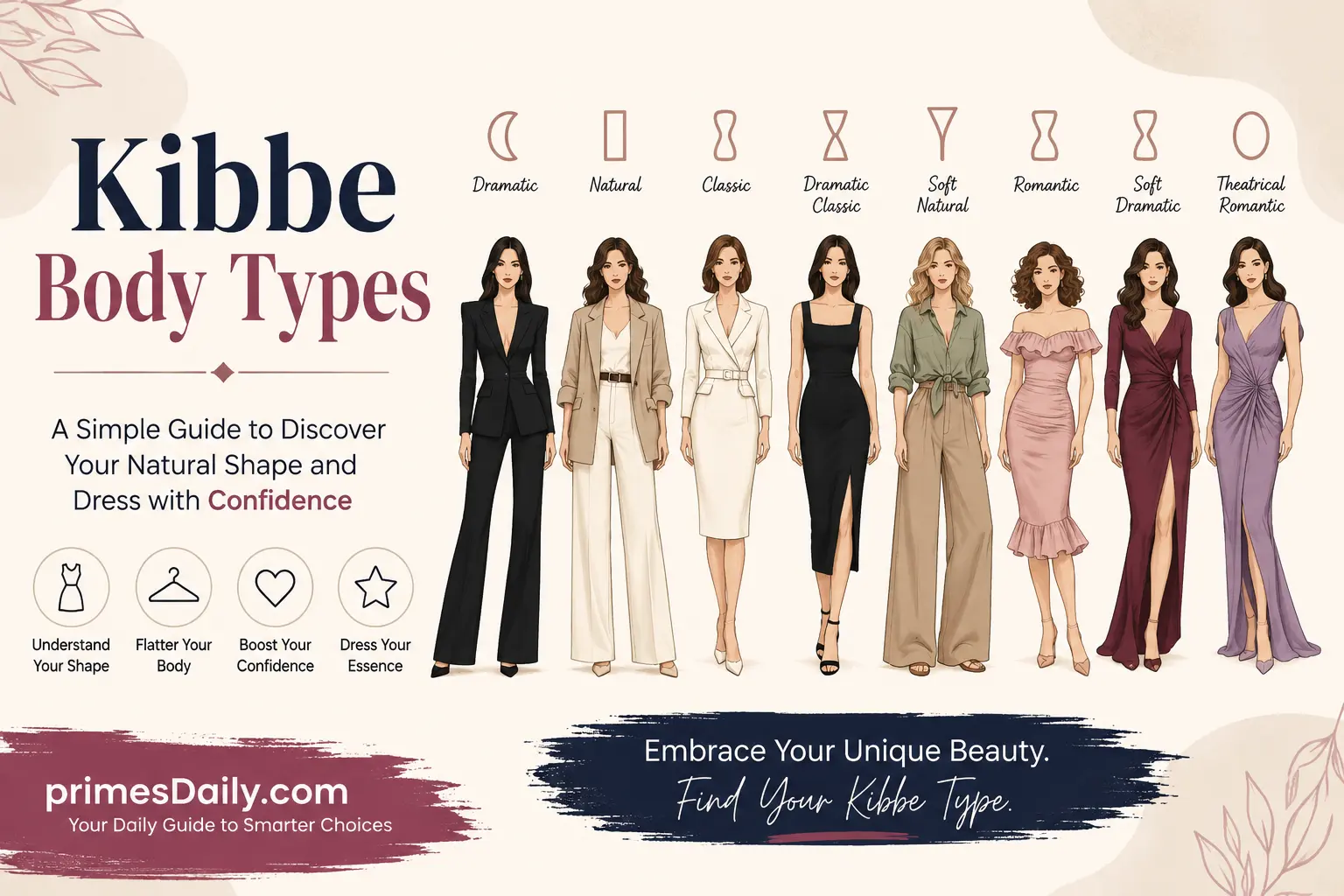
If you’ve ever stood in front of your closet convinced that every trend on your feed looks amazing on everyone except you, there’s probably a reason. It’s not your size, and it’s not a lack of style sense. It’s that most style advice is built around one flawed idea: that clothes should be chosen based on your measurements. David Kibbe’s system throws that idea out entirely.
Instead of asking “am I an hourglass, a pear, or a rectangle,” Kibbe asks a completely different question: does this garment’s line agree with your own natural line, or does it fight it? That single shift in thinking is why so many people who felt invisible in “flattering for your shape” advice finally feel like their clothes make sense once they understand this framework.
This guide walks through every layer of the system: the origin story, the yin/yang theory underneath it, all thirteen types with their real physical markers, how to actually self-type without guessing, how each family should dress, and the questions people ask most often once they start down this rabbit hole. No fluff, no filler, and no need to open ten other tabs to finish understanding it.
What Is the Kibbe Body Type System?
The kibbe body types system is a personal style framework that sorts people into thirteen categories based on the lines created by bone structure, flesh distribution, and facial features, not on waist-to-hip ratios or dress size. It was built to answer one practical question: which silhouettes, fabrics, and design details will look like they belong on your frame, rather than looking borrowed from someone else’s body.
Where older shape-based systems (pear, apple, hourglass, rectangle) only look at the width of your shoulders versus your hips, this system looks at the entire visual impression a body creates, including how sharp or soft your features read, how long or compact your proportions look, and how those elements combine into one unified “line.” That’s why two people who wear the exact same dress size can belong to entirely different categories and need entirely different wardrobes to look their best.
The goal isn’t to lose weight into a type or to change your bone structure. It’s to recognize the line you were already born with and choose clothing that echoes it instead of contradicting it.
The Origin of the Kibbe Theory
The framework comes from David Kibbe, an American stylist who published the book Metamorphosis in 1987. At the time, mainstream style advice was almost entirely shape-based: hide your hips, minimize your bust, balance your proportions with an hourglass as the unspoken ideal. Kibbe rejected that approach as too narrow, arguing that it ignored bone structure, muscle tone, and facial geometry entirely.
His background as a stylist working directly with models and performers gave him a different vantage point. He noticed that some women looked stunning in soft, draped fabric no matter their weight, while others only looked pulled-together in sharp tailoring, and that this pattern had almost nothing to do with how curvy or straight their outline was. From those observations, he built out thirteen distinct “Image Identities,” organized under five umbrella families, each rooted in a balance of what he called yin and yang.
Metamorphosis eventually went out of print, but the framework kept spreading through word of mouth, style forums, and later through online communities dedicated entirely to self-typing and outfit analysis. Decades after its release, it remains one of the most detailed and most debated personal style systems in circulation, and interest in it has only grown as more people search for alternatives to generic “flattering for your shape” advice.
Understanding Yin and Yang in Kibbe Body Types
Every part of this system rests on one core idea: yin and yang. Yang represents sharpness, angularity, and length. Yin represents softness, roundness, and curve. Nobody is purely one or the other; every person carries some blend, and the specific ratio of yin to yang across your bone structure, your flesh, and your facial features is what determines your category.
Yang traits generally include:
- Straight or angular bone structure
- Broad or squared shoulders
- Sharp facial features (a defined jawline, narrow nose, angular cheekbones)
- Long limbs relative to the torso
- Little natural curve at the waist
Yin traits generally include:
- Rounded or sloped bone structure
- Soft, curved silhouette with a defined waist
- Full or rounded facial features (large eyes, soft cheeks, full lips)
- Shorter or more petite proportions
- Flesh that reads soft and rounded regardless of weight
A person who leans heavily toward one side without much of the other is described as “sharp yang” or “lush yin.” A person who carries strong markers of both extremes at once, rather than sitting in the middle, is described as having “contrast,” and this is what defines the Gamine family specifically. Someone who sits in the moderate middle of the spectrum, with neither extreme dominating, is described as “blended,” which is the hallmark of the Classic family.
Once you understand this yin/yang split, the thirteen types stop feeling like an arbitrary list and start feeling like a logical map, because each one represents a specific combination point along that spectrum.
The 5 Kibbe Families and Subtypes
Every one of the thirteen categories belongs to one of five parent families, and each family reflects a distinct position on the yin/yang scale.
- Dramatic — Sharp yang. Long, angular, elongated lines with minimal curve.
- Natural — Soft yang. Broad, blunt, athletic lines with a relaxed, approachable quality.
- Classic — Balanced yin and yang. Symmetrical, moderate lines that read as polished rather than extreme in either direction.
- Gamine — Contrast between yin and yang within the same body. A mix of delicate and sharp, or petite and defined, in the same frame.
- Romantic — Lush yin. Soft, curved, rounded lines with a strong hourglass quality.
Within each family, there are pure types and blended subtypes. A pure type leans almost entirely into one direction across bone structure, flesh, and face. A blended subtype carries the dominant family trait through most categories but picks up a noticeable undercurrent from a neighboring family, usually through the face or the flesh rather than the bone structure. That’s how you end up with names like Soft Dramatic or Flamboyant Gamine: they describe exactly where the blend is happening.
All 13 Kibbe Body Types Explained
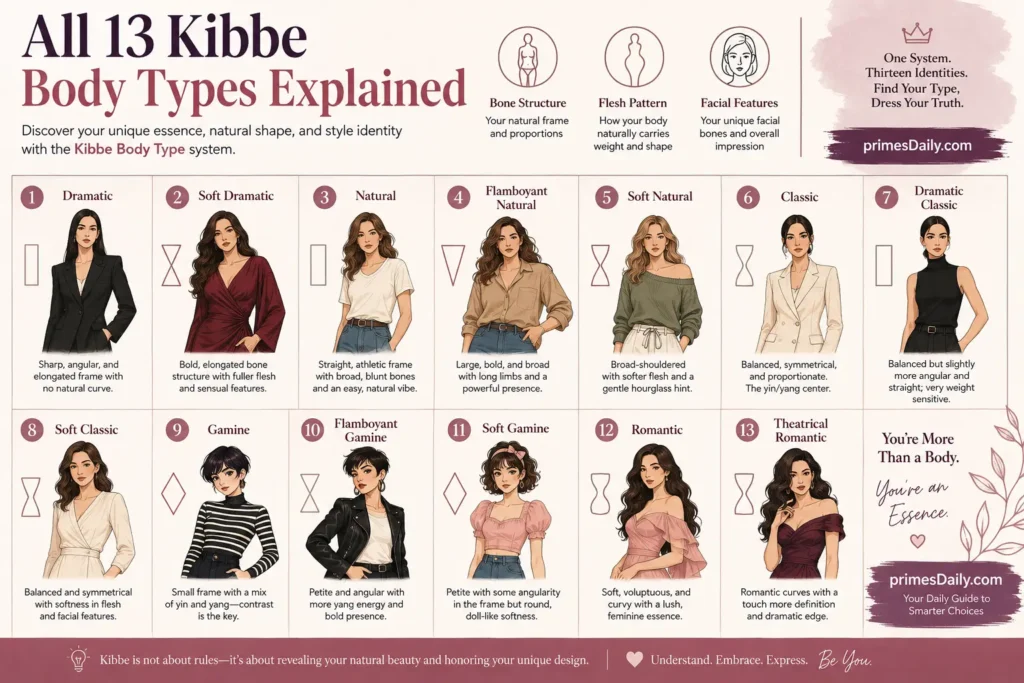
Here is where the theory becomes concrete. Each type below is described by its bone structure, its flesh pattern, and its facial features, since those are the three categories Kibbe originally used to sort people.
Dramatic Kibbe Body Type
Dramatic sits at the sharp yang extreme. Height typically reads moderate to tall, with a straight, angular frame and long, narrow limbs. Shoulders are square, hands and feet are long and narrow, and facial bones (nose, jaw, cheekbones) are sharp and prominent rather than soft. There’s no natural hourglass curve here, and even at a higher weight the body tends to hold its straight line rather than developing rounded curves. The overall effect is striking, elongated, and almost architectural.
Soft Dramatic Kibbe Body Type
Soft Dramatic keeps the same bold, elongated bone structure as pure Dramatic, but layers in noticeably fuller, more sensual flesh and facial features. Think large eyes, full lips, and fleshy cheeks sitting on top of a long-limbed, large-boned frame. The bust and hip area tend to carry more fullness than a pure Dramatic would, giving the overall look a glamorous, sultry quality rather than a purely severe one.
Natural Kibbe Body Type
Natural is soft yang: a straight, athletic frame with slightly broad, blunt bone structure rather than sharp angles. Shoulders are broad, the bustline and hips read relatively flat and straight, and facial features are open and slightly irregular rather than symmetrical or delicate. It reads as approachable, easygoing, and outdoorsy, and it holds its shape well even when weight shifts.
Flamboyant Natural Kibbe Body Type
Flamboyant Natural is a bigger, bolder version of Natural. The bone structure is large and blunt with broad shoulders, long limbs, and sizeable hands and feet, giving a commanding physical presence. Facial features stay broad and open rather than sharp, but everything about the frame reads larger in scale than a standard Natural, with a strong, capable quality to the overall silhouette.
Soft Natural Kibbe Body Type
Soft Natural takes the slightly angular, broad-shouldered Natural bone structure and pairs it with noticeably softer, fleshier flesh and rounder facial features. The waist stays relatively soft and undefined, but there’s a gentle hourglass suggestion rather than the flat straightness of pure Natural. Eyes and cheeks read full and rounded, giving an approachable, warm quality on top of that sturdy frame.
Classic Kibbe Body Type
Classic sits directly in the yin/yang middle. Bone structure is symmetrical with only slight sharpness, shoulders are moderately tapered, and the bust, waist, and hips fall into even, balanced proportion without extreme curve or extreme straightness. Facial features are chiseled but even, never overly soft or overly sharp. This is the type most associated with a polished, tailored, timeless look, since nothing about the frame pulls hard toward either extreme.
Dramatic Classic Kibbe Body Type
Dramatic Classic keeps the Classic family’s balanced proportions but carries a slightly more angular, straight bone structure underneath. The body stays trim and compact at an even weight, with shoulders that are tapered or slightly square. What sets this type apart is how noticeably the silhouette shifts with weight changes even though the bone structure itself never changes, since excess weight tends to gather from the waist down.
Soft Classic Kibbe Body Type
Soft Classic mirrors the same balanced Classic bone structure but leans slightly toward softness in the flesh and face. The frame is symmetrical with gently rounded rather than sharp edges, arms and thighs carry a bit more softness, and facial features are full and evenly spaced rather than angular. It’s Classic’s more relaxed, gracious cousin.
Gamine Kibbe Body Type
Gamine is where contrast takes over. Rather than being consistently yin or yang across the board, a Gamine mixes both extremes within the same small frame, typically 5’5″ and under. Bone structure is angular and narrow, but facial features often include very large, striking eyes that read distinctly soft against that sharp frame. The overall effect is spirited, fresh, and slightly unpredictable, since no single trait dominates.
Flamboyant Gamine Kibbe Body Type
Flamboyant Gamine leans the contrast toward the yang side. The bone structure is broadly angular with square shoulders and noticeably larger hands and feet than a typical Gamine, all packed into a petite, coltish frame. Extremely large eyes are common here too, but paired with a bolder, more defined musculature than the standard Gamine carries.
Soft Gamine Kibbe Body Type
Soft Gamine leans the same contrast toward the yin side instead. The bone structure still carries some angularity, particularly through the shoulders, but the flesh and facial features are noticeably rounder and more doll-like, with full cheeks and large, saucer-shaped eyes. It’s a petite, curvy frame sitting on a slightly angular base, which is exactly the kind of contrast that defines this family.
Romantic Kibbe Body Type
Romantic is lush yin taken to its fullest expression. The bone structure is delicate and often slightly wide, but it’s overwhelmed visually by a soft, voluptuous, hourglass body with fleshy arms and legs. Facial features are full and sensual: large luminous eyes, full lips, soft rounded cheeks. Even at a lower weight, this type holds visible curve, and at a higher weight the whole body simply becomes more rounded rather than gaining sharp definition anywhere.
Theatrical Romantic Kibbe Body Type
Theatrical Romantic keeps the same soft, hourglass curve as pure Romantic but layers in a touch more definition through the bone structure, giving a slightly sharper edge to the shoulders, jawline, or nose. The waist tends to stay more clearly defined than in a pure Romantic even at a higher weight, giving this type a magnetic, dramatic-but-soft quality that sits right between Romantic and Dramatic influence.
For the latest, updated, and unique information, visit Pokémon Unite Builds.
How to Find Your Kibbe Body Type
Self-typing is genuinely the hardest part of this whole system, and it’s worth being upfront about why: most people default to looking at their weight, their dress size, or a single feature they’re insecure about, when none of those are what the system actually measures.
A workable self-typing process follows three separate categories, in this order of importance:
- Bone structure first. This is the most reliable signal because it doesn’t change with weight. Look at shoulder width and shape, the length and thickness of your wrists and ankles, and whether your bone structure reads sharp, blunt, or delicate.
- Flesh pattern second. This isn’t about how much fat you carry, it’s about how flesh sits on the frame regardless of weight. Some people stay taut and lean-looking even at a higher weight; others carry soft, rounded flesh even when thin.
- Facial features last. Jawline, cheekbones, nose shape, and eye shape all carry yin or yang signals, but Kibbe intentionally weighted this category as the least decisive of the three, since faces alone can be misleading.
A few practical tips that make the process far more accurate:
- Take photos in fitted clothing or a swimsuit under even lighting, standing straight, camera at chest height rather than above or below.
- Compare your features against real reference photos of confirmed types rather than relying purely on written descriptions, since the visual pattern is often easier to recognize than to read.
- Expect a few answers to point in a different direction than the majority; that’s normal and doesn’t change your overall type, since the system looks for an overall pattern rather than a perfect match on every single question.
- If two categories both feel close, you’re very likely looking at a pure type versus its neighboring blended subtype (Natural versus Soft Natural, for example), not two unrelated families.
Because bone structure carries the most weight, height and weight fluctuations don’t move you into a different category. Someone described as a “petite kibbe body types” match by height alone might still turn out to be Dramatic if their vertical line and bone structure read long, since visual proportion matters more than inches on a tape measure. Similarly, a heavier build doesn’t automatically make someone Natural or Soft Dramatic; those are questions of bone width and flesh pattern, not overall size, which is exactly why plus-size individuals can be typed using the same criteria as anyone else, without adjusting the questions.
How to Style Each Kibbe Body Type
Once you know your type, styling stops being guesswork. The underlying rule across every category is the same: choose silhouettes, fabrics, and details that repeat your natural line instead of interrupting it.
- Dramatic: Long, lean, structured silhouettes. Column dresses, sharp tailoring, monochrome looks, high contrast in color and texture. Avoid soft ruffles, cutesy details, or anything that chops the vertical line into pieces.
- Soft Dramatic: The same elongated silhouettes as Dramatic, but in fluid, draping fabrics like silk or jersey instead of stiff structure, with more body-skimming shapes that show the fuller curve underneath the long line.
- Natural: Relaxed, unstructured clothing with texture, like linen, suede, or chunky knits. Loose blazers, wide-leg trousers, and layered pieces work better than anything tightly fitted or overly polished.
- Flamboyant Natural: The same relaxed textures as Natural, scaled up with bolder proportions, oversized outerwear, and statement accessories that match the frame’s larger scale.
- Soft Natural: Relaxed silhouettes like Natural, but with softer fabrics and a bit more shape at the waist, since this type carries a gentle curve that pure Natural doesn’t.
- Classic: Tailored, symmetrical pieces with clean lines and minimal embellishment: sheath dresses, structured blazers, and simple, high-quality fabric. Anything overly trendy or overly dramatic fights against this type’s inherent polish.
- Dramatic Classic: Classic’s tailoring with slightly sharper lines and a touch more structure, favoring crisp fabric over anything soft or clingy.
- Soft Classic: Classic’s tailoring softened with fluid fabric and gentle draping rather than stiff structure, striking a balance between polish and softness.
- Gamine: Contrast is the whole point here: mix textures, patterns, or proportions within one outfit (a fitted top with a full skirt, or a structured jacket over something soft). Predictable, one-note outfits tend to fall flat on this type.
- Flamboyant Gamine: Gamine’s contrast principle pushed toward boldness, with graphic prints, sharper proportions, and more statement pieces.
- Soft Gamine: Gamine’s contrast principle pulled toward softness, favoring rounded silhouettes, sweet details, and softer color palettes layered with one sharper element.
- Romantic: Soft, curve-hugging fabric with delicate detail: draped jersey, lace, fitted waists, and rounded necklines that echo the natural hourglass.
- Theatrical Romantic: Romantic’s soft curve paired with slightly more defined tailoring at the waist or shoulder, giving a dramatic edge without losing the softness.
Kibbe Body Types Celebrity Examples
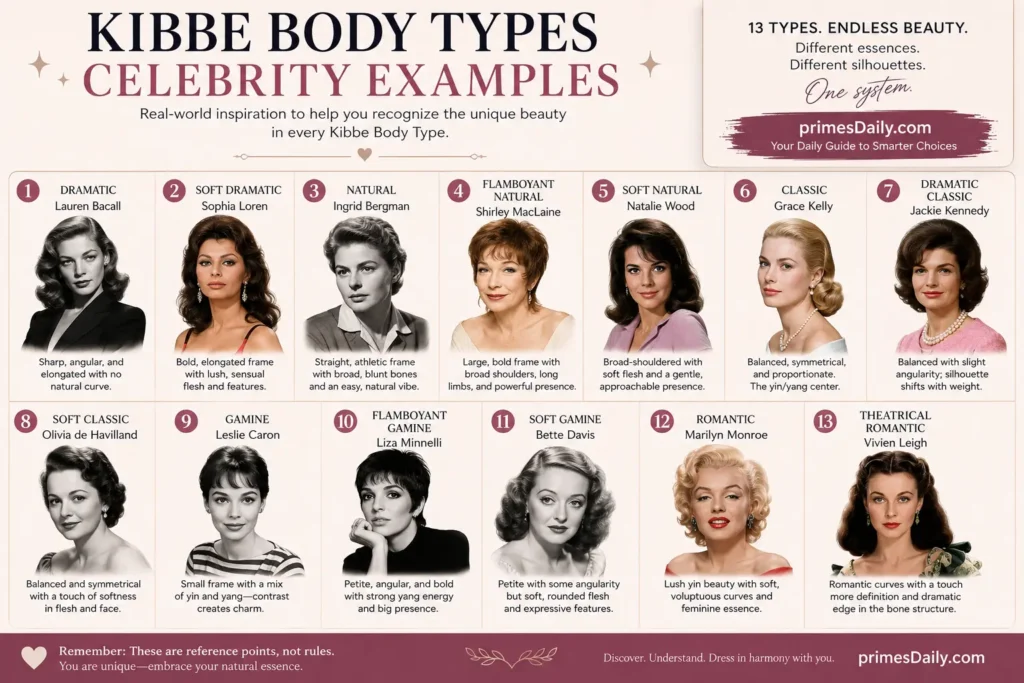
Public figures are often used as reference points because they’re easy to picture and give a consistent visual anchor for each type. A handful of widely cited examples include Lauren Bacall for Dramatic, Sophia Loren for Soft Dramatic, Ingrid Bergman for Natural, Shirley MacLaine for Flamboyant Natural, Natalie Wood for Soft Natural, Grace Kelly for Classic, Jackie Kennedy for Dramatic Classic, Olivia de Havilland for Soft Classic, Leslie Caron for Gamine, Liza Minnelli for Flamboyant Gamine, Bette Davis for Soft Gamine, Marilyn Monroe for Romantic, and Vivien Leigh for Theatrical Romantic.
It’s worth using these references as a starting point for recognizing a visual pattern, not as an exact template, since bone structure, flesh, and facial features vary from person to person even within the same category.
Kibbe vs. Other Body Typing Systems
Kibbe vs. typing by shapes. Traditional shape systems (pear, apple, hourglass, rectangle, inverted triangle) sort people based purely on the width relationship between shoulders, waist, and hips. They ignore bone structure, height proportion, and facial features entirely, and they change every time your weight changes. The Kibbe framework was built specifically to correct that gap by anchoring the type to bone structure, the one thing that doesn’t shift with weight.
Kibbe vs. typing by weight or height. Height and weight influence how a garment fits, but neither one determines your type on its own. A tall person isn’t automatically Dramatic, and a shorter person isn’t automatically Gamine or Romantic; what matters is the visual proportion (vertical line) and bone width, not the literal number on a tape measure or scale.
Kibbe vs. McJimsey/Kitchener Essences. This is an older personality-and-style framework that sorts people by “essence” categories like Gamine, Romantic, Dramatic, Classic, and Ingenue, based more heavily on personality and styling preference than strict physical measurement. Kibbe borrowed some naming conventions from this tradition but built a far more detailed, physically anchored system around bone structure and yin/yang balance.
Kibbe vs. the Body Matrix. The Body Matrix is a newer framework that also incorporates bone structure and proportion but organizes types along different axes and uses different terminology. It shares Kibbe’s rejection of pure shape-based typing but isn’t a direct offshoot of it.
Kibbe vs. Style Roots. Style Roots leans more heavily into personal aesthetic preference and vibe rather than strict physical bone-structure analysis, making it a looser, more subjective companion to Kibbe rather than a competing physical framework.
Can You Be Between Two Kibbe Body Types?
Yes, and this is one of the most common points of confusion. Nobody fits a category with mathematical precision, and Kibbe’s own guidance acknowledges that a handful of answers pointing a different direction is completely normal as long as the overall pattern stays consistent.
Where people genuinely land “between” two types is almost always between a pure type and its closest blended subtype, since those pairs share the same bone structure and differ only in flesh and facial features. If you consistently see traits of Natural in your bone structure but also see softness in your face and flesh, Soft Natural (not a separate, unrelated category) is very likely your answer. When self-typing feels genuinely stuck between two options, going back to bone structure specifically, since it’s the most stable and reliable of the three categories, usually resolves the tie.
Does Height or Weight Affect Your Kibbe Body Type?
No, not directly. Bone structure and the pattern in which flesh sits on that structure are what determine the type, and neither of those things is defined by a number on a scale or a measuring tape. Someone can gain or lose a significant amount of weight and remain the exact same type throughout, because the underlying bone width and vertical line proportion haven’t changed.
That said, weight does affect where a body carries fullness, and Kibbe’s original material actually describes this pattern for each type (a Dramatic gains weight at the hip and thigh rather than the torso, for example, while a Romantic simply becomes more rounded overall). That’s a description of where weight shows up for a given type, not a rule for determining the type itself. Height works the same way: what matters is your vertical line, meaning how tall you visually read based on head size relative to your body and shoulder proportion, not your literal height in inches. A shorter person with a small head and long limbs can visually read as having a long vertical line, and a taller person with a larger head relative to their frame can read as visually shorter.
FAQs
What is a Kibbe body type? It’s one of thirteen personal style categories, developed by David Kibbe, that groups people by the balance of yin (soft, rounded) and yang (sharp, angular) traits across bone structure, flesh pattern, and facial features, used to guide clothing choices that echo a person’s natural line.
What are the 13 Kibbe types? Dramatic, Soft Dramatic, Natural, Flamboyant Natural, Soft Natural, Classic, Dramatic Classic, Soft Classic, Gamine, Flamboyant Gamine, Soft Gamine, Romantic, and Theatrical Romantic.
Does height or weight affect my Kibbe type? No. Type is determined by bone structure and flesh pattern, both of which stay consistent as weight changes. Vertical line (how tall you visually read) matters more than literal height in inches.
How do I find my Kibbe body type? Work through bone structure, flesh pattern, and facial features in that order, using photos taken in fitted clothing under even lighting, and compare against real reference images rather than relying on written descriptions alone.
Can I be between two Kibbe types? Yes, most often between a pure type and its closest blended subtype, since those pairs share bone structure and differ mainly in flesh and facial softness.
Can facial features alone determine my type? No. Facial features are intentionally weighted as the least decisive of the three categories, since faces can send misleading signals on their own; bone structure carries the most weight in typing.
What is the rarest Kibbe body type? There’s no official statistic on this, since no large-scale, verified survey exists. Community discussion tends to cite Flamboyant Gamine and Flamboyant Natural as less commonly reported, likely because both require a fairly specific combination of scale and bone structure.
How does Kibbe differ from traditional body shape theories? Traditional shape theories (pear, hourglass, rectangle, apple) sort by the width relationship between shoulders, waist, and hips, and that classification shifts with weight. The Kibbe framework anchors type to bone structure and yin/yang balance instead, which stays stable regardless of weight changes.
Conclusion
The appeal of this framework isn’t that it’s simpler than shape-based advice, it’s that it’s actually more accurate, because it accounts for the parts of your body that never change instead of the parts that fluctuate weekly. Bone structure, the pattern of your flesh, and the character of your facial features together create a line that’s uniquely yours, and once you can name that line, dressing stops being trial and error.
Give yourself permission to take the self-typing process slowly. Look at real reference photos, not just descriptions. Expect a few answers to point in unexpected directions. And remember that the goal was never to squeeze into a category, it was to finally understand why certain clothes have always worked for you, and to stop fighting your own natural line.
For the latest, updated, and unique information, visit Bernese Mountain Dog Puppy.