You’ve just received an invitation to a high-profile wedding, corporate gala, or prestigious awards ceremony, and right there at the bottom in elegant letters, it says “black tie required.” Your stomach tightens a bit. Maybe you’re thinking—do I actually own a tuxedo? What does this even mean? Will I fit in? If these questions are running through your mind, you’re definitely not alone. Black tie is one of those dress codes that can feel intimidating if you’ve never navigated it before, but here’s the truth: it’s actually more straightforward than you think, and this guide will walk you through every single detail.
This formal dress code isn’t just about throwing on fancy clothes and hoping for the best. It’s about understanding a specific dress code that signals respect, sophistication, and awareness of formal social protocol. Whether you’re attending a destination wedding, a diplomatic dinner event, or an upscale gala celebration, this represents the highest level of formality in everyday dress codes. It’s the uniform of elegance.
What Is Black Tie Attire
Let’s start with the fundamental question: what exactly does it mean when an event requires formal evening wear? Simply put, it’s a dress code that represents the most elevated form of personal presentation outside of diplomatic white-tie occasions. The code originated in 19th-century Britain and has evolved into a globally recognized standard for formal events.
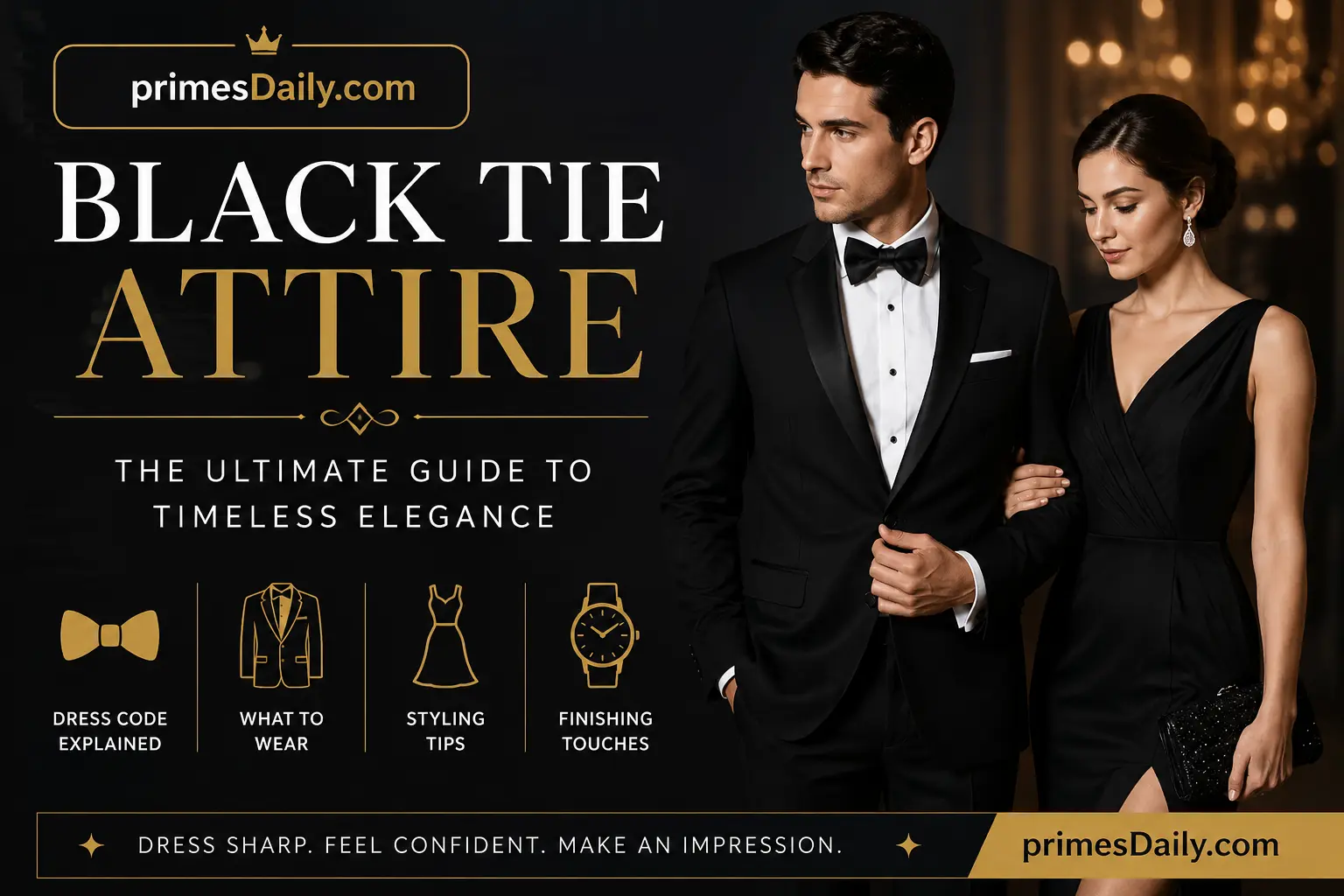
For men, this means a tuxedo—specifically a dinner jacket with matching trousers, a white formal shirt, and a black bow tie. For women, it typically means an evening gown made from elegant materials like silk, satin, or velvet. The term itself derives from the black bow tie that forms the centerpiece of the formal outfit.
Why Is It Called “Black Tie”?
The name comes directly from the most visible and distinguishing element of the formal outfit: the black bow tie worn by men. This small detail became so iconic that it essentially named the entire dress code. Think of it as the signature piece that says “this is formal evening wear” without saying a word.
The bow tie creates an unmistakable visual that cannot be mistaken for business formal or cocktail attire. Unlike a regular necktie, the bow tie signals that you’ve taken formal preparation seriously. It’s not an afterthought—it’s a deliberate choice that requires attention, care, and often, a certain level of skill to tie properly.
Modern Expectations vs. Traditional Rules
In 2026, the interpretation of formal evening wear has become somewhat more flexible than it was historically. While the fundamentals remain sacred—the tuxedo for men, elegant evening gowns for women—modern events increasingly allow for personal expression. Some contemporary galas might accept a midnight blue dinner jacket instead of strictly black. Progressive events might welcome unconventional approaches to formal wear, including gender-neutral interpretations.
However, if the invitation doesn’t explicitly state otherwise, assume the traditional version is expected. When in doubt, formal always trumps fashionable. It’s far better to show up slightly more formally dressed than to arrive underdressed and feel out of place.
History and Origins of Black Tie Attire
Understanding the history of formal evening wear gives you perspective on why certain rules exist and why they’re still relevant today. This dress code didn’t emerge randomly—it developed through specific historical circumstances and social evolution.
The British Innovation (1880s-1890s)
The story begins in Victorian England during the 1880s. British aristocrats and wealthy gentlemen wanted a more comfortable option for evening wear than the formal white-tie ensemble, which required a white bow tie, tails, and an exceptionally rigid structure. Someone at an exclusive London club decided to experiment with a shorter dinner jacket—a less formal version than the tailcoat worn with white-tie requirements.
The innovation was simultaneously practical and revolutionary. The dinner jacket allowed for comfort without sacrificing elegance. The black jacket paired with a simple black bow tie created a look that was undeniably formal yet somehow more approachable than the elaborate white-tie requirements. British gentlemen embraced this new option enthusiastically.
American Adoption and Global Spread
The formal dinner jacket concept crossed the Atlantic to America relatively quickly. By the early 1900s, American high society had adopted the code. What made American adoption significant was that Americans refined and standardized it. The typical American tuxedo became more structured, more defined, and more clearly distinguished from other formal wear.
Throughout the 20th century, formal evening wear became the standard for major social events and galas, wedding celebrations, diplomatic functions, awards ceremonies, theater openings and cultural events, and formal business dinners.
Why It Persisted in Modern Times
You might wonder why a dress code from the 1880s still matters in 2026. The answer is simple: it works. The formal dinner jacket creates a visual language that’s instantly recognizable across cultures, nationalities, and socioeconomic backgrounds. When everyone wears this formal outfit, it creates equality and unity—a person in a tuxedo looks essentially the same as any other person in a tuxedo, regardless of wealth or social status.
Additionally, formal evening wear represents an investment in an occasion. When you wear it, you’re saying “this event is important enough that I prepared specifically for it.” This matters psychologically for both the wearer and the guests. It elevates the atmosphere and creates a sense of occasion that casual dress simply cannot achieve.
Black Tie Attire vs Other Formal Dress Codes
One of the most common sources of confusion is understanding how formal evening wear differs from other formal dress codes. The formal world has a hierarchy, and it’s important to understand where your event falls on that spectrum.
White-Tie Dress Code (Most Formal)
White-tie is the most formal dress code that exists. It’s primarily reserved for diplomatic events, royal functions, and ultra-formal galas. For men, white-tie requires a black tailcoat (not a dinner jacket), white piqué shirt front, white bow tie (the key distinguishing element), black trousers with a single stripe, and formal waistcoat or cummerbund.
For women, white-tie typically means a floor-length gown, often with long gloves and formal jewelry. The white bow tie in men’s formal wear is what distinguishes it from the black bow tie of lower-formality events.
Key difference from black tie: White-tie is more elaborate, more restrictive, and more rarely required. If your invitation says white-tie, take it seriously—this is the highest social formality.
Black Tie Dress Code (High Formal)
This is where we’re focusing our attention. It’s less elaborate than white-tie but significantly more formal than business attire.
For men this means a tuxedo (dinner jacket with satin or grosgrain lapels), white formal shirt, black bow tie, black trousers with satin stripe, and black patent leather or formal shoes.
For women this means a floor-length evening gown (though knee-length cocktail dresses can sometimes work), formal shoes or heels, elegant jewelry, and formal hairstyle and makeup.
Cocktail Attire (Semi-Formal)
Cocktail attire sits between business formal and formal evening wear. It’s appropriate for cocktail parties, semi-formal weddings, evening business events, and upscale dinners that aren’t strictly formal.
For men, cocktail typically means a dark suit (not necessarily a tuxedo), dress shirt, regular necktie or bow tie, and dress shoes.
For women this means a cocktail dress (typically knee-length or slightly shorter), dress shoes or heels, accessories and jewelry.
Key difference from formal evening wear: Cocktail attire is shorter, less elaborate, and less rigid. You have more flexibility in colors and styles.
Business Formal
This is what you wear to office meetings, professional conferences, and business dinners. It’s formal but not celebratory.
For men: Dark suit, dress shirt, professional necktie, dress shoes For women: Business suit or professional dress, minimal jewelry, professional shoes
Key difference: Business formal is about professionalism and power, not elegance and celebration.
Smart Casual
This increasingly common dress code means dressing nicely but without formality. Think polished but comfortable.
The Hierarchy Simplified: White-Tie > Black-Tie > Cocktail > Business Formal > Smart Casual > Casual
Understanding this hierarchy helps you immediately recognize how formal your event actually is. If the invitation says formal evening wear, you know you need to dress more formally than cocktail but not quite as elaborately as white-tie.
Essential Components of Black Tie Attire for Men
Let’s break down exactly what men need to properly dress for a formal evening event. This isn’t about fashion preferences—these are the actual requirements.
The Core Elements
A complete formal outfit for men consists of:
- Dinner Jacket – The foundation of the look
- Formal Trousers – Matching the jacket with specific detailing
- Formal Shirt – White with specific front details
- Bow Tie – Black, silk, hand-tied
- Cummerbund or Waistcoat – Waist coverage
- Formal Shoes – Black, polished or patent leather
- Formal Socks – Black, appropriate length
- Accessories – Watch, cufflinks, pocket square (minimal)
Each element serves a purpose. Nothing is decorative in the strict sense—everything contributes to the overall image of formality and sophistication.
Quality Considerations
When choosing pieces, quality matters more than brand names. A well-made, properly fitted outfit from a less expensive retailer will outshine an expensive outfit that doesn’t fit correctly. Consider:
- Fabric weight: Quality formal wear uses heavier fabrics that drape properly
- Construction: Look for reinforced seams and quality lining
- Fit: This is non-negotiable. Ill-fitting formal wear looks worse than casual wear
- Details: Check that buttons are properly attached, zippers work smoothly, and lapels lie flat
The Tuxedo Jacket for Black Tie Attire
The dinner jacket is the centerpiece of the formal outfit. Understanding its construction and variations helps you choose appropriately.
Jacket Structure
A proper tuxedo jacket has several distinguishing features.
Lapel Types:
- Peak lapels – Points upward, considered slightly more formal and dramatic
- Shawl lapels – Curved and continuous, softer and more elegant looking
- Notch lapels – Angular, less common for formal wear but increasingly seen in modern interpretations
Satin Details: The lapels and button facing are typically covered in satin or grosgrain ribbon. This gives the jacket its distinctive formal shine. The satin makes the formal jacket immediately distinguishable from a regular black suit.
Buttons:
- Single-breasted formal jackets typically have one or two buttons
- Double-breasted versions have four or six buttons
- Buttons may be covered in fabric or made from materials like mother-of-pearl
Jacket Fit
Proper fit is absolutely critical for formal occasions.
- The jacket should reach to the knuckles when arms hang naturally
- Shoulders should align with your natural shoulder line—not sloping or straining
- The jacket should be snug enough that you cannot fit a full hand inside, but not so tight that you feel restricted
- When buttoned, there should be no pulling or straining
- The lapels should lie flat and frame your body symmetrically
Ventilation and Movement
A well-made formal jacket allows for comfortable movement. You should be able to sit without the jacket hiking up, raise your arms without strain, walk and gesture naturally, and maintain the jacket’s shape throughout the evening.
Color Options
While black is traditional and most common, modern interpretations accept:
- Midnight blue – Slightly less formal than black but increasingly acceptable
- Navy – More of a contemporary choice
- Black – The gold standard
If choosing anything other than black, ensure your invitation doesn’t specify “black tie” strictly. When in doubt, black is always correct.
Black Tie Attire Trousers and Fit
The formal trousers complete the silhouette and require specific details to be considered appropriate.
Trouser Construction
Formal trousers differ from regular suit pants in several key ways.
Satin Stripe: A stripe of satin or grosgrain runs down the outside seam of each leg. This is not optional—it’s what distinguishes formal trousers from regular suit pants. The stripe serves both aesthetic and practical purposes, creating a visual line that elongates the leg.
Waistband: Formal trousers typically have a higher waistband than modern casual trousers. The waistband should sit at your natural waist, not lower on the hips. This is why a cummerbund or waistcoat is worn—it covers the waistband and contributes to the formal silhouette.
No Cuffs (Hemming): Traditional formal trousers end with a clean break, no cuffs. They should reach just to the top of your shoe, creating a crisp line. The break should be slight—not dragging on the ground but not stopping above your ankle either.
Proper Fit
- The waistband should be snug but not restrictive—you should be able to insert two fingers comfortably
- The thigh should be comfortable but not baggy
- The inseam should account for the shoes you’ll wear (formal shoes have different heel heights than everyday shoes)
- The length should create a minimal break over the shoe
Trouser Fabric
Quality matters significantly for formal trousers:
- Higher thread-count wool or wool-blend fabrics
- Sufficient weight to drape properly
- Smooth finish without excessive shininess
- Durability to withstand multiple wearings without bagging
Black Tie Attire Dress Shirts Explained
The formal shirt is more structured and different than regular dress shirts in specific ways.
Shirt Front
The most visible difference is the shirt front. Formal shirts typically feature:
Piqué Bib Front: The front of the shirt has a raised textured pattern (piqué weave) rather than smooth fabric. This creates visual interest and sophistication. The bib extends from the neck to roughly mid-chest.
Pleated or Smooth: Some formal shirts have vertical pleats down the bib, while others are completely smooth. Both are appropriate—it’s a matter of personal preference and formality level. Pleated is slightly more formal.
Button Studs Instead of Buttons: Rather than traditional buttons, formal shirt fronts typically close with button studs—small decorative closures that create a more elegant appearance. These studs may be made from pearl, mother-of-pearl, metal, or crystal or gems (less common).
Collar Type
Formal shirts typically have:
- Turndown collars (most common) – Regular collar style but structured more formally
- Wing collars – A very formal option with small pointed wings, rarely required in 2026
- Spread collars – Less formal but sometimes acceptable
The collar should frame the bow tie properly, with the tie sitting comfortably in the collar’s opening.
Cuffs
Formal shirt cuffs are typically:
- Double cuffs (French cuffs) – Most formal, requiring cufflinks
- Single button cuffs – Less formal but acceptable
Double cuffs are preferred for formal occasions because they require cufflinks, which are part of the formal aesthetic.
Shirt Color and Condition
- White is the only appropriate color for the shirt front
- The shirt must be pristine—no wrinkles, stains, or yellowing
- It should be crisply starched for the evening
- White piqué or subtle texture is standard, not plain weave
- The shirt should be long enough in the torso that it doesn’t come untucked during the evening
Shirt Fit
- Shoulders should align with your natural shoulder point
- The torso should be snug but not tight
- Sleeves should reach to just past your wrist bone (not over your hands, not stopping short of wrists)
- The front should not gap open when buttoned
- Length should be long enough to stay tucked throughout the evening
Bow Ties and Accessories for Black Tie Attire
The bow tie is the defining visual element of formal evening wear, and it deserves careful attention.
Bow Tie Requirements
Color:
- Black is standard and universally appropriate
- Midnight blue is an acceptable contemporary alternative
- No other colors (white ties belong to white-tie dress code)
- Matte finish is preferred to high-shine
Fabric:
- Silk is the traditional choice
- Velvet is increasingly acceptable for contemporary formal wear
- Wool can work in winter settings
- Avoid cheap polyester that looks plastic-y and shiny
Tie Style:
- Hand-tied (self-tie) – Shows proper formality and sophistication
- Pre-tied or clip-on – Technically acceptable but considered less formal
- Bow ties with hidden elastic are less formal than true self-tie versions
For formal occasions, a hand-tied bow tie is genuinely preferred. Yes, it requires skill, but learning to tie a bow tie is an investment worth making for someone who attends formal events regularly.
How to Tie a Bow Tie Properly
Most people find it easier to tie a bow tie if they follow these steps:
- Drape the tie around your neck with ends hanging evenly
- Cross the right end over the left end
- Wrap the right end around behind the left end
- Bring the right end back across the front and tuck it into the loop
- Create a loop with the left end (the “first bunny ear”)
- Create a loop with the right end (the “second bunny ear”)
- Tighten gently by pulling the center knot
Practice is essential. A well-tied bow tie sits symmetrically and looks intentional and elegant.
Additional Formal Accessories
Beyond the bow tie, formal accessories should be minimal and carefully chosen.
Cufflinks:
- Formal wear requires cufflinks with double cuffs
- Choose understated styles—nothing too trendy or loud
- Metal finishes (silver, gold, or platinum) are traditional
- Avoid large, gaudy stones or overly decorative versions
- Keep them simple and elegant
Pocket Square:
- Optional but adds sophistication
- Typically white linen, folded into a simple triangle
- Can be solid color or simple pattern
- Should complement without drawing excessive attention
- Tuck it into the jacket pocket, not hanging visibly
Dress Watch:
- A simple watch with black leather strap is appropriate
- Avoid sports watches or digital displays
- Avoid oversized statement watches
- The watch should be understated and elegant
Studs and Accessories:
- Shirt studs should match if paired with cufflinks
- Pearl, silver, or simple metal options
- Nothing too ornate or trendy
- Keep the accessory level conservative
What Not to Wear
- Novelty bow ties with patterns or cartoons
- Clip-on bow ties unless absolutely necessary (if you haven’t learned to tie one)
- Colorful or trendy accessories
- Multiple accessories that compete for attention
- Anything that looks like costume rather than formal wear
Cummerbund and Waistcoat in Black Tie Attire
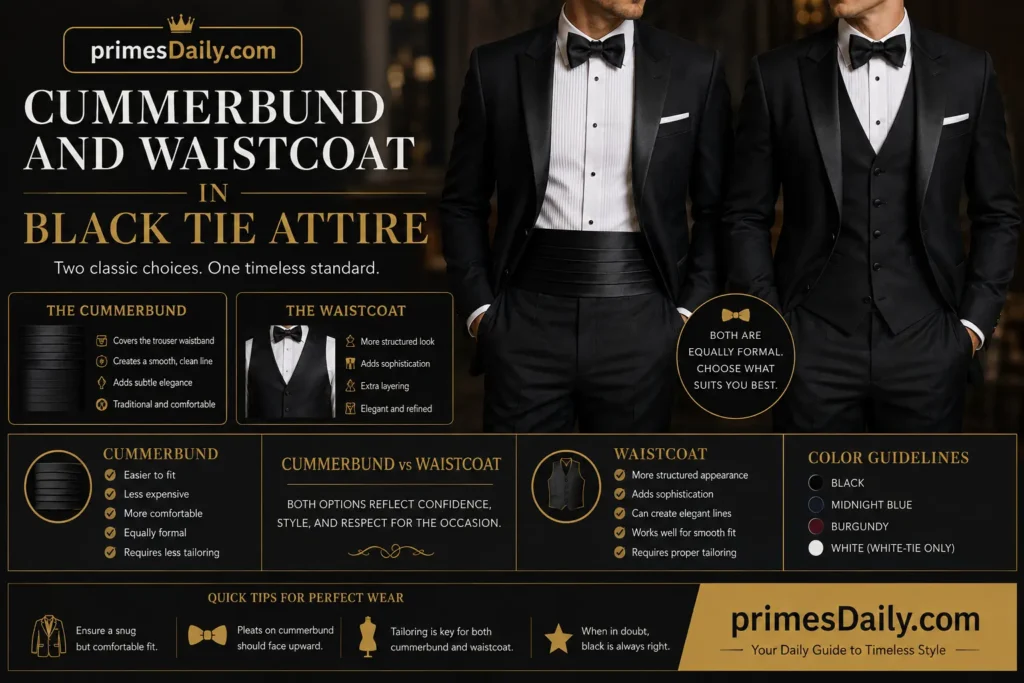
These pieces serve the practical purpose of covering the waistband while contributing to the formal aesthetic.
The Cummerbund
A cummerbund is a broad, pleated waistband worn around the middle of the formal outfit. Historically, it served a practical purpose—hiding the waistband of formal trousers which weren’t designed to be seen.
Purpose:
- Covers the trouser waistband
- Creates a smooth line across the torso
- Adds visual interest through pleating
- Contributes to the formal silhouette
Construction:
- Typically 4-6 inches wide
- Made from silk or silk-blend fabric
- Usually black, though dark colors are acceptable
- Pleats typically face upward (originally for holding small items during formal events)
Wearing It Properly: The cummerbund sits directly above the waistband of the trousers, at your natural waist. It should be snug but not restrictive. The pleats should be visible and uniform, creating a neat appearance.
Color Considerations: While black is traditional, some contemporary formal events allow:
- Midnight blue
- Burgundy (less common but occasionally seen)
- White (only for white-tie events)
When in doubt, black is always correct.
The Waistcoat (Vest) Alternative
Some men prefer a waistcoat instead of a cummerbund. A waistcoat is a formal vest that covers the same area.
Advantages of Waistcoat:
- More structured and formal appearance
- Provides additional layering and sophistication
- Allows for more elegant lines
- Can be slightly more comfortable than a cummerbund
- Works well for larger men who want a smoother line
Disadvantages:
- Requires proper fitting (often overlooked)
- Can make you appear heavier if not fitted correctly
- Adds an additional layer (can feel warm)
- Requires careful tailoring
Waistcoat Style:
- Black or midnight blue
- Typically made from matching or complementary fabric as the jacket
- Should be tailored to fit closely to the body
- Usually buttoned completely under the jacket
Cummerbund vs Waistcoat: Which to Choose?
Most men choose the cummerbund because it’s easier to fit, less expensive, more comfortable, equally formal, and requires less tailoring. However, a well-fitted waistcoat can look slightly more sophisticated. Choose based on personal preference, body type and what flatters you, availability and fit, and comfort level during a long event.
Footwear Standards for Black Tie Attire
Shoes might seem like an afterthought, but they’re actually crucial to completing the formal look.
Shoe Types
Patent Leather Shoes (Most Formal):
- High-shine finish that’s been carefully polished
- Creates an elegant, reflective quality
- Traditional choice for formal occasions
- Requires significant maintenance (must be kept pristine)
Polished Leather Shoes:
- High-gloss finish achieved through careful polishing
- Slightly less formal than patent but still very appropriate
- Requires regular maintenance
- More durable than patent leather
Matte Black Leather:
- Less formal but increasingly acceptable in contemporary settings
- More practical and easier to maintain
- Still looks elegant and appropriate
- Good choice for someone uncomfortable with high-shine shoes
Shoe Styles
Oxford Shoes (Most Common):
- Laced formal shoes
- Traditional and universally appropriate
- Available in all three finish types
- Works for men of all ages and styles
Derby Shoes:
- Open lacing pattern (less formal than Oxfords but still appropriate)
- More comfortable for many men
- Still maintains formal elegance
- Good alternative for those who find Oxfords uncomfortable
Loafers:
- Traditionally less formal
- Increasingly accepted at contemporary events
- Should still be formal leather, well-polished
- Better for slightly less strict formal events
Velvet Slippers:
- Formal evening shoe gaining popularity
- Adds sophistication and personality
- Typically embroidered
- Best for well-established, high-profile events where personal style is welcomed
Avoid:
- Sneakers or athletic shoes
- Casual loafers or driving shoes
- Brown or tan shoes (black only)
- Shoes with excessive wear or damage
- Anything that looks like everyday footwear
Shoe Fit and Maintenance
Proper Fit:
- Shoes should be snug but not painful
- Heel should not slip when walking
- No pinching across the toes
- Should feel secure and stable
Maintenance:
- Shoes must be immaculately clean and polished
- No scuffs, marks, or signs of wear visible
- Patent leather requires specialized polish to maintain shine
- Soles should be clean and not worn down
- Use shoe trees to maintain shape between wearings
Breaking In: Wear new formal shoes around the house before the event. They should be comfortable enough to wear all evening without blisters or discomfort.
Women’s Black Tie Attire Guide
Women’s formal evening wear differs significantly from men’s, with much more flexibility in interpretation while maintaining sophistication.
Core Requirements
Unlike men’s formal wear, which follows a relatively rigid formula, women’s formal evening wear has several acceptable options.
The Essential Elements:
- Floor-length or at minimum, an elegant knee-length gown
- Formal footwear (heels or elegant flats)
- Sophisticated accessories and jewelry
- Polished hair and makeup
- Overall impression of elegance and celebration
Women have more freedom in interpretation but must still maintain an overall sophisticated appearance.
Black Tie Attire Gowns and Dresses
The gown is the most visible element of women’s formal evening wear.
Gown Length
Floor-Length (Most Formal):
- Reaches from floor when standing naturally
- Slight train or sweep acceptable
- Most appropriate for traditional formal events
- Creates the most dramatic and elegant effect
Midi Length (Knee-Length and Below):
- Falls at the knee or slightly below
- Contemporary option increasingly accepted
- Elegant but slightly less formal than floor-length
- Good for women who feel more comfortable in shorter lengths
Cocktail Length (Knee-Length):
- Reaches to approximately the knee
- Can work for less formal black-tie events
- More practical and mobile than longer gowns
- Less traditional but increasingly acceptable in 2026
Avoid:
- Anything shorter than knee-length for formal evening wear
- Casual dresses or regular outfit regardless of color
Gown Fabric
Formal fabrics create elegance through their quality and drape.
Silk and Silk Blends:
- Gold standard for formal wear
- Drapes beautifully
- Creates an elegant sheen
- Works in all seasons
Satin:
- High-gloss finish
- Creates dramatic effect
- May be too shiny for some occasions
- Elegant and clearly formal
Velvet:
- Luxurious appearance
- Ideal for winter events
- Rich colors and sophisticated look
- Adds texture and dimension
Chiffon:
- Lightweight and flowing
- Good for summer events
- Creates ethereal, elegant effect
- May require layering for opacity
Tulle and Netting:
- Often used as layering
- Creates volume and texture
- Elegant and feminine
- Can stand alone or over other fabrics
Avoid:
- Cotton or cotton blends (too casual)
- Synthetic materials that look cheap
- Overly shiny materials that look plastic
- Anything that doesn’t drape elegantly
Gown Color
Traditional Colors:
- Black – Classic, elegant, universally appropriate
- Navy – Sophisticated alternative
- Deep jewel tones (emerald, sapphire, burgundy) – Elegant and formal
- Metallic shades (gold, silver) – Glamorous and appropriate
- White or cream – Acceptable but less common than other colors
Contemporary Options:
- Blush or pale pink – Modern choice increasingly seen
- Deep plum – Sophisticated
- Rich red – Bold and elegant
- Champagne or gold – Glamorous
Avoid:
- Bright, neon, or fluorescent colors
- Very light pastels (unless specifically worn as part of a cohesive formal look)
- Anything that looks casual (no t-shirt style gowns)
Gown Style and Cut
Elegant Silhouettes:
- Fitted bodice with flowing skirt
- A-line (universally flattering)
- Mermaid or fishtail (dramatic and formal)
- Sheath (sleek and sophisticated)
- Wrap or draped styles
Necklines:
- Sweetheart (elegant and flattering)
- Strapless (formal and classic)
- Halter (sophisticated)
- Off-shoulder (contemporary and elegant)
- Boat neck (understated elegance)
- V-neck (slimming and sophisticated)
Sleeves:
- Sleeveless is most formal
- Cap sleeves can work
- Long sleeves are elegant, especially for winter events
- Sheer sleeves add sophistication without coverage
Details to Consider:
- Beading or embellishment should be elegant, not costume-y
- Slits are acceptable if modest (to knee or slightly higher)
- Trains add formality but aren’t necessary
- Draping should be intentional and sophisticated
- Avoid excessive ruffles or overly trendy details
Jewelry and Accessories for Women’s Black Tie Attire
Accessories complete the formal look and should be chosen carefully.
Jewelry Guidelines
Keep It Elegant:
- Quality matters more than quantity
- A few statement pieces work better than many small ones
- Avoid costume jewelry that looks cheap
- Choose metals that complement your skin tone
Recommended Pieces:
- Elegant earrings (drop, chandelier, or simple studs)
- A bracelet or bangle (one is ideal; maximum two)
- A necklace if the gown’s neckline allows (keep pendant length minimal)
- Rings are acceptable but keep them minimal
What Works Well:
- Pearls (classic and always appropriate)
- Diamonds or diamond-like stones
- Gold, silver, or platinum finishes
- Coordinated sets that match
Avoid:
- Overly trendy costume jewelry
- Too many pieces that compete for attention
- Anything that looks theatrical or costume-like
- Large, dangling jewelry that gets in the way
- Mismatched metals (unless deliberately coordinated)
Bags and Clutches
Style:
- Elegant clutch or small formal bag
- Should complement the gown
- Can be metallic, satin, or quality leather
- Minimal embellishment looks more sophisticated
Color:
- Black (most versatile)
- Metallic (gold or silver)
- Should coordinate with gown or shoes
- Can match jewelry
Size:
- Small enough to be elegant
- Large enough for essentials (phone, lipstick, keys)
- Avoid overstuffed or bulky bags
Shawls and Wraps
For cooler evenings or more conservative events:
Style:
- Elegant silk or velvet wrap
- Pashmina shawl
- Faux fur stole (for winter events)
- Elegant lace shawl or cover-up
Color:
- Should complement the gown
- Black or neutral tones work with any gown
- Metallic options add glamour
Practical Tip: Bring a wrap if the venue might be cold, but wearing a bulky coat ruins the formal effect. Choose something you can elegantly drape.
Footwear for Women
Heel Height:
- 2-4 inches is typical (higher is acceptable if comfortable)
- Flat shoes work if the style is formal
- Comfort matters—you’ll be wearing them for hours
Style:
- Closed toe or elegant sandal
- Strappy heels are formal
- Pumps are classic and appropriate
- Avoid overly trendy styles
Color:
- Black (most versatile with any gown)
- Metallic (gold or silver) works with most colors
- Nude or skin tone with lighter gowns
- Should not clash with the gown
Material:
- Satin or silk for formal elegance
- Quality leather
- Metallic finish for contemporary feel
- Avoid cheap-looking materials
Hair and Makeup
Hair:
- Should be neat and intentionally styled
- Updo is traditional and elegant
- Half-up styles work beautifully
- Loose waves can be elegant if controlled
- Avoid messy or casual-looking styles
Makeup:
- Should be polished and refined
- Not overly dramatic but more than everyday makeup
- Professional application looks best if you’re not experienced
- Avoid looks that appear costume-y or overly trendy
- Coordinate with gown color and your skin tone
Nails:
- Should be clean and well-groomed
- Elegant nail color or French manicure
- Avoid chipped polish or overly long nails
- Can be neutral or coordinated with overall look
For the latest, updated, and unique information, visit Is cinnamon bad for dogs.
Black Tie Attire for Weddings
Formal evening wear looks slightly different when attending a wedding versus other events.
Wedding-Specific Considerations
Respect the Couple: When a couple specifies formal evening wear for their wedding, they’re making a statement about the formality level and time of day. Respecting this choice shows consideration.
Timing Matters:
- Evening weddings (after 6 PM) appropriately call for formal wear
- Ceremony time affects dress code expectations
- Reception location and venue formality matter
For Men at Formal Weddings
The formal tuxedo is perfect for a wedding:
- Stick to traditional black tuxedo if the couple doesn’t specify otherwise
- White shirt with subtle formal front (not too ornate)
- Black bow tie
- Formal shoes polished to perfection
- Minimal accessories
Avoid:
- Colored bow ties or ties (unless specifically requested)
- Wearing the groom’s formal outfit (watch for these details in invitations)
- Costume-like accessories or trendy elements
For Women at Formal Weddings
Women have more flexibility at formal weddings:
Gown Considerations:
- Floor-length gown is appropriate and expected
- Avoid white (this is for the bride)
- Avoid wearing the same color as bridesmaids if you know it
- Dark colors or jewel tones work beautifully
Practical Considerations:
- If ceremony includes church or outdoor elements, consider practicality
- Venue formality should match your outfit level
- Reception location affects shoe choice (sand, grass, marble floors)
Respectful Choices:
- Don’t wear anything that outshines or competes with the bride
- Avoid excessive jewelry or dramatic styling
- Keep focus on celebrating the couple
What Not to Wear to a Formal Wedding
- The same color as bridesmaids
- White or cream (bride’s prerogative)
- Anything flashier than the bride’s gown
- Costume-like outfits
- Overly trendy or casual interpretations
Black Tie Attire for Galas and Award Ceremonies
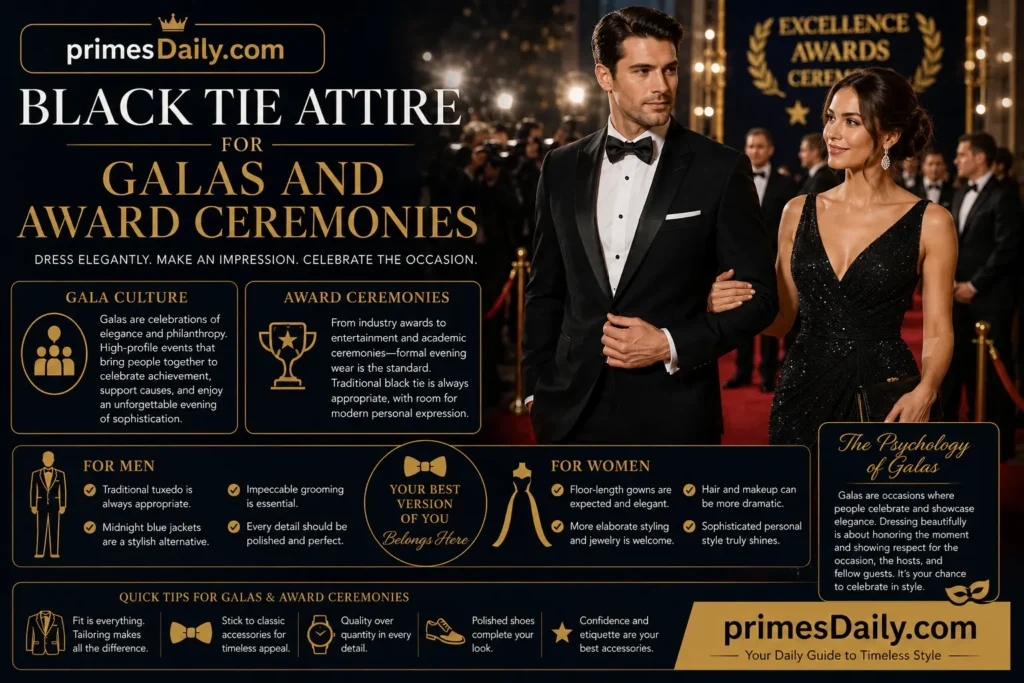
Formal galas and award ceremonies often have their own specific culture and expectations.
Gala Culture
Formal galas are celebrations of elegance and philanthropy. They’re typically high-profile social events, fundraising functions, celebrations of achievement or milestone, and opportunities for formal dressing and presentation.
For Gala Attendees
Men:
- Traditional formal tuxedo is always appropriate
- This is where more contemporary variations might work (midnight blue jacket, for example)
- Impeccable grooming is essential
- All details should be polished and perfect
Women:
- This is an opportunity for elegant, sometimes glamorous formal wear
- Floor-length gowns are expected and appropriate
- More elaborate styling and jewelry is acceptable here than at other formal events
- Hair and makeup can be more dramatic
- Sophisticated personal style shines at galas
The Psychology of Galas: Galas are occasions where people celebrate and showcase elegance. Dressing beautifully isn’t just about following dress code—it’s about celebrating the occasion. This is where your best, most polished version of yourself should appear.
Award Ceremonies
Award ceremonies include variety from industry events to entertainment industry awards to academic ceremonies.
Consistency:
- Formal evening wear is appropriate regardless of industry
- Dress code of formal evening wear means the same across contexts
- Traditional formal wear works for any award ceremony
Personal Expression: Modern award shows often allow more personal interpretation while maintaining formality. You might see unconventional bow tie colors on men, more diverse gown colors and styles for women, and contemporary interpretations of formal wear.
However, unless the event specifically invites personal interpretation, traditional formal evening wear is always safest.
Seasonal Variations in Black Tie Attire
The season affects which fabrics and styles work best while maintaining formality.
Spring and Summer Considerations
Fabric Choices:
- Lighter-weight fabrics feel more comfortable
- Linen blends work if they maintain formal appearance
- Silk remains ideal
- Avoid heavy wools and velvets
Color Flexibility:
- Lighter colors are acceptable in warm months
- Pastels work better in summer (avoid in winter)
- Still maintain elegance and formality
Comfort Elements:
- Breathable fabrics prevent overheating
- Sleeveless options for women are comfortable
- Shorter gloves if wearing them
Fabric to Avoid:
- Heavy velvets in summer
- Wool that will feel uncomfortable in heat
- Overly structured fabrics that restrict movement
Summer Black Tie Attire Styling
Summer formal events require thoughtful choices to stay cool while remaining elegant.
Men’s Summer Formal Wear
Jacket Options:
- Lightweight wool or wool-blend tuxedo (thinner than winter weight)
- Consider lightweight texture
- May substitute midnight blue or even lighter colors if not strictly specified
- Ensure fabric quality remains high
Shirt Choices:
- Lightweight cotton or cotton-blend formal shirt
- Breathable piqué front
- Linen-cotton blend can work if structured formally
- Light color essential (white is perfect)
Accessories:
- Silk bow tie works in summer (not heavier materials)
- Consider comfort for extended wear
- Lightweight cummerbund if not using waistcoat
- Formal shoes (necessary even in summer)
Practical Tips:
- Wear formal wear as late as possible to minimize time in heat
- Ensure excellent ventilation at event
- Choose indoor events over outdoor when possible
- Bring a lightweight cover if needed
Women’s Summer Formal Wear
Gown Fabric:
- Lightweight silk or silk blends
- Chiffon or flowing fabrics
- Avoid heavy satins and velvets
- Ensure breathability
Gown Style:
- Sleeveless or cap sleeves comfortable
- Flowing skirts over fitted are cooler
- Consider backless or open-back styles for ventilation
- Slightly shorter lengths (midi vs floor-length) can feel cooler
Color Choices:
- Lighter colors work in summer
- Pastel jewel tones beautiful in summer
- White or cream acceptable in summer (darker option with white top)
- Avoid heavy, dark colors that retain heat
Practical Styling:
- Minimal jewelry to avoid excessive heat
- Updo hairstyle keeps hair off neck
- Strappy sandals comfortable for evening
- Consider wrap for cool evening air
Outdoor Considerations: If the summer event is outdoors, protect skin from sun (formal long sleeves or jacket required), avoid overheating before the event, choose locations with shade or air conditioning for preparation, and select comfortable shoes for potentially uneven ground.
Winter Black Tie Attire Outerwear
Winter formal events require outerwear that complements your formal outfit.
Men’s Winter Outerwear
Formal Overcoat:
- A black overcoat or tuxedo coat worn over the dinner jacket
- Should be knee-length or slightly longer
- Quality wool or wool-blend
- Maintains formal silhouette
Tuxedo Jacket with Overcoat:
- The overcoat is worn over everything
- Protects formal wear during travel
- Removed upon arrival
What Not to Wear:
- Casual winter coats or parkas (destroys the formal effect)
- Oversized coats that drown your formal silhouette
- Anything that looks casual or sporty
- Leather jackets (too casual)
Fabric:
- Heavy wool or wool-blend
- Dark colors, primarily black or charcoal
- Quality construction essential
- Should have formal drape
Women’s Winter Outerwear
Formal Wraps and Cloaks:
- Elegant velvet or silk wrap
- Faux fur stole (luxurious and formal)
- Formal shawl in quality fabric
- Dramatic cape (contemporary option)
Formal Coat:
- Long formal coat in wool or wool-blend
- Black, navy, or coordinating color
- Should reach approximately dress length
- Quality construction and elegant drape
Footwear for Winter:
- Formal shoes still required (not boots)
- Higher heels work on dry surfaces
- Flats are acceptable for icy conditions
- Avoid changing into different shoes after arrival
Practical Winter Strategies:
- Wear formal outerwear to protect the gown
- Change coat or wrap upon arrival only
- Consider indoor coat check
- Plan transport to avoid standing in cold in formal wear
- Ensure outdoor heating or canopies if outdoor elements
What Not to Wear:
- Casual winter coats (puffer jackets, parkas, ski jackets)
- Oversized sweaters or cardigans
- Anything that looks casual or sporty
- Winter boots (formal shoes required)
Modern Interpretations of Black Tie Attire
In 2026, formal evening wear is evolving while maintaining its essential sophistication.
Contemporary Variations
Color Flexibility:
- Midnight blue tuxedos increasingly accepted
- Women experimenting with non-traditional gown colors
- Jewel tones replacing black for women more frequently
- Alternative colors acceptable if invitation allows
Fabric Innovation:
- Performance fabrics that breathe and move better
- Sustainable and eco-friendly formal wear gaining acceptance
- Unconventional textures while maintaining elegance
- Blended fabrics that offer comfort without sacrificing appearance
Silhouette Evolution:
- Less rigid, more body-conscious cuts emerging
- More variety in women’s gown styles
- Contemporary interpretations of traditional pieces
- Personal body-type dressing becoming more accepted
Accessory Experimentation:
- More colorful bow tie options appearing at high-fashion events
- Statement jewelry increasingly visible
- Personalized accessories that reflect individual style
- Creative interpretation of traditional pieces
Why Tradition Remains
Despite modern variations, traditional formal evening wear persists because it creates equality and unity, is immediately recognized globally, signals respect for the occasion, transcends age, gender, and cultural boundaries, looks elegant in photographs, and never looks out of date.
Creative Black Tie Attire Ideas
For those comfortable bending the rules slightly, creative interpretations can maintain elegance while expressing personality.
For Men: Contemporary Touches
Bow Tie Variations:
- Velvet bow ties in jewel tones
- Textured or patterned silk bow ties (still formal-looking)
- Slightly larger or smaller proportions (not exaggerated)
- Metallic or shimmery materials
Jacket Creativity:
- Midnight blue or navy instead of black
- Velvet dinner jackets for dramatic effect
- Subtle texture or sheen in the fabric
- Modern cut while maintaining formality
Shirt Details:
- Lightly colored formal shirt if specified allows
- Subtle texture or weave in piqué
- Interesting button or stud designs
- Contemporary cut while maintaining formality
What Remains Fixed:
- The overall silhouette must remain formal
- Bow tie remains (not regular necktie)
- Formal shirt remains white unless specified otherwise
- Black formal trousers remain essential
- Shoes remain black and polished
For Women: Creative Expression
Gown Innovation:
- Unconventional but elegant necklines
- Asymmetrical cuts that remain sophisticated
- Bold but elegant colors
- Interesting fabrics or textures
- Personalized details that don’t overwhelm
Style Personality:
- Sleek and modern interpretations
- Vintage-inspired elegant gowns
- Contemporary silhouettes in formal fabrics
- Gender-neutral or androgynous formal wear
- Creative interpretations that remain elegant
Accessory Expression:
- Statement jewelry that’s still sophisticated
- Creative but elegant shoes
- Interesting hairstyles (still polished and intentional)
- Personalized styling that reflects the wearer
What Remains:
- Floor-length or appropriate length gown
- Elegant, formal fabrics
- Sophisticated overall appearance
- Recognition of the occasion’s formality
- Respect for the event and fellow attendees
The Balance
Creative interpretations work when they maintain overall formality and sophistication, show intentionality and thought, don’t look costume-like or casual, remain respectful to the occasion, and reflect genuine personal style, not just trendy experimentation.
Black Tie Attire Optional – What It Really Means
Many invitations now include “black tie optional,” which creates confusion about what to wear.
Understanding the Phrase
“Black tie optional” doesn’t mean casual or business attire. It means traditional formal evening wear is appropriate and expected, less traditional alternatives are acceptable, you have flexibility in how you interpret formality, and the event is still formal, but strictness is relaxed.
What to Wear to a Black Tie Optional Event
For Men:
- Traditional tuxedo remains perfect
- Dark suit with bow tie is acceptable
- Dinner jacket with formal trousers works
- Essentially, your formal evening wear in any form is appropriate
For Women:
- Floor-length gown is still beautiful and appropriate
- Knee-length elegant dress works fine
- Cocktail dress may be appropriate depending on venue
- Essentially, elegant formal wear at whatever level feels right
Why Events Say “Black Tie Optional”
Hosts include this phrase to acknowledge that not everyone owns formal wear, reduce pressure on guests, allow flexibility without expecting casual dress, indicate that while formal is welcome, other elegant options work, and accommodate diverse comfort levels with formal dressing.
The Strategy
If you own formal evening wear, wear it to a black tie optional event. If you don’t, wear your most elegant, formal alternative. The optional part is for people who genuinely cannot access formal wear, not permission to dress casually.
Common Mistakes to Avoid in Black Tie Attire
Understanding what not to do helps you get it right.
Men’s Common Mistakes
Jacket Errors:
- Wearing a regular black suit instead of a tuxedo
- Choosing jacket that doesn’t fit properly
- Ignoring the satin lapels and stripe requirements
- Wearing anything other than black (unless explicitly allowed)
Shirt Problems:
- Using regular dress shirt instead of formal shirt with piqué
- Wearing colored or patterned formal shirt
- Ignoring wrinkles or stains
- Choosing shirts that are poorly fitted
Tie Mistakes:
- Wearing a regular necktie instead of bow tie
- Using pre-tied clip-on bow tie when hand-tied is clearly expected
- Choosing colorful or patterned bow ties
- Tying the bow tie incorrectly or unevenly
Shoe Errors:
- Wearing casual shoes or sneakers
- Choosing brown or tan shoes
- Wearing shoes that are scuffed or worn
- Forgetting to polish shoes properly
Accessory Problems:
- Overdoing accessories (too many cufflinks, pocket squares, etc.)
- Wearing trendy or casual accessories
- Forgetting that minimal is always more formal
- Wearing costume-like accessories
General Mistakes:
- Poor grooming (unshaved, messy hair, etc.)
- Untucked shirt or visible waistband
- Wearing casual underwear visible (wear white undershirt)
- Not practicing bow tie tying before the event
Women’s Common Mistakes
Gown Errors:
- Wearing anything shorter than knee-length
- Choosing casual dresses regardless of color
- Selecting gown that doesn’t fit properly (either too tight or too loose)
- Wearing white or cream (unless specifically appropriate)
Fabric Problems:
- Using cheap, shiny synthetic materials
- Wearing cotton or casual fabrics
- Choosing anything that looks mass-produced or costumey
- Ignoring that fabric quality shows
Color Mistakes:
- Wearing bright neons or fluorescent colors
- Choosing colors that clash with complexion
- Selecting anything that looks casual
- Forgetting that elegant, sophisticated colors work best
Accessory Problems:
- Overdoing jewelry (too many pieces competing)
- Wearing costume-like or trendy pieces
- Forgetting that elegant simplicity is more formal
- Choosing bags or shoes that look casual
Shoe Errors:
- Wearing anything other than heels or elegant flats
- Choosing shoes that don’t match gown or overall look
- Wearing shoes that are uncomfortable (visible hobbling ruins effect)
- Forgetting to polish and maintain shoes
Hair and Makeup Mistakes:
- Leaving hair down and messy (looks casual)
- Applying makeup too heavily or with trendy looks
- Neglecting grooming (visible roots, chipped nails)
- Styling that looks costume-like rather than elegant
General Mistakes:
- Wearing the same outfit as bridesmaids (wedding)
- Dressing more formally than the bride (wedding)
- Overdressing for the venue (ballroom formal is different from garden formal)
- Not practicing with the outfit before the event (comfort matters)
What Both Genders Should Avoid
- Casual shoes – Sneakers, sandals, or flip-flops
- Wrinkled or stained clothes – Must be pristine
- Poor grooming – Hair, nails, shaving all matter
- Costume-like appearance – Should look elegant, not theatrical
- Visible discomfort – Fidgeting with clothes, adjusting constantly
- Phone use – Phones should be invisible
- Casual attitude – Your demeanor should match your outfit
Black Tie Attire Etiquette and Social Standards
Dressing formally is not just about clothes—it’s about understanding and respecting social norms.
The Purpose of Dress Codes
Dress codes exist to create equality and unity (everyone dressed at same level), signal respect for the occasion, establish atmosphere and tone, help guests understand expectations, and make photographs and memories coherent.
When you follow a dress code, you’re showing respect not just to the hosts but to all fellow attendees.
Social Expectations
At Formal Events:
- Behavior should match formality of dress
- Conversation should be respectful and sophisticated
- Posture and movement should be intentional
- Interaction should be gracious and considerate
- Phones should be silenced and invisible
Photography Expectations:
- Formal wear looks intentional and elegant in photos
- Appearing in formal dress elevates group photographs
- You’ll look put-together and polished in memory
- Future viewing of event photos will show respect for the occasion
Respect for Others:
- Following dress code shows respect for hosts
- Proper dressing respects other guests
- Appearance reflects on the occasion
- Thoughtfulness in dressing shows consideration
When to Dress Formally
Absolutely Formal:
- Weddings (unless specified otherwise)
- Galas and fundraising events
- Awards ceremonies
- Formal dinners and receptions
- High-profile social events
- Diplomatic functions
Probably Formal:
- Evening theater or opera attendance
- High-end restaurant special occasions
- Formal business events
- Upscale celebration events
Possibly Formal:
- Evening cocktail parties
- Social club events
- Some corporate functions
- Semi-formal events
Always check the invitation for specifics. When in doubt, more formal is better than less formal.
How to Wear Black Tie Attire Confidently
Confidence in formal wear comes from understanding what you’re wearing and feeling comfortable in it.
Mental Preparation
Understand the Why:
- Know why you’re dressing formally
- Understand the occasion’s significance
- Recognize that formal wear creates atmosphere
- Remember that everyone at the event is also dressed formally
Shift Your Mindset:
- View formal wear as celebration, not obligation
- Recognize the elegance you create
- Understand that proper dress contributes to your confidence
- Remember that you’re joining others in formality
Practice Beforehand:
- Wear your formal outfit around the house before the event
- Practice walking, sitting, and moving in the outfit
- Test the comfort of shoes with extended wear
- Practice the bow tie if you’re hand-tying
- Ensure everything works and nothing restricts movement
Practical Confidence Building
Fit is Everything:
- Ill-fitting clothes undermine confidence
- Proper fit makes you feel and look better
- Take time to ensure everything fits correctly
- Consider tailoring for perfect fit
Grooming Matters:
- Impeccable grooming creates confidence
- Ensure hair is neat and intentionally styled
- Men: shave carefully or maintain beards immaculately
- Women: polish nails, remove visible body hair, apply makeup carefully
- Everyone: shower, use cologne/perfume sparingly, ensure cleanliness
Testing and Adjustment:
- Wear the outfit before the event to test comfort
- Identify any issues (shoes rub, jacket restricts, etc.)
- Make adjustments before the event
- Ensure you can sit comfortably, move freely, and feel at ease
Small Details:
- Ensure everything is clean and undamaged
- Check that zippers work and buttons are secure
- Verify that seams are intact
- Confirm that all accessories are present and functional
- Ensure shoes are polished and in good condition
At the Event
Posture and Presence:
- Stand and sit with good posture
- Move deliberately and intentionally
- Avoid fidgeting or adjusting clothes
- Display confidence through your body language
Attitude:
- Recognize that everyone is also formally dressed
- Understand that the formality is temporary
- Remember that discomfort is normal but manageable
- Focus on the occasion, not on your outfit
Practical Comfort:
- Know where coat check is and use it
- Sit carefully to avoid wrinkling gown
- Dance carefully in formal wear (it’s possible)
- Take breaks if standing all evening
- Keep tissues handy for minor spills
Grooming Tips for Black Tie Attire
Grooming is as important as the clothes themselves.
Men’s Grooming
Facial Hair:
- Clean-shaven is most formal (no stubble)
- Well-groomed beard acceptable if immaculate
- Facial hair should be shaped and trimmed perfectly
- Beard oil or conditioning prevents scratchiness
Hair:
- Should be neatly cut a week or two before event
- Hair should be clean and styled
- Product should be minimal and natural-looking
- Avoid excessive shine or obvious product
- Consider professional haircut close to event date
Nails:
- Fingernails should be clean and trim
- No dirt under nails
- No chipping or rough edges
- File nails smooth if necessary
- Keep cuticles neat
Skin Care:
- Skin should be clean and clear
- Address visible blemishes if possible
- Moisturize if skin is dry
- Avoid excessive shine
- Consider professional facial if time allows
General:
- Bathe or shower day of event
- Use antiperspirant
- Apply cologne sparingly (less is more)
- Brush teeth and use mouthwash
- Ensure fresh breath
Women’s Grooming
Makeup:
- Professional application looks best
- Consider hiring a makeup artist for big events
- Makeup should be more polished than everyday but not theatrical
- Colors should complement skin tone
- Ensure makeup won’t smudge or transfer
Hair:
- Professional styling recommended for important events
- Updo is elegant and removes hair from face
- Haircut should be relatively fresh (within 2-3 weeks)
- Hair should be clean and healthy-looking
- Consider professional blow-out day of event
Nails:
- Clean, well-groomed nails essential
- Elegant color or French manicure
- No chipping or damage
- Shape nails into attractive shape (oval or square)
- Professional manicure recommended
Skin Care:
- Skin should be clean, clear, and moisturized
- Address visible blemishes if possible
- Facial the day before can prep skin
- Avoid trying new skincare day of event
- Use primer if makeup tends to shift
Body Hair Removal:
- Remove visible body hair (legs, underarms)
- Consider professional waxing/threading
- Shave carefully to avoid irritation
- Ensure hair removal is complete 24 hours before
General:
- Bath or shower day of event
- Use perfume sparingly
- Apply deodorant before dressing
- Ensure teeth are clean and white (consider whitening strips)
- Overall hygiene must be impeccable
Rent or Buy Black Tie Attire – Decision Guide
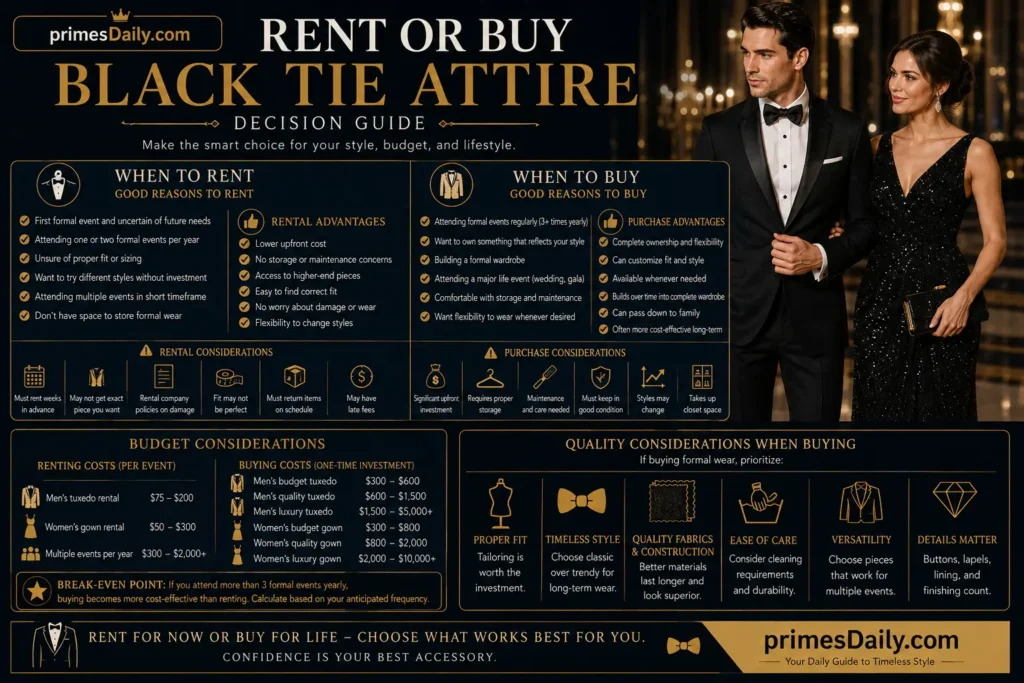
One of the first decisions is whether to rent formal wear or invest in owning pieces.
When to Rent
Good Reasons to Rent:
- First formal event and uncertain of future needs
- Attending one or two formal events per year
- Unsure of proper fit or sizing
- Want to try different styles without investment
- Attending multiple events in short timeframe
- Don’t have space to store formal wear
Rental Advantages:
- Lower upfront cost
- No storage or maintenance concerns
- Access to higher-end pieces than you might buy
- Easy to find correct fit
- No worry about damage or wear
- Flexibility to change styles
Rental Considerations:
- Must rent weeks in advance for availability
- May not get exact piece you want
- Rental company policies on damage
- Fit may not be perfect
- Must return items on schedule
- May have late fees
When to Buy
Good Reasons to Buy:
- Attending formal events regularly (3+ times yearly)
- Want to own something that reflects your style
- Building a formal wardrobe
- Attending a major life event (wedding, gala)
- Comfortable with storage and maintenance
- Want flexibility to wear whenever desired
Purchase Advantages:
- Complete ownership and flexibility
- Can customize fit and style
- Available whenever needed
- Builds over time into complete wardrobe
- Can pass down to family
- Often more cost-effective long-term
Purchase Considerations:
- Significant upfront investment
- Requires proper storage
- Maintenance and care needed
- Must keep in good condition
- Styles may change
- Takes up closet space
Budget Considerations
Renting Costs:
- Men’s tuxedo rental: $75-$200 per event
- Women’s gown rental: $50-$300 per event
- Multiple events per year: $300-$2,000+
Buying Costs:
- Men’s budget tuxedo: $300-$600
- Men’s quality tuxedo: $600-$1,500
- Men’s luxury tuxedo: $1,500-$5,000+
- Women’s budget gown: $300-$800
- Women’s quality gown: $800-$2,000
- Women’s luxury gown: $2,000-$10,000+
Break-Even Point: If you attend more than 3 formal events yearly, buying becomes more cost-effective than renting. Calculate based on your anticipated frequency.
Quality Considerations When Buying
If buying formal wear, prioritize proper fit (tailoring is worth investment), timeless style over trendy, quality fabrics and construction, ease of care and maintenance, versatility (pieces that work with other pieces), and professional tailoring for perfect fit.
Budget-Friendly Black Tie Attire Options
Quality formal wear doesn’t require unlimited budget.
Smart Shopping Strategies
Where to Shop:
- Department stores (sales sections)
- Online formal wear specialists
- Outlet stores
- Secondhand formal wear retailers
- End-of-season sales
- Discount formal wear sites
When to Shop:
- After major event seasons (post-wedding season sales, post-holiday)
- End-of-season clearance
- Online flash sales
- Holiday promotions
- Black Friday and Cyber Monday
Smart Choices:
- Classic styles over trendy
- Timeless colors (black, navy, neutral tones)
- Quality basics that last
- Pieces that work with existing wardrobe
Budget-Friendly Tips for Men
Tuxedo Shopping:
- Standard black tuxedo is most affordable
- Buy jacket and trousers separately if allows better fit
- Consider budget brands that focus on formal wear
- Look for sales on previous season colors
- Choose simpler styles (fewer embellishments = lower cost)
Shirt and Accessories:
- Formal shirts often on sale
- One high-quality formal shirt works for multiple events
- Budget bow ties available everywhere
- Cufflinks available at any price point
- One pair of formal shoes works with multiple outfits
Smart Layering:
- One formal jacket, multiple formal shirts
- Various formal trousers coordinate with one jacket
- Multiple bow ties for variety
- Cost-effective approach to formal wardrobe
Budget-Friendly Tips for Women
Gown Shopping:
- Shop end-of-season sales
- Consider multiple-occasion gowns
- Navy, black, or deep jewel tones more affordable than trendy colors
- Simple styles often cheaper than heavily embellished
- Online shopping offers more affordable options
- Secondhand formal wear is quality-equivalent at lower cost
Rental as Budget Option:
- Renting saves significant money if attending few formal events
- Access to more expensive gowns without ownership cost
- Perfect for experimental styling
Accessories:
- Affordable shoes available everywhere
- Costume jewelry can look elegant if chosen carefully
- DIY hairstyling saves salon costs
- Makeup can be done personally or at drugstore
Quality Without Expense
Remember: proper fit and grooming matter more than price tag. A $300 tuxedo that fits perfectly outshines a $2,000 tuxedo that doesn’t fit. Focus on fit and tailoring, cleanliness and maintenance, grooming and presentation, confidence and posture. These matter infinitely more than labels or price tags.
Cultural Differences in Black Tie Attire
Formal evening wear is increasingly global, but cultural interpretations vary.
Western Interpretation (UK, USA, Europe)
The most standardized version has formal black-tie rules relatively consistent, tuxedo standard for men globally in Western contexts, evening gowns standard for women, and relatively narrow range of acceptable variation.
South Asian Interpretation
In Pakistan, India, and South Asia more broadly, formal evening wear is less common than traditional formal wear, Western formal wear increasingly used at international events, traditional formal wear (sherwani, saree, etc.) often substituted, and high-end corporate and diplomatic events adopting Western formal wear. Blending of traditional and Western formal wear is becoming common.
In Pakistan specifically:
- Formal evening wear increasingly seen at international corporate functions, diplomatic events, high-end destination weddings, and awards ceremonies at international standards
- Traditional formal wear remains more common for most events
- Western formal wear considered appropriate for international contexts
Middle Eastern Interpretation
- Formal evening wear adapts to local dress codes
- Women may wear formal abayas instead of gowns
- Men wear traditional formal wear alongside Western suits
- International events increasingly adopting Western formal standards
Asian Interpretation
- Varies by country and context
- Japan: Western formal wear standard for business and formal events
- China: Western formal wear increasingly standard for international events
- India: Blend of traditional and Western formal wear common
- Most cosmopolitan cities adopting Western formal standards
Why Cultural Adaptation Matters
Understanding cultural context helps you navigate expectations. International events typically expect Western formal standards, local events may accept traditional formal wear, high-profile corporate events generally require Western formal, and respectful approach is to ask if uncertain.
Why Dress Codes Matter for Black Tie Attire Events
Understanding the importance of dress codes helps explain why they exist and why following them matters.
The Function of Dress Codes
Dress codes create visual equality (everyone at same formality level creates sense of unity), atmospheric tone (formal dressing creates formal atmosphere), respect signal (following dress code shows respect for event and hosts), psychological effect (dressing formally puts you in formal mindset), photographic coherence (everyone dressed at same level makes better photographs), and tradition and meaning (formal dressing recognizes occasion’s significance).
What Happens Without Dress Codes
Events without dress codes often suffer from visual inconsistency and distraction, reduced sense of occasion, some guests feeling underdressed while others overdressed, loss of atmospheric formality, photographs that lack coherence, and reduced psychological elevation of the event.
Respect and Consideration
Following dress codes shows respect for hosts and their vision for the event, consideration for fellow attendees, understanding of social norms, willingness to participate in collective experience, investment in making the occasion special, and recognition of the event’s importance.
Modern Evolution
While traditional rules remain, modern interpretation allows more flexibility while maintaining core principles of respect and appropriateness. The goal isn’t rigid compliance but thoughtful participation in the formal experience.
The Evolution of Black Tie Attire in 2026
Formal evening wear continues to evolve while maintaining essential elements.
Current Trends in 2026
More Inclusive Interpretation:
- Gender-neutral formal options gaining acceptance
- Non-binary formal wear increasingly recognized
- More flexibility in color and style
- Broader understanding of what constitutes “formal”
Sustainability Focus:
- Quality pieces meant to last (not disposable)
- Sustainable formal wear gaining attention
- Secondhand and rental formal wear becoming more mainstream
- Eco-conscious choices in formal fashion
Digital Effects:
- Virtual events creating new formal norms
- Hybrid formal dress standards emerging
- Video conferencing affecting grooming standards
- Technology influencing formal wear presentation
Personalization:
- More room for personal style within formality
- Individual expression while maintaining elegance
- Contemporary interpretations of tradition
- Balance between classic and modern
What Remains Constant
Despite evolution, certain fundamentals endure the importance of fit and proper construction, the role of formality in creating atmosphere, the significance of grooming and presentation, the respect that dress codes communicate, and the elegance of timeless, well-chosen pieces.
Looking Forward
As formal evening wear evolves, the core principles remain respect for the occasion, consideration for fellow attendees, confidence in your presentation, understanding of social norms, and willingness to participate in collective experience.
The future of formal wear is one where traditional excellence meets modern inclusivity—where everyone can feel elegant and appropriate while still expressing individuality.
FAQs
What exactly is the difference between a tuxedo and a regular black suit?
A tuxedo (dinner jacket) has satin-covered lapels, buttons, and a stripe down the trouser leg. A regular suit lacks these details. The satin creates the formal distinction and makes the tuxedo immediately recognizable as formal wear. Tuxedos are reserved for evening and formal occasions, while regular suits work for business and many daytime events.
Can I wear a regular black suit to an event requiring formal evening wear?
While not ideal, a very high-quality black suit in perfect condition can work in less strict settings. However, traditional formal evening wear specifically requires a tuxedo with proper satin details. If the invitation specifies formal evening wear, a tuxedo is the correct choice.
Is it acceptable to wear a colored bow tie to a formal event?
Traditional formal evening wear requires a black bow tie (white for white-tie events only). Colored bow ties are increasingly appearing at contemporary and high-fashion formal events, but unless the invitation specifically invites interpretation, black remains the correct choice.
What should women wear if they don’t like wearing dresses?
Women increasingly have options for formal wear beyond dresses. Formal pantsuits, elegant jumpsuit designs, or tailored formal separates can work at contemporary formal events. However, ensure the outfit maintains elegance, proper length, and formal fabrics. Check with hosts if uncertain, particularly for traditional events like weddings.
How much should I spend on formal wear if attending just one event?
Renting is the most cost-effective option for single events ($75-$300). If buying, budget-conscious options exist ($300-$800). Remember that proper fit and grooming matter more than spending heavily. A well-fitted $500 piece outshines a poorly-fitted $2,000 item.
What’s acceptable for shoes at a formal event?
Black patent leather or polished formal shoes are standard. Women can also wear elegant heels or formal flats. Everything should be formal in style, immaculately clean, and polished. Sneakers, casual shoes, or worn footwear are never appropriate.
Can I wear jewelry at formal events?
Absolutely, but keep it elegant and minimal. Quality matters more than quantity. For men, cufflinks are the primary jewelry. For women, choose a few elegant pieces—perhaps earrings, a bracelet, and necklace—that complement rather than compete with your outfit.
Is it okay to wear my phone to a formal event?
Your phone should be completely invisible. Keep it in a pocket (men) or clutch (women), silenced, and not accessed during the event. Using your phone visibly contradicts the formality of the occasion.
What if I’m uncomfortable in formal wear?
Practice wearing your outfit before the event. This helps identify uncomfortable elements and builds confidence. Remember that everyone at a formal event is also formally dressed. Discomfort is often temporary, but confidence comes from proper fit and preparation.
How do I maintain my formal wear after the event?
Hang jackets and dresses properly (not crumpled in a closet). Store in breathable garment bags. Have items professionally cleaned if needed (but airing out often works). Keep shoes in protective covering. Fold or hang trousers carefully. Store in a cool, dry place away from direct sunlight. With care, formal wear lasts for years and multiple events.
What’s the appropriate time to wear formal evening wear?
Generally, formal evening wear is for events after 6 PM. The formality of the invitation is the ultimate guide—follow what the invitation specifies. When in doubt, more formal is better than less formal.
Is it required to wear a cummerbund?
A cummerbund or waistcoat covers the trouser waistband and is part of traditional formal wear. However, if the jacket covers everything, it’s technically not required. For maximum formality, include it. For comfort, you can skip it in less formal settings.
What should I do if I don’t own formal shoes?
Borrow from someone with similar shoe size, rent formal shoes, or purchase budget-friendly formal shoes. Avoid wearing anything but formal black shoes—this is non-negotiable. Quality formal shoes are available at many price points.
Can I wear a turtleneck under my formal wear?
No. The formal white shirt with its specific front is essential to the look. A turtleneck would completely change the aesthetic and destroy the formality. Stick with the prescribed formal shirt.
What if my formal wear doesn’t fit perfectly?
Professional tailoring is worth the investment. Most formal wear requires some adjustment for perfect fit. Budget $50-$150 for tailoring depending on alterations needed. Proper fit is infinitely more important than original price.
Conclusion
Formal evening wear represents one of the few remaining dress codes that transcends fashion trends and personal preference. It creates a shared experience where everyone arrives at the same level of formality, contributing to an atmosphere of celebration, respect, and elegance.
Understanding formal evening wear isn’t about rigid rules or pretentiousness—it’s about participating respectfully in a tradition that has endured because it works. When you wear formal evening wear properly, you’re not just following rules; you’re contributing to something larger than yourself. You’re saying to the hosts and fellow attendees that this occasion matters enough that you’ve prepared intentionally.
The beautiful part about formal evening wear is that it’s genuinely accessible. You don’t need to spend thousands of dollars to look elegant and appropriate. You need proper fit (tailor if necessary), quality basics over expensive brands, impeccable grooming, confidence in your preparation, and respect for the occasion.
This guide has covered every element—from the specific construction of a formal jacket to the psychology of wearing it confidently. You now understand why dress codes exist, how to interpret them correctly, what works for your body type and comfort level, and how to adapt traditional formal wear to contemporary contexts while maintaining elegance.
The next time you receive an invitation with “formal evening wear required,” you’ll know exactly what to wear, how to make it work within your budget, and how to feel genuinely confident in your presentation. You’ll understand that the person in the well-fitted, properly-groomed formal outfit isn’t overdressed or pretentious—they’re respectfully participating in a tradition of celebration and elegance.
Formal evening wear endures because it works. It creates beauty, equality, and atmosphere in a way that casual dress simply cannot. Whether you’re attending your first formal event or your fiftieth, understanding and respecting this dress code ensures you’ll always look appropriate, feel confident, and contribute positively to the occasion.
Now you’re ready. The next formal event in your calendar need not create anxiety or confusion. You understand what’s required, why it matters, and exactly how to execute it. Walk into that gala, wedding, or awards ceremony knowing that you’ve prepared thoughtfully and intentionally. That confidence will shine through, regardless of what you’re wearing, and ultimately, that’s what truly matters.
For the latest, updated, and unique information, visit Growth Navigate Startup Tools.