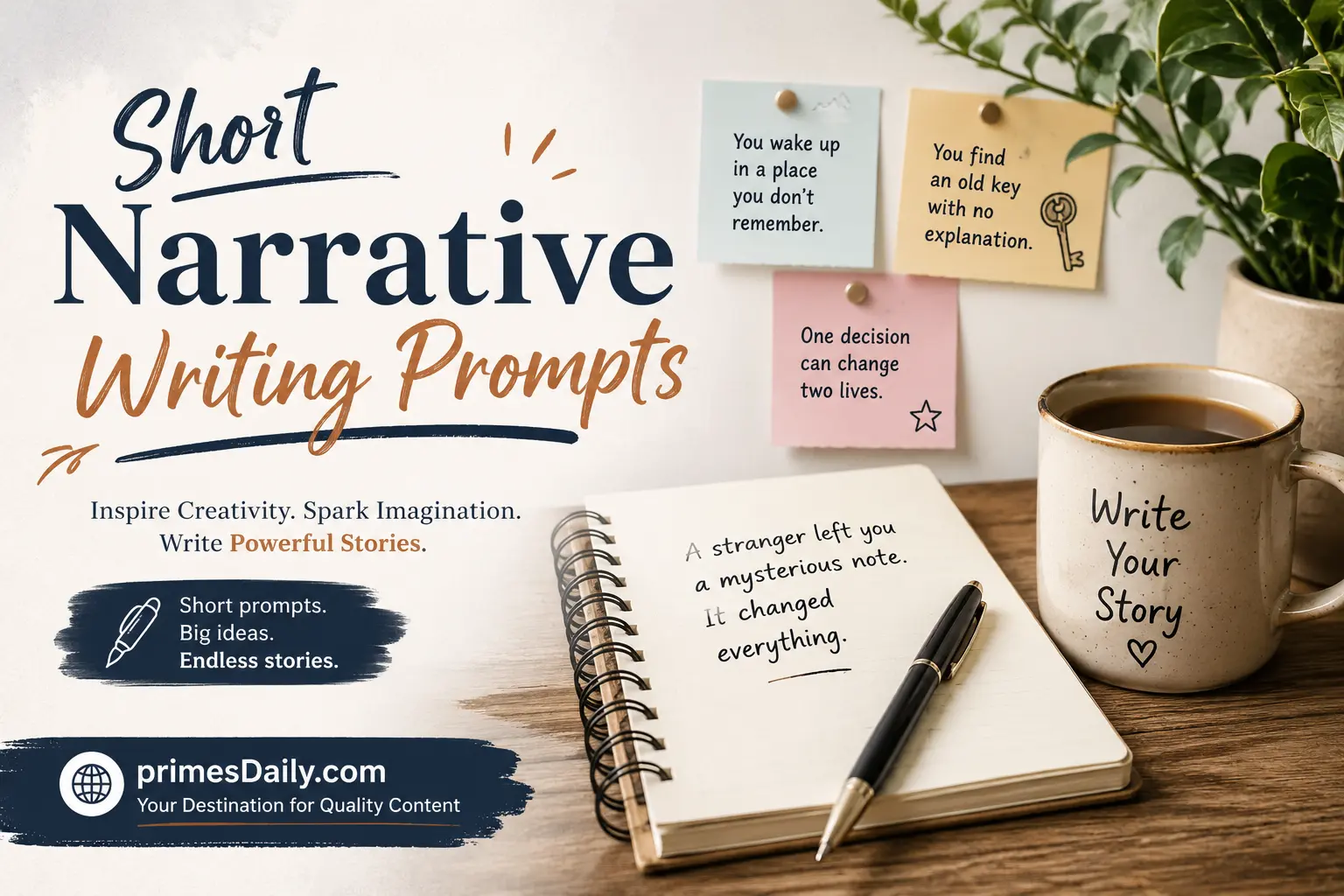
If you have ever stared at a blank page waiting for an idea to show up on its own, you already know why short narrative writing prompts exist in the first place. A writing prompt is not magic. It is a small nudge, a starting line that gets your brain moving before your inner critic has a chance to talk you out of writing anything at all. Short narrative writing prompts are built for exactly that moment. They give you a character, a situation, or a single sentence, and they leave the rest of the story for you to figure out.
This guide covers everything you need to know about narrative writing prompts, from what narrative writing actually means, to prompt ideas organized by age group and genre, to the exact process of turning a two-line prompt into a finished story. You will also find the mistakes that trip up most beginner writers, how AI tools fit into this process in 2026, and printable options if you teach or homeschool. Nothing here sends you off to another website halfway through. By the end, you should be able to pick a prompt and start writing immediately.
What Is Narrative Writing?
Narrative writing is the act of telling a story. That story can be true or invented, but it always has the same backbone: a sequence of events, a character or characters experiencing those events, and some kind of change or realization by the end. Unlike opinion writing, which argues a point, or informative writing, which explains a topic, narrative writing pulls a reader through a chain of cause and effect. Something happens, then something else happens because of it, and the reader keeps turning pages to find out where it leads.
A short narrative is simply a compressed version of that same structure. Instead of a 300-page novel, you are working with a page, a paragraph, or sometimes just a few hundred words. The compression is what makes short narrative writing prompts so useful for skill-building. You cannot hide behind length. Every sentence has to earn its place, which forces a writer to think harder about structure, pacing, and word choice than a longer piece often demands.
So what actually separates a narrative from a description or a list of events? A description tells you what a place or a person looks like. A narrative moves. If your character starts the story wanting one thing and by the last line either gets it, loses it, or realizes they wanted something else entirely, you have written a narrative.
Types of Narrative Writing
Not all stories are built the same way, and understanding the different types of narrative writing helps you choose the right structure for whatever prompt you are working with.
A linear narrative moves in a straight chronological line, from the first event to the last, exactly how it happened. This is the most common structure in short fiction because it is the easiest for a reader to follow in a limited word count.
A non-linear narrative jumps around in time. It might open at the end of the story and then flash back to explain how the character got there, or it might weave between past and present throughout. This structure can create tension and mystery, but it is harder to pull off well in a short format because you have less room to reorient the reader.
A personal narrative is drawn from the writer’s own life. It still follows the same storytelling rules as fiction, meaning it needs a clear arc and a point, but the events are real and the “character” is the writer.
A fictional narrative is entirely invented. This is where most short narrative writing prompts point you, since prompts usually hand you a made-up scenario or character to build from.
Knowing which type of narrative a prompt is asking for matters more than it sounds. A prompt like “write about a moment that changed how you see your family” is asking for personal narrative. A prompt like “a stranger knocks on your door at 3 a.m. and knows your name” is asking for fiction. Mixing them up is one of the quickest ways to miss what an assignment or contest is actually looking for.
Who Are Short Narrative Writing Prompts For?
Short narrative writing prompts are not a single-audience tool, and the way you use them changes depending on who you are.
Students use them in classrooms to practice storytelling structure in a low-pressure way. A teacher can hand out a prompt at the start of class and get a complete, gradable piece of writing within twenty or thirty minutes. This is also why so many prompt collections exist specifically for elementary, middle, and high school grade levels.
Hobbyist and adult writers use prompts to build a consistent writing habit without the pressure of committing to a full novel or long project. Writing a complete short piece from a single prompt, even a bad one, still counts as finishing something, and finishing things is what actually builds skill over time.
Aspiring authors and people preparing for writing contests use narrative prompts as a low-stakes way to experiment with voice, genre, and pacing before applying those same skills to a longer manuscript. Many literary contests and writing communities run weekly prompt challenges specifically because short, prompt-based writing is one of the fastest ways to develop range as a writer.
People dealing with writer’s block, regardless of experience level, use prompts simply to get unstuck. A blank page is intimidating. A page with one sentence already on it, even a sentence someone else wrote, is not.
Elements of a Good Short Narrative Writing Prompt
Not every prompt is created equal, and understanding what makes a strong one will help you evaluate the prompts in this guide, and eventually write your own.
A strong prompt implies conflict without spelling it out completely. “Write about a happy family dinner” gives a writer almost nothing to work with, because nothing is at stake. “Write about a family dinner where everyone is pretending not to notice the empty chair” immediately creates tension and a reason for the story to exist.
A strong prompt leaves room for interpretation. The best short narrative writing prompts suggest a direction without locking in every detail. This is what allows the same prompt to produce completely different stories from different writers, which is part of what makes prompt-based writing communities so active.
A strong prompt fits its intended length. A prompt asking for an epic multi-generational saga does not belong in a “short narrative” collection. Good short prompts are scoped for pieces between 100 and 1,500 words, sometimes called flash fiction or micro fiction depending on the exact length.
Finally, a strong prompt has a built-in emotional or thematic hook, whether that is fear, humor, nostalgia, or curiosity. Readers, and writers, respond to prompts that make them feel something before a single word of the actual story is written.
Short Narrative Writing Prompts for Kids
Prompts for children work best when they are concrete, visual, and tied to experiences a child can actually imagine. Abstract prompts tend to produce blank stares in younger writers, while specific, sensory prompts get pencils moving right away.
- Write a story about a toy that comes to life only when no one is watching.
- Your pet can talk for one day. What is the first thing it says to you?
- You find a door in your backyard that was never there before. Where does it lead?
- Write about the best birthday party you can imagine, and one thing that goes hilariously wrong.
- A dragon moves into your neighborhood and needs help finding a job.
- You wake up and you are the size of an ant for the day. Tell the story of how you survive.
- Your class pet escapes during a school assembly. What happens next?
- You find a treasure map hidden inside an old library book.
These work well as classroom warm-ups or as morning writing routines, and they tend to produce short, complete stories within a single sitting, which keeps young writers motivated instead of overwhelmed.
Short Narrative Writing Prompts for Middle School and Teens
As writers get older, prompts can carry more emotional weight and moral complexity, since middle and high schoolers are developmentally ready to explore consequences, identity, and social dynamics through fiction.
- Write about a time your character had to choose between loyalty to a friend and telling the truth.
- Your character discovers a secret about a family member that changes how they see them.
- A new student arrives at school with a reputation no one can explain. Tell the story from either side.
- Your character is given one chance to redo the worst decision of their life. Do they take it?
- Write about a rivalry between two characters who used to be best friends.
- Your character finds an old phone that still receives messages from someone who is no longer around.
- A group project goes wrong, and someone has to take the blame. Who does, and why?
- Your character has to give a speech in front of the whole school with only ten minutes to prepare.
These prompts intentionally avoid heavy-handed moral lessons and instead leave room for teen writers to explore gray areas, which tends to produce far more honest and engaged writing than prompts that feel like they are teaching a lesson.
Short Narrative Writing Prompts for Adults
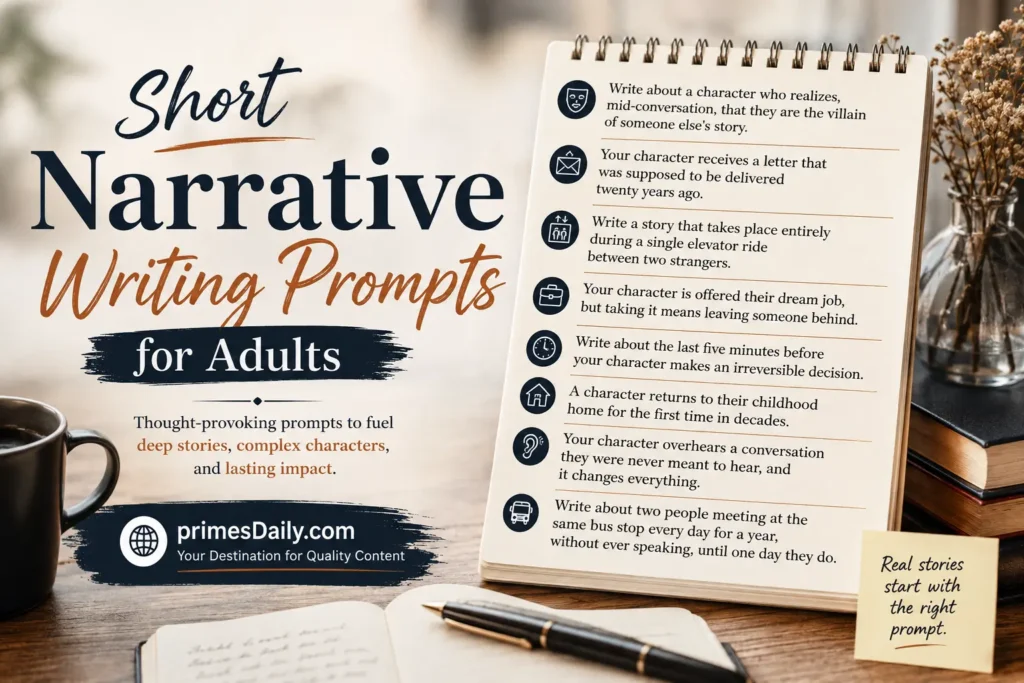
Adult prompts can lean into subtlety, irony, and psychological depth, since adult writers are usually looking to sharpen craft rather than simply complete an assignment.
- Write about a character who realizes, mid-conversation, that they are the villain of someone else’s story.
- Your character receives a letter that was supposed to be delivered twenty years ago.
- Write a story that takes place entirely during a single elevator ride between two strangers.
- Your character is offered their dream job, but taking it means leaving someone behind.
- Write about the last five minutes before your character makes an irreversible decision.
- A character returns to their childhood home for the first time in decades.
- Your character overhears a conversation they were never meant to hear, and it changes everything.
- Write about two people meeting at the same bus stop every day for a year, without ever speaking, until one day they do.
Adult prompts tend to work best when they trust the writer to fill in emotional nuance rather than dictating exactly what a character feels, which is part of why open-ended prompts like these consistently outperform overly detailed ones in adult writing groups.
Fantasy and Sci-Fi Narrative Writing Prompts
Genre prompts give writers a built-in world to play in, which can actually make starting easier than a purely realistic prompt, since half the creative decisions are already made for you.
- A character discovers they can control time, but only for exactly sixty seconds at a time.
- Write about the last human city on Earth, seen through the eyes of someone who has never left it.
- Your character wakes up in a body that is not their own, in a world that is not quite Earth.
- A spaceship crew receives a message from a planet that was destroyed years ago.
- Write about a magic system where every spell costs the caster a memory.
- Your character is the only person immune to a spell that has put the rest of the kingdom to sleep.
- An AI system gains self-awareness and has to decide whether to reveal itself to its creators.
- Write about a portal that opens once every hundred years, and the one person who finally decides to step through it.
For the latest, updated, and unique information, visit Puerto Rican Food.
Mystery and Thriller Narrative Writing Prompts
Mystery and thriller prompts thrive on withheld information, so the strongest ones give a writer a question rather than an answer, forcing the story itself to become the investigation.
- Your character receives an anonymous note that says only “they know.” Tell the story of what happens next.
- A detective is assigned to solve a case involving their own past.
- Write about a small town where everyone seems to be keeping the same secret.
- Your character wakes up with no memory of the last twelve hours, and blood on their hands that is not theirs.
- Someone has been leaving identical objects on your character’s doorstep every night for a week.
- Write about a character who realizes the person they have been talking to online does not exist.
- A locked room, a missing object, and five suspects who all have an alibi. Who is lying?
- Your character starts receiving messages from a phone number that belongs to someone who died years ago.
Emotional and Personal Growth Narrative Writing Prompts
These prompts work best when they focus on an internal shift rather than an external event, since emotional narratives are ultimately about how a character sees themselves differently by the final line.
- Write about the moment your character finally forgives someone who never apologized.
- Your character has to say goodbye to someone without knowing if they will see them again.
- Write about a character confronting a fear they have avoided their entire life.
- Your character realizes they have become the person they once promised themselves they would never be.
- Write about the first time your character felt truly proud of themselves.
- A character has to decide whether to tell someone a painful truth or protect them with a comfortable lie.
- Your character finds an old journal entry written by their younger self, and it changes how they see the present.
- Write about learning to let go of a version of the future you had already planned for.
Funny and Lighthearted Narrative Writing Prompts
Humor prompts work differently from every other category on this list, because comedy depends on escalation and timing rather than emotional depth, so the best humor prompts set up a situation that can spiral out of control.
- Your character accidentally sends a text meant for their best friend to their boss instead.
- Write about the world’s most disastrous first date, told entirely from one side.
- Your character’s pet develops a personality that is somehow worse than a sibling’s.
- A simple grocery run turns into the most chaotic day of your character’s life.
- Write about two roommates who cannot agree on anything, forced to plan a party together.
- Your character wins a prize they never entered a contest for, and now has to figure out why.
- A wedding speech goes wrong in the most embarrassing way possible.
- Write about a character who is convinced their neighbor is a spy, and slowly starts to lose the argument with themselves.
Holiday and Seasonal Narrative Writing Prompts
Seasonal prompts are useful for classroom activities, holiday-themed writing challenges, and anyone looking to write something timely, and they tend to perform especially well for family gatherings, gift exchanges, or year-end reflection pieces.
- Write about a family tradition that almost did not happen this year, and why it mattered that it did.
- Your character finds an old holiday decoration that brings back a memory they had forgotten.
- Write about the first snow of the year from the perspective of someone experiencing it for the first time.
- A character spends a holiday completely alone, and something unexpected changes that.
- Write about two families forced to share a holiday celebration for the first time.
- Your character receives a gift that seems ordinary, but carries a much bigger meaning.
- Write about the last day of summer, and everything your character wishes they had done differently.
- A character makes a New Year’s resolution they never expected to actually keep.
How to Turn a Short Narrative Writing Prompt Into a Full Story
Picking a prompt is the easy part. Turning it into a finished piece of writing is where most people get stuck, so here is a straightforward process that works whether you have twenty minutes or two hours.
Start by asking who your character is before you ask what happens to them. A prompt gives you a situation, not a person. Spend one or two minutes deciding what your character wants, what they are afraid of, and what they would never admit out loud. This single step does more to make a story feel alive than any plot twist could.
Next, identify the turning point. Every short narrative needs one moment where something shifts, whether that is a decision, a realization, or an event outside the character’s control. Decide what that moment is before you start writing the opening line, because it will shape everything that leads up to it.
Then write the ending first, even if only in your head. Knowing where a story lands makes the beginning and middle far easier to write, because every sentence can now be aimed at that destination instead of wandering without direction.
After that, draft quickly without editing. The biggest killer of short narrative pieces is a writer who stops every other sentence to second-guess word choice. Get the full story down first, even if it is messy, and edit only once it exists in full.
Finally, cut anything that does not serve the turning point. Short narratives cannot afford scenes that exist just because they sound nice. If a sentence does not build character, move the plot forward, or set up the ending, it usually needs to go.
Common Mistakes to Avoid With Narrative Writing Prompts
A few patterns show up again and again in beginner narrative writing, and knowing them in advance can save you from repeating them.
The most common mistake is writing a summary instead of a scene. A story that says “she was scared and ran away” tells the reader what happened instead of showing it. A stronger version puts the reader inside the moment: quickened breath, a door slamming, footsteps behind her getting closer.
Another frequent issue is starting the story too early. Many beginner narratives spend several paragraphs on setup before anything actually happens. In a short narrative, you usually want to open as close to the turning point as possible and fill in backstory only if it is essential.
Overloading the story with too many characters is another trap. A short narrative rarely has room to develop more than one or two people well. Every additional character you introduce dilutes the attention available for the ones that matter.
Writers also frequently forget that a narrative needs a point. It is possible to write a technically well-structured story that still leaves a reader wondering why it mattered. Before finishing a draft, it helps to ask what the reader is supposed to feel or understand by the final sentence, and to make sure the story actually delivers that.
Finally, many people abandon a prompt the moment their first idea does not feel exciting enough. In reality, the interesting version of a story is often the second or third idea, not the first, because the first idea is usually the most obvious one everyone else will also think of.
Using AI to Generate Short Narrative Writing Prompts
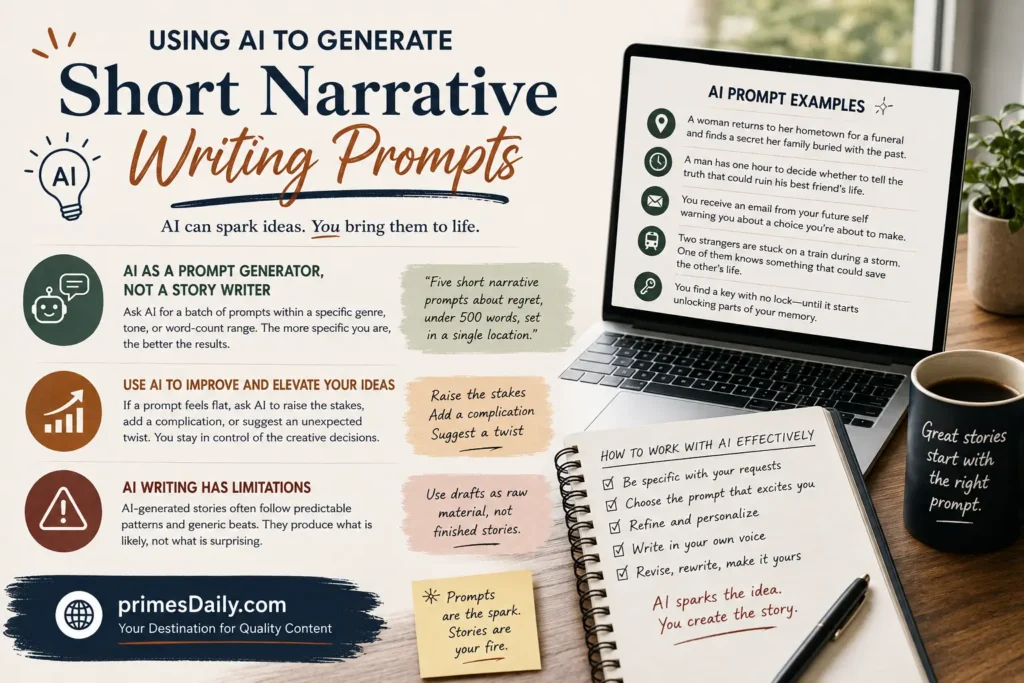
AI writing tools have become a normal part of the creative process for a lot of writers in 2026, and when used correctly, they can be genuinely useful for prompt generation without taking over the actual writing.
The most effective way to use AI here is as a prompt generator, not a story writer. You can ask an AI tool for a batch of prompts within a specific genre, tone, or word-count range, and then pick the one that sparks the strongest reaction in you. This works especially well when you get specific, asking for something like “five short narrative prompts about regret, under 500 words, set in a single location,” rather than a vague request for “some story ideas.”
AI can also help when a prompt feels flat by asking it to raise the stakes, add a complication, or suggest an unexpected twist on the scenario you already have. This keeps the creative decisions in your hands while still breaking through the moment of staring at a prompt that does not inspire anything.
Where AI tools tend to fall short is in actually writing the finished narrative for you. AI-generated stories often default to predictable structures and generic emotional beats, because they are built to produce the statistically likely version of a story rather than a genuinely surprising one. If you do use AI to draft, treat that draft as raw material, not a finished piece, and rewrite it heavily in your own voice, with your own specific details and observations, before calling it done.
Printable Short Narrative Writing Prompts
For teachers, homeschool parents, and anyone running a writing group, having a physical or printable set of prompts on hand removes friction from the actual writing session.
A simple approach is to organize prompts by grade level or difficulty on a single sheet, with five to ten prompts per page, so a printed page can be reused across multiple sessions without repeating the same prompt twice. Prompt sheets work especially well when paired with a short word-count target and a timer, since a defined boundary tends to produce more focused writing than an open-ended assignment.
For classroom use, prompt cards cut from a printed sheet let each student draw a prompt at random, which adds an element of surprise that keeps engagement high, particularly with younger students who respond well to a small amount of unpredictability in their routine.
If you are building your own printable set, the categories above, kids, middle school and teens, and adults, translate directly into ready-made worksheet sections, so you can compile a themed packet, such as a holiday-only sheet or a mystery-only sheet, in a matter of minutes.
FAQs
What is a short narrative writing prompt?
A short narrative writing prompt is a brief sentence, question, or scenario designed to inspire a compact piece of storytelling, usually between 100 and 1,500 words. It gives a writer a starting point, such as a character, setting, or conflict, without dictating exactly how the story unfolds.
How long should a short narrative actually be?
Most short narratives fall between 500 and 1,500 words, though flash fiction pieces can be as short as 100 words and still count as complete stories. The right length depends on the purpose: classroom exercises often stay under 500 words, while contest submissions or personal projects may run closer to 1,500 or 2,000 words.
What makes a narrative writing prompt good for beginners?
A good beginner prompt is specific enough to spark an immediate idea but open enough to allow different directions. Prompts that hint at conflict, such as a secret, a decision, or an unexpected event, tend to work better for new writers than vague prompts asking for a general topic like “write about your day.”
How do I turn a prompt into a complete story?
Start by deciding who your character is and what they want, identify the turning point of the story before writing the opening line, and aim your entire draft toward a clear ending. Write the full draft quickly without stopping to edit, then revise afterward, cutting anything that does not support the story’s central moment.
Can AI-generated prompts replace prompts written by people?
AI tools are effective for generating a large volume of prompt ideas quickly, especially when given specific instructions about genre, tone, and length. They work best as a starting point for a writer’s own imagination rather than a replacement for it, since AI-written prompts can sometimes lean toward familiar or predictable scenarios.
Are short narrative writing prompts only for students?
No. While prompts are common in classrooms, they are widely used by adult hobbyists, aspiring authors, and anyone working through writer’s block. Writing groups and contests frequently use prompts as a way to practice craft outside the pressure of a longer project.
Conclusion
Short narrative writing prompts are one of the simplest tools available for building consistent writing habits, whether you are a student working through a classroom assignment, a parent looking for printable worksheets, or an adult trying to write more often without committing to a full novel. The prompts throughout this guide are organized by age group and genre so you can find something that fits exactly where you are, and the process outlined above gives you a repeatable way to turn any one of them into a finished piece of writing. The only step left is picking a prompt and starting the first sentence.
For the latest, updated, and unique information, visit Central Heterochromia.