
Picture a narrow stone street in southern Spain, lit only by candles and the soft glow of streetlamps. Incense curls into the night air. A drum begins to beat, slow and heavy, and then a wall of silence falls over a crowd of thousands. A wooden float, carried on the shoulders of thirty or forty men hidden beneath its skirts, rounds the corner. Somewhere above the crowd, a voice breaks into a saeta, a raw, unaccompanied flamenco lament, and grown men wipe away tears they didn’t expect to shed.
This is Holy Week in Spain, and for 2026, the dates are set: March 29 through April 5. If you’ve never experienced it, no photograph or video quite prepares you for what it feels like to stand in that crowd. If you have experienced it before, you already know why people plan entire years around this single week.
This guide is built to answer every question you might have before, during, and after this trip. Where should you go. What should you pack. How much will it cost. What do the processions actually mean. Which cities are worth your time and which ones are better left for another year. We’re not going to send you off to five other websites to piece this together. Everything you need is right here, written by people who understand both the religious weight of this tradition and the practical realities of traveling during one of Spain’s busiest weeks.
By the end of this guide, you’ll know exactly what to expect, how to plan around it, and how to experience it the way locals do rather than the way a rushed tourist does.
What is Semana Santa 2026? History and Meaning of Holy Week
Holy Week in Spain marks the final week of Lent, the period leading directly into Easter. It commemorates the Passion of Jesus Christ: his entry into Jerusalem, the Last Supper, his trial, crucifixion, and resurrection. Unlike Easter celebrations in most of the world, which tend to center around a single Sunday service, Spain turns the entire week into a public, communal experience that plays out on the streets rather than only inside churches.
The tradition traces back centuries, with roots in medieval religious brotherhoods known as cofradías or hermandades. These were originally associations of laypeople, often organized by trade or neighborhood, who took on the responsibility of staging processions as acts of penance and devotion. Over hundreds of years, these brotherhoods developed elaborate rituals, commissioned extraordinary religious artwork, and built traditions that have been passed down largely unchanged from one generation to the next.
What makes this different from a historical reenactment or a staged festival is that it’s still deeply personal for the people who participate. Many of the men who carry the heavy wooden floats through the streets, called costaleros, come from families who have done this same work for generations. Some brotherhoods have been marching the same route since the 1500s. This isn’t a show put on for visitors. It’s a living tradition that tourists are welcome to witness.
Understanding this distinction matters because it shapes how you should approach the week. This is not Carnival. There’s no confetti, no loud parties in the streets during the processions themselves. It’s solemn, deeply felt, and for many participants, genuinely spiritual. That doesn’t mean it isn’t also a spectacular, unforgettable experience for visitors of any background. It absolutely is. But knowing the weight behind it changes how you watch it.
When is Semana Santa 2026? Exact Dates and Calendar
Holy Week dates shift every year because they’re calculated based on the lunar calendar, specifically the first Sunday following the first full moon after the spring equinox. For 2026, that calculation places Holy Week from Sunday, March 29 through Sunday, April 5.
This is notably earlier than 2025, when Holy Week fell in mid-April. If you’re used to associating this celebration with warmer April weather, 2026 will feel slightly different. Expect cooler evenings, particularly in cities like Toledo and Zamora, and pack accordingly.
Here’s the full week broken down:
Palm Sunday falls on March 29, 2026, marking the beginning of the week with processions commemorating Jesus’s entry into Jerusalem. Holy Monday, Holy Tuesday, and Holy Wednesday follow, each with their own processions building in intensity. Maundy Thursday lands on April 2, commemorating the Last Supper, followed by Good Friday on April 3, which represents the most solemn and dramatic day of processions across the country. Holy Saturday on April 4 is typically quieter, a day of reflection before Easter Sunday on April 5 brings celebration and resurrection processions.
If you’re planning your trip, mark these dates now. Hotel availability tightens dramatically as these dates approach, and flight prices into Madrid, Seville, and Málaga climb steadily from January onward.
Semana Santa 2026 Religious Significance and Traditions Explained
At its core, this week tells one continuous story across seven days: betrayal, suffering, death, and resurrection. Each day of the week corresponds to a specific moment in that narrative, and the processions you’ll see are visual retellings of these events.
The floats, called pasos, typically come in pairs for each brotherhood. One depicts a scene from the Passion, often showing Christ carrying the cross or on the crucifix. The other depicts the Virgin Mary, usually as the Virgen de los Dolores, or Our Lady of Sorrows, dressed in ornate robes and often moved to tears through carefully applied glass beads on her painted face. These aren’t simple statues. Many were carved by renowned sculptors centuries ago and are considered priceless works of religious art.
The brotherhoods themselves function almost like extended families. Membership is often passed down within families, and being chosen to carry a paso, walk as a penitent, or hold a specific ceremonial role within a brotherhood is considered an honor. Some brotherhoods have thousands of members; others are small, tightly-knit groups tied to a single neighborhood parish.
Penitents, the hooded figures you’ll see walking in the processions wearing tall pointed caps called capirotes, are not meant to be sinister despite how the imagery might initially read to visitors unfamiliar with the tradition. The hood and robe tradition dates back centuries and was originally meant to allow penitents to perform acts of penance anonymously, without pride or recognition. Some penitents walk barefoot. Some carry heavy candles for hours. Others walk chained at the ankles as an act of personal devotion.
Understanding these traditions transforms how you experience the processions. What might initially look like a slow-moving parade becomes, once you understand the symbolism, an intensely personal and moving expression of faith that’s been refined over centuries.
Key Dates During Semana Santa 2026: Palm Sunday to Easter Sunday
Each day carries its own character, and knowing what to expect daily helps you plan which days matter most for your itinerary.
Palm Sunday, March 29, opens the week with a lighter, more celebratory tone. Processions feature palm branches and the atmosphere is less heavy than what follows later in the week. This is a good day for first-time visitors to ease into the experience.
Holy Monday through Holy Wednesday, March 30 through April 1, bring a steady rhythm of processions in most major cities, each day building slightly in intensity. These days tend to have smaller crowds than the peak days, making them ideal if you want a genuine experience without shoulder-to-shoulder crowds.
Maundy Thursday, April 2, marks a significant shift. Processions grow more elaborate and emotionally weighted, commemorating the Last Supper and the beginning of the Passion narrative. In many cities, this is when the most prestigious brotherhoods process.
Good Friday, April 3, is widely considered the most dramatic and important day. This is when the crucifixion is commemorated, and in cities like Seville, this includes the overnight procession known as La Madrugá, which runs from the very early hours of Good Friday morning. Crowds peak on this day across nearly every Spanish city with a Holy Week tradition.
Holy Saturday, April 4, offers a quieter contrast. Many cities have few or no processions, treating the day as a period of solemn waiting between the crucifixion and resurrection.
Easter Sunday, April 5, closes the week with resurrection-themed processions that carry a noticeably different emotional tone, celebratory rather than mournful. In some towns, this includes traditions like the “encuentro,” a staged meeting between processions representing Christ and Mary, met with applause rather than silence.
Best Cities for Semana Santa 2026 Celebrations in Spain
Not every city celebrates this week the same way, and choosing where to go should depend on what kind of experience you want. Some cities are famous for scale and grandeur. Others are known for intimacy, unique regional traditions, or a specific procession that’s unlike anything else in the country.
Seville remains the undisputed epicenter, with more brotherhoods, more elaborate floats, and larger crowds than anywhere else. Málaga offers a coastal alternative with its own distinct military-influenced traditions. Granada blends Holy Week with the city’s layered Moorish and Christian history. Toledo delivers a more austere, medieval atmosphere through its narrow stone streets. Valencia brings a maritime twist you won’t find inland. Zamora, often overlooked by international visitors, offers candlelit, deeply intimate processions through a town that feels frozen in time.
If this is your first time and you want the full, iconic experience, Seville should be your priority. If you’ve already seen Seville, or if you’re drawn to something quieter and less crowded, Zamora, Toledo, or Cuenca offer equally moving experiences without the crush of a million visitors.
Seville Semana Santa 2026: The Heart of Holy Week Spain
Seville doesn’t just celebrate this week, it transforms around it. Over seventy brotherhoods take to the streets across the seven days, each with its own history, membership, route, and character. The city’s compact historic center becomes an obstacle course of barricaded streets, folding chairs, and crowds that can stretch into the hundreds of thousands on peak days.
The atmosphere here is unlike anywhere else. Balconies overlook narrow streets, and families who’ve lived in the same homes for generations open their windows to watch processions pass directly beneath them. The scent of orange blossom, which blooms across the city in spring, mixes with incense and melted wax from thousands of candles.
If you only have time for one city, this is the one most visitors point to as unmissable. The scale, the emotional intensity, and the sheer number of processions mean there’s genuinely something happening around the clock during peak days.
Neighborhoods like Triana and Santa Cruz are particularly worth exploring, not just for the processions but for the daily life that continues around them, tapas bars filling with locals between processions, and the general buzz of a city fully absorbed in its biggest week of the year.
Málaga Semana Santa 2026: Passion and Tradition on the Coast
Málaga’s Holy Week has its own distinct personality, shaped partly by the city’s history and partly by its coastal setting. One of the most recognizable features here is the involvement of the Spanish Legion, the military unit that famously escorts certain processions, most notably carrying the Cristo de Mena statue while singing the Legion’s own hymn. It’s a striking, unexpected sight, soldiers in full dress uniform marching alongside centuries-old religious imagery.
The floats in Málaga tend to be exceptionally large, some of the biggest in the country, requiring well over a hundred bearers to carry. Unlike Seville, where processions weave through tight medieval streets, Málaga’s wider boulevards allow for a different kind of spectacle, floats moving through open plazas with room to appreciate their full scale.
Because Málaga also has beaches, direct flights from across Europe, and a slightly lower cost of living than Seville, it’s an increasingly popular alternative for visitors who want the full Holy Week experience without Seville’s premium prices and overwhelming crowds.
Granada Semana Santa 2026: Moorish Heritage Meets Holy Week
Granada’s Holy Week carries a layered cultural weight that you won’t find in other Spanish cities. This is a place where Islamic and Christian history sit side by side, visible in the architecture, the street names, and even in some of the processional routes that wind past the Alhambra and through the old Albaicín quarter.
The standout event here is the Cristo de los Gitanos procession, which departs from the Sacromonte caves, historically home to Granada’s Roma community. This procession is unlike anything else in Spain. It moves through steep, narrow paths carved into the hillside, with views over the Alhambra as the backdrop, and it’s often accompanied by flamenco singing that feels raw and unrehearsed compared to the more formal saetas heard elsewhere.
Granada’s smaller scale compared to Seville makes it more manageable for visitors who want a powerful experience without navigating million-person crowds. It’s also considerably more affordable, with hotel prices generally 30 to 40 percent lower than equivalent options in Seville during the same week.
Toledo Semana Santa 2026: Medieval Traditions and Historic Processions
Toledo’s Holy Week feels distinctly different in tone. This is a smaller, more austere celebration that fits the city’s medieval character. The stone streets, many barely wide enough for two people to pass, create an intimate, almost claustrophobic atmosphere during processions, in the best possible sense.
Because Toledo is compact and easily walkable, it’s one of the better cities for visitors who want to catch multiple processions without extensive planning or transportation logistics. Its status as a UNESCO World Heritage city means the entire backdrop, cathedrals, synagogues, mosques converted into churches, adds historical depth that few other cities can match.
Many visitors combine Toledo with Madrid, since it’s less than an hour away by train, making it a realistic day trip option if you’re based in the capital and want to experience Holy Week without committing to an overnight stay elsewhere.
Zamora Semana Santa 2026: Candlelit Processions and Ancient Customs
Zamora rarely makes it onto international travel lists, and that’s exactly its appeal. This small city in northwestern Spain hosts some of the country’s most solemn and visually striking processions, many of them taking place entirely at night, lit only by candlelight against Romanesque stone architecture that dates back to the 12th century.
The Procession of Silence, held here, is exactly what it sounds like: thousands of participants moving through the streets in complete silence, no music, no drums, just footsteps and candlelight. For visitors who find Seville’s crowds overwhelming, Zamora offers the emotional core of Holy Week without the tourist density.
Hotel prices here run significantly lower than the major Andalusian cities, often 50 to 60 percent less for comparable quality, and the smaller crowds mean you can actually get close enough to appreciate the detail on the pasos rather than watching from a distance over a sea of heads.
Valencia Semana Santa 2026: Maritime Holy Week on Spain’s Coast
Valencia offers something genuinely different from every other city on this list: a maritime-themed Holy Week that reflects its coastal identity. In the Poblats Marítims district, traditionally home to fishing communities, processions have long incorporated seafaring elements into their imagery and symbolism.
The city’s Easter Sunday celebrations are particularly worth catching, with a livelier, more celebratory atmosphere than the solemn days earlier in the week. Combined with Valencia’s beaches, its modern City of Arts and Sciences complex, and its famously good food scene, it makes for an appealing option if you want to pair Holy Week with a broader city break.
Other Spanish Cities for Semana Santa 2026: Córdoba, Cádiz, and More
Beyond the headline cities, Spain has dozens of towns with meaningful Holy Week traditions worth knowing about. Córdoba, with its Mezquita-Cathedral as a backdrop, offers processions through streets that blend Islamic and Christian architectural history in a way that echoes Granada but with its own distinct character.
Cádiz, Spain’s oldest city, hosts processions along its Atlantic coastline, with sea breezes and coastal light adding a different visual texture to the traditional imagery. Cuenca, a UNESCO World Heritage town known for its dramatic hanging houses built into cliff faces, has been officially recognized as a Fiesta of International Tourist Interest for its Holy Week celebrations, drawing visitors specifically for the unique setting.
Valladolid, in Spain’s northern plateau region, is known for having some of the country’s finest processional sculpture, with museums dedicated entirely to Holy Week artistry. If you’re interested in the artistic and historical side of these traditions as much as the spectacle, Valladolid deserves consideration.
Semana Santa 2026 in Latin America: Guatemala and Colombia Celebrations
While Spain remains the most internationally recognized destination for this week, Latin America’s celebrations, shaped by centuries of Spanish colonial influence, have developed into equally spectacular traditions with their own distinct character.
Antigua, Guatemala, hosts what many consider the most visually stunning Holy Week celebration in the Americas. The city becomes famous for its alfombras, elaborate carpets made from dyed sawdust, flower petals, and pine needles, laid across entire streets in intricate patterns hours before processions pass over them. Local families and communities spend entire nights creating these temporary works of art, only for them to be walked over and destroyed within minutes as processions pass.
Popayán, Colombia, known as the White City for its whitewashed colonial architecture, hosts processions so significant they’ve been recognized by UNESCO as part of humanity’s intangible cultural heritage. Unlike Spain’s often crowded, tourist-heavy processions, Popayán’s celebrations retain a more local, community-centered atmosphere, even as international recognition grows.
Both destinations offer travelers who’ve already experienced Spain’s Holy Week a compelling reason to see how the same religious tradition evolved differently across the Atlantic, blending Spanish Catholic ritual with local indigenous and colonial influences.
Processions and Pasos: Understanding Semana Santa 2026 Floats
The pasos are, without question, the visual centerpiece of every procession you’ll witness. These aren’t simple platforms. Many weigh over a thousand kilograms once fully assembled with flowers, candles, silver ornamentation, and the wooden sculptures themselves. Some are lit with dozens or even hundreds of candles, their flickering light against gold leaf detailing creating an almost otherworldly glow as they move through darkened streets.
Beneath each paso, hidden entirely from view by long fabric skirts, walk the costaleros, the bearers who carry the immense weight on their necks and shoulders using a specially designed cushion called a costal. Training for this role takes months. Bearers practice walking in unison, in near-total darkness beneath the float, guided only by a designated leader who taps a small hammer against the front of the platform to signal when to lift, walk, and rest.
Watching a paso navigate a tight corner is one of the most quietly impressive moments of any procession. It requires dozens of bearers to move in perfect coordination, often adjusting their grip and stance simultaneously without being able to see each other or their surroundings clearly.
Hermandades (Brotherhoods): The Heart of Semana Santa 2026
Every procession you see belongs to a hermandad, a religious brotherhood responsible for organizing everything from the float’s design and maintenance to recruiting and training the costaleros who carry it. These organizations often trace their origins back centuries, and membership frequently runs in families for multiple generations.
Joining a hermandad isn’t simply about attending a procession once a year. Members contribute to the upkeep and restoration of the religious artwork, participate in year-round religious and charitable activities, and often dedicate significant personal time and resources to ensuring their brotherhood’s procession meets exacting standards.
The rivalry and pride between different hermandades adds another layer of depth to the week. Locals often have strong opinions about which brotherhoods carry the most beautiful pasos, which have the most moving music, or which maintain the oldest and most authentic traditions. Striking up a conversation with a local about their favorite hermandad is one of the fastest ways to get genuine insight into what makes this week so meaningful to the people who live it every year.
La Madrugá: The Most Iconic Semana Santa 2026 Event
If there’s one single event that captures the emotional peak of the entire week, it’s La Madrugá in Seville. Running through the overnight hours from Maundy Thursday into Good Friday, this procession features some of the city’s most prestigious and beloved brotherhoods, including El Silencio, Jesús del Gran Poder, and La Macarena.
What makes La Madrugá extraordinary isn’t just the timing, it’s the atmosphere. Crowds pack the streets from midnight onward, many having claimed their spot hours in advance. The combination of exhaustion, candlelight, incense, and the emotional weight of the processions creates an atmosphere that longtime attendees describe as genuinely unforgettable, something closer to a collective spiritual experience than a typical tourist event.
If you attend only one procession during your entire trip, seasoned visitors will almost universally point you toward this one. Be prepared for a long night, minimal sleep, and crowds that require real patience, but also for an experience that’s genuinely difficult to replicate anywhere else in the world.
Saetas and Music: The Soundscape of Semana Santa 2026
Sound plays an enormous role in shaping the emotional texture of every procession. The most distinctive element is the saeta, an unaccompanied flamenco song, often sung spontaneously from a balcony as a paso passes below. There’s no set schedule for when a saeta will happen. It simply occurs when someone in the crowd feels moved to sing, and when it does, everything around it stops. The procession pauses. The crowd falls silent. And for the length of that raw, aching melody, the entire street becomes a shared moment of grief and devotion.
Beyond saetas, most processions are accompanied by marching bands playing somber, deliberately paced music specifically composed for Holy Week. These compositions, some over a century old, are instantly recognizable to locals and often carry deep personal or family associations for people who’ve grown up attending the same processions year after year.
In contrast, the Nazarenos, the hooded penitents, typically walk in complete silence, their steady, unhurried pace against the backdrop of drums and brass creating a rhythm that’s easy to fall into as a spectator, almost meditative after standing in a crowd for an hour or more.
Capirotes and Traditional Robes: Semana Santa 2026 Iconic Symbols
The tall, pointed hoods worn by penitents, known as capirotes, are perhaps the most visually striking and, for first-time visitors, most initially unsettling element of the entire week. It’s worth addressing directly: these robes and hoods have no connection to other, more troubling associations some visitors might mistakenly draw from similar imagery elsewhere in the world. Their origin is entirely religious, dating back centuries, and their purpose was to allow penitents to perform acts of public penance while remaining anonymous, removing personal pride or recognition from the act of devotion.
The color of the robe and hood typically corresponds to the specific hermandad. Some brotherhoods wear black, symbolizing mourning. Others wear purple, associated with penance, or white, representing purity. Each brotherhood has its own distinct colors and design details, and locals can often identify which hermandad is processing simply by the color combination from a distance.
Some penitents carry large wax candles, walking for hours while wax drips down their robes, a physical reminder of the act of devotion they’re performing. Others walk entirely barefoot, regardless of how cold or rough the pavement might be.
What to Expect During Semana Santa 2026: Atmosphere and Experience
Nothing quite prepares first-time visitors for the sheer sensory intensity of experiencing this week in person. The crowds are real and, in cities like Seville, genuinely enormous. Streets that normally hold light foot traffic become dense with spectators standing shoulder to shoulder for hours at a time.
The atmosphere shifts dramatically depending on the day and the specific procession. Earlier in the week, particularly during daytime processions, there’s a lighter, almost festive undertone, families with children, vendors selling snacks, a general buzz of community celebration. As the week progresses toward Good Friday, the mood deepens considerably. Crowds grow quieter. The processions themselves slow down and carry more visible emotional weight.
Expect long periods of standing, often several hours at a stretch if you want a good viewing spot for a major procession. Expect crowds that require patience and a willingness to be gently jostled. Expect incense smoke that lingers in your clothes for days afterward. And expect moments, whether it’s a particularly moving saeta, the sight of an elderly local weeping quietly as a beloved paso passes, or simply the overwhelming scale of thousands of candles moving through a darkened street, that will stay with you long after you’ve returned home.
Planning Your Semana Santa 2026 Trip: The Ultimate Guide
Successful planning for this week comes down to a handful of key decisions made early. First, choose your city or cities based on the kind of experience you want, grand and overwhelming in Seville, coastal and unique in Málaga, intimate and quiet in Zamora. Second, book your accommodation as early as possible, ideally four to six months in advance for major cities. Third, map out which specific processions matter most to you, since trying to see everything in a single city over one week is genuinely impossible given how many run simultaneously.
Consider building in rest days, particularly if you’re attending overnight events like La Madrugá. The combination of standing for hours, minimal sleep, and constant walking adds up quickly, and burning out by day three of a seven-day week is a common mistake among first-time visitors who try to see absolutely everything.
Finally, build some flexibility into your itinerary. Processions can run later than scheduled, weather can shift routes or cause cancellations, particularly rain, which is a genuine risk given the timing on the calendar. Having a backup plan, whether that’s an alternative procession nearby or simply a museum visit if weather disrupts outdoor plans, will save you frustration.
How to Book Accommodations for Semana Santa 2026
Accommodation is, without question, the single biggest logistical challenge of planning this trip. In Seville particularly, hotels within or near the historic center routinely sell out four to six months in advance, and prices climb steeply as availability shrinks.
If you want a room with a balcony overlooking a procession route, expect to pay a significant premium, sometimes double or triple standard rates, and expect to book those specific rooms even earlier, often close to a year in advance for the most sought-after locations along Seville’s main routes.
For more reasonable pricing, consider staying slightly outside the absolute historic center. Neighborhoods a fifteen to twenty minute walk from the main procession routes often offer considerably better value while still keeping you within easy walking distance of the action. Alternatively, staying in a smaller nearby town and taking day trips into the major cities can dramatically reduce costs while still allowing you to experience the key processions.
Budget Breakdown: How Much Does Semana Santa 2026 Cost?
Costs vary enormously depending on your city choice, accommodation standard, and how far in advance you book. As a general framework, budget travelers staying in hostels or budget guesthouses in smaller cities like Zamora or Cuenca can expect to spend roughly thirty to fifty dollars per night on accommodation. Mid-range hotels in cities like Granada or Málaga typically run eighty to one hundred fifty dollars per night during this period, roughly double their off-season rates.
Seville, unsurprisingly, sits at the top of the pricing scale. Mid-range hotels here often run one hundred fifty to two hundred fifty dollars per night, with premium locations offering balcony views commanding significantly more. Food costs remain relatively reasonable across all these cities, with a full meal at a mid-range restaurant typically costing fifteen to twenty-five dollars, and tapas-style eating, popular throughout the week, often working out even cheaper if you’re strategic about it.
Factor in transportation, whether flights into Spain or trains between cities, and a realistic total budget for a week-long trip ranges from roughly six hundred dollars for a bare-bones budget approach up to two thousand dollars or more for a comfortable, well-located experience in a major city like Seville.
Getting Around During Semana Santa 2026: Transportation Tips
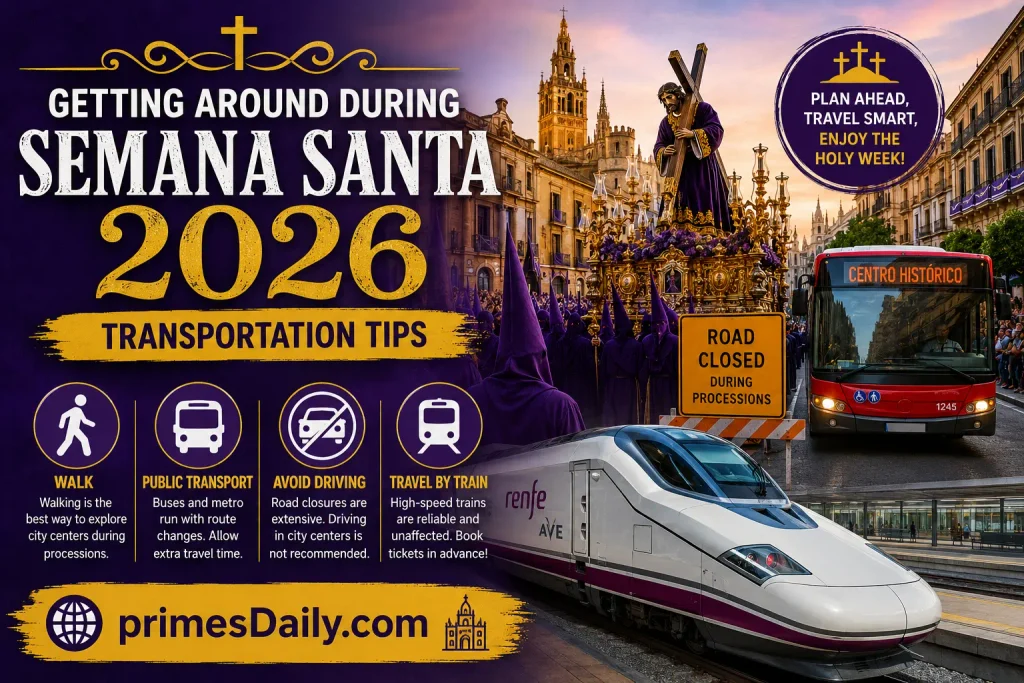
Road closures are extensive and constantly shifting during this week, particularly in city centers where processions take place. Driving into or through historic centers is often simply not possible during peak hours, and even outside processions, traffic congestion from road closures can make short trips take significantly longer than usual.
Walking becomes your primary mode of transportation in most cities during the week itself. Public transportation, buses and metro systems, generally continues operating but with modified routes around procession areas, so build extra time into any journey that requires crossing through or near a city center.
For traveling between cities, Spain’s high-speed rail network remains reliable and is generally unaffected by local processions, making train travel the most stress-free option if your itinerary includes multiple cities. Booking these train tickets in advance is strongly recommended, since demand for popular routes like Madrid to Seville increases substantially during this period.
What to Pack for Semana Santa 2026 Travel
Comfortable, broken-in walking shoes should be at the top of every packing list. You’ll likely be on your feet for extended periods, often standing in one spot for hours to secure a good viewing position, so shoes that have already been worn in matter far more than fashion here.
Given the late March and early April timing, pack layers. Daytime temperatures in southern cities like Seville and Málaga can feel pleasantly warm, but evenings, particularly during overnight processions, get noticeably cooler. A light jacket or cardigan you can easily carry becomes essential once the sun goes down.
Bring a portable phone charger or power bank. Between navigation, photos, and simply staying connected with your group in dense crowds, phone batteries drain quickly, and finding a charging outlet during peak procession hours is often impractical. A small, secure crossbody bag or money belt is worth considering given the dense crowds, which unfortunately do attract pickpockets in the busiest tourist areas.
Semana Santa 2026 Procession Routes and Best Viewing Spots
Every hermandad follows a specific, published route, typically moving from their home church toward the city’s cathedral before returning. In Seville, this stretch near the cathedral, known as the carrera oficial, or official route, tends to draw the largest and most tightly packed crowds, since it’s where every single procession passes at some point.
For a genuinely good viewing experience without the most extreme crowding, locals often recommend positioning yourself somewhere along a procession’s route away from the immediate cathedral area, ideally near the brotherhood’s home church where the procession departs or returns. Crowds here tend to be thinner, and you’ll often get a closer, more personal view of the paso and its bearers.
Arriving early, genuinely early, sometimes two to three hours before a major procession is scheduled, remains the most reliable way to secure a good spot without paying for premium seating or balcony access. Bring something to sit on if you’re claiming a spot well in advance, since standing for hours before the procession even arrives adds up quickly.
Safety Tips for Semana Santa 2026: Crowds and Pickpocketing Prevention
Large, dense crowds unfortunately create ideal conditions for pickpocketing, and Spanish authorities consistently note increased incidents during this week in the most heavily trafficked tourist areas. Keep valuables secured in a front pocket, money belt, or crossbody bag worn across your chest rather than a back pocket or loosely carried bag.
Stay aware of your immediate surroundings, particularly in the tightest crowd crushes near major procession routes. If you’re traveling with children, agree on a clear meeting point in case anyone gets separated in a crowd, since phone signals can become unreliable in extremely dense areas.
For overnight events like La Madrugá, pace yourself. Standing for six or more hours through the night, combined with minimal sleep, takes a real physical toll. Bring water, wear appropriate layers, and don’t hesitate to step back from the densest crowd sections if you start feeling overwhelmed or unwell. Local pharmacies remain open in most cities even during peak procession hours for minor medical needs.
Photography and Video at Semana Santa 2026: Rules and Ethics
Photography is generally welcomed and even encouraged during processions, but a few points of etiquette matter significantly to locals and fellow spectators. Avoid using flash photography directly at pasos or penitents, since it disrupts the atmosphere and can be seen as disrespectful given the solemn, often deeply personal nature of what’s taking place.
Be mindful of physically blocking other spectators’ views for extended periods to get your shot, particularly people who may have been standing in position for hours. If you’re using a tripod or larger equipment, be considerate about placement in already-crowded streets.
Some of the most striking photography opportunities come not from the pasos themselves but from the surrounding details, the candlelight reflecting off cobblestones, penitents’ silhouettes against illuminated church facades, or the concentrated expressions on the faces of costaleros as they navigate a tight turn. Early morning and evening light, common during many procession times, naturally lends itself to atmospheric, memorable images without needing flash at all.
Food and Drink During Semana Santa 2026: Traditional Dishes
Food traditions during this week reflect its religious origins, with many dishes historically tied to Lenten fasting restrictions that avoided meat. Fish and seafood dishes feature prominently across Spain during this period, alongside a handful of specifically Holy Week desserts that appear almost exclusively during this time of year.
Restaurants throughout Andalusia and beyond adjust their menus accordingly, and trying these seasonal specialties adds another layer to the experience beyond simply watching processions. Tapas culture remains alive and well throughout the week, with bars filling up between processions as locals and visitors alike take breaks to eat, drink, and rest their feet before heading back out to catch the next procession.
Wine and sherry, particularly in Andalusian cities, pair naturally with the tapas culture that dominates the social side of this week. Even amid the solemnity of the processions themselves, the surrounding social atmosphere in bars and restaurants retains a warmth and conviviality that balances the more serious tone of the religious observances.
Torrijas: The Iconic Semana Santa 2026 Spanish Treat
If there’s one dish synonymous with this week across Spain, it’s torrijas. Essentially a Spanish take on French toast, torrijas are made from thick slices of slightly stale bread, soaked in milk or wine and beaten egg, then fried and finished with cinnamon and sugar or honey. Nearly every bakery and restaurant across the country sells them specifically during this period, and recipes vary from family to family and region to region.
Historically, torrijas served a practical purpose, using up bread that would otherwise go stale during a period associated with simplicity and modest eating. Today, they’ve become something closer to a beloved seasonal treat that locals genuinely look forward to each year, appearing in bakery windows weeks before the week itself even begins.
If you want an authentic taste of this tradition, skip the tourist-focused restaurants near major squares and look instead for small, family-run bakeries in residential neighborhoods, where recipes have often been passed down for generations and prices remain far more reasonable than in heavily trafficked areas.
Business Hours and Closures During Semana Santa 2026
Business operations shift noticeably during this week, and it’s worth understanding what to expect before you arrive. Good Friday and, in many regions, Holy Thursday are official public holidays across Spain, meaning banks, government offices, and many shops close entirely.
Restaurants and bars generally remain open, particularly in tourist-heavy areas, though hours may shift around major procession times. Smaller, family-run shops in residential neighborhoods are more likely to close or reduce hours, particularly if family members are participating in nearby brotherhoods.
It’s worth noting that some of the smaller towns known for their processions essentially shut down entirely aside from businesses directly serving visitors, since a significant portion of the local population is either processing, watching, or otherwise fully absorbed in the week’s events. Planning ahead, particularly for anything requiring banking or official business, will save you frustration.
Accommodation Options for Semana Santa 2026 Visitors
Beyond standard hotels, this week has spawned an entire secondary market of specialized accommodation options built specifically around the processions. Vacation rental apartments overlooking procession routes command premium prices but offer an alternative to hotel stays, often with more space and the flexibility to prepare your own meals between long days of standing and walking.
Religious guesthouses and convents in some cities offer simple, budget-friendly accommodation, though availability during this specific week is understandably limited given how significant the period is for religious communities themselves.
For visitors on tighter budgets, consider staying in a nearby town with reliable train or bus connections into the major procession cities. This approach can cut accommodation costs significantly while still allowing you to experience the key events, provided you’re comfortable with slightly more logistics and earlier starts to catch morning processions.
Hotels with Balcony Access for Semana Santa 2026 Viewing
For visitors who prioritize comfort over immersion in street-level crowds, balcony viewing represents the premium option for experiencing processions. Hotels and rental apartments directly along major routes, particularly Seville’s official route near the cathedral, offer paid balcony access or included viewing as part of premium room rates.
This option removes the physical demands of standing for hours in dense crowds, making it particularly appealing for elderly travelers, families with young children, or anyone with mobility concerns. The tradeoff is cost, these rooms and balcony packages often run several times the price of standard accommodation, and availability for the most coveted spots typically requires booking six months to a year in advance.
If balcony viewing appeals to you but budget is a concern, some restaurants and cafes along procession routes offer paid seating with viewing access for a single procession or evening, providing a middle-ground option between full street-level immersion and a private balcony rental.
Neighborhoods to Stay in During Semana Santa 2026
Choosing the right neighborhood significantly shapes your overall experience. In Seville, Santa Cruz offers a beautiful, historic setting within easy walking distance of the cathedral and official route, though it comes with premium pricing and heavy foot traffic throughout the week. Triana, across the river, offers a slightly more residential, local feel while still remaining an easy walk into the historic center.
In Granada, staying near the Albaicín gives you proximity to some of the city’s most distinctive processions, including routes near the Alhambra, while also placing you within one of the city’s most atmospheric neighborhoods for simply wandering between events.
For Málaga, staying near the historic center puts you within walking distance of most major processions while still allowing reasonably quick access to the beach for a break from the crowds if needed. Across all these cities, staying slightly outside the absolute most central, tourist-saturated streets typically offers better value without meaningfully sacrificing convenience.
Flying to Spain for Semana Santa 2026: Flight Tips and Booking
Flight prices into Spain climb steadily as this week approaches, particularly for direct routes into Seville and Málaga, both of which see significant demand spikes during this period. Booking three to four months in advance typically offers the best balance between price and flight time flexibility.
Madrid often serves as the most cost-effective entry point, given its status as Spain’s primary international hub, with excellent onward train connections to Seville, Toledo, and other major Holy Week destinations. If your itinerary focuses primarily on Andalusia, flying directly into Seville or Málaga can save considerable time, though prices for these routes tend to be higher during this specific week compared to flying into Madrid and connecting by train.
Consider flexible date searches if your schedule allows it, since flying in a day or two before Palm Sunday or departing a day or two after Easter Sunday, rather than during the absolute peak dates, can sometimes yield meaningfully lower fares.
Train Travel During Semana Santa 2026: Getting Between Cities
Spain’s high-speed rail network, connecting Madrid with Seville, Málaga, and other major cities in as little as two and a half hours, remains one of the most efficient and stress-free ways to move between destinations during this week. Unlike road travel, trains are largely unaffected by the extensive street closures that come with processions.
Booking train tickets in advance is strongly recommended, particularly for popular routes during this period, since demand increases substantially and last-minute tickets can be significantly more expensive or entirely unavailable on peak travel days. If your itinerary includes multiple cities, mapping out your train schedule around specific processions you want to catch in each location helps ensure you’re not missing key events due to travel timing.
Regional trains connecting smaller Holy Week destinations like Zamora or Cuenca to major hubs run less frequently than the high-speed lines between major cities, so double-check schedules well in advance if your itinerary includes these smaller, quieter towns.
Driving and Car Rentals for Semana Santa 2026
Renting a car for this specific week comes with significant caveats worth understanding before booking. Historic city centers, where the vast majority of procession activity takes place, are frequently closed to vehicle traffic entirely during the week, and parking within or near these areas becomes extremely limited and expensive.
A car does offer genuine value if your plans include visiting smaller towns off the main train routes, or if you want the flexibility to explore the surrounding countryside between major procession days. If you do rent a car, plan to park it outside historic centers and rely on walking or public transportation for actually navigating the areas where processions take place.
Be aware that road closures around processions can appear with little advance notice and may significantly extend travel times even for routes that don’t directly pass through a historic center, since traffic redirected away from closed streets often creates congestion on surrounding roads.
Mobile Connectivity and Internet for Semana Santa 2026
Staying connected during dense crowd events can prove more challenging than you might expect, since cell networks in extremely crowded areas sometimes experience slowdowns or temporary congestion as thousands of people simultaneously attempt to use data and calls in a concentrated area.
International visitors should consider a local Spanish SIM card or an eSIM arranged before departure, both of which are widely available and generally offer better rates than international roaming plans through home carriers. Most hotels and many cafes throughout Spain offer reliable WiFi, providing a useful backup during periods of cellular congestion.
Downloading offline maps of your destination cities before your trip is a smart precaution, ensuring you can navigate even if cellular data becomes temporarily unreliable during peak crowd moments.
Early Booking Strategy for Semana Santa 2026
The overarching lesson from experienced Holy Week travelers is simple: book earlier than feels necessary. Accommodation in Seville routinely sells out four to six months ahead of the week itself, and the most desirable options, balcony rooms, centrally located hotels, disappear even earlier.
A realistic booking timeline starts with accommodation research around six to eight months ahead, with actual bookings ideally locked in by four to five months before the week. Flights should follow a similar timeline, three to four months ahead for the best combination of price and availability. Restaurant reservations for anything beyond casual tapas dining are worth arranging once you’re within a month or two of your trip, particularly for well-known establishments in heavily touristed areas.
Crowding and When to Visit Semana Santa 2026
If avoiding the heaviest crowds is a priority, timing your visit around the earlier days of the week, Palm Sunday through Holy Wednesday, offers a meaningfully different experience than the peak crush of Maundy Thursday through Easter Sunday. Crowds during these earlier days are noticeably lighter while still offering full access to genuine, moving processions.
Weekday processions generally draw smaller crowds than weekend events, simply due to the practical reality that more visitors, both domestic and international, travel specifically for the weekend portion of the week. If your schedule allows flexibility, arriving a few days before the absolute peak and departing before Easter Sunday itself can meaningfully reduce the crowd density you experience while still capturing the core of the tradition.
Regional Differences in Semana Santa 2026 Celebrations
Spain’s regional diversity shows through clearly in how different areas approach this week. Andalusian celebrations, centered in Seville, Málaga, and Granada, tend toward the most elaborate, emotionally expressive style, with saetas, large crowds, and grand processional scale.
Castilian towns like Zamora and Valladolid lean toward a more austere, solemn presentation, emphasizing silence, candlelight, and restraint over spectacle. Coastal regions like Valencia incorporate maritime elements unique to their local history. Even within Andalusia itself, smaller towns often maintain distinctly local traditions that differ meaningfully from the more internationally famous celebrations in the region’s major cities.
Understanding these regional variations helps set realistic expectations, since a visitor expecting Seville’s overwhelming scale might find Zamora’s quieter, more solemn approach initially surprising, even though both offer equally authentic and moving experiences within their own distinct traditions.
For the latest, updated, and unique information, visit Central Heterochromia.
Seville vs Málaga vs Granada: Semana Santa 2026 Comparison
These three cities represent the most commonly compared Holy Week destinations, and each offers a genuinely different experience worth understanding before you choose. Seville offers unmatched scale, over seventy brotherhoods, the largest crowds, and the most internationally recognized traditions, but comes with correspondingly higher costs and the most intense crowding of any Spanish city.
Málaga offers a strong middle ground, still large-scale and impressive, with its distinctive military procession elements, but generally more affordable and slightly less overwhelming than Seville, with the added bonus of coastal access.
Granada brings a unique cultural dimension through its Moorish heritage and the standout Sacromonte procession, alongside meaningfully lower costs than either Seville or Málaga. If budget is a significant factor, Granada often provides the best value while still delivering a genuinely memorable experience.
Quiet Alternatives to Main Semana Santa 2026 Cities
For visitors who’ve already experienced the major cities, or who simply prefer a quieter, more contemplative atmosphere, several alternatives deliver equally powerful experiences without the crowds. Zamora’s candlelit, silent processions offer perhaps the most emotionally intense alternative to Seville’s grand scale.
Cuenca, with its dramatic hanging house architecture, provides a visually distinctive backdrop alongside meaningfully smaller crowds than the major Andalusian cities. Small towns throughout rural Andalusia and Castile often maintain deeply local traditions, sometimes centuries old, that rarely appear on international tourist itineraries at all, offering a genuinely authentic experience for visitors willing to venture beyond the well-known destinations.
Smaller Towns for Semana Santa 2026: Hidden Gems
Beyond the well-documented major destinations, Spain is dotted with smaller towns where Holy Week traditions run just as deep, often with a more intimate, community-centered atmosphere than the major cities can offer. These towns rarely appear in international guides, meaning crowds remain thin and the experience feels considerably more personal.
Viveiro, in the northwestern region of Galicia, hosts one of the area’s most significant celebrations, drawing regional visitors while remaining largely unknown to international tourists. Similar smaller-scale traditions exist throughout rural Spain, often centered around a single, deeply beloved procession that the entire town turns out for.
If you’re comfortable with less English-language infrastructure and a more independent travel style, seeking out these smaller towns can offer some of the most genuinely moving moments of an entire trip, precisely because they haven’t been shaped or altered by mass tourism.
Is Semana Santa 2026 Religious or Cultural? Understanding the Celebration
This question comes up frequently among visitors trying to understand how to approach the week respectfully. The honest answer is that it’s genuinely both, deeply intertwined in a way that’s difficult to separate. For many participants, particularly costaleros, brotherhood members, and penitents, this remains a profoundly personal religious observance, an act of faith and devotion that carries real spiritual weight.
At the same time, the week has undeniably become a major cultural event, drawing millions of visitors regardless of religious background, generating significant tourism revenue, and functioning as a defining expression of regional and national identity in the areas where it’s celebrated. These two dimensions coexist without necessarily conflicting. A visitor with no religious background can absolutely appreciate the artistry, history, and communal spirit of the week while still recognizing and respecting its deeper religious significance for many of the people actually participating.
Can Non-Catholics Attend Semana Santa 2026?
Absolutely, and in fact, the vast majority of visitors attending processions each year have no direct religious connection to Catholicism at all. These are public, outdoor events taking place on open streets, and there’s no requirement or expectation that spectators share the religious beliefs being commemorated.
That said, approaching the week with a degree of respect and awareness of its significance to many participants enhances the experience considerably. This doesn’t require religious belief, simply a willingness to observe quietly during the more solemn moments, particularly during periods of silence or when a saeta begins, and to recognize that for many people around you, this is a deeply meaningful, sometimes emotional experience rather than simply entertainment.
Respecting Traditions During Semana Santa 2026
A handful of straightforward etiquette points go a long way toward showing respect during processions. Avoid loud conversations or laughter during particularly solemn moments, especially during the Good Friday processions or moments of silence. If a saeta begins, it’s customary for the crowd to fall completely silent until it ends.
Dress reasonably modestly, particularly if you plan to enter any churches along procession routes, which often remain open for visitors between processions. Avoid physically obstructing penitents or costaleros as they pass, and be mindful that some processions move quite slowly, requiring patience rather than pushing forward to get a better view.
Photography etiquette matters too, as covered earlier, avoiding flash directly at participants and being considerate of others’ viewing space. Ultimately, treating the week with the same respect you’d show at any significant religious or cultural event in your own community translates well here, regardless of your personal beliefs.
Church Services and Mass Times for Semana Santa 2026
Beyond the outdoor processions, churches throughout Spain hold their own services throughout the week, and many remain open to visitors between scheduled masses, offering a quieter counterpoint to the crowded streets outside. Palm Sunday services typically include the blessing of palm branches, often followed by a procession from the church itself.
Maundy Thursday services commemorate the Last Supper, sometimes including foot-washing ceremonies in larger cathedrals. Good Friday services tend to be particularly solemn, often held in the afternoon to coincide with the traditional hour of the crucifixion. Easter Sunday brings the week’s most celebratory services, marking the resurrection with noticeably different music and tone compared to the somber services earlier in the week.
If you’re interested in experiencing this more contemplative, indoor side of the week alongside the outdoor processions, checking individual church schedules once you arrive, often posted directly outside each church, will give you accurate local timing.
Solo Travel During Semana Santa 2026: Safety and Experience
Traveling alone during this week is entirely manageable and, for many visitors, offers a particularly flexible way to experience the events without needing to coordinate schedules with travel companions. The same general safety precautions apply as with any crowded event, staying aware of your surroundings and keeping valuables secure.
Solo travelers often find it easier to squeeze into good viewing positions in dense crowds than groups do, and the shared, communal atmosphere of processions makes striking up conversations with fellow spectators, both locals and other travelers, relatively natural. Hostels in cities like Granada and Zamora often organize informal group outings to processions, offering solo travelers an easy way to experience events alongside others if they prefer some company.
Family Travel During Semana Santa 2026: Kid-Friendly Tips
Families visiting with children can absolutely enjoy this week, though some planning adjustments help significantly. Earlier, lighter processions, particularly on Palm Sunday, tend to work better for younger children than the longer, more solemn overnight events like La Madrugá, which are genuinely demanding even for adults.
Bringing a small folding stool or portable seat helps young children see over crowds without needing to be carried for hours. Building in breaks between processions, rather than attempting to catch every single event in a day, keeps the experience enjoyable rather than exhausting for children who may not have the stamina for extended standing in dense crowds.
Many local families attend with children of all ages, so you’ll find plenty of familiar company, and the overall atmosphere, particularly during daytime processions, remains welcoming to visitors of all ages.
Couple’s Guide to Experiencing Semana Santa 2026
For couples, this week offers a genuinely romantic backdrop, particularly during evening and overnight processions where candlelight, incense, and haunting music create an atmosphere that feels distinctly different from typical tourist attractions. Booking a hotel with balcony access, if budget allows, offers a memorable, more comfortable way to experience a procession together without the physical demands of standing in dense street crowds for hours.
Pairing procession viewing with the region’s excellent food and wine culture, tapas crawls between events, long dinners in quiet neighborhood restaurants, adds a natural rhythm to a couple’s trip that balances the intensity of the processions themselves with quieter, more relaxed moments together.
Multi-City Itinerary for Semana Santa 2026
For visitors wanting to experience more than one destination, Spain’s rail network makes a multi-city itinerary genuinely feasible within a single week, provided you plan realistically. A common approach involves starting in Madrid, taking a day trip to Toledo early in the week when crowds are lighter, then traveling south to Seville for the peak days of Maundy Thursday through Easter Sunday.
Alternatively, combining Granada and Málaga works well given their relative proximity, allowing you to experience Granada’s distinctive Sacromonte procession alongside Málaga’s military-influenced traditions and coastal setting within a manageable travel distance. Whatever combination you choose, avoid overpacking your itinerary. Trying to squeeze three or four cities into seven days often means arriving exhausted and missing the deeper, more meaningful moments in favor of simply checking boxes.
Day Trip Ideas from Madrid for Semana Santa 2026
If your trip is centered in Madrid, several rewarding day trip options let you experience Holy Week traditions without committing to overnight stays elsewhere. Toledo, less than an hour away by high-speed train, offers a complete, atmospheric Holy Week experience within its compact, walkable historic center, making it entirely feasible to catch multiple processions in a single day trip.
Segovia and Ávila, both within reasonable train distance of Madrid, host their own smaller-scale Holy Week celebrations alongside their already well-known historical attractions, offering a way to combine sightseeing with procession viewing for visitors with limited time.
Combining Beach and Culture: Semana Santa 2026 Spain Itinerary
For travelers wanting to balance the intensity of Holy Week with some genuine relaxation, coastal cities offer a natural solution. Málaga and Valencia both combine significant procession traditions with beach access, allowing you to alternate between the emotional intensity of the processions and downtime by the water.
This approach works particularly well for families or travelers concerned about burnout from days of standing in crowds, offering built-in recovery time without sacrificing the core Holy Week experience entirely.
La Madrugá 2026: Seville’s Most Intense Night of Holy Week
Returning to this pivotal event with more practical detail: La Madrugá runs through the overnight hours from Thursday into Friday, typically beginning around midnight and continuing until well into Friday morning. Several of Seville’s most historically significant brotherhoods process during this window, drawing the city’s largest single-night crowds of the entire week.
Given the overnight timing and extreme crowd density, practical preparation matters significantly. Claim your viewing spot early, ideally by early evening on Thursday if you want a prime location along the busiest stretches. Bring water, wear warm layers for the coldest overnight hours, and pace yourself, since this genuinely is an endurance event as much as a viewing experience.
Jesús del Gran Poder: Iconic Seville Semana Santa 2026 Procession
Among the many brotherhoods processing during La Madrugá, Jesús del Gran Poder holds particular significance for many Sevillanos, carrying one of the city’s most revered and historically important religious sculptures. The brotherhood’s procession is known for its solemnity and the deep emotional response it draws from local crowds, many of whom consider this specific image among the most powerful representations of the Passion found anywhere in the city.
Cristo de los Gitanos: Granada’s Unique Semana Santa 2026 Spectacle
Worth revisiting in more detail, this procession departing from Granada’s Sacromonte caves stands apart from virtually every other event during the week. The setting alone, steep hillside paths overlooking the illuminated Alhambra, creates a visual spectacle unlike anything found in flatter, more traditional urban settings elsewhere in Spain.
The connection to Granada’s Roma community adds a distinct cultural layer, often bringing flamenco elements into the procession that feel more raw and community-rooted than the more formalized musical traditions found in other cities’ processions.
Spanish Legion Parade: Málaga’s Unique Semana Santa 2026 Tradition
The sight of Spanish Legion soldiers marching alongside religious imagery remains one of the most visually distinctive and, for many first-time visitors, genuinely surprising elements of Málaga’s celebrations. The tradition connects to the city’s specific history and has become one of its most recognizable and anticipated events each year, drawing significant crowds specifically for this moment.
Festival of International Tourist Interest: Semana Santa 2026 Toledo
Toledo’s Holy Week has received official recognition for its cultural and historical significance, a designation that reflects both the quality and authenticity of its traditions alongside the exceptional architectural backdrop the city provides. This recognition has helped preserve the celebration’s traditional character even as international visitor numbers have grown in recent years.
Valladolid Semana Santa 2026: Northern Spain’s Solemn Traditions
Valladolid’s approach to this week emphasizes artistic and historical depth over sheer scale, with the city’s collection of processional sculpture considered among the finest in the country. Museums here dedicated specifically to Holy Week imagery offer visitors a way to appreciate the artistry behind the pasos even outside the procession schedule itself, adding an educational dimension that complements the live events.
Health and Wellness During Semana Santa 2026: Long Days and Crowds
The physical demands of this week are genuinely worth taking seriously, particularly if your itinerary includes overnight events. Standing for extended periods, walking significant distances between processions, and disrupted sleep schedules from late-night events can add up to real fatigue by the middle of the week.
Staying hydrated matters more than many visitors initially expect, particularly during warmer daytime processions or lengthy overnight events. Pace your schedule realistically, building in at least one lighter day mid-week to recover physically before pushing through toward the demanding Good Friday and Easter Sunday events.
Comfortable Shoes and Footwear for Semana Santa 2026
This point deserves specific emphasis given how consistently overlooked it is by first-time visitors. Standing on cobblestone streets for several hours at a stretch, repeated across multiple days, is genuinely demanding on feet that aren’t prepared for it. Broken-in walking shoes with good support matter far more than any other single packing decision for this trip.
Weather and Rain Considerations for Semana Santa 2026
Given the March and April timing, weather remains a genuine wildcard. Rain poses a real logistical risk, since processions are frequently canceled or significantly altered if rain threatens the elaborate, irreplaceable religious artwork carried on each paso. Checking forecasts in the days leading up to specific processions you want to attend, and having backup plans for rainy days, protects you from disappointment if weather disrupts your primary plans.
Dealing with Jet Lag During Semana Santa 2026
International visitors, particularly those traveling from significantly different time zones, should factor jet lag recovery into their itinerary planning. Arriving two to three days before the events you most want to see gives your body time to adjust, rather than attempting to dive straight into demanding overnight processions immediately after a long flight.
Post-Event Recovery After Experiencing Semana Santa 2026
After an intense week of standing, walking, and emotionally powerful experiences, building in genuine recovery time before heading home or continuing onward travel makes a meaningful difference. Many visitors describe feeling a kind of emotional and physical exhaustion after the week concludes, not unlike the feeling after a significant, moving life event, which in many ways, this is.
Semana Santa 2026 Tourism and Impact on Spain’s Economy
This week represents one of the most economically significant periods of the year for many Spanish regions, with hotels, restaurants, and local businesses seeing substantial revenue increases compared to typical weeks. The influx of both domestic and international visitors supports countless small businesses, from family-run bakeries selling seasonal treats to independent guesthouses that rely heavily on this specific period for a significant portion of their annual income.
Booking Tours for Semana Santa 2026: Guided Experiences
For visitors wanting deeper historical and cultural context beyond what’s visible on the surface, guided experiences led by knowledgeable local guides can add meaningful depth to your understanding of the traditions, symbolism, and history behind what you’re watching. These typically cover the significance of specific brotherhoods, the artistry behind the pasos, and practical logistics for navigating crowds effectively.
Private Chapel Access During Semana Santa 2026: Behind the Scenes
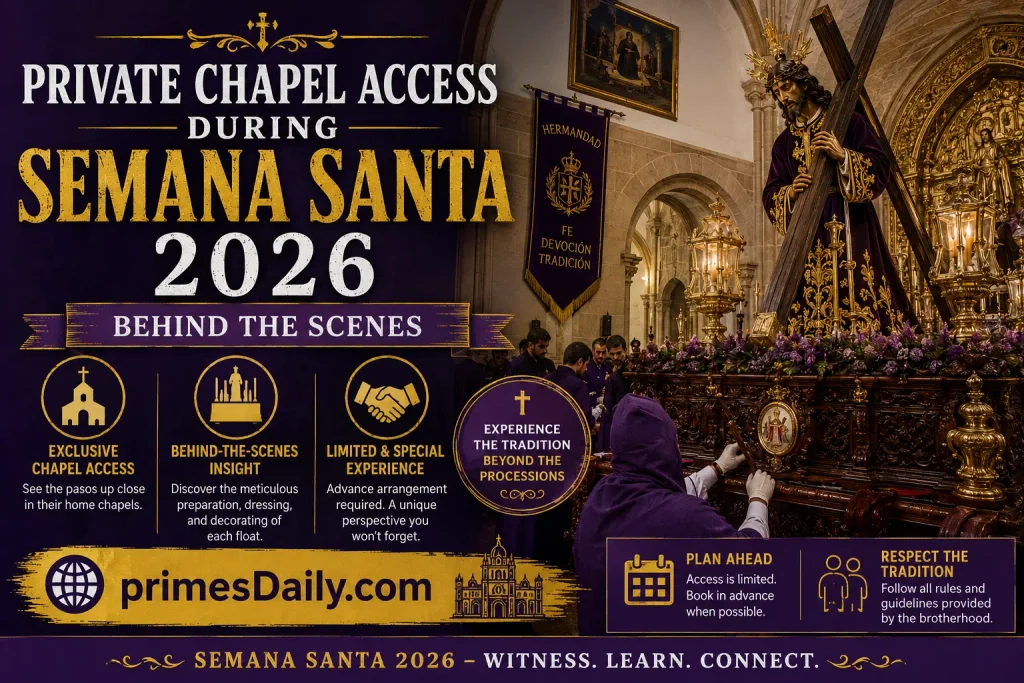
Some brotherhoods and churches offer limited behind-the-scenes access, allowing visitors to see the pasos up close in their home chapels before or after they process, along with insight into the meticulous preparation involved in dressing and decorating each float. This kind of access typically requires advance arrangement and isn’t widely available, but offers a genuinely unique perspective for visitors with particular interest in the craftsmanship involved.
Art Exhibitions During Semana Santa 2026
Several cities host dedicated exhibitions during this period, showcasing historical religious artwork, procession garments, and artifacts related to the week’s traditions. These offer a valuable, quieter complement to the outdoor processions, particularly useful for understanding the historical development of the artistic and religious elements central to the celebrations.
Flamenco Shows and Cultural Events During Semana Santa 2026
Beyond the religious processions themselves, this week coincides with a broader cultural calendar in many cities, including flamenco performances that draw on the same emotional intensity found in the saetas heard during processions. Evening flamenco shows offer a way to further immerse yourself in the region’s cultural traditions during quieter hours between major procession events.
UNESCO World Heritage Sites and Semana Santa 2026
Several of the cities hosting significant Holy Week celebrations, including Toledo and Cuenca, hold UNESCO World Heritage status, meaning the processions unfold against architectural and historical backdrops of exceptional global significance. Combining Holy Week attendance with exploration of these broader historical sites adds substantial value to any visit, particularly for travelers with interest in architecture and history beyond the religious celebrations themselves.
Street Closures and Road Closures During Semana Santa 2026
Detailed, city-specific closure schedules are typically published in advance by local authorities, though these can shift with relatively little notice depending on procession timing and weather. Checking local information sources upon arrival, rather than relying solely on information gathered before your trip, ensures you have the most current details for navigating each day effectively.
Public Holidays and Official Holidays for Semana Santa 2026
Good Friday is a national public holiday throughout Spain, with Maundy Thursday also observed as a holiday in most regions, though specific regional variations exist. This affects banking hours, government services, and some retail operations, so planning any essential errands around these specific dates helps avoid unexpected closures.
Working During Semana Santa 2026: Business Impact in Spain
For business travelers or anyone needing to conduct professional activities during this period, it’s worth understanding that many Spanish businesses operate on reduced schedules or close entirely for at least part of the week, particularly around the Thursday through Sunday stretch. Scheduling any essential meetings or business activities earlier in the week, before the most significant holidays and processions begin, avoids potential complications.
Post-Easter Travel Plans After Semana Santa 2026
Many visitors choose to extend their trip beyond Easter Sunday itself, taking advantage of the days immediately following the week to explore Spain with significantly reduced crowds and often lower accommodation prices, since the intense demand driving up rates during the week itself typically eases considerably once the processions conclude.
Tips from Locals: Experiencing Semana Santa 2026 Authentically
Locals consistently point visitors toward a few pieces of advice that don’t always make it into standard guides. Eat where locals eat, away from the most heavily trafficked squares near major procession routes, for better food at significantly better prices. Attend at least one procession in a smaller, less internationally famous brotherhood, since these often carry deep local significance without the overwhelming crowds surrounding the most famous events.
Take time between processions to simply sit in a quiet plaza and absorb the atmosphere, rather than rushing from one event to the next. Some of the most memorable moments of the week happen in these quieter, unplanned interludes rather than during the processions themselves.
Myths and Misconceptions About Semana Santa 2026
A handful of misconceptions occasionally trip up first-time visitors. The hooded robes worn by penitents, despite superficial visual similarities some visitors might initially notice, have no connection whatsoever to other troubling historical associations found elsewhere in the world; their origin and meaning are entirely distinct and rooted in centuries-old Spanish Catholic tradition of anonymous penance.
Another common misconception assumes the entire week is uniformly somber and heavy throughout. In reality, tone shifts considerably across the seven days, with lighter, more celebratory moments, particularly on Palm Sunday and Easter Sunday, balancing the deeper solemnity found around Good Friday.
Photography Tour Recommendations for Semana Santa 2026
For visitors specifically interested in photography, timing your positioning around the golden hour light of early evening processions, combined with the natural candlelight of later events, offers some of the most rewarding conditions for capturing the atmosphere without needing flash or artificial lighting that might disrupt the solemn mood.
Cultural Sensitivity During Semana Santa 2026 Celebrations
Approaching this week with genuine curiosity and respect, rather than treating it purely as a photo opportunity or entertainment spectacle, enriches the experience considerably for both visitors and the local communities hosting these deeply meaningful traditions. Taking time to understand the history and significance behind what you’re watching, as covered throughout this guide, naturally fosters this kind of respectful engagement.
Children and Semana Santa 2026: Age Appropriate Experiences
Younger children generally handle daytime, lighter processions considerably better than the longer, more intense overnight events. Some of the more solemn imagery, particularly crucifixion scenes and the sight of large crowds in tight spaces, may feel overwhelming for very young children, so gauging your own child’s temperament and adjusting expectations accordingly helps ensure a positive experience for the whole family.
Elderly Travelers at Semana Santa 2026: Accessibility and Comfort
For elderly visitors, prioritizing shorter, daytime processions over demanding overnight events like La Madrugá makes considerable sense. Investing in balcony or paid seating access, where budget allows, removes the physical strain of extended standing while still providing an excellent view of the processions.
Accessible Viewing Options for Semana Santa 2026
Several cities offer designated accessible viewing areas for visitors with mobility limitations, typically providing better sightlines and reduced crowd density compared to general standing areas. Checking with individual city tourism offices upon arrival for current accessible viewing arrangements ensures you have accurate, up-to-date information specific to your destination.
Semana Santa 2026: A Spiritual Journey for Believers
For visitors approaching this week from a place of genuine religious faith, the experience often carries a depth that extends well beyond cultural observation. Many describe the week as a profound opportunity for personal reflection, connecting with centuries of shared religious tradition in a way that feels distinctly different from typical Sunday worship.
Personal Stories: Semana Santa 2026 Visitor Experiences
Visitors consistently describe certain recurring moments as particularly powerful: the sudden silence when a saeta begins, the sight of an elderly local moved to tears watching a procession they’ve followed their entire life, or simply the overwhelming scale of thousands of candles moving slowly through a darkened street. These unplanned, deeply human moments often leave a more lasting impression than the scheduled events themselves.
Environmental Impact of Semana Santa 2026 Celebrations
The sheer scale of visitor numbers during this week does create genuine environmental considerations, from waste management in heavily trafficked areas to the resource demands of accommodating millions of additional visitors within a concentrated timeframe. Many cities have implemented improved waste management and sustainability initiatives in recent years specifically to address these pressures.
Sustainable Tourism During Semana Santa 2026
Visitors can meaningfully reduce their environmental footprint by choosing train travel over car rentals where practical, supporting smaller, locally-owned accommodations and restaurants rather than large international chains, and being mindful of waste, particularly given the sheer volume of visitors concentrated in relatively small historic city centers during this period.
Accommodations Near Public Transportation for Semana Santa 2026
Choosing accommodation with easy access to public transportation, rather than relying entirely on walking or taxis, offers both practical convenience and a more sustainable way to navigate between destinations, particularly if your itinerary includes day trips to smaller towns outside the main city centers.
Park and Ride Options During Semana Santa 2026 in Spain
For visitors who do choose to drive, several cities offer park and ride facilities on the outskirts, allowing you to leave your vehicle outside the restricted historic center and use public transportation for the final stretch into the areas where processions take place, avoiding the parking challenges and restrictions found in city centers during this period.
Last-Minute Tips for Planning Semana Santa 2026
If you’re planning relatively close to the dates themselves, focus on smaller, less internationally famous towns where accommodation availability tends to hold out longer than in Seville or the other headline destinations. Being flexible about specific accommodation type and location, rather than holding out for a specific hotel or neighborhood, significantly improves your chances of finding reasonable options even with limited lead time.
Refunds and Cancellation Policies for Semana Santa 2026 Bookings
Given the weather-related uncertainty that can affect processions, and the general unpredictability that comes with travel planning this far in advance, carefully reviewing cancellation and refund policies before booking accommodation and transportation protects you from significant financial loss if your plans need to change.
Travel Insurance Recommendations for Semana Santa 2026
Given the combination of significant advance financial commitment, particularly for premium accommodation, and the physical demands of the week itself, comprehensive travel insurance covering both trip cancellation and medical needs represents a genuinely worthwhile investment for this specific type of trip.
Passport and Documentation for Semana Santa 2026 Travel
International visitors should verify passport validity requirements well in advance, along with any visa requirements specific to their nationality, ensuring all necessary documentation is confirmed and in order months before travel rather than scrambling at the last minute.
Currency and Money Tips for Semana Santa 2026 in Spain
Spain uses the euro, and while major tourist areas generally accept cards widely, carrying some cash remains useful for smaller, family-run establishments, particularly bakeries and smaller bars in residential neighborhoods that may not always accept cards, along with certain viewing arrangements or informal transactions that sometimes arise around procession events.
ATM Access and Banking During Semana Santa 2026
Given that Good Friday and often Maundy Thursday are official holidays with banks closed, ensure you’ve withdrawn sufficient cash before these specific dates if you anticipate needing it, since ATM access, while generally still available, shouldn’t be relied upon as your only backup given the holiday closures affecting broader banking services.
Pharmacies and Medical Facilities During Semana Santa 2026
Pharmacies throughout Spain maintain a rotating on-call system ensuring at least some remain open even during official holidays, typically posted on pharmacy doors or available through local information services. For more significant medical needs, hospital emergency services remain fully operational throughout the week regardless of holiday schedules.
Emergency Contacts for Semana Santa 2026 Travelers
Spain’s general emergency number, 112, connects to police, medical, and fire services and operates in multiple languages, providing a reliable resource for any serious emergency that might arise during your visit, including situations related to the dense crowds common during major processions.
Return Visits: Experiencing Semana Santa 2026 Multiple Times
Many visitors who experience this week once find themselves drawn back in future years, often specifically to explore different cities or smaller towns after having experienced one of the major destinations initially. Each city and even each specific procession offers a genuinely distinct experience, meaning repeat visits rarely feel redundant.
Volunteer Opportunities During Semana Santa 2026
For visitors interested in deeper cultural immersion, some organizations coordinate volunteer opportunities connected to broader community activities surrounding the week, though direct participation in the religious processions themselves generally remains reserved for local brotherhood members with established family or community connections.
Learning Spanish Before Semana Santa 2026 Trip
While English is reasonably well understood in major tourist areas, even basic Spanish phrases significantly enhance your experience, particularly in smaller towns and when engaging with locals eager to share the history and significance of their specific brotherhood or procession traditions.
Audio Guides and Apps for Semana Santa 2026
Several apps and audio resources have emerged specifically covering procession schedules, brotherhood histories, and practical navigation for major Holy Week cities, offering a convenient way to access real-time information about timing and routes without needing to track down printed schedules throughout your trip.
Comparing Budget vs Luxury Experience for Semana Santa 2026
The range of possible experiences during this week spans enormously, from budget travelers staying in hostels and watching processions from standard street positions, to luxury visitors booking premium balcony suites with private guided tours and reserved seating throughout. Both approaches offer genuine, meaningful access to the core experience, the difference lies primarily in comfort level and proximity rather than the fundamental authenticity of what you’re witnessing.
All-Inclusive Packages for Semana Santa 2026
Some tour operators offer packaged experiences bundling accommodation, guided tours, and premium viewing access into a single booking, which can simplify planning considerably for visitors who prefer not to coordinate every logistical detail independently, though these packages typically come at a meaningful premium compared to independently arranged travel.
Combining Semana Santa 2026 with Beach Vacation
Given the timing coincides with genuinely pleasant spring weather along Spain’s southern and eastern coasts, pairing your Holy Week experience with several additional days at the beach, particularly around Málaga or Valencia, offers a natural way to extend your trip while balancing the intensity of the processions with genuine relaxation.
Wine Tours and Gastronomy During Semana Santa 2026
Andalusia’s renowned sherry region, centered around Jerez, offers an excellent complement to Holy Week travel, particularly given its proximity to both Seville and Cádiz. Combining winery visits with procession viewing provides a natural rhythm of cultural immersion balanced against more relaxed, food and wine focused experiences.
Art and Architecture Tour During Semana Santa 2026
Beyond the processions themselves, the architectural backdrop across nearly every Holy Week destination offers substantial value for visitors with interest in history and design. Combining guided architecture tours with procession viewing deepens understanding of both the physical settings and the historical development of the traditions unfolding within them.
Meeting Locals During Semana Santa 2026
The communal, public nature of this week creates natural opportunities for genuine interaction with local residents, many of whom are eager to share insight into their specific brotherhood, family traditions, or personal connection to the week’s events with curious, respectful visitors.
Email Alerts and Updates for Semana Santa 2026 Events
Given how schedules can shift due to weather or other factors, staying subscribed to local tourism office updates or checking official schedules regularly in the days immediately before and during your trip ensures you have the most current information rather than relying solely on details gathered months in advance.
Official Tourism Board Information for Semana Santa 2026
Local tourism offices in each city maintain the most current, accurate information regarding procession schedules, route changes, and any weather-related adjustments, making them a valuable resource to check upon arrival even after thorough advance planning.
Semana Santa 2026 vs Other Religious Festivals: A Comparison
Compared to other major religious festivals globally, this week stands out for its combination of public, street-level accessibility and profound artistic and historical depth. Unlike festivals centered primarily around a single day or a contained indoor ceremony, this celebration unfolds continuously across an entire week, with each day offering distinct events and evolving emotional tone.
Colonial Cities and Semana Santa 2026 in Latin America
The Spanish colonial influence across Latin America produced Holy Week traditions that, while rooted in the same religious origins found in Spain, evolved distinctly through the blending of Spanish Catholic practice with local indigenous cultures, resulting in celebrations that feel both familiar and genuinely unique compared to their Spanish counterparts.
Indigenous Traditions Mixed with Semana Santa 2026
In several Latin American destinations, indigenous artistic and cultural elements have become deeply woven into Holy Week celebrations over centuries, creating distinctive regional variations found nowhere else, reflecting the complex cultural history of these communities rather than simply replicating Spanish traditions unchanged.
Popayán Semana Santa 2026: Colombia’s White Processions
Popayán’s UNESCO-recognized celebrations maintain a notably more restrained, community-focused character compared to some of the larger, more internationally famous destinations, with the city’s distinctive white colonial architecture providing an elegant, understated backdrop to processions that have taken place largely unchanged for centuries.
Antigua Semana Santa 2026: Guatemala’s Flower Carpets (Alfombras)
The elaborate flower and sawdust carpets created throughout Antigua represent one of the most visually extraordinary traditions found anywhere connected to Holy Week celebrations, transforming entire streets into temporary works of art through countless hours of community labor, only to be respectfully walked over and destroyed as processions pass, a poignant reflection of impermanence woven directly into the tradition itself.
Other Latin American Semana Santa 2026 Celebrations
Beyond Guatemala and Colombia, countries throughout Latin America maintain their own distinctive Holy Week traditions, from Ecuador’s elaborate Good Friday processions to various Mexican regional celebrations, each reflecting the particular blend of Spanish colonial and local indigenous influence found in that specific area.
Best Budget Airline Deals for Semana Santa 2026 Spain
For budget-conscious travelers, several low-cost carriers operate routes into Spain’s major cities, though availability and pricing during this specific week require earlier booking than typical off-season travel, given the significant demand spike this period generates across both domestic and international routes.
Hotel Loyalty Programs for Semana Santa 2026 Bookings
Travelers with existing hotel loyalty program memberships may find value in checking point redemption options for this period, though be aware that award availability at popular properties often disappears even faster than standard paid bookings given the overall demand during this week.
Early Bird Discounts for Semana Santa 2026
Some hotels and tour operators offer meaningful early booking discounts for reservations made significantly in advance, sometimes six months or more ahead of the actual dates, rewarding travelers willing to commit to their plans well before the peak booking rush begins.
Last-Minute Deals During Semana Santa 2026
While rare given the overall demand, occasional last-minute cancellations do create opportunities for flexible travelers willing to monitor availability closely in the weeks immediately before the events, though relying on this approach carries genuine risk given how consistently this period sells out across most accommodation categories.
Flexibility in Plans During Semana Santa 2026
Building genuine flexibility into your itinerary, rather than rigidly planning every hour, allows you to adapt to weather changes, unexpected schedule shifts, or simply the discovery of an unplanned, meaningful moment worth lingering over rather than rushing past to stick to a predetermined schedule.
Recording Videos Respectfully During Semana Santa 2026
Video recording follows similar etiquette principles to photography, avoiding disruptive behavior, respecting the solemnity of particularly significant moments, and being mindful of blocking others’ views for extended periods while capturing footage.
Social Media Etiquette During Semana Santa 2026
When sharing your experience on social media, providing context about the religious and cultural significance behind what you’re posting helps foster genuine understanding among your audience, rather than presenting the deeply meaningful traditions you’ve witnessed as simply an exotic spectacle disconnected from their actual significance.
Documenting Your Semana Santa 2026 Experience Responsibly
Keeping a written journal alongside photos and videos often captures dimensions of the experience that visual media alone misses, particularly the emotional and sensory details, the specific smell of incense in a certain street, the sound of a distant saeta, that tend to fade from memory faster than visual impressions.
Pre-Trip Preparations for Semana Santa 2026
Beyond logistical bookings, taking time before your trip to understand the basic history and symbolism covered throughout this guide meaningfully enhances your ability to appreciate what you’re witnessing once you arrive, transforming passive observation into genuine, informed engagement with centuries of tradition.
Visa Requirements for Semana Santa 2026 Spain Travel
Visa requirements vary significantly based on your nationality, and international visitors should verify current requirements well in advance of travel, since processing times for any required visas can extend several weeks or longer depending on your country of origin and current embassy processing volumes.
Health Protocols for Semana Santa 2026
Standard travel health precautions apply for this trip, and given the crowded conditions inherent to major processions, staying current on routine vaccinations and considering standard travel health precautions like comprehensive travel insurance remains sensible preparation for any international trip of this scale.
Travel Advisories for Semana Santa 2026 Destinations
Checking current official travel advisories for Spain and any Latin American destinations you’re considering, in the weeks immediately before departure, ensures you have the most current safety and logistical information available specific to your planned itinerary.
Semana Santa 2026: Creating Lasting Memories
The combination of centuries-old tradition, genuine community devotion, and overwhelming sensory experience creates memories that tend to last considerably longer and feel more profound than typical tourist experiences, precisely because what you’re witnessing carries such deep, authentic meaning for the communities hosting these celebrations.
Bringing Home Souvenirs from Semana Santa 2026
Beyond typical tourist souvenirs, consider seeking out items with genuine connection to the traditions you’ve witnessed, small devotional items, local religious artwork, or regional foods like the ingredients for making torrijas at home, offering a more meaningful way to carry the experience forward than generic mass-produced trinkets.
Post-Trip Reflections After Semana Santa 2026
Many visitors find themselves processing the emotional weight of what they’ve witnessed for weeks or even months after returning home, a testament to just how genuinely moving and distinct this experience proves compared to typical travel. Giving yourself space to reflect, rather than immediately rushing back into ordinary routine, honors the significance of what you’ve experienced.
Sharing Your Semana Santa 2026 Story
Whether through conversations with friends and family, written reflections, or simply carrying the memory privately, sharing your experience thoughtfully, with genuine understanding of its cultural and religious significance rather than reducing it to simple spectacle, honors both your own experience and the traditions of the communities who welcomed you into witnessing something genuinely sacred to them.
FAQs
When exactly does Semana Santa 2026 start and end? It runs from Palm Sunday, March 29, through Easter Sunday, April 5, 2026.
Which city has the biggest celebration? Seville hosts the largest and most internationally recognized Holy Week celebration, with over seventy participating brotherhoods.
Do I need tickets to watch processions? No, processions take place on public streets and are free to watch, though premium balcony or reserved seating options exist for an additional cost.
Is it safe to attend with children? Yes, particularly for lighter daytime processions, though the longer overnight events are generally more suitable for older children and adults.
How early should I book my hotel? Four to six months in advance is recommended for major cities like Seville, with even earlier booking needed for premium balcony locations.
What should I wear? Comfortable walking shoes are essential, along with layers, since evenings turn noticeably cooler than daytime temperatures.
Can I take photos during processions? Yes, photography is generally welcomed, though avoid flash directly at participants and be mindful of blocking others’ views.
What is La Madrugá? It’s Seville’s most famous overnight procession, running from Thursday night into Friday morning, featuring some of the city’s most historically significant brotherhoods.
Is Semana Santa only in Spain? No, Latin American countries including Guatemala and Colombia host equally significant, though distinctly different, celebrations shaped by their own colonial and indigenous histories.
What are pasos? These are the elaborate wooden floats, often over a thousand kilograms, carried by hidden bearers called costaleros, depicting scenes from Christ’s Passion or the Virgin Mary.
What is a saeta? An unaccompanied flamenco song, sung spontaneously from a balcony or the crowd as a procession passes, often stopping the entire procession in respectful silence.
Why do penitents wear pointed hoods? The capirote tradition dates back centuries and was designed to allow penitents to perform acts of devotion anonymously, without personal recognition or pride.
Is it appropriate for non-religious visitors to attend? Yes, the majority of spectators each year have no direct religious connection, though showing respect during solemn moments is appreciated.
What is the best alternative to crowded Seville? Zamora offers similarly moving, candlelit processions with significantly smaller crowds and lower costs.
How much does a typical trip cost? Budgets range from roughly six hundred dollars for a bare-bones approach up to two thousand dollars or more for comfortable accommodation in major cities.
Are processions canceled if it rains? Yes, rain frequently causes processions to be altered, delayed, or canceled entirely to protect the irreplaceable religious artwork carried on each paso.
What food should I try during this week? Torrijas, a cinnamon-spiced version of French toast, is the signature seasonal treat found throughout Spain during this period.
Can I drive between cities during this week? Trains are strongly recommended over driving, since road closures and traffic disruptions around processions are extensive and unpredictable.
What is the significance of Good Friday processions? Good Friday commemorates the crucifixion and typically features the week’s most solemn, dramatically staged processions across nearly every Spanish city.
Is there an official dress code? There’s no strict dress code for spectators, though modest dress is appreciated, particularly if entering churches along procession routes.
What emergency number should I know while traveling in Spain? 112 connects to police, medical, and fire services and operates in multiple languages throughout the country.
How do costaleros carry such heavy floats? They use a specially designed neck cushion called a costal, walking in coordinated unison beneath the float’s fabric skirts, guided by a leader who signals movements with a small hammer.
What’s the difference between Seville and Granada’s celebrations? Seville offers larger scale and more brotherhoods overall, while Granada offers a unique cultural blend through its Sacromonte procession and Moorish heritage, generally at lower cost.
Should I visit during Holy Week or avoid it due to crowds? If you want the full, authentic experience, the crowds are genuinely part of what makes this week extraordinary, though visitors seeking a quieter alternative should consider smaller towns like Zamora or Cuenca instead.
Conclusion
Few travel experiences carry the depth, history, and raw emotional power found across Spain’s Holy Week. Whether you find yourself standing in Seville’s overwhelming crowds during La Madrugá, watching candlelight flicker through Zamora’s silent streets, or witnessing the extraordinary flower carpets of Antigua, you’re not simply observing a tourist attraction. You’re bearing witness to centuries of unbroken tradition, community devotion, and artistic achievement that continues to move both believers and curious visitors alike, year after year.
Planning carefully, booking early, choosing the right city or cities for your particular interests, and approaching the week with genuine curiosity and respect will ensure your experience matches the extraordinary reputation this tradition has earned. March 29 through April 5, 2026 marks another chapter in a story that’s been unfolding on Spain’s streets for centuries, and now you have everything you need to become part of it.
For the latest, updated, and unique information, visit Short Narrative Writing Prompts.