

Baby breath flowers have been gracing gardens, weddings, and homes for generations, yet most people never stop to wonder about the fascinating story behind these tiny, delicate blooms. Whether you’re standing in front of a wedding venue imagining your ceremony, tending to your garden looking for the perfect addition, or admiring a dried arrangement on your bookshelf, baby breath flowers add elegance to countless moments in our lives without us even realizing it.
Here’s the truth: there’s a massive knowledge gap about these flowers. Most people know them only as that background filler in fancy bouquets, tucked discreetly behind roses and peonies. But florists, gardeners, and event planners understand something different entirely. They know baby breath flowers are affordable, incredibly durable, stunningly beautiful, and surprisingly easy to grow. They work equally well in a beginner’s first garden and in professional floral arrangements prepared by master florists. They last longer than most flowers when dried, making them perfect for permanent décor that never fades. And they come in far more colors than most people realize—from traditional white to blush pink, bold coral, and even jewel tones created through modern tinting techniques.
This comprehensive guide exists because you deserve complete, honest information about one of nature’s most underrated flowers. We’re going to walk you through every aspect—from understanding what makes them special, to growing them from tiny seeds, to using them in creative ways that transform your space. By the end, you’ll understand why florists have relied on these flowers for over a century, and how you can use them in your own life in ways you never imagined possible. Whether you’re planning a wedding, creating a sustainable garden, or simply looking for beautiful, affordable flowers that actually last, baby breath flowers are the answer you’ve been searching for.
What Are Baby Breath Flowers?
At their core, baby’s breath belongs to the genus Gypsophila, which comes from Greek words meaning “lover of chalk,” referring to their preferred alkaline soil conditions. The most commonly grown variety is Gypsophila paniculata, also known as perennial baby’s breath or common baby’s breath.
Here’s what you need to picture: imagine a delicate plant reaching anywhere from one to three feet tall, with thin, wiry stems that branch profusely, each stem covered in thousands of tiny, star-shaped flowers. Each individual bloom has just five petals, but because they grow in such overwhelming abundance, they create a spectacular cloud-like effect that seems to float above the ground. The leaves are small and needle-like, almost appearing grass-like, which gives the entire plant an airy, ethereal quality.
The real magic lies in the abundance. A single mature plant can produce literally thousands of tiny blooms throughout its growing season. This is why florists and gardeners love them so much—you get maximum visual impact with minimal plant material. One single stem of these flowers can easily fill out an entire arrangement or add volume to a bouquet that might otherwise look sparse.
How did this flower become so famous? The rise to popularity happened gradually over decades. In the Victorian era, when flower language became fashionable among the wealthy, the delicate nature of this plant made it perfect for conveying gentle, romantic messages. By the twentieth century, commercial flower production recognized their tremendous value as a filler flower that could make any bouquet look fuller and more professional without adding significant cost. Today, they’re so standard in the floral industry that you’ll find them in virtually every professional florist’s refrigerated cooler, available year-round.
Are there different types to choose from? Absolutely, yes. While Gypsophila paniculata is the perennial standard that most people recognize, there’s also Gypsophila elegans, an annual variety that grows faster and blooms quicker than its perennial cousin. The annual types are perfect if you want results in a single season without waiting. There are also many cultivars developed specifically for the commercial cut flower market, with different stem lengths, bloom densities, and flower sizes. Some varieties produce larger, more prominent flowers, while others create those perfect delicate clouds of microscopic blooms.
Baby Breath Flowers Meaning & Symbolism
Why do flowers need meaning? For centuries, flowers have been our silent language. When words fail us or emotions run too deep for speech, flowers speak in their own universal language. Baby’s breath carries profound symbolism that transcends different cultures and centuries, making it far more than just a decorative element in arrangements.
The primary meaning is everlasting love. This is the most recognized symbolism, which is why you see it in virtually every wedding bouquet around the world. The message is simple but profoundly powerful—the delicate flowers, which can last for months when dried, represent love that endures beyond time and circumstance. It’s not passionate, aggressive love; it’s gentle, steady, and enduring love. This makes it perfect for weddings, anniversaries, and romantic gestures that emphasize commitment and longevity.
Secondary meanings you should know about include purity and innocence, largely because of its white color and delicate appearance. In Victorian times, giving someone these flowers was a way of saying, “You have everlasting love and devotion from me,” often expressing pure, spiritual affection rather than romantic love. This is why you’ll see it in sympathy arrangements and memorial flowers—it conveys respect and honor for someone who has passed.
The flower also represents happiness and gratitude in different contexts. When someone gives you flowers that include these delicate blooms, they’re essentially saying, “I’m grateful for you,” or “Your presence makes me happy.” This meaning works well for thank-you bouquets, congratulations arrangements, and celebrations of joy and achievement.
How does color change the meaning? White varieties carry all the traditional meanings we’ve discussed—everlasting love, purity, and grace. Pink varieties, however, add a layer of femininity and charm, making them perfect for baby showers, Mother’s Day celebrations, and other joyful events. Colored varieties created through tinting or drying processes are more contemporary and can carry whatever meaning you assign to them—they’re less bound by traditional symbolism and more open to personal interpretation.
Why does understanding meaning matter for your flower choices? This understanding helps you choose the right flowers for the right occasions. If you’re expressing sympathy for someone’s loss, these flowers’ meaning of everlasting love and purity is absolutely perfect. If you’re celebrating a joyful event, they add grace without overshadowing the occasion. If you’re gardening purely for beauty, the symbolism adds another layer of appreciation and connection for what you’re growing.
Types of Baby Breath Flowers
How many varieties actually exist? This might genuinely surprise you: there are dozens of cultivated varieties of Gypsophila, each one bred for specific purposes and growing conditions. Let’s break down the main types you’ll encounter in gardens, flower shops, and online.
Perennial Varieties:
Gypsophila paniculata remains the gold standard and most popular choice. It lives for several years, typically growing quite large (three to four feet tall in mature specimens), and produces abundant small white flowers throughout its growing season. If you’re planting these flowers in a garden with the intention of them returning year after year, this is your best choice. It’s drought-resistant once established, deer-resistant, and relatively low-maintenance once it gets going. However, it requires full sun and absolutely demands well-drained soil. It also takes a full season to really establish itself, so patience during the first year is necessary.
Gypsophila repens is a dwarf perennial variety, perfect for borders and small gardens where space is limited. It stays under a foot tall and creates beautiful white or pink flowers throughout the season. While it doesn’t produce the volume of blooms that the standard variety does, it’s perfect for creating groundcover or using in rock gardens and alpine areas.
Gypsophila muralis is another compact perennial option, similar to repens but with slightly different growing requirements. It’s excellent for containers and raised beds where height restrictions exist.
Annual Varieties:
Gypsophila elegans is the annual option—it grows quickly, blooms within just weeks of planting, and produces abundant flowers ideal for cutting. If you want these flowers but don’t want to wait a full season for establishment, this is perfect. It’s also ideal for those in colder climates where perennials might struggle to survive winter, or for people who like to rotate their flower beds annually for variety.
Cultivated Cut-Flower Varieties:
Beyond species classification, there are numerous cultivars bred specifically for the commercial flower industry. These have become industry standards over decades of selection:
Bristol Fairy is perhaps the most famous cultivar ever created, producing pure white, double flowers (flowers with extra petals for extraordinary fullness). It’s the classic choice for weddings and commercial arrangements globally.
Covent Garden is another popular double-flowered white variety, with slightly larger flowers than Bristol Fairy, creating a bolder look.
Million Stars is a variety that produces an exceptionally dense cloud of tiny flowers, perfect for that ultra-fluffy, romantic look people love.
Flamingo is a pink double-flowered variety that brings romance and femininity to arrangements with its blushing color.
Coral Pink is a warmer pink shade perfect for contemporary arrangements and modern wedding aesthetics.
Colored varieties are increasingly available—blue, purple, yellow, and red versions exist, all created through special drying or tinting processes to provide florists and gardeners with more color options than nature originally offered.
Which type should you choose? For a permanent garden feature that returns year after year, choose a perennial variety like Gypsophila paniculata. For quick results in a single season without waiting, choose Gypsophila elegans (annual). For wedding or professional arrangements where you need specific qualities, look for cultivated varieties like Bristol Fairy or Million Stars. For dried flowers and long-term arrangements that need to last years, any variety works, but white varieties hold color best over time.
Characteristics of Baby Breath Flowers
What exactly are you getting when you choose these flowers for your garden or arrangements? Understanding the specific characteristics helps you make better decisions about how to use them.
Physical Characteristics:
The plant reaches anywhere from twelve inches (dwarf varieties) to four feet (full-size perennials in ideal conditions). The stems are thin and wiry, branching profusely, creating that signature cloud effect. The leaves are needle-like and minimal, which means the plant stays relatively airy even when completely full of blooms. The flowers themselves are tiny—usually about one-eighth to one-quarter inch across—with simple five-petal configurations. Each plant can produce literally thousands of flowers during peak bloom season, creating an almost overwhelming abundance.
Growth Characteristics:
These flowers are cool-season plants, meaning they actually prefer temperatures between sixty and seventy degrees Fahrenheit and may struggle noticeably in intense heat. They’re remarkably drought-tolerant once established, making them perfect for low-water gardens and xeriscaping projects. They thrive in full sun (at least six hours daily) and absolutely require excellent drainage—wet soil will damage or kill them faster than almost anything else.
Durability Characteristics:
This is where these flowers truly shine compared to other delicate-looking blooms. Fresh-cut stems can last two to three weeks in water, which is longer than most wedding flowers like tulips or lilies. When dried properly, they can last for years without fading significantly or deteriorating. They’re not as delicate as they appear—they handle transport, arrangement, and rearrangement quite well. They’re also relatively resistant to common flower diseases and pests that plague other ornamentals.
Seasonal Characteristics:
These flowers bloom from late spring through fall in most climates. The peak bloom period is usually June through August in northern regions. After blooming finishes, cutting the plant back can encourage additional blooms in fall. In harsh winters, perennial varieties will go completely dormant but return in spring with renewed vigor.
Availability Characteristics:
Because of their popularity, they’re available year-round commercially, though peak availability is during wedding season (late spring through early fall) and around Valentine’s Day. Garden centers typically stock seeds and plants in spring when most gardeners are planning their gardens.
What Do Baby Breath Flowers Look and Smell Like?
The Visual Experience:
When you first encounter these flowers in person, the most striking feature is the overwhelming sense of delicate beauty. Imagine looking at a cloud that’s somehow become a living plant. The tiny white (or pink, or colored) flowers are so numerous and so small that your eye doesn’t process individual blooms—instead, you see an overall textured cloud effect. It’s ethereal, romantic, and genuinely beautiful. There’s a reason it’s been the default choice for weddings for over a century; it simply creates an elegant, romantic atmosphere that few other flowers can match.
The individual flowers, when you look closely with magnification, are perfectly symmetrical five-petal stars. The individual petals are soft and delicate, slightly translucent at the edges. The stems are visible through the flowers, creating a sense of lightness and airiness. In pink varieties, you get the same structure but with a warm, feminine tone. In colored varieties created through tinting or drying, the colors can be quite vibrant while maintaining that delicate appearance.
The Sensory Experience—Smell:
Here’s something that genuinely surprises many people: these flowers have virtually no noticeable fragrance. While some varieties have a very subtle, barely perceptible scent, most people smell nothing at all. This isn’t a disadvantage—many florists actually prefer this characteristic because it means the flowers won’t compete with the fragrance of other flowers in an arrangement, and it won’t trigger fragrance sensitivities in people with allergies. If you’re sensitive to flower scents or prefer arrangements without strong fragrance, these flowers are perfect.
The Tactile Experience:
The flowers feel surprisingly delicate but resilient in your hands. The petals are thin and papery, the stems are thin but surprisingly strong, and the leaves are fine and needle-like. Despite their fragile appearance, they’re remarkably durable for such delicate-looking flowers. You can handle them, move them around in arrangements, and even transport them without them falling apart.
Visual Variations Worth Understanding:
White varieties create a pure, classic, elegant look. It’s timeless and works with virtually every color scheme and theme. Pink varieties range from pale blush to deep coral. Pale pink creates a romantic, subtle look, while coral pink is more contemporary and bold. Colored varieties (blue, purple, yellow, red) are tinted or dyed, creating modern, trendy looks. These work well in contemporary arrangements and add personality to designs.
Dried versions take on a slightly cream or ivory tone, becoming even more delicate-looking as moisture leaves the petals. They maintain their beauty for years without significant fading.
How to Grow Baby Breath Flowers From Seed
Why start from seed? Growing from seed is significantly cheaper than buying plants, gives you full control over the growing process, and comes with a deep sense of accomplishment. A tiny seed packet costs just a few dollars but can produce dozens of thriving plants.
Understanding the Seeds:
These seeds are incredibly tiny—almost dust-like. A single seed packet contains hundreds or even thousands of seeds. Despite their size, they have excellent germination rates (usually seventy to eighty percent), meaning most seeds you plant will actually grow.
Timing Matters:
For best results, start seeds indoors six to eight weeks before your last spring frost date. In most US regions, this means late March through April. You can also direct seed outdoors after the last frost, but indoor starting gives you a significant head start on the season and more reliable germination.
Step-by-Step Indoor Seed Starting:
Gather your supplies first. You’ll need seed-starting mix (not garden soil—use a sterile, lightweight mix), seed trays or pots with drainage holes, a warm spot (ideally seventy degrees Fahrenheit), fluorescent lights or a sunny window, and a spray bottle for misting.
Prepare your soil by filling seed trays with seed-starting mix and moistening it thoroughly. The soil should be damp but not soggy.
Sow the seeds properly—this step is crucial. These seeds need light to germinate. Simply sprinkle the seeds on top of the soil and press them gently into place. Do NOT cover them with soil. This is different from most seeds, so don’t forget this critical step. The light exposure is absolutely essential for successful germination.
Mist and cover by gently misting the seeds with water using a spray bottle. You can cover the tray with a humidity dome or plastic wrap to maintain moisture while keeping it ventilated.
Provide warmth and light by keeping the soil consistently moist (not wet) and maintaining temperatures around seventy degrees Fahrenheit. Provide bright light from day one—fluorescent lights placed four to six inches above the seeds work well, or a sunny south-facing window.
Watch for germination, which typically occurs within seven to fourteen days. Once you see sprouts emerging, remove any covering and ensure they continue to receive plenty of light (fourteen to sixteen hours daily).
Thin seedlings once they develop their first true leaves. Thin them out so each plant has about two to three inches of space. This prevents them from becoming leggy and weak.
Harden off your seedlings about two weeks before your transplant date. Place them outdoors in a sheltered spot for a few hours daily, gradually increasing exposure over seven to ten days.
Transplant seedlings once all danger of frost has passed and they’re about two inches tall. Transplant them into the garden, spacing them twelve to eighteen inches apart. Water thoroughly after planting.
Direct Seeding Outdoors:
If you prefer to skip the indoor steps, you can direct seed outdoors after your last frost date. Simply prepare the soil, sprinkle seeds on the surface (remember—light is needed for germination), press them gently into the soil, and keep the area consistently moist until germination occurs. This method is less controlled but requires no indoor equipment.
Timeline to Blooms:
Annual varieties (Gypsophila elegans) can produce flowers within six to eight weeks of sowing. Perennial varieties take longer—they focus on root development the first year and may not bloom prolifically until year two. This patience is worth it since perennial varieties will return every year.
Best Time to Plant Baby Breath Flowers
When is the perfect planting window? Timing is absolutely essential for successful cultivation of these flowers.
Spring Planting (Most Common):
Late spring (after the last frost date in your area) is the ideal time to transplant seedlings or young plants into your garden. Your last spring frost date varies significantly depending on your location. If you’re in the northern United States, this might be late May or early June. In southern regions, it could be late March or April. Check your local frost date—this single piece of information is crucial for gardening success.
Spring planting gives your plants the maximum growing season to establish strong root systems before winter arrives. This is especially important for perennial varieties, which need the entire growing season to build reserves for winter survival.
Fall Planting (Secondary Option):
In regions with mild winters (USDA zones seven and warmer), you can also plant these flowers in fall (September through November). This gives them time to establish before extreme heat arrives in summer. However, in colder regions, fall planting may not give them enough time to establish before winter stress and freezing temperatures.
What to Avoid:
Avoid planting in hot summer months. The stress of transplanting combined with intense heat can overwhelm young plants. Similarly, avoid fall planting in cold regions where winter will arrive before plants establish properly.
Regional Considerations:
In the northern United States (zones three to five), plant in late spring after frost danger passes. Plants will bloom that summer, go dormant in winter, and return stronger the next year.
In the middle United States (zones five to seven), you have more flexibility. Late spring is still ideal, but fall planting (August-September) can also work well.
In the southern United States (zones eight to ten), spring planting (February-March) is ideal. You might also succeed with fall planting, but summer heat can be challenging.
In very warm regions (zones ten to eleven), these flowers struggle with intense heat. Consider treating them as annuals or growing them in partial shade to reduce heat stress.
Moisture Timing:
Regardless of your region, ensure that whenever you plant, the soil isn’t overly wet. Planting into waterlogged soil dramatically increases the risk of root rot and fungal diseases. If your area has heavy rains scheduled, wait a few days for the soil to drain before planting.
How to Plant Baby Breath Flowers
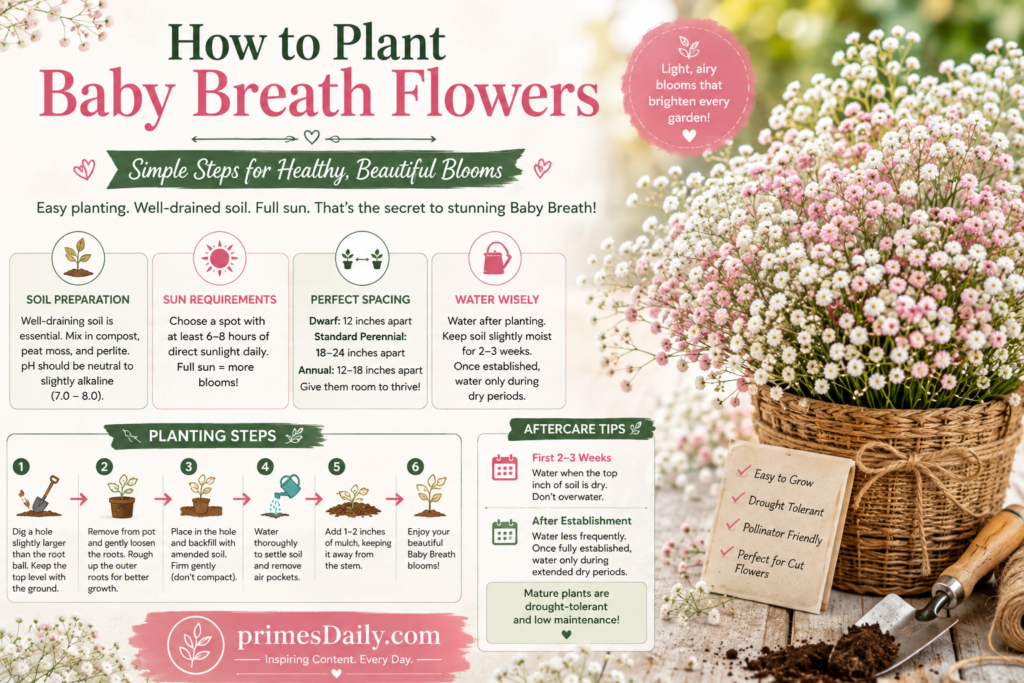
The actual planting process is simpler than you might think, but specific details matter greatly for success.
Soil Preparation—The Foundation of Success:
These flowers are extraordinarily particular about soil drainage. This is the single most important factor in growing healthy plants. Here’s what you need to do:
Test your soil drainage first. Dig a hole about twelve inches deep and fill it with water. If the water drains within a few hours, you have good drainage. If it’s still sitting there after twenty-four hours, you need to amend your soil significantly.
Create a raised bed or mound if your soil has poor drainage. These flowers won’t tolerate “wet feet” (soil that stays wet). Building a raised bed even just six to twelve inches high can transform impossible drainage into perfect drainage.
Amend heavy clay soils with compost, peat moss, and perlite or coarse sand. Aim for a mix that’s roughly fifty percent original soil and fifty percent amendments. The goal is creating a light, airy soil that drains quickly.
Test the pH if possible. These flowers prefer neutral to slightly alkaline soil (pH seven point zero to eight point zero). If your soil is acidic (below seven point zero), add lime according to soil test recommendations. While they’ll tolerate slightly acidic soil, they perform best in neutral to alkaline conditions.
Sun Requirements:
Full sun is non-negotiable for healthy growth. These flowers need at least six hours of direct sunlight daily, ideally eight or more hours. In partial shade, plants become weak, leggy, and bloom sparsely. Choose a location where sunlight isn’t blocked by buildings or trees during the growing season.
Spacing:
Dwarf varieties need spacing of twelve inches apart.
Standard perennial varieties need spacing of eighteen to twenty-four inches apart.
Annual varieties need spacing of twelve to eighteen inches apart.
Don’t crowd them. Overcrowding reduces air circulation, increasing disease risk, and leads to weaker plants that must compete for nutrients and light.
Planting Steps:
Dig a hole slightly larger than your plant’s root ball. The hole should be deep enough that the top of the root ball is level with the ground surface. Plant too deep and you risk rot; plant too shallow and roots dry out.
Remove the plant from its pot and gently loosen the root ball. Rough up the outer roots with your fingers to encourage outward growth.
Place the plant in the hole and backfill with your amended soil, pressing gently as you fill. Avoid compacting the soil—it should be loose enough for roots to penetrate easily.
Water thoroughly after planting. This settles the soil and eliminates air pockets around the roots.
Add one to two inches of mulch around the base, keeping it a few inches away from the stem. Mulch helps retain moisture while you’re establishing the plant, but these flowers don’t need mulch once established (which is fine—they’re quite drought-tolerant).
Immediate Aftercare:
For the first two to three weeks after planting, water when the top inch of soil feels dry. Don’t overwater, but don’t let them dry completely either. This establishment period is critical.
After establishment (usually three to four weeks), water less frequently. Once fully established (usually by late summer of the first year), water only during extended dry periods. Mature plants are quite drought-tolerant.
Starting Baby Breath Flowers Indoors
Why start indoors when you could direct seed? Starting indoors gives you more control, faster blooms, and a significant head start on the growing season.
The Indoor Advantage:
When you start seeds indoors, you skip the most challenging part of seed germination—protecting tiny seeds from outdoor elements like rain, wind, and wildlife. You control moisture, temperature, light, and pests. By the time seedlings go outside, they’re robust little plants rather than vulnerable seeds.
Seed Starting Setup:
Containers can be seed trays with drainage holes, small pots, or recycled containers (yogurt cups, egg cartons) with drainage holes drilled in the bottom. Seeds don’t need deep containers—two to three inches is sufficient for starting.
Use seed-starting mix, not garden soil. Garden soil compacts and doesn’t drain well for seeds. Seed-starting mix is light, sterile, and specifically formulated for germination. It’s worth the investment.
Seeds need bright light from germination onward. A sunny south-facing window works, but fluorescent shop lights (available at any hardware store for fifteen to thirty dollars) are more reliable and consistent. Position lights four to six inches above seedlings and keep them on for fourteen to sixteen hours daily.
Keep soil around seventy degrees Fahrenheit for best germination. A heated seed mat (optional but helpful) can improve germination rates from seventy percent to eighty-five percent or higher. Even without a heat mat, most homes are warm enough indoors.
Moisture is critical. The soil should be consistently moist but never waterlogged. Use a spray bottle rather than pouring water, which can displace seeds. Check moisture daily.
The Day-by-Day Process:
Days one to seven: Sow seeds on top of moist soil, press gently (don’t bury), mist with water, and cover lightly with humidity dome or plastic wrap. Check moisture daily and mist if needed.
Days seven to fourteen: Watch for germination. Once sprouts appear, remove any covering and provide bright light immediately.
Days fourteen to twenty-eight: Maintain moisture, ensure plenty of light (fourteen to sixteen hours daily), and maintain sixty-five to seventy-five degree Fahrenheit temperatures. Seedlings will quickly develop true leaves.
Days twenty-eight to forty-two: Thin seedlings so each has two to three inches of space. This prevents weak, leggy growth. Begin reducing watering frequency slightly—roots need some oxygen, not constant moisture.
Days forty-two to fifty-six: Continue growing under lights, gradually lowering light intensity slightly. Begin fertilizing weekly with diluted (half-strength) balanced fertilizer. This stage prepares them for outdoor planting.
Hardening Off (Critical Step):
When seedlings reach two to three inches tall and outdoor temperatures consistently stay above fifty degrees Fahrenheit, begin hardening off. This gradual acclimation prevents transplant shock.
Week one: Place seedlings in a sheltered outdoor spot (against a wall, under a porch) for two to three hours daily. Bring them back inside.
Week two: Gradually increase outdoor time to four to six hours daily. Still in a sheltered location.
Week three: Leave them outside during the day but bring inside at night.
Week four: If nighttime temperatures stay above fifty degrees Fahrenheit, leave outside overnight. This is a major hardening step, so monitor the forecast.
After hardening off: Your seedlings are ready for transplanting into the garden.
Common Indoor Starting Problems and Solutions:
Leggy seedlings (tall and weak) result from too little light or inconsistent light direction. Move lights closer or provide more hours of light daily.
Damping off (seedlings collapse at the base) is a fungal issue from excessive moisture. Reduce watering, improve air circulation with a small fan, and ensure well-draining soil.
Slow germination may need warmth. Try a heat mat or move to a warmer location.
Failure to germinate usually results from burying seeds (remember, they need light). Check that you’re not covering them.
Direct Seeding Baby Breath Flowers Outdoors
Prefer to skip the indoor step? Direct seeding works—it’s just slower and less controlled.
When to Direct Seed:
Wait until after your last spring frost date. Planting too early into cold soil results in seed rot. Wait until the soil has warmed up—ideally at least fifty to sixty degrees Fahrenheit. In most regions, this means late April through May.
Soil Preparation:
Same as transplanting preparation: excellent drainage, full sun, and loose, airy soil. The better your soil preparation, the higher your germination rates will be.
Sowing Process:
Loosen the top two to three inches of soil where you’ll be planting. Remove any large clods and weeds.
Scatter seeds directly on the soil surface. You can sow a bit thickly since not every seed will germinate. If you prefer precision, space seeds about two to three inches apart.
Press seeds gently into the soil so they have good contact with soil moisture. Do not bury them.
Mist the area gently with water. The soil should be moist but not waterlogged.
Keep soil consistently moist for two to three weeks until germination occurs. This means checking daily and misting if the surface dries out.
Once seedlings emerge, gradually reduce watering frequency as they establish.
Timeline:
Germination occurs within seven to fourteen days.
First true leaves appear within two to three weeks.
Thinning time is when seedlings are one to two inches tall. Thin to twelve to eighteen inches apart depending on variety.
First blooms appear within six to eight weeks for annual varieties. Perennials may not bloom prolifically until the second year.
Advantages of Direct Seeding:
No indoor equipment needed
No hardening off required
Less labor overall
Lower cost per plant
Seedlings are adapted to your specific outdoor conditions from the start
Disadvantages:
Less control over germination conditions
Higher seed loss (birds, weather, inconsistent moisture)
Slower to blooms
Weeds can overwhelm seedlings
Potting and Repotting Baby Breath Flowers
Can you grow these flowers in containers? Yes, absolutely, though they’re not the easiest container plants to grow long-term.
Container Growing Basics:
These flowers are technically perennials, but growing them in containers requires specific care. They need:
Excellent drainage (this is absolutely critical—no exceptions)
At least six or more hours of direct sunlight daily
Deep containers—at least twelve inches deep for standard varieties
Quality potting soil mixed with perlite or coarse sand for extra drainage
Consistent (but not excessive) watering during the growing season
Container Size and Type:
For dwarf varieties, use eight to ten inch containers.
For standard varieties, use twelve to fourteen inch containers.
Use containers with drainage holes. No exceptions—no matter how pretty a pot is, if it doesn’t have drainage, it will kill your plant.
Terra cotta is ideal because it’s porous and allows soil to breathe. Plastic works but doesn’t dry as quickly.
Soil Mix:
Don’t use regular garden soil. Mix commercial potting soil with twenty to thirty percent perlite or coarse sand. For example: seven parts potting soil plus three parts perlite. This creates the excellent drainage these plants demand.
Initial Potting:
Fill the container with your soil mix. Plant the seedling or transplant at the same depth it was growing in its previous pot. Water thoroughly.
Watering Container Plants:
During the growing season, water when the top inch of soil feels dry. Container plants dry faster than garden plants, so check frequently.
During establishment, water more frequently (more like every two to three days) until the plant is growing vigorously.
Once mature, water less frequently. In fact, slightly dry soil is better than consistently moist soil for these plants.
Fertilizing:
Container plants benefit from monthly fertilizing during the growing season since potting soil nutrients get depleted faster. Use a balanced (ten-ten-ten) liquid fertilizer at half-strength.
Repotting:
Unlike most plants, these flowers don’t actually need frequent repotting. In fact, they prefer slightly snug containers. If you’re growing them as perennials in containers:
Year one: Initial potting in spring
Year two and beyond: You might need to repot if the plant is extremely pot-bound, but they often do fine in the same container indefinitely
If repotting is necessary: Do it in early spring before new growth begins. Move up only one container size (for example, from ten inches to twelve inches).
Overwintering Container Plants:
In cold climates, move containers to a sheltered location against your home. In extremely cold regions, you might need to bring them into an unheated garage or cold frame. Water minimally during dormancy.
In mild climates, leave containers outside. Reduce watering but don’t let them completely dry out during dormancy.
Container Growing Limitations:
Container plants never achieve the size of garden plants
Blooms are often less abundant than garden-grown plants
They require more attention to watering and feeding
They’re short-lived compared to garden plants (usually two to three years maximum)
When Container Growing Makes Sense:
You have poor garden soil drainage and can’t build raised beds
You have very limited garden space
You want the flexibility to move plants around
You live in a region where the plant isn’t hardy and you want to bring it indoors during winter
You’re renting and can’t plant permanently
Baby Breath Flowers Care Guide
What does “care” actually mean for these remarkably hardy flowers? These flowers require less fussy care than most plants, but understanding their needs ensures thriving plants with abundant blooms.
The five core care areas are light, soil, water, temperature, and fertility. Master these five, and you’ll have beautiful, healthy plants year after year.
Light Requirements for Baby Breath Flowers
How much light do they actually need? This is straightforward: these flowers need full sun.
Full Sun Definition:
Full sun means six or more hours of direct, unobstructed sunlight daily. Ideally, eight or more hours. Partial shade (less than six hours) results in:
Weak, leggy growth
Few or no flowers
Increased disease susceptibility
Plants that look unhealthy despite your best efforts
Understanding Your Light Situation:
Observe your garden throughout the day. Notice where the sun hits. Remember that trees that are bare in spring will be full in summer, completely changing the light situation.
South-facing locations get the most sun in the Northern Hemisphere.
North-facing locations get the most sun in the Southern Hemisphere.
East-facing locations get morning sun (cool) and afternoon shade.
West-facing locations get afternoon sun (hot).
For most regions, a south or southeast-facing spot is ideal.
Special Considerations:
In regions with intense afternoon heat (zones nine and above), afternoon shade can actually be beneficial. Morning sun with afternoon shade helps prevent heat stress.
In northern regions with limited sunlight, choose the sunniest available location—every hour of direct sun counts.
Watch for light changes through the seasons. A spot that gets full sun in spring might be shaded in summer when deciduous trees leaf out.
Reflection from light-colored buildings or hardscape can increase effective light hours.
Soil Requirements for Baby Breath Flowers
What makes perfect soil for these plants? The answer is: excellent drainage above everything else.
Drainage is Everything:
More plants die from poor drainage than from any other single factor. These flowers simply will not survive in wet soil. Waterlogged soil causes root rot, which leads to plant death. It’s not gradual—it happens relatively quickly.
Test your soil before planting. Dig a hole twelve inches deep and twelve inches across. Fill it with water and let it drain completely. Refill it and measure how many inches of water drain in one hour. If more than two inches drains per hour, you have excellent drainage. If less than half an inch drains per hour, you have poor drainage and need to amend heavily or build raised beds.
Soil Composition:
These flowers prefer loose, well-aerated soil. Sandy or sandy loam soils are ideal. Clay soils are problematic and need significant amendment.
Ideal soil composition is:
- Forty to fifty percent mineral soil (sand, silt)
- Twenty to thirty percent organic matter (compost, well-rotted manure)
- Twenty to thirty percent perlite or coarse sand for additional drainage
- Neutral to slightly alkaline pH (seven point zero to eight point zero)
Soil pH:
While these flowers tolerate a range of pH, they perform best in slightly alkaline conditions. If your soil test shows acidic conditions below six point five, add agricultural lime according to recommendations. If your soil is very acidic (below six point zero), lime is essential for success.
Building Perfect Soil:
If your native soil is heavy clay, don’t try to amend it in place—you’ll have frustrating results. Instead, build a raised bed at least twelve inches high (eighteen inches is better) and fill it with amended soil mix.
If your soil is already reasonably good, simply amend the planting hole by mixing in thirty to fifty percent compost and perlite.
Test your soil every three to four years and amend as needed.
Watering Baby Breath Flowers
How much water do these flowers actually need? This surprises many people: less than you’d think.
The Watering Principle:
Once established, these flowers are quite drought-tolerant. The challenge is getting them through the establishment period (first season) without either drowning them or drying them out.
First Year (Establishment):
For the first four to six weeks after planting, water when the top inch of soil feels dry. Check soil moisture every two to three days. Don’t wait for the plant to wilt—that’s too late. But also don’t water every single day unless the soil is drying that quickly.
After establishment, gradually extend the time between waterings. By midsummer of the first year, your plants should rarely need supplemental water except during drought conditions.
Mature Plants:
Established plants need water only during extended dry periods (no rain for more than two weeks in summer). If you’re in a climate with regular rainfall, you probably won’t need to water at all during the growing season.
In containers, water more frequently than garden plants. Check container soil every two to three days. Water when the top inch feels dry.
Climate Considerations:
In humid regions, reduce watering significantly. These plants can’t tolerate consistent moisture.
In dry regions, water more frequently, but still ensure excellent drainage to prevent rot.
In hot regions, more frequent watering may be necessary, but never keep the soil soggy.
Warning Signs:
Yellowing leaves often indicate overwatering or poor drainage. Reduce watering immediately.
Wilting during the day (not recovering at night) indicates underwatering. Water more frequently.
Sudden plant collapse usually indicates root rot from overwatering. At this point, recovery is unlikely.
Temperature and Humidity for Baby Breath Flowers
What temperatures do these flowers prefer? This matters more than many gardeners realize.
Optimal Temperature Range:
These flowers perform best when temperatures are between sixty and seventy degrees Fahrenheit. This cool-season preference is important for understanding where they’ll succeed.
Heat Tolerance:
Most varieties begin to struggle when temperatures exceed eighty-five degrees Fahrenheit consistently. Growth slows, blooms become sparse, and the plant becomes more susceptible to disease.
Annual varieties (Gypsophila elegans) handle heat slightly better than perennials.
In zones nine and above (consistently hot summers), you’ll have more success with afternoon shade and consistent moisture management.
Cold Tolerance:
Perennial varieties are cold-hardy to at least zone three (minus forty degrees Fahrenheit). They’ll go completely dormant in winter but reliably return in spring.
Annual varieties are frost-sensitive and will be killed by freezing temperatures.
Humidity Considerations:
These flowers actually prefer lower humidity. High humidity (above seventy percent for extended periods) increases disease risk, especially fungal diseases.
In humid climates, ensure excellent air circulation around plants. Avoid watering foliage—water at soil level only.
Seasonal Adjustments:
In spring and fall (cool seasons), these flowers thrive with minimal care.
In summer heat, reduce watering slightly (counterintuitively), ensure maximum air circulation, and consider afternoon shade in hot climates.
In winter, dormant perennial plants need minimal care—reduce watering significantly and ensure they’re not waterlogged.
Best Fertilizer for Baby Breath Flowers
Do these flowers actually need fertilizer? The answer is: they need very little.
Fertilizer Basics:
These flowers are not heavy feeders. They prefer lean soil rather than rich soil. Over-fertilizing actually reduces blooms and encourages excessive leaf growth at the expense of flowers.
If your soil was amended with compost during planting, your plants might not need any supplemental fertilizer the first year.
When Fertilizer Helps:
Perennial plants in their second and subsequent years benefit from light fertilizing in spring as they emerge from dormancy.
Container plants benefit from monthly fertilizing during the growing season since potting soil nutrients get depleted.
Plants growing in poor, unamended soil benefit from light fertilizing.
Best Fertilizer Types:
Use a balanced fertilizer (equal NPK ratios like ten-ten-ten). This promotes overall health without over-stimulating vegetative growth.
Slow-release fertilizers are better than liquid fertilizers because they provide steady nutrition without nutrient spikes.
Bone meal provides phosphorus, which supports flower production.
Avoid high-nitrogen fertilizers. Nitrogen promotes leafy growth at the expense of blooms.
Application Schedule:
For garden plants, fertilize once in spring as new growth begins. That’s usually sufficient.
For container plants, fertilize monthly during the growing season at half the recommended rate.
Avoid fertilizing in late summer. This stimulates new growth that may not harden off before winter, increasing frost damage risk.
Signs of Over-Fertilizing:
Excessive leafy growth with few flowers
Leggy, weak stems
Yellowing leaves (nutrient imbalance)
Reduced blooming
If you notice these signs, stop fertilizing and don’t amend the soil the next year.
Pruning Baby Breath Flowers
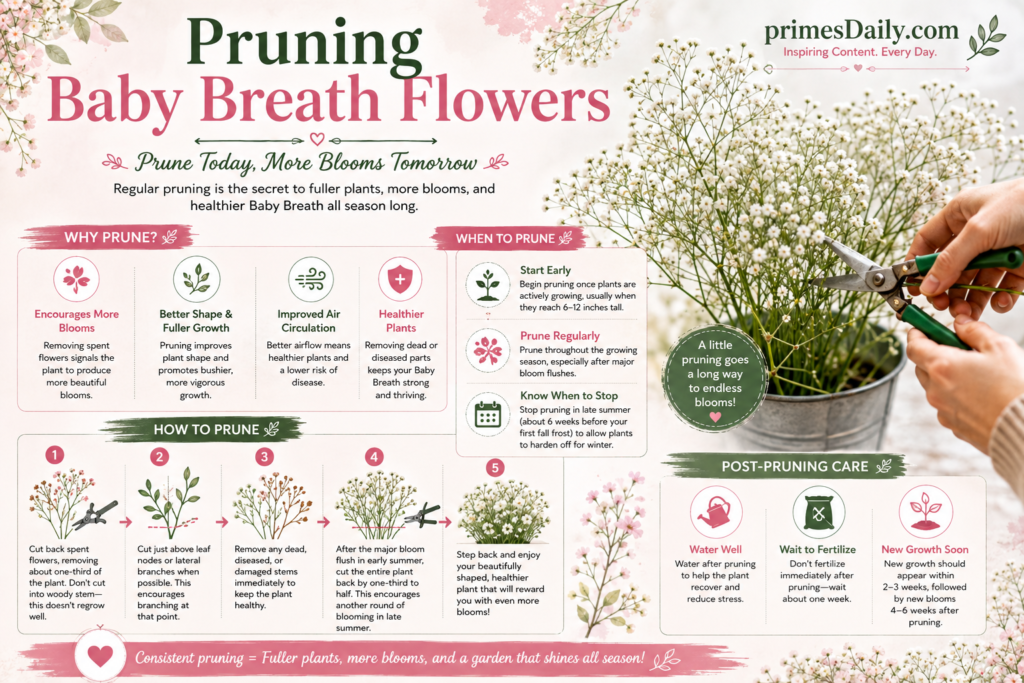
Should you prune these flowers? Yes, and it’s one of the best-kept secrets for encouraging abundant blooms.
Why Prune:
Pruning removes spent flowers, which signals the plant to produce more blooms. Without pruning, plants eventually stop blooming as they focus energy on seed production.
Pruning improves plant shape and encourages bushier, fuller growth.
Pruning improves air circulation, reducing disease risk.
When to Prune:
Begin pruning as soon as plants are actively growing, usually when they reach six to twelve inches tall.
Prune regularly throughout the growing season, especially after major bloom flushes.
Stop pruning in late summer (about six weeks before your first fall frost) to allow plants to harden off for winter.
How to Prune:
Cut back spent flowers, removing about one-third of the plant. Don’t cut into woody stem—this doesn’t regrow well.
Cut just above leaf nodes or lateral branches when possible. This encourages branching at that point.
Remove any dead, diseased, or damaged stems immediately.
After the major bloom flush in early summer, cut the entire plant back by one-third to half. This encourages another round of blooming in late summer.
Post-Pruning Care:
Water after pruning to help the plant recover.
Don’t fertilize immediately after pruning—wait a week.
New growth should appear within two to three weeks, followed by new blooms four to six weeks after pruning.
Propagating Baby Breath Flowers
Can you propagate these flowers without seeds? Yes, though it’s less common.
Propagation Methods:
Seeds are the easiest and most reliable method (covered in previous sections).
Cuttings can be used but are less reliable and take longer to establish.
Division is rarely used since plants develop deep taproot systems that don’t divide well.
Propagation by Cuttings:
Take cuttings in early summer from new growth. Cuttings should be three to four inches long.
Use sterile, sharp pruners. Remove lower leaves from cuttings.
Dip the cut end in rooting hormone (optional but helpful).
Place cuttings in moist seed-starting mix or a fifty-fifty mix of peat and perlite.
Cover with a humidity dome or plastic bag to maintain moisture.
Keep in bright, indirect light at sixty-five to seventy degrees Fahrenheit.
Misting daily helps maintain humidity while preventing rot.
Rooting typically takes four to six weeks. Once rooted, pot up individual cuttings and grow under lights before hardening off.
Why Cuttings Are Less Common:
Lower success rates than seeds (often less than fifty percent)
Longer time to mature plants
Takes more work than seeds
Seeds are so cheap and easy that most gardeners just use seeds
Overwintering Baby Breath Flowers
How do you keep these flowers through winter? The answer depends on your climate.
Cold Climate Overwintering (Zones 3-6):
Perennial varieties are fully hardy and require no special care. They go completely dormant but reliably return in spring.
Cut back dead foliage after the first hard freeze if desired (optional—leaving it standing provides winter structure).
Mulch with one to two inches of compost or shredded leaves. This isn’t for insulation but to improve soil as it breaks down.
No watering needed once the plant goes dormant.
Mild Climate Overwintering (Zones 7-9):
Plants may stay partially green. Reduce watering significantly but don’t let soil completely dry.
Light pruning in late winter (February) removes dead wood and stimulates spring growth.
Mild mulch (half an inch) helps moderate soil temperature fluctuations.
Warm Climate Overwintering (Zones 10-11):
These are treated more like evergreens. They may continue growing slowly through winter.
Reduce watering and fertilizing during cooler months.
These plants may struggle with summer heat and humidity more than winter cold.
Container Plant Overwintering:
Cold climates: Move containers to a sheltered location (against a home, under eaves) in late fall. Water minimally through winter.
Mild climates: Leave containers outside but reduce watering significantly.
Warm climates: Leave containers outside. Reduce watering but don’t let soil dry completely.
Alternatively, move containers into an unheated garage or shed where they experience dormancy similar to garden plants.
Annual Varieties:
Annual varieties are killed by the first frost. There’s no way to overwinter them. They must be replanted each spring.
However, they often self-seed, providing free plants the next spring if you let some flowers go to seed.
How to Get Baby Breath Flowers to Bloom
Why aren’t your plants blooming? Understanding bloom requirements helps you fix the problem.
Bloom Requirements:
Full sun (at least six hours daily) is absolutely essential. Plants in partial shade simply won’t bloom abundantly.
Mature plants (second year and beyond) bloom more freely than first-year plants.
Proper pruning encourages more blooms than leaving plants alone.
Adequate drainage prevents root rot, which kills plants before they can bloom.
Cool-season temperatures (sixty to seventy degrees Fahrenheit) promote blooming. During intense heat, blooms may decrease.
Encouraging More Blooms:
Deadhead spent flowers consistently. This removes the plant’s signal to set seeds and keeps it producing flowers.
Prune back by one-third in early summer. This stimulates a new round of blooming in late summer.
Ensure full sun exposure throughout the growing season.
Avoid over-fertilizing. High-nitrogen fertilizers promote leaves at the expense of flowers.
Water appropriately—neither drowning nor letting them dry completely.
Baby Breath Flowers Bloom Season
When do these flowers actually bloom? This varies by variety and climate.
Northern Regions (Zones 3-5):
Bloom begins in late May or June, peaks in July-August, and continues through September or until the first frost.
Annual varieties (planted in spring) begin blooming six to eight weeks after planting, typically in early July.
Perennial varieties planted in spring may bloom lightly the first year, then abundantly in subsequent years.
Middle Regions (Zones 6-7):
Bloom season is longer, running from May through October.
Annual varieties start blooming in June-July.
Perennials bloom prolifically from June onward.
Southern Regions (Zones 8-10):
Bloom season is even longer, potentially November through April in warm climates.
However, summer heat often causes a bloom slowdown or pause from July through September.
Planting in fall can provide winter and spring blooms in warm climates.
Year-by-Year:
First year plants (whether from seeds or transplants) usually bloom modestly, with peak blooms occurring in midsummer.
Second year plants bloom prolifically and for longer periods.
Established plants (third year and beyond) produce the most abundant blooms.
Factors Affecting Bloom Timing:
Temperature: Cool weather promotes blooming; heat reduces blooms
Daylight hours: Longer days (summer) promote blooming
Pruning: Proper pruning extends bloom season by two to four weeks
Watering: Consistent moisture (but not soggy) promotes continued blooming
Fertilizing: Proper fertilizing supports blooming without over-promoting leaves
Deadheading Baby Breath Flowers
What is deadheading and why does it matter? Deadheading is removing spent flowers, and it’s one of the most powerful tools for encouraging blooming.
Why Deadhead:
When flowers fade and go to seed, the plant receives a signal that reproduction is complete. Once reproduction is complete, the plant’s focus shifts to survival (storing energy and hardening off for winter), not continued flower production.
By removing spent flowers before they set seed, you interrupt this signal and keep the plant focused on producing more flowers.
When to Deadhead:
Deadhead regularly throughout the growing season. Once flowers begin to fade (usually turning brown or tan), remove them.
Deadhead at least weekly during peak bloom season for maximum effect.
Stop deadheading in late summer (about six weeks before the first frost) to allow the plant to naturally set seed and harden off for winter.
How to Deadhead:
Cut or pinch off spent flower clusters just below where they attach to the main stem.
Cut back to the nearest strong lateral branch or leaf node when possible. This encourages branching at that point.
Don’t remove healthy green foliage—only remove the spent flowers.
Gather removed flowers for drying if desired, or simply compost them.
Results of Regular Deadheading:
More blooms: Proper deadheading can extend bloom season by two to four weeks and increase flower production by fifty percent or more.
Bushier plants: Repeated deadheading encourages branching, creating fuller, more attractive plants.
Better plant health: Removing spent flowers reduces disease risk by improving air circulation.
Less self-seeding: Less unwanted volunteer plants from self-seeds.
For the latest, updated, and unique information, visit Black Tie Attire.
Caring for Baby Breath Flowers After Blooming
What happens after the bloom season ends? This affects whether your plants will bloom again next year.
Post-Bloom Care for Perennials:
After the main bloom season ends (usually September-October), gradually reduce watering and stop deadheading. Allow some flowers to go to seed. This triggers the plant’s dormancy response.
Cut back dead foliage after the first hard freeze if desired. Some gardeners leave dead stems standing for winter structure.
Apply light mulch (half to one inch) of compost or shredded leaves. As it breaks down, it improves soil structure.
Do not fertilize in late summer or fall. This stimulates new growth that won’t harden off before winter.
Post-Bloom Care for Annuals:
Since annuals are killed by frost anyway, you can simply pull out plants after blooms fade.
Alternatively, let some flowers go completely to seed. The seeds will self-sow and provide free plants next spring.
Compost spent plants (they’re pest and disease-free typically).
Preparing for Next Year:
In spring, examine perennial plants. Remove any dead wood. New growth should emerge from the base.
If mulched the previous year, pull mulch away from the center of the plant as growth begins.
Begin watering as new growth emerges.
Fertilize lightly in early spring with a balanced fertilizer.
Plan pruning for early summer to encourage peak blooming.
Common Pests and Diseases in Baby Breath Flowers
What pests and diseases should you watch for? Good news: these flowers are remarkably resistant.
Common Pests:
Spider mites occasionally attack plants during hot, dry periods. Signs include fine webbing on plant parts and yellowing leaves. Spray with water or use miticide if severe.
Thrips rarely affect these flowers but can cause flower distortion if present. Insecticidal soap handles thrips.
Grasshoppers and locusts may chew foliage occasionally but rarely cause significant damage.
Most insects avoid these flowers entirely because they’re not particularly attractive to common pests.
Common Diseases:
Root rot from poorly drained soil is the most common problem. This isn’t really a “disease” but rather environmental stress. Prevention (good drainage) is the only cure.
Powdery mildew can occur in humid conditions or with poor air circulation. Improve air circulation, ensure plants aren’t crowded, and avoid overhead watering.
Rust is rare but can occur in very humid climates. Remove infected leaves and improve air circulation.
Prevention is Everything:
Proper drainage prevents most problems.
Full sun exposure keeps plants healthy and pest-resistant.
Avoiding crowding ensures good air circulation and reduces disease.
Watering at soil level (not overhead) keeps foliage dry.
Regular inspections catch problems early when they’re easiest to handle.
When to Use Pesticides:
Most pest problems are minor and self-limiting. Pesticides are rarely necessary.
If problems persist despite cultural controls, use the least toxic option (insecticidal soap before stronger chemicals).
Avoid broad-spectrum pesticides that kill beneficial insects.
Always follow label directions carefully.
Are Baby Breath Flowers Toxic to Pets?
Is this a safe flower for pet owners? The answer is important for pet safety.
Toxicity Level:
These flowers are mildly toxic to cats, dogs, and horses. They’re not deadly like lilies, but ingestion can cause problems.
Symptoms of Toxicity:
Gastrointestinal irritation (vomiting, diarrhea)
Stomach upset
Loss of appetite
In rare cases, more severe gastrointestinal upset
Important Notes:
Most pets avoid eating flowers naturally, so accidental ingestion is rare.
The toxin is in all plant parts (flowers, stems, leaves).
Symptoms are typically mild and self-limiting but can be uncomfortable.
Safety Precautions:
Keep cut arrangements where pets can’t access them.
Supervise pets in gardens with these flowers.
If your pet ingests significant amounts, contact your veterinarian.
Your vet can provide activated charcoal or other supportive care if needed.
Consider alternative flowers if you have a pet that chews plants.
Pet-Safe Alternatives:
Roses (thorns are the only concern)
Sunflowers
Zinnias
Dahlias
Marigolds
Asters
Gerbera daisies
If your pet has a history of plant eating, these safer options are better choices.
Are Baby Breath Flowers Invasive?
In some regions, these flowers are considered invasive. Understanding this is important for responsible gardening.
Invasive Status by Region:
Many Western states consider Gypsophila paniculata (perennial baby’s breath) invasive or a noxious weed.
The Great Lakes region lists it as invasive in some states.
Northeastern states generally allow cultivation without restriction.
Southern states typically allow cultivation.
Why They’re Invasive:
These flowers produce abundant seeds that spread easily via wind and water.
Established plants are very difficult to eradicate due to deep root systems.
They can outcompete native plants in sensitive ecosystems.
Once established in natural areas, they spread rapidly.
How to Check Your Region:
Search “[your state] invasive plants database” to check official status.
Contact your local cooperative extension office for guidance.
Some areas allow growing in gardens but prohibit allowing them to spread to wild areas.
Responsible Gardening:
If invasive in your region: Ask your state if you can grow annual varieties (which don’t persist). Annual varieties can be legally grown and simply removed after blooming.
Deadhead religiously to prevent seed production if you grow them.
Don’t allow them to spread outside your garden.
Remove any volunteers in nearby natural areas.
Alternative Approach:
If you want white filler flowers but they’re invasive in your region, consider:
Queen Anne’s Lace (native to some areas, but also invasive in others—check)
Nigella (annual, self-seeds but easy to remove)
Ammi majus (annual white filler flower)
Limonium (annual statice)
These alternatives provide similar effects with less environmental concern.
Baby Breath Flowers for Weddings and Events
Why are these flowers the standard for wedding and event use? Understanding their value helps you use them effectively.
Wedding Use:
These flowers are perfect for bridal bouquets, bridesmaid bouquets, and wedding arrangements.
They add volume and elegance without adding significant cost or weight to bouquets.
They’re available year-round, ensuring availability for any wedding date.
They last longer in arrangements than most flowers, maintaining beauty throughout a long event day.
They photograph beautifully and look romantic in photos.
Event Use Beyond Weddings:
Anniversaries: Perfect for expressing everlasting love
Baby showers: Pink varieties work beautifully
Graduations: White varieties add elegance
Funerals and memorials: Symbolize everlasting love and respect
Engagement parties: Romantic and elegant
Corporate events: Professional and sophisticated look
Cost Advantages:
These flowers are inexpensive compared to other event flowers.
Bulk pricing is available for large events.
Using them as fillers allows you to use fewer expensive focal flowers while maintaining visual impact.
Availability:
Year-round availability from florists and online suppliers
Bulk options available for weddings and large events
Online bulk flower retailers often ship fresh flowers directly
Local flower shops can order specific varieties
Wholesale options available for very large events
Quantity Guide for Events:
Small bouquet (six stems): Focal flower with baby’s breath filler
Medium wedding arrangement (table centerpiece): Eight to twelve stems with focal flowers
Large bridal bouquet: Fifteen to twenty stems with focal flowers
Ceremony backdrop: Ten to fifteen large bunches of stems
Reception: Multiple arrangements throughout venue
Consultation with a florist helps determine quantities for your specific event.
Baby Breath Flowers for DIY Bouquets and Crowns
Can you create professional-looking arrangements at home? Absolutely, and it’s easier than you think.
DIY Bouquet Assembly:
Gather supplies: sharp florist shears, floral tape, rubber bands, a vase with water.
Prepare flowers: Remove lower leaves, cut stems at a 45-degree angle under running water.
Build the bouquet: Start with greenery as a base. Add focal flowers (roses, peonies) first. Fill around focal flowers with baby’s breath and other filler flowers.
Shape as you go: Rotate the bouquet, adding flowers spirally until you reach desired fullness.
Secure the bouquet: Wrap the stems tightly with floral tape or a rubber band at about the same point where it will sit in water.
Finish the stems: Trim stems so they’re even and will sit in water when placed in a vase.
Hydrate: Place in a clean vase with fresh water immediately.
Flower Crown Construction:
Gather supplies: Wire coat hanger or floral crown base (available online), floral tape, florist shears, small pieces of foam or tape to hold flowers.
Prepare flowers: Cut stems into short pieces (two to four inches long).
Create base: Bend coat hanger into a circle that fits your head, or use a pre-made crown base.
Wrap base: Wrap the base tightly with floral tape for a finished look.
Add flowers: Insert flower pieces around the crown, securing with small pieces of floral tape or by wrapping around the base wire.
Achieve fullness: Layer flowers for a lush, full look. Baby’s breath works beautifully as filler.
Test fit: Try on before cementing the design. Adjust as needed.
Hydrate: Spray lightly with water to hydrate and refresh. Store in a cool place until wearing.
DIY Tips:
Odd numbers of flowers create more visual interest than even numbers.
Layer different heights for dimensional interest.
Use odd numbers of flower types (three types is better than two or four).
Change water daily to keep flowers fresh longer.
Keep arrangements away from direct sun, heat, and ripening fruit (which releases ethylene that shortens flower life).
Mist arrangements daily to add humidity.
Remove any foliage below the water line to prevent bacterial growth.
How to Dry Baby Breath Flowers
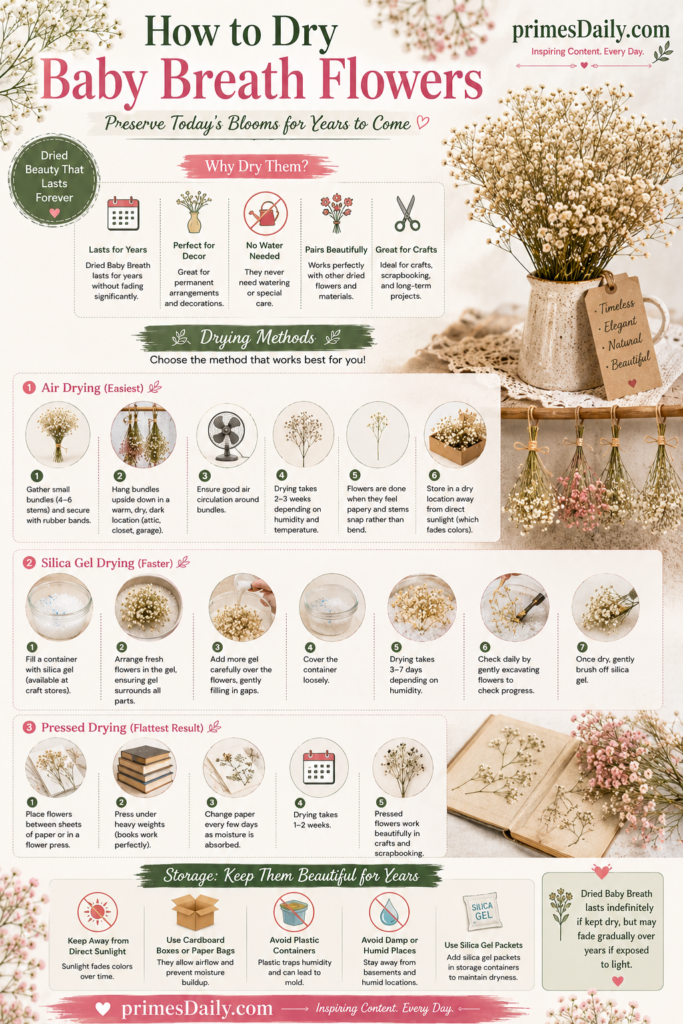
Fresh flowers fade, but dried versions last for years. How do you dry them?
Why Dry Them:
Dried flowers last for years without fading significantly.
They’re perfect for permanent arrangements and decorations.
They never need watering.
They work perfectly with other dried flowers and materials.
They’re ideal for crafts and long-term projects.
Drying Methods:
Air Drying (Easiest):
Gather small bundles (four to six stems per bundle) and secure with rubber bands.
Hang bundles upside down in a warm, dry, dark location (attic, closet, garage).
Ensure good air circulation around bundles.
Drying takes two to three weeks depending on humidity and temperature.
Flowers are done when they feel papery and stems snap rather than bend.
Store in a dry location away from direct sunlight (which fades colors).
Silica Gel Drying (Faster):
Fill a container with silica gel (available at craft stores).
Arrange fresh flowers in the gel, ensuring gel surrounds all parts.
Add more gel carefully over the flowers, gently filling in gaps.
Cover the container loosely.
Drying takes three to seven days depending on humidity.
Check daily by gently excavating flowers to check progress.
Once dry, gently brush off silica gel.
Pressed Drying (Flattest Result):
Place flowers between sheets of paper or in a flower press.
Press under heavy weights (books work).
Change paper every few days as moisture is absorbed.
Drying takes one to two weeks.
Pressed flowers work beautifully in crafts and scrapbooking.
Storage:
Store dried flowers in a dry location away from direct sunlight (which fades colors).
Cardboard boxes or paper bags work well.
Avoid plastic containers which can trap humidity and promote mold.
Avoid damp basements or humid locations.
Silica gel packets in storage containers help maintain dryness.
Dried flowers last indefinitely if kept dry but fade gradually over years if exposed to light.
Baby Breath Flowers vs Other Wedding Fillers
How do these flowers compare to other common wedding fillers?
Compared to Limonium (Statice):
Baby’s breath is more delicate and romantic; statice is more structured.
Baby’s breath is denser; statice has more defined individual flowers.
Baby’s breath lasts longer (three weeks vs two weeks fresh).
Both dry beautifully and last years when dried.
Baby’s breath is usually cheaper than statice.
Compared to Ruscus Greenery:
Baby’s breath is white/pink flowers; ruscus is green foliage.
Baby’s breath is delicate; ruscus is sturdier and can be reused multiple times.
Baby’s breath is lighter, easier to handle in arrangements.
Ruscus is better for adding structure and greenery to arrangements.
They’re often used together, not as replacements for each other.
Compared to Eucalyptus:
Baby’s breath has flowers; eucalyptus has foliage and texture.
Eucalyptus is more contemporary and trendy; baby’s breath is classic.
They complement each other beautifully in arrangements.
Eucalyptus is pricier than baby’s breath.
Compared to Waxflower:
Both are delicate and romantic.
Waxflower has more pronounced individual flowers; baby’s breath is more cloud-like.
Both last three weeks fresh and years when dried.
Waxflower comes in more color options.
Baby’s breath is usually cheaper.
Best Combinations:
Baby’s breath + eucalyptus: Contemporary romantic style
Baby’s breath + ruscus + roses: Classic bridal style
Baby’s breath + ranunculus: Ultra-romantic style
Baby’s breath + garden roses + greenery: Garden wedding style
Baby’s breath + lisianthus: Elegant, romantic style
Best Baby Breath Flowers Color Combinations
How do you choose colors for your arrangements?
Classic White:
White baby’s breath + white roses = Pure, formal elegance
White baby’s breath + pink roses = Romantic, soft elegance
White baby’s breath + red roses = Classic, bold romance
White baby’s breath + peach roses = Warm, inviting romance
Pink Varieties:
Pale pink baby’s breath + white flowers = Soft, feminine romance
Pink baby’s breath + pink roses = Monochromatic elegance
Coral pink baby’s breath + peach flowers = Warm, contemporary style
Pink baby’s breath + greenery = Simple, elegant style
Colored Varieties:
Blue baby’s breath + white flowers = Cool, modern style
Purple baby’s breath + lavender flowers = Sophisticated, trendy style
Yellow baby’s breath + cream flowers = Warm, cheerful style
Red baby’s breath + white flowers = Bold, modern contrast
Seasonal Combinations:
Spring: Pale pink baby’s breath + peonies + tulips
Summer: White baby’s breath + sunflowers + garden roses
Fall: Coral baby’s breath + rust-colored dahlias + greenery
Winter: White baby’s breath + burgundy roses + evergreen branches
Monochromatic Arrangements (Single Color):
Pure white baby’s breath alone creates sophisticated elegance.
Pink varieties combined (different shades) create romantic interest.
Colored varieties mixed create trendy, contemporary looks.
The key is mixing flower sizes and textures within the color scheme.
2026 Baby Breath Flowers Trends
What’s current and trendy with these flowers in 2026?
Trend: Maximalism
Huge, overflowing arrangements with abundant flowers.
Multiple varieties of filler flowers combined.
Baby’s breath used heavily (not sparsely) for cloud-like effect.
Large vase arrangements filling entire spaces.
Trend: Sustainable Choices
Local flower sourcing rather than imported.
Dried arrangements that last years.
Growing your own flowers for events.
Reusing and repurposing arrangements.
Baby’s breath is perfect for sustainability because it’s affordable, grows easily, dries beautifully, and is available year-round locally.
Trend: Color Beyond White
Tinted varieties in trendy colors (2026 Pantone colors are dominating).
Personalized color choices rather than traditional white.
Moody, darker tones rather than pastels.
Multi-color arrangements with colored fillers.
Trend: DIY and Personal Creation
Home gardeners growing flowers for personal use and events.
DIY arrangement classes and workshops booming.
Subscription boxes for growing your own flowers.
Baby’s breath is perfect for this trend because it’s easy to grow, forgiving, and produces abundant flowers.
Trend: Slow Flowers Movement
Seasonal, locally-grown flowers.
Supporting local growers and florists.
Understanding flower origins and environmental impact.
Baby’s breath supports this because it’s low-maintenance, grows in most climates, and doesn’t require pesticides.
Trend: Mixed Media
Flowers combined with unusual materials (twine, dried grasses, wood).
Textured arrangements mixing flowers, foliage, and sculptural elements.
Asymmetrical, organic arrangements.
Baby’s breath provides delicate cloud texture perfect for mixed-media designs.
How to Make Baby Breath Flowers Last Longer
Whether fresh or dried, you want your flowers to last as long as possible.
Fresh Flowers Last Longer When:
Stems are cut at a 45-degree angle under running water before being placed in water. This increases surface area for water absorption.
Lower leaves are removed (all foliage below the waterline promotes bacterial growth).
They’re placed in clean containers with fresh, cool water.
Water is changed daily or every other day. Fresh water prevents bacterial growth.
Containers are kept away from direct sunlight, heat sources, and ripening fruit.
Flowers are kept in cool temperatures (60-70°F is ideal).
They’re misted daily with water to increase humidity around the flowers.
Floral food is used if available. The sugar feeds the flowers while the biocide prevents bacterial growth.
Arrangements are kept in a cool location overnight. Many florists refrigerate their displays overnight to extend life.
Dried Flowers Last Longer When:
Kept completely dry. Any moisture causes deterioration.
Stored away from direct sunlight, which fades colors.
Kept in cool temperatures (extremes of heat or cold cause deterioration).
Stored in dark locations. Even indirect light fades colors over time.
Protected from dust and handling.
Displayed away from high-humidity areas like bathrooms and kitchens.
Arrangements are in dust-proof display cases (optional but effective).
Silica gel packets are placed in storage containers to absorb any ambient moisture.
Expected Lifespans:
Fresh cut flowers: 14-21 days in a vase with proper care
Bridal bouquets: Full beauty for 8-12 hours; acceptable appearance for 24+ hours
Dried flowers stored properly: 5-10 years or longer with minimal color fading
Dried flowers in dry storage: Up to 20+ years with very little deterioration
FAQs
Q: Can I grow baby’s breath indoors?
A: Baby’s breath needs at least six hours of direct sunlight daily and excellent air circulation. Indoor growing is challenging because most homes don’t provide these conditions. Window gardens with south-facing windows and supplemental grow lights might work, but outdoor growing is much more successful. Container growing on a sunny patio is a good compromise.
Q: What’s the difference between annual and perennial baby’s breath?
A: Perennial varieties (Gypsophila paniculata) live for multiple years and need only one planting. They grow larger and bloom for longer periods but take longer to establish. Annual varieties (Gypsophila elegans) complete their entire life cycle in one year, blooming quickly but requiring replanting each year. Annuals are faster but perennials are more economical long-term.
Q: Why are my baby’s breath plants dying?
A: The most common cause is poor drainage. These flowers cannot tolerate wet soil. Check soil drainage immediately. Other common causes include insufficient light (need at least six hours daily), over-watering, or root rot from waterlogged soil. Improve drainage, move to sunnier location, and reduce watering frequency.
Q: Can baby’s breath survive frost?
A: Perennial varieties are cold-hardy to zone three (minus forty degrees Fahrenheit). They’re killed back by frost but return in spring. Annual varieties are frost-killed and won’t survive freezing temperatures. Knowing your zone helps determine whether you need to replant annually or if perennials will persist.
Q: How much water do baby’s breath plants need?
A: Once established, very little. They’re quite drought-tolerant. During establishment (first season), water when the top inch of soil feels dry, but reduce frequency as they mature. Over-watering is more problematic than under-watering. Never keep soil consistently moist.
Q: When should I harvest baby’s breath for cutting?
A: Harvest in early morning when stems are hydrated. Cut stems when flowers are mostly open but before they begin to fade. Flowers continue opening slightly after cutting. Harvest regularly to encourage more blooms.
Q: Are baby’s breath flowers expensive?
A: No, they’re quite affordable compared to other wedding flowers. Wholesale bulk prices are very reasonable, making them perfect for large events. Retail bouquets are inexpensive. Growing your own is virtually free after initial seed investment.
Q: Can I use baby’s breath in arrangements with other flowers?
A: Absolutely. They’re designed to complement other flowers. They pair beautifully with roses, peonies, ranunculus, dahlias, and virtually any other flower. Their delicate nature doesn’t compete with focal flowers.
Q: How often should I fertilize?
A: Garden plants need fertilizer rarely—perhaps once in spring if soil wasn’t well-amended. Over-fertilizing reduces blooms by promoting leaf growth. Container plants benefit from monthly fertilizing during the growing season at half strength. Less is more with these flowers.
Q: Why do my baby’s breath plants have few blooms?
A: Most common causes are insufficient light (need minimum six hours daily), over-watering, over-fertilizing, or lack of pruning. Ensure full sun exposure, reduce watering frequency, stop fertilizing unless necessary, and deadhead regularly to encourage blooming.
Q: Can baby’s breath be grown in shade?
A: Not successfully. They absolutely need full sun (six to eight hours minimum). In partial shade, growth is weak, leggy, and flowering is minimal. Move plants to full sun for best results.
Q: What’s the best way to store dried baby’s breath?
A: Store in a cool, dry, dark location away from direct sunlight. Cardboard boxes or paper bags are ideal. Avoid plastic containers that trap humidity. Use silica gel packets to absorb ambient moisture. Properly stored dried flowers last years without significant deterioration.
Q: Can I save seeds from my baby’s breath plants?
A: Yes. Allow some flowers to go to seed. Once seed pods dry and turn brown, cut entire stems and place in a paper bag in a dry location. Shake to release seeds. Store seeds in a cool, dry place until next season. Seeds remain viable for several years.
Q: Are there baby’s breath varieties for very hot climates?
A: Standard perennial varieties struggle in intense heat. Annual varieties (Gypsophila elegans) handle heat better. In hot climates, afternoon shade helps prevent heat stress. Consider replanting annually with heat-tolerant varieties or moving to cooler microclimates (eastern exposure, under tree shade).
Q: How do I keep cut arrangements from drying out too quickly?
A: Change water daily, keep away from heat and direct sun, mist daily with water, use floral food, and keep in cool temperatures (60-70°F). Refrigerate arrangements overnight when possible. These steps can extend vase life from two weeks to three weeks or longer.
Q: Can baby’s breath be used in wedding bouquets for outdoor ceremonies?
A: Yes, absolutely. They’re perfect for outdoor weddings. The delicate flowers look beautiful in natural light. Keep arrangements in water until the ceremony. After the ceremony, return to water immediately for continued longevity. Mist occasionally if outdoor temperatures are warm.
Q: What pests specifically target baby’s breath?
A: Few pests target these flowers. Spider mites occasionally attack during hot, dry periods. Thrips rarely affect them. Grasshoppers may chew foliage occasionally. Most insects avoid baby’s breath. Prevention through healthy plant culture is more important than pest management.
Q: How close should container baby’s breath be to a south-facing window?
A: Place directly in front of or very close to the window to maximize direct sun exposure. South-facing windows provide the most hours of direct sun. Ideally, plants should receive direct sun from the window for as many hours as possible daily. If growth becomes leggy, move closer to the light.
Q: Can I divide mature baby’s breath plants?
A: Division is not recommended. These plants develop deep taproot systems that don’t separate well. They’re best propagated from seed or cuttings. Dividing typically damages both sections, resulting in weak growth or death.
Conclusion
Baby’s breath flowers represent one of nature’s most underrated treasures. Throughout this comprehensive guide, we’ve explored their remarkable characteristics, their ease of cultivation, their versatility in design, and their enduring symbolism. From growing them from tiny seeds to drying them for years of enjoyment, from using them in grand wedding arrangements to creating simple bouquets for your own enjoyment, these flowers truly have something to offer everyone.
The most important takeaways as you move forward with your baby’s breath journey are these: provide full sun and excellent drainage, avoid over-watering, deadhead regularly for abundant blooms, and don’t over-complicate their care. These hardy, forgiving plants reward even novice gardeners with beautiful results when given these basic conditions.
Whether you choose to grow your own flowers from seed for an upcoming event, establish a permanent planting in your garden that returns year after year, or simply purchase cut flowers from a florist, baby’s breath will serve you well. They’re affordable, available year-round, long-lasting, and beautiful. They photograph beautifully, complement any other flowers, and create an atmosphere of romance and elegance that has made them the choice of florists worldwide for over a century.
The knowledge you’ve gained from this guide positions you to make informed decisions about baby’s breath—when to plant them, how to care for them, how to use them in arrangements, how to dry them for lasting beauty, and how to understand their deeper meanings. You now understand why they’ve become such a staple in the floral world and how to use them effectively in your own life.
Start small if you’re nervous about growing flowers. Plant a few seeds or purchase a few plants from your local garden center. Observe how they grow, experiment with different locations and soil amendments, and build your confidence. Before long, you’ll have abundant flowers at your fingertips, ready to use for your own enjoyment or for sharing with others.
The world of baby’s breath flowers awaits your exploration. Welcome to the community of gardeners, florists, and flower lovers who have discovered the remarkable value and beauty of these delicate, enduring blooms. Your garden—and your life—will be richer for their presence.
For the latest, updated, and unique information, visit Who Is the Best Fortnite Player.