When you first jump into Pokémon Unite, you’re not just picking a character and heading into battle. You’re making strategic decisions that can mean the difference between climbing to Master rank and getting stuck in mid-tier frustration. But here’s the thing that catches most new players off guard: each Pokémon can play dozens of different ways depending on how you set them up. This is where understanding builds becomes your secret weapon.
Think of a build like the DNA of your Pokémon. It’s the combination of your held items, battle items, move choices, and emblem pages that work together to create a specific playstyle. Want your Pikachu to be a speedy hit-and-run attacker? One build does that. Need Pikachu to support teammates instead? A completely different build makes that happen. The same Pokémon can be a damage dealer, a tank, a support player, or something entirely unique.
Why does this matter? Because understanding builds isn’t just for competitive players trying to hit Master rank. Whether you’re a casual player wanting to have fun with friends or someone grinding ranked seasons, having the right setup transforms how you experience the game. Instead of struggling with moves that don’t click, you’re running strategies that make sense for your playstyle. Instead of getting one-shot by enemies, you’re building durability into characters meant for damage.
This guide covers everything you need to know about Pokémon Unite builds in 2026. We’re talking about the meta builds that dominate right now, the items that make your character shine, the strategic positioning that wins games, and the exact tweaks you need to make for different situations. By the time you finish reading this, you won’t just know about builds—you’ll understand how to create, modify, and adapt them for any battle scenario.
Best Held Items to Support Your Pokémon Unite Builds
Your held items are the foundation of everything. These are the pieces of equipment your Pokémon wears into battle, and they provide stat boosts that add up over the entire match. Unlike battle items that you use once and trigger again, held items work passively the whole time you’re fighting. Understanding which items work best for different characters is crucial.
Let’s start with the heavy hitters that appear in almost every strong build. Muscle Band has been a staple since forever, and there’s a reason. If your Pokémon relies on basic attacks to deal damage, Muscle Band amplifies that damage significantly. It gives you Attack Power and also increases your damage against enemies with higher maximum HP. This makes it fantastic for Attackers, Speedsters, and All-Rounders who want to leverage their basic attack animation canceling.
Focus Band is the defensive answer to aggressive opponents. When you drop below a health threshold, Focus Band activates a shield that absorbs damage. Here’s what makes it so good: that shield can mean the difference between living a team fight and getting eliminated. Players often underestimate defensive items early game, then wonder why they keep getting deleted. If you’re playing anyone who needs to survive burst damage—Defenders, some Supporters, or All-Rounders—Focus Band is your friend.
Buddy Barrier is where things get really interesting. This item shields both you and a nearby ally when you need it most. If you’re playing a Supporter or a character meant to enable teammates, Buddy Barrier transforms you into a protector. The shield values are chunky enough that they can turn losing fights into winning ones. Plus, the Hp stat boost means you’re naturally harder to kill, creating this beautiful synergy where the shield protects a bigger healthpool.
Special Attack Specs and Wise Glasses serve the same purpose as Muscle Band but for special attackers. Which one should you grab? Wise Glasses gives you more consistent special attack power, while Special Attack Specs scales with ability power. For most special damage dealers, Wise Glasses does the trick. The item works beautifully on characters like Gengar, Gardevoir, and Chandelure.
Energy Amplifier is becoming more relevant in 2026 meta. This item increases your ability power and reduces the cooldown on your moves. If your character has powerful abilities that come up repeatedly, Energy Amplifier lets you spam them more often. Picture a Delphox using Fire Blast every few seconds instead of waiting around—that’s the energy amplifier advantage.
Assault Vest gives you special defense and ability power, creating this interesting hybrid where you can both take special damage better and dish it out harder. It’s underrated honestly. When you’re playing against teams with heavy special attackers, Assault Vest makes you nearly impossible to burst down.
Scope Lens increases your critical strike chance and critical damage. Here’s the thing about crits: they feel amazing, and they do scale well into late game when your attack power is high. But early game, crits aren’t consistent. So Scope Lens is more of a late-game focused item for characters who have high attack speed and can proc crits frequently.
Float Stone gives movement speed and ability power, and that movement speed is genuinely underrated. In a game where positioning is everything, having that extra 20% movement speed means you can rotate faster to objectives, escape ganks more reliably, and position better in team fights. Characters like Talonflame, who want to stay mobile, absolutely love this.
Weakness Policy amplifies your damage when enemies hit you. The more damage you take, the harder you hit back. This creates an interesting dynamic for tankier All-Rounders and Defenders who want to deal damage while staying front and center. Snorlax with Weakness Policy becomes this unkillable damage machine that trades hits better than anything else on the map.
Choice Specs boosts your special attack and gives you a damage increase when you hit enemies with your moves. It’s straightforward and effective for special attackers who want maximum damage output. Pair this with characters like Pikachu or Dragonite, and you’re dealing ridiculous numbers.
Rapid-Fire Scarf increases your attack speed and physical attack, making it phenomenal for basic attack reliant characters. This becomes your go-to for speedsters who want to chain their basic attacks together for maximum damage.
Curse Incense reduces your ability cooldown and gives special defense. The cooldown reduction is sneaky valuable for characters with short-cooldown abilities that you want to spam constantly.
Here’s what most players don’t understand about item selection: it’s not about picking the statistically best item. It’s about creating synergy. If you’re playing Blissey, grabbing three damage items is silly even though they boost your stats. You want support items that let you keep teammates alive. If you’re playing Absol, you want damage amplification plus survivability to let you clean up fights.
The meta in August 2026 rewards diversified builds more than ever. Teams that have variety in their damage types, survivability approaches, and team utility win more matches. When everyone on your team has identical items, enemy teams can itemize defensively against you. When your team has varied approaches, they can’t prepare for everything.
Optimal Emblem Sets for Every Pokémon in Unite Builds
Emblems are the passive bonuses you layer onto your character’s abilities. Think of them as small percentage boosts that add up into something substantial. You’re not going to notice a single emblem boosting your HP by 1%, but when you stack five emblems plus other sources of tankiness, you become significantly harder to kill.
There are colored emblems: red for attack power and attack speed, blue for special attack and special defense, green for HP and special defense, white for speed and cooldown reduction, and purple for various unique effects. Every emblem has a primary stat and secondary benefits. Most strong builds mix colored emblems strategically rather than stacking all one color.
Attack-focused emblem pages usually run red and white emblems. You’re maximizing damage output and movement speed to chase down kills or rotate around the map faster. This works beautifully for Speedsters like Zeraora or Talonflame who want to get in, do damage, and get out before enemies can respond.
Defense-focused emblem pages lean into blue and green emblems. You’re stacking HP, special defense, and regular defense to become a frontline champion that the enemy team can’t ignore. Defenders and tanks absolutely need these setups to function properly.
Special attack pages mix blue and white emblems for casters. You want special attack from blue emblems and cooldown reduction from white emblems so you can throw abilities more frequently. Gengar, Chandelure, and Gardevoir benefit massively from this approach.
Support pages typically mix blue and green emblems for utility. You’re not trying to outdamage anyone. You’re trying to stay alive while keeping your team alive. This means HP, defensive stats, and ability power to make your healing or shielding stronger.
The meta has shifted in 2026 to reward specialization. Instead of generic defensive pages on everyone, players are now building hyper-specialized emblem setups that maximize exactly what their character needs. If you’re playing Pikachu as a pure attacker, you’re not running defensive emblems. You’re running full damage emblems because your job isn’t to tank—it’s to burst enemies.
Common emblem combinations include the “Physical Attacker” setup with red and white for basic attack characters. The “Special Fighter” setup uses blue and white for ability-focused characters. The “Tanky Support” setup combines green and blue for frontline supporters. The “Speed Assassin” setup maximizes red and white for quick burst damage characters.
One thing new players miss: emblem farming. You can’t just have one emblem page and call it a day. You need multiple pages built toward different roles so that when you get into a match and need to switch strategies, you have an emblem page ready. This is where players with multiple ranks really pull ahead—they’ve invested in diverse emblem pages.
The specific emblems matter too. Certain emblems have effects that trigger under specific conditions. Some boost your damage against lower-health enemies, perfect for burst characters. Others boost your stats when you hit multiple enemies, great for area effect characters. Learning which effects work with your chosen character’s kit makes the difference between good players and great players.
Featured Pokémon Unite Builds
Some builds have become legendary in the community because they work so well. These are the setups that top players use when they need to win games, and understanding them shows you what effective builds look like.
The Snorlax “Juggernaut” build uses Aeos Cookie, Weakness Policy, and Drain Crown. This setup makes Snorlax an impossible-to-kill ball of HP and damage. Weakness Policy means the more damage Snorlax takes, the harder it hits back. Aeos Cookie increases your HP and shields you. Drain Crown heals you based on damage dealt. The moves are Tackle for engage and Flail for ramping damage as you get lower on health. This build won’t kill anyone with burst, but it’ll wear down enemies through superior sustain and durability.
The Blissey “Cheerleader” build runs Buddy Barrier, Exp. Share, and Rescue Hood. Blissey is support incarnate with this setup. You’re not trying to damage anyone. You’re amplifying your team’s effectiveness by shielding them, giving them experience, and keeping them alive. Pound and Safeguard are your moves, letting you engage safely while protecting teammates. This is what a pure support playstyle looks like.
The Greninja “Assassin” build focuses on quick burst and repositioning. You’re running high attack items and movement speed, using moves that let you get in, eliminate a target, and escape before the enemy team responds. This build requires excellent positioning and timing but feels incredible when you pull off the combo.
The Pikachu “Electro Ball” build uses Special Attack Specs, Energy Amplifier, and Curse Incense. You’re maximizing special attack and ability cooldown so you can spam Electro Ball repeatedly. Every time Electro Ball connects, you’re dealing massive damage. This build turns Pikachu into a ranged special damage dealer that keeps enemies at distance.
The Cinderace “ADC” build stacks Muscle Band, Scope Lens, and Rapid-Fire Scarf for pure basic attack damage. You’re positioned in the backline dealing consistent damage with your basic attacks, occasionally using abilities to reposition or burst priority targets. This is the traditional attack damage carry playstyle translated into Pokémon Unite.
The Machamp “Brawler” build combines Attack Weight, Weakness Policy, and Focus Band. You’re a mid-range fighter who charges into enemies, gets stronger as you fight longer, and laughs off burst damage with shields. This works because Machamp has high attack speed and constant healing from abilities, letting you be aggressive without instantly exploding.
The Absol “Assassin Picker” build runs Muscle Band, Attack Weight, and Razor Claw. You’re the jungler who hunts for isolated enemies and eliminates them before they can react. Absol’s high mobility and critical strike chance make this work beautifully. You’re not teamfighting much—you’re hunting for picks throughout the map.
The Gengar “Speedy Caster” build maximizes Wise Glasses, Energy Amplifier, and Float Stone. You’re constantly moving around the map with enhanced movement speed, dropping ability combos on enemies before they know what happened. This playstyle requires excellent map awareness but creates massive pressure across the entire battlefield.
These featured builds work because they follow a simple principle: every item synergizes with the character’s natural kit and playstyle. They’re not random stat stacking. They’re carefully chosen to amplify what makes that character unique.
Most Recent Pokémon Unite Builds & Updates
The August 2026 patch brought significant changes that shifted the meta considerably. Understanding these shifts helps you stay competitive and know which builds are actually viable right now versus outdated.
The major change was a rebalance of held items. Items that gave percentage-based boosts got adjusted, specifically affecting how much Attack Power and Special Attack scales into late game. This means the difference between a 200 attack stat and a 250 attack stat is less dramatic than before. This change makes defensive and utility items relatively stronger compared to pure damage items.
Several Pokémon received adjustments based on their win rates. Characters that were overperforming got nerfed, primarily through cooldown increases on their main damage abilities. Conversely, underperforming characters received buffs to their attack power or movement speed. This opened up new viable build paths for characters that were previously considered weak.
The emblem system got rebalanced in July 2026, reducing the stat amplification from low-rarity emblems while slightly increasing high-rarity emblem effects. This change incentivizes players to invest in fully upgrading emblems rather than running mismatched rarity levels. Building a complete 6-emblem page of the same rarity now provides significantly better stats than a mixed collection.
New seasonal gameplay mode changes in August 2026 introduced objectives that reward team coordination over solo carry performance. This shift favors builds that help teammates more than builds that maximize individual damage. You’re seeing more diverse team compositions with multiple supporters and utility characters because coordinated teams with varied roles win more matches.
The ranked season currently running emphasizes objective control. Defending capture points, controlling map vision, and securing roaming spawns matter more than killstealing. This makes positional items like Float Stone and defensive items like Focus Band relatively stronger because they enable better objective play rather than raw damage optimization.
Community build data shows that hybrid builds are outperforming pure damage or pure defense builds. Characters like Scizor who can do damage while tanking, or Cramorant who can deal area damage while staying at range, have higher win rates because they’re more versatile in various team scenarios. The lesson here: flexibility matters more than optimization in one specific area.
Top-ranked players are experimenting with unconventional builds that break traditional role boundaries. Supporters who itemize for damage, Defenders who skip tankiness items for mobility, and Attackers who focus on utility. These experiments work because they create unexpected advantages that enemies don’t prepare for defensively.
Looking at August 2026 specifically, the most successful builds share these characteristics: they include at least one defensive item even on damage-focused characters, they leverage movement speed for better map positioning, they build items that synergize with the character’s natural cooldowns, and they maintain enough offensive pressure to not be ignored in fights.
Pokémon Unite Builds By Role
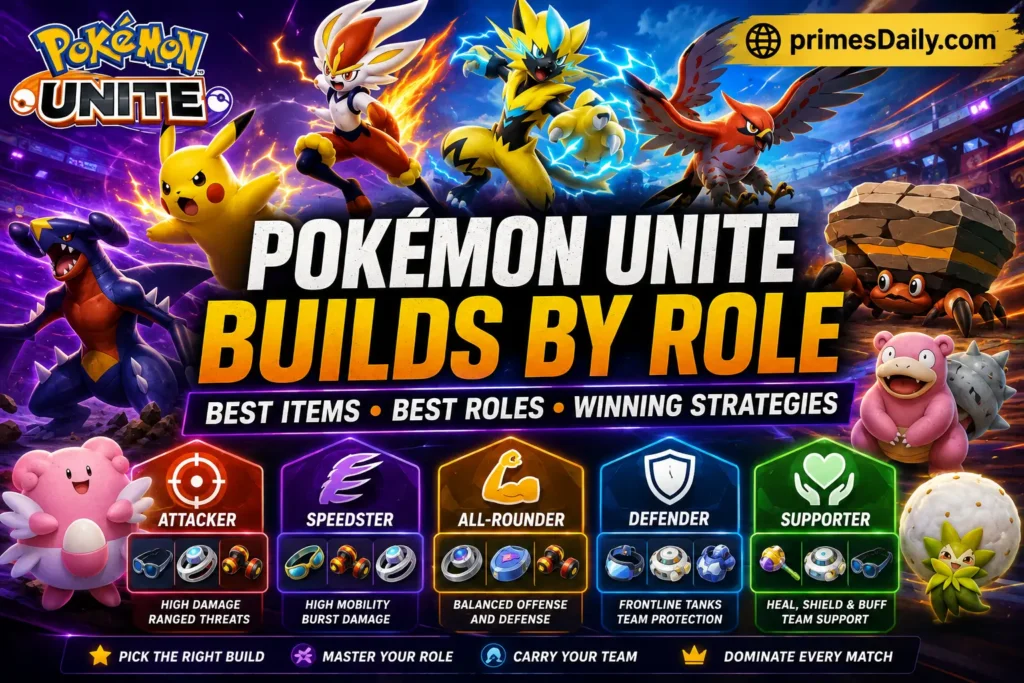
Different roles need fundamentally different approaches to itemization. You’re not going to build Supporters the same way as Attackers because their jobs in a team are completely different.
Attacker Builds
Attackers are your primary damage dealers. They’re positioned safely away from the frontline, dealing consistent damage from range. Think of them as the arrow shooters in fantasy RPGs. Their builds need high attack power, but they also need just enough defensiveness to survive one enemy rotation before your team collapses.
A strong Attacker build includes one high-damage item like Muscle Band for basic attack types or Special Attack Specs for ability types. You add a scaling item like Attack Weight or Energy Amplifier depending on whether you’re physical or special. Finally, you include one survival item. Attackers who skip survival items and die instantly aren’t dealing damage to anyone.
The Pikachu example is perfect here. You’re running Special Attack Specs for burst damage, Energy Amplifier for ability cooldown, and Curse Incense for that extra special defense. You’re positioned at the edge of fights where you can pellet enemies with Electro Ball without getting engaged on immediately. When enemies dive you, you’re tanky enough to survive the initial rotation while your team peels for you.
Cinderace plays differently because she’s a basic attack Attacker. Muscle Band for attack power, Scope Lens for critical scaling, and Float Stone for movement to kite away from enemies. You’re standing just at the edge of attack range, moving backward as enemies approach, letting your team block for you while you deal consistent damage.
The key to Attacker builds is positioning maturity. Your items enable you to stand at correct ranges where you can attack without getting deleted. If you’re getting one-shot constantly, you’re either positioning wrong or itemizing incorrectly. Both situations need fixing.
Speedster Builds
Speedsters are your assassins. They excel at quick bursts and repositioning. They need massive damage to kill priority targets before enemies respond, high movement speed to chase or escape, and just enough tankiness to not fall over to any breeze.
Speedster builds maximize movement speed and attack power simultaneously. Float Stone gives you movement speed and damage. Muscle Band or Attack Weight gives you pure damage that synergizes with their high basic attack speeds. Razor Claw adds critical damage for burst potential. You’re not building tankiness usually because Speedsters avoid extended fights entirely.
Zeraora exemplifies this. You’re running Muscle Band, Attack Weight, and Razor Claw. You’re a ranged melee character with high mobility and burst damage. You engage from angles enemies don’t expect, eliminate someone quickly, then dash away before retaliation. If you stay in fights past that initial burst, you’re dead because you’re not tanky. The entire playstyle is about not staying.
Talonflame is similar but with mobility built into his ability kit. You’re running Muscle Band for damage, Float Stone for movement, and Attack Weight for scaling. You’re zipping around the map, hitting people when they’re isolated or out of position, then moving to the next threat. You’re playing the map, not specific engagements.
Speedster builds require precise timing and positioning. One mistake means you’re dead. But when played correctly, speedsters exert so much pressure that enemies can’t coordinate effectively because they’re managing the constant threat you pose.
All-Rounder Builds
All-Rounders are versatile. They deal decent damage, take decent damage, and function in various situations. They’re the jack-of-all-trades characters. Their builds need to balance offense and defense without sacrificing too much of either.
The best All-Rounder builds include one defensive item like Focus Band or Weakness Policy, one damage item like Muscle Band, and one scaling or utility item like Aeos Cookie. You’re creating a character that can brawl in the middle of fights for extended periods while still dealing meaningful damage.
Snorlax is the All-Rounder archetype. You run Weakness Policy and Aeos Cookie for tankiness, plus Drain Crown for healing. You’re walking into enemy team fights, getting stronger the more you’re attacked, healing off the damage you take, and outlasting everyone else. You win through attrition, not burst.
Garchomp with Dragon Dance active becomes incredibly fast and tanky. You’re running defensive items to capitalize on your natural durability, damage items to punish enemies for engaging you, and utility items that let you engage fights better. You’re not the fastest character, but you’re definitely not going away.
All-Rounder builds work because they don’t commit fully to one strategy. They’re flexible enough to adapt to whatever the game throws at them. If enemies are squishy, you lean into damage. If enemies are tanky, you lean into durability and sustained damage.
Defender Builds
Defenders are frontline protectors. Their job is to absorb damage meant for teammates and create space for your team to work. They need stacking tankiness because every point of defense they build makes them exponentially harder to kill.
Defender builds are almost entirely defensive with one damage item to not be completely ignored. Focus Band, Buddy Barrier, and Assault Vest become your core items. You’re stacking HP, defense, and special defense so aggressively that enemies waste time hitting you instead of your damage dealers.
Crustle is a Defender that uses this approach. You run Focus Band for burst mitigation, Buddy Barrier to protect teammates, and Assault Vest for special defense. You’re positioning between your team and enemies, using your abilities to lock down enemies, and being so tanky that enemies have to commit multiple teammates to kill you. By then, your team has eliminated their damage sources.
Slowbro works similarly. You’re not trying to damage anyone. You’re freezing enemies in place with your abilities while being so tanky that they can’t threaten you or your team. Your presence on the map forces enemies to play around you because you’re an immovable object.
Here’s what separates good Defender players from bad ones: they understand that sometimes taking damage is the goal. When you’re tanking enemy ults and ability rotations, you’re saving your teammates from those same rotations. Your damage doesn’t matter. Your ability to say “no” to enemy offense matters.
Supporter Builds
Supporters enable teammates. They heal, shield, buff, or provide utility. They need enough tankiness to stay alive while doing their support job, enough ability power to make their healing meaningful, and items that directly amplify their support capabilities.
Support builds include Buddy Barrier for shielding teammates, healing or utility items like Weakness Policy if you have damage, and stat items that boost ability power. You’re positioning yourself to protect your most vulnerable teammate while staying out of the absolute frontline.
Blissey is the pure Supporter. You run Buddy Barrier to shield teammates, Exp. Share to buff their experience gains, and Rescue Hood to heal more effectively. You’re not dealing damage. You’re keeping your Attacker alive while they murder enemies. When your Attacker dies despite your protection, it’s a game failure. When they live and dominate, you win.
Eldegoss focuses on healing and movement speed. You’re running items that maximize healing output and movement to keep teammates protected. You’re less about shielding and more about continuous healing and buff application. Your role is literally to be everywhere keeping everyone healthy.
Support builds require different mental framing than damage-focused roles. You’re measuring success by how long teammates stay alive, how often you enable kills through utility, and whether enemies are distracted by your presence. It’s harder to quantify but just as important.
For the latest, updated, and unique information, visit Who Is the Best Fortnite Player.
In-Depth Strategy Guides for Pokémon Unite Builds
Understanding builds is different from executing them correctly in actual matches. Strategy is about making builds work within game scenarios.
The early game defines your entire match. While you’re all level 5 and relatively weak, the items you have are roughly equal to everyone else’s. But your positioning, map awareness, and understanding of where enemies are determines who gets advantages early. A good Pikachu player with mediocre items will beat a bad player with perfect items because positioning is fundamental.
During the early game, your build doesn’t matter yet. You’re farming experience, taking camps that give level advantages, and establishing vision. What matters is getting to level 6 before enemies so you gain your evolution evolution and unlock your full ability kit. Most builds assume you’re evolved, so your itemization assumes completed movesets.
The mid-game is where your build starts mattering. You’re now level 7-11 and coming online with your items and moves. This is where build synergy reveals itself. A Snorlax with Weakness Policy feels weak until you’re level 9 and Weakness Policy actually activates strong shields. Before that, it’s just defensive stats. Once it activates, suddenly you’re unkillable.
Team fights happen more frequently now. Your build needs to let you position properly for your role. If you’re an Attacker, you need items that let you stay at the right range without getting deleted. If you’re a Defender, you need items that make you an actual wall. Builds that don’t let you function in team scenarios are bad builds regardless of stats.
The late game is where most matches are decided. You’re all level 12-15, items are fully stacked with multiple items, emblems are activated their full potential. Now small advantages from good builds become massive advantages. A Cinderace with 250 attack is hitting so much harder than someone with 200 attack that it’s noticeable.
Late game also rewards correct positioning and team cohesion more than anything else. Your build enables you to position correctly, but execution is everything. You can have perfect items and still lose if you position wrong. You can have mediocre items and win if you play around your limitations intelligently.
The transition periods between game phases matter most. When you hit level 6, you unlock your evolution and new strategic options. Your build should enable your new evolved form. If your items don’t synergize with your evolved kit, you’re wasting power.
One advanced strategy concept: scaling. Some builds scale better into late game than others. Builds focused on percentage-based bonuses scale forever. Builds focused on flat stat bonuses eventually cap out. In a long match going to time, scaling-focused builds eventually dominate. In close matches ending at 8 minutes, early power matters more than scaling.
Another concept: team synergy. Some builds are better when your team also builds certain ways. If your team has multiple Special Attack characters, building into Assault Vest for special defense makes sense. If your team lacks mobility, builds that provide movement speed matter more. Analyzing your team composition and building accordingly is what separates Solo Queue grinders from actual strategists.
Pokémon Unite Builds By Character
Different Pokémon need different approaches because they have different ability kits, stat distributions, and intended roles.
The Starter Pokémon like Charizard have flexible builds because they can function as Physical Attackers or Special Attackers. You can build full damage to eliminate enemies quickly, or build tanky to frontline fights. Charizard’s strength is versatility, so multiple successful builds exist.
Gengar is pure Special Attack with high mobility. You’re not building any defense items on Gengar because you’re playing around never getting hit. Your entire strategy revolves around being somewhere enemies don’t expect, deleting them with abilities, then repositioning away. Items support this by maximizing special attack and cooldown reduction.
Pikachu can be built as Special Attacker or Support depending on moveset. Special Attack Pikachu with Electro Ball and Thunderbolt focuses on consistent ranged damage. Support Pikachu with Nuzzle and Thunder Wave focuses on crowd control and team protection. Same character, completely different builds, different roles.
Blissey only has one legitimate build because her role is purely support. You’re not deviating from the Buddy Barrier plus healing items plus ability power approach because that’s the only way to fulfill her role effectively.
Absol as Speedster has specific item requirements around attack power and movement speed. There’s less flexibility here than with Charizard because Absol’s role is more defined. You need damage to kill targets, movement to chase or escape, and survival to get away after kills.
Machamp as a Physical All-Rounder wants attack power and defensive items because you’re engaging directly. Scizor similarly wants balanced offense and defense because you’re a mid-range brawler.
Defenders like Crustle, Slowbro, and Lapras almost always run similar tanky item builds because their role demands it. There’s not much flexibility here. You’re building defensively to create space for teammates.
Supporters have some flexibility between shields versus healing focuses but generally follow similar itemization patterns.
The pattern you see: roles constrain itemization. Attackers need attack items. Defenders need defense items. Supports need utility items. Within those constraints, individual characters have unique strengths that make specific items shine. Exploiting those synergies is where good builds come from.
Battle Items for Pokémon Unite Builds
Battle items are active abilities you use during fights. They’re separate from your held items and have cooldowns. Understanding which battle items enable your builds to work is essential.
Eject Button lets you reposition instantly. This is security for characters who might get ganked. It’s especially valuable for squishy characters like pure Attackers or Supporters who position at the backline. When enemies jump you, Eject Button gets you to safety. This item is almost universally applicable.
X Attack temporarily increases your attack power. If you’re an Attack-focused build, this amplifies your burst temporarily. Stack it with your highest damage ability and you’re eliminating targets faster. This works particularly well on Speedsters who burst in, use their high-damage rotation, and leave.
Slow Smoke reduces your cooldown and makes you invisible briefly. This enables repositioning but also lets you land abilities that enemies can’t see coming. It’s less commonly used than Eject Button but still valuable for specific characters.
Full Heal restores your health. This is security for tankier characters who are playing frontline. When you’re getting focused, Full Heal lets you tank more damage. Support characters and Defenders use this frequently.
Score Shield lets you score Aeos Goals safely. During match, you earn points from defeating enemies and farming. Score Shield protects you while you’re depositing those points. This is underutilized but genuinely powerful when you’re winning fights and need to bank your lead.
Goal-Getter increases your movement speed toward enemy goals. If your strategy involves scoring objectives, this lets you capitalize faster. It’s situationally useful but becomes important in specific matchups.
X Speed increases movement speed temporarily. For characters who need mobility, this provides the boost to chase, escape, or rotate. Speedsters and Supports use this frequently.
X Defense and X Special Defense increase defensive stats temporarily. When you’re getting focused in fights, these provide brief survival boosts. Less common than attack boosts but valuable against burst-heavy enemies.
The key principle: battle items give you clutch moments. Your build creates your overall strategy. Battle items enable specific plays within that strategy. A Blissey without Eject Button might get ganked while trying to protect someone. With Eject Button, she can escape and continue supporting. The same build works dramatically differently based on battle item choice.
Most top players use Eject Button on anything squishy and Full Heal or X Attack on tankier characters. These are safe choices that enable basic functions. As you improve, you use more specialized battle items that create specific advantages in particular matchups.
Tips & Tricks for Mastering Pokémon Unite Builds
Having the right build is only half the battle. Executing correctly is where most players struggle.
First tip: understand your item spike moments. Most items become strong at specific points. Weakness Policy becomes amazing once you start taking significant damage, which happens level 9+ in mid-game fights. Before that, it’s just defensive stats. Playing around when your items actually activate makes you exponentially stronger.
Second tip: position based on your defensive stats. If you built defensively, you can position more aggressively. If you built offensively, you need to position more conservatively. This seems obvious but watch players constantly. You see squishy Attackers standing in the frontline getting destroyed instantly. You see tanky Defenders standing in the backline doing nothing. Build constrains positioning. Adapt accordingly.
Third tip: watch your team composition and build to complement weaknesses. If your team is all Special Attack based, you’re overbuilding special defense is unnecessary. You want to cover your team’s weaknesses. If your team has no mobility, you’re mobility item becomes more valuable. If your team lacks crowd control, crowd control ability enhancing items become more valuable.
Fourth tip: item adaptivity matters more than perfect builds. Your build going into the match might need adjustment based on what enemies build. If enemies go full physical damage, you should lean into physical defense over special defense. Good players have flexible builds they adjust in draft phase, great players adjust mid-match based on what enemies are actually doing.
Fifth tip: mute the damage numbers. New players obsess over damage meters. High damage doesn’t mean you contributed to winning. Eliminating priority targets, protecting key teammates, and enabling winning fights matters more than raw number inflations. Some of the best plays involve zero damage.
Sixth tip: understand your character’s win condition. Cinderace wins by dealing consistent damage and being hard to kill. Gengar wins by eliminating threats before fights start. Blissey wins by keeping teammates alive long enough to eliminate enemies. Snorlax wins through raw durability and outlasting enemies. Builds that enable your character’s natural win condition work best.
Seventh tip: farm efficiently. Your early game farming determines how quick you come online with items. Builds assume you have resources to afford items. If you’re behind on experience, your build doesn’t work as intended yet. Prioritize leveling and item acquisition before flashy plays.
Eighth tip: play to your build’s strengths rather than fighting its weaknesses. A support-heavy build can’t 1v5 enemies. Don’t try. Let your team do team things while you do support things. A burst-focused Speedster can’t survive prolonged fights. Get in, burst, get out. Builds have roles and playstyles they’re designed for. Respecting that makes you much more effective.
Game Mechanics Affecting Pokémon Unite Builds
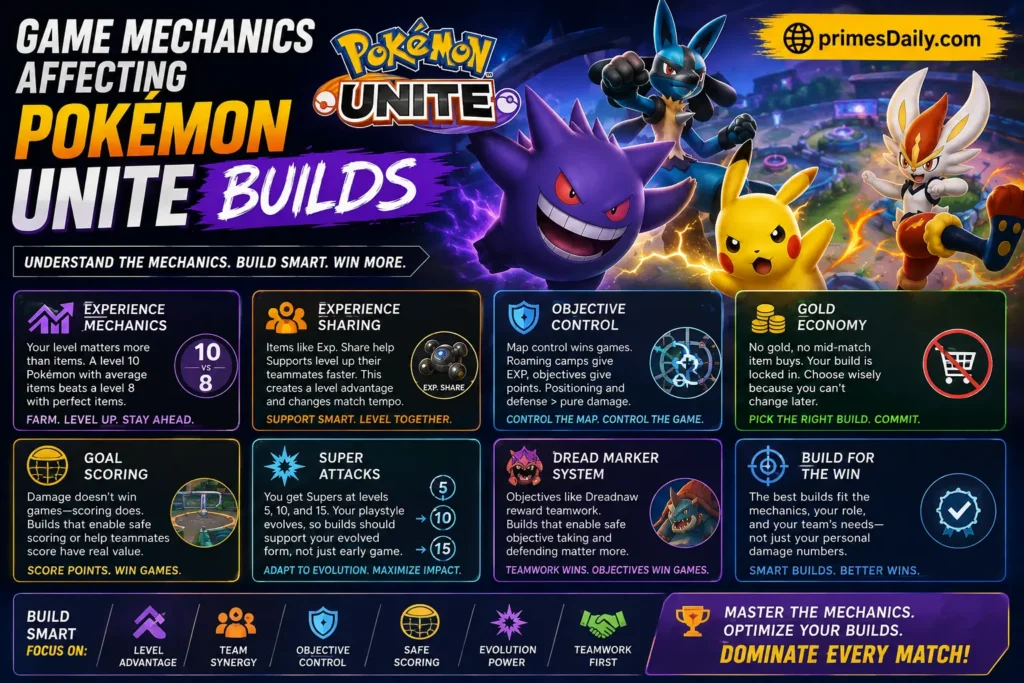
Certain game mechanics directly influence which builds work best in given situations.
Experience mechanics mean that your level matters more than anything else. A level 10 character with mediocre items beats a level 8 character with perfect items. This means farming and level advantages matter more than perfect itemization. Builds assume you’re the same level as enemies. If you’re ahead, nearly any build works. If you’re behind, no build fixes the deficit.
Experience sharing through items like Exp. Share means Supporter builds can accelerate their team’s leveling. This creates a team advantage. Top teams run supporters with Exp. Share specifically to level teammates faster and come online quicker. Supports with this item change the entire tempo of matches.
Objective control means map control matters. Holding roaming camps gives experience. Controlling objectives gives points toward goals. Builds that enable better positioning and objective defense matter more than pure damage. This favors tanky builds and utility builds over pure damage.
Gold economy doesn’t exist in Pokémon Unite. You get experience to level and items from your item build. You can’t buy items mid-match. This means your chosen build is locked in essentially. You can’t adjust after first item like in other MOBAs. Build selection becomes more critical because you’re committed.
Goal scoring means you need ways to translate advantages into actual wins. Pure damage builds don’t win if you never score goals. Builds that enable safe goal scoring or enable teammates to score goals matter. This is why Scorers and objective-enabling builds have value despite not having highest damage numbers.
Super Attacks come at level 5, 10, and 15. Your abilities evolve as you level, changing optimal playstyles. Builds should enable your evolved form better than your base form. A build that’s optimized for level 5 Gengar might not work for level 15 Gengar because your abilities are completely different.
Dread Marker system in some maps creates objectives that reward teamwork. Builds that enable safe objective taking and defending matter more than builds optimized for individual performance. This shifts meta toward coordinated builds.
Tier Lists for Pokémon Unite Builds
Meta changes constantly, but some builds consistently outperform others.
S-Tier builds in August 2026 include the Snorlax Juggernaut because it’s nearly impossible to counter. You can’t burst it down, you can’t out-trade it, you can’t out-rotate it. If you’re playing against Snorlax as Speedster, you might bounce off and die. As Attacker, you’re not doing enough sustained damage. As Defender, Snorlax is better at defending. This build has almost no bad matchups.
Cinderace ADC build is S-Tier because consistent ranged damage wins games. Any team with a good Cinderace built correctly has more consistent damage output than teams without. This enables safer objectives and better teamfighting.
Gengar burst build is S-Tier because eliminating priority targets outright wins fights. When your Gengar deletes enemy Supports before teamfights start, your team automatically wins 5v4. This consistency makes Gengar reliably strong.
A-Tier includes versatile builds like Charizard that can adapt to different situations. Blissey support because good support enables strong Attackers. Pikachu because consistent special attack dealing works well.
B-Tier includes builds that work in specific situations but not universally. Absol works if you play perfectly but falls off quickly if you miss kills. Machamp works if your team enables frontline fighting but struggles against poke-based teams.
C-Tier includes builds that are outclassed by alternatives. Pure damage Defenders who skip tankiness. Builds that contradict character’s role fundamentally.
The honest truth: skill matters way more than tier lists. A skilled player on a B-Tier build beats an unskilled player on an S-Tier build easily. But given equal skill, S-Tier builds do perform better because they’re more forgiving and have fewer weaknesses.
Patch Notes & Latest News on Pokémon Unite Builds
August 2026 brought the “Balance Rebalance” patch focusing on evening out item effectiveness. Previously, some items were clearly better than others. Now there’s more room for different approaches.
The Attack Power scaling received adjustment in late July, reducing percentage-based scaling slightly. This means the difference between 250 attack and 200 attack isn’t as dramatic as it was before. More characters can achieve relevant damage output without dedicated damage builds. This opened up more build diversity.
Several Pokémon received adjustments. Gengar’s cooldown on Sludge Bomb increased, requiring more cooldown items to maintain spam. This slightly reduced Gengar’s overall power but opened build variety. Pikachu received attack power buffs, making pure attack builds more viable without requiring ability power items.
New Pokémon releases typically shift meta as players experiment with new abilities and stat distributions. Miraidon’s release required new build exploration because its unique abilities didn’t fit traditional builds. The community spent weeks finding optimal builds.
Battle Pass season 12 (running through September 2026) emphasizes team coordination rewards. Matches with more diverse team compositions tend to reward better. This favors builds that enable varied strategies rather than stacking identical approaches.
Looking forward to September 2026, rumors suggest item rebalancing affecting defensive items. If true, tankier builds might become more viable than current damage-heavy meta. But meta shifts happen, so adapt quickly.
Lane Guide & Role Playstyle for Pokémon Unite Builds
Map positioning and lane assignments directly affect which builds work best.
Top lane typically has Defenders and some All-Rounders. These characters need tankiness for extended 1v1s. Builds for top lane emphasize durability more than damage. Crustle in top lane runs full defensive builds because you’re holding an entire lane against enemies.
Bottom lane has the ADC Attacker and Support. The Attacker build prioritizes damage with some survivability. Support builds prioritize keeping Attacker alive. These two must be compatible. A support Blissey amplifies a damage-focused Cinderace. A damage support contradicts a support-focused Attacker.
Jungle is the roaming role. Characters rotate around the map securing camps and participating in fights. Jungle builds need mobility and damage to secure objectives and kill priority targets. Float Stone and damage items enable jungling effectively.
Mid lane sometimes exists and creates a bridge between top and bottom. Builds for mid lane are adaptable. You’re sometimes teamfighting, sometimes roaming. Items that enable both like Energy Amplifier become valuable.
Each lane has environmental advantages that builds need to exploit. Top lane jungle camps give high-value experience. Builds that farm those camps quickly matter. Bottom lane duo can focus enemy duo farm, requiring builds that handle 2v2s well. Jungle characters need builds enabling rapid rotations between objectives.
The meta heavily favors lanes with good build cohesion. A Support that complements their ADC’s build enables that Attacker to deal massive damage. Pairing mismatched builds creates conflicts. This is why good ranked teams draft builds that work together, not just strong individual builds.
Ranked Season & Competitive Pokémon Unite Builds
Competitive play reveals what builds actually work at highest levels.
Season 12 ranked (June to August 2026) demonstrated the viability of diverse builds. Top players weren’t copying identical builds. Instead, they were building intelligently based on matchups, team composition, and personal playstyle. This suggests the meta is in a healthy state where multiple approaches work.
Masters rank data from August 2026 shows these trends: Supporter popularity increased significantly because coordinated team play rewards Supports more than damage dealers. Players are playing around Supporters enabling victory rather than hard-carrying through damage.
Jungler popularity shifted toward mobility-focused characters. Static damage dealers like Gardevoir got outpaced by mobile characters like Gengar that can rotate and impact multiple lanes. This shifted jungle builds toward movement speed items.
ADC builds maintained consistency. Physical attack builds dominate because consistent damage is safer than burst. Builds like Cinderace remain meta because you don’t need perfection to deal damage, just positioning awareness.
The highest-ranked players use builds with redundant survivability. A Speedster with supposedly low durability still has an eject button, still has positioning discipline, still has one defensive item. The goal isn’t dying. Flashy builds that sacrifice survival for damage aren’t competitive at highest levels.
Looking at Masters players’ build progression: they start with standard meta builds to climb. Once established, they experiment with pocket picks and unique builds that exploit current meta blind spots. This suggests builds themselves matter less than adaptive thinking and execution.
How to Customize Pokémon Unite Builds for Different Matchups
This is where strategic build variation becomes crucial.
When facing burst-heavy teams, you build defensively. More focus on items like Focus Band and Assault Vest to survive initial rotation. You’re sacrificing some damage to ensure you don’t explode instantly.
When facing poke-heavy teams that deal sustained damage gradually, you build sustainably. Drain Crown and healing-enabling items let you out-heal their constant poke. You’re going longer duration fights where sustainability matters.
When facing immobile teams, you build for kiting. Movement speed items become higher priority. You position at ranges where enemies can’t catch you while dealing damage safely.
When facing mobile teams that chase you, you build tankiness. You’re not outrunning them so accept it and build durability to survive when they catch you.
When facing teams with low damage but high crowd control, you prioritize crowd control resistance. More healing and defense to outlast their utility while your team deals damage.
When facing physical-heavy teams, you build special defense and armor. When facing special-heavy teams, you build magic resist. Adaptive defense is underrated.
When your team needs more damage, you sacrifice some defense for offensive items. When your team needs more utility, you build utility items over damage. You’re not playing in isolation. You’re filling team needs.
The key: analyze what’s actually threatening you in specific matches. A squishy Cinderace facing burst Gengar needs different build than Cinderace facing poke Pikachu. One game you need defense, another game you need mobility. Good players build around specific threats. Great players build around preventing specific win conditions from enemy team.
FAQs About Pokémon Unite Builds
What makes a build good? A good build amplifies your character’s strengths while covering weaknesses. It synergizes with your chosen moves, enables your role in teamfights, and helps you survive long enough to execute your strategy. The best builds aren’t the highest damage—they’re the ones that let you function optimally and win games.
How many builds should I have per character? Ideally three: one standard meta build for learning, one alternative build for different team situations, and one pocket pick build for specific matchups. Most players use one main build per character, which is fine for climbing. Flexibility comes later.
Can I build outside my character’s intended role? Yes, but it usually doesn’t work as well. You can build Supports for damage or Attackers for tankiness, but they rarely outperform their intended roles. The game’s balance assumes certain characters fill specific roles. Deviating usually creates weaknesses elsewhere.
When should I adjust my build mid-game? You can’t change items mid-game, but you can change item load-out before queuing. Before entering matches, adapt your build based on enemy team composition. If enemies have all magical damage, lean into magic resist items beforehand.
Do emblems matter more than items? Items matter more. Emblems provide bonuses, but items provide baseline stats and core functionality. You need the right items to function. Emblems amplify that functioning.
What’s the most important stat for my role? Attackers: Attack Power. Supporters: Ability Power. Defenders: Defense and HP. Speedsters: Attack Power and Movement Speed. Identify your primary stat and build toward it, then handle secondary stats.
Should I always copy pro player builds? Pro player builds are strong references, but they’re built for their specific playstyle and team. What works for a pro might not work for you. Use pro builds as inspiration, then adapt to your strengths and team composition.
How do I know if my build isn’t working? If you’re dying constantly to specific threats, you need more defense against those threats. If you’re not dealing enough damage to kill priority targets, you need more offensive items. If your abilities come up too slowly, you need cooldown items. Watch what’s actually killing you and build against it.
Can new players use complicated builds? Yes, but start with simple builds first. Once you understand item synergies and your character’s kit, experiment with complex builds. Complicated builds reward deeper understanding but punish mistakes more.
What if my team has bad builds? Your job is winning your lane and contributing to team victory regardless. You can’t fix teammates’ builds. Focus on your own contribution and making intelligent plays. Sometimes carrying bad builds requires exceptional play.
How often should I update my builds? Every major patch (roughly monthly). Item rebalances change optimal builds. New Pokémon releases open new possibilities. Meta shifts require adaptation. Checking build changes every patch keeps you relevant.
Should I prioritize damage or survivability? Balance them. Pure damage means you eliminate threats fast but die quickly. Pure survivability means you never die but never win either. The right balance depends on your role. Attackers lean damage. Defenders lean survival. Everyone else finds middle ground.
What’s the best beginner build? Standard meta builds for your chosen character. These are refined by community testing and generally work well without requiring deep understanding. Once you master one, experiment with alternatives.
Do I need perfect emblems for good builds? No. Optimal emblems help, but sub-optimal emblems still work. A full 6-emblem page of mixed rarity still enables your build functioning. Perfect optimization comes much later.
Can supports carry games alone? Technically yes if your team capitalizes on your enables. But supports succeed by making teammates strong, not becoming strongest themselves. If your Attacker can’t deal damage despite your support, you’ll lose. Supports need competent teammates.
Conclusion
Understanding Pokémon Unite builds transforms how you experience the game. You stop randomly picking items and start strategically building toward specific strategies. You stop blaming teammates and start analyzing whether your build enabled your role properly. You stop getting frustrated with balance and start exploiting build flexibility.
The beautiful part about builds in Pokémon Unite is that flexibility exists within structure. Your character’s role constrains certain choices. But within those constraints, dozens of viable approaches exist. Standard meta builds work reliably because they’ve been tested extensively. But creative builds that exploit current meta blind spots create advantages against predictable opponents.
Here’s the honest truth: you can climb to Masters with a single standard build if you execute it correctly. Build optimization matters, but execution matters more. The best build in the world loses to skilled players on mediocre builds. That said, good builds make skillful execution rewarding and compensate for minor mistakes.
Looking ahead to late 2026, the meta should continue diversifying. Balance patches seem to be focusing on evening out item effectiveness rather than drastically shifting power. This creates environments where multiple builds work rather than one dominant approach. That’s healthier for the game and more rewarding for players who develop deep understanding.
Your journey with builds should go: learn standard builds, execute them until climbing naturally, understand why certain builds work, experiment with alternatives in low-stakes situations, eventually develop builds tailored to your playstyle and team composition. This progression takes time, but it’s where mastery exists. Players who can build intelligently based on context rather than copying guides are the ones who consistently win.
Start with the builds provided in this guide. Learn how they function, understand why items synergize, and practice executing their strategic gameplan. Then branch out and develop your own variations. That’s how you move from following builds to creating builds. That’s how you become the kind of player others try to copy.
For the latest, updated, and unique information, visit Baby Breath Flowers.