
Every day, millions of sports fans open their phones looking for one thing: a quick, satisfying puzzle that tests how much they really know about their favorite teams. That’s exactly what has made Crossover Grid one of the most talked-about trivia games of 2026. It takes the simple idea of a 3×3 grid and turns it into a daily ritual for basketball, football, baseball, and soccer lovers alike. If you’ve been hearing the name everywhere but haven’t tried it yet, or you’re already playing but want to understand every mode, rule, and strategy in detail, this guide covers everything from A to Z so you don’t need to look anywhere else.
This guide is written for two kinds of readers. The first is someone who just discovered the puzzle through a friend’s shared score or a short clip online and wants a complete walkthrough before jumping in. The second is someone who already plays regularly but wants to sharpen their approach, understand every mode available, and learn how the different sport editions differ from one another. Whichever category you fall into, the goal here is to leave nothing unanswered.
Q: Why has this game become so popular in 2026? A: Because it combines nostalgia, competition, and bite-sized daily entertainment in one simple format that takes only a few minutes to enjoy but keeps players coming back every single day.
What is Crossover Grid?
Crossover Grid is a daily sports and entertainment puzzle where players fill in a nine-square board by naming athletes who match both the row and column requirements at the same time. Each square represents an intersection of two categories, such as a team and a career achievement, or two different franchises a player has represented. The goal is simple on the surface but genuinely challenging in practice, since players must recall real statistics, rosters, and career histories to complete the board correctly.
Unlike a normal quiz, this format rewards depth of knowledge rather than luck. A player who has followed a league closely for years often has a clear edge over a casual fan, which is part of why the game has built such a loyal community. It isn’t limited to one sport either; the same grid concept has been adapted across basketball, football, baseball, and soccer, giving fans of every major league their own version to enjoy.
To picture how an intersection works, imagine a row labeled with a specific franchise and a column labeled with a career scoring milestone. The correct answer would need to be someone who both played for that franchise at some point and reached that milestone during their career, whether with that team or another. Some intersections have dozens of valid answers, while others narrow down to only a small handful of eligible names, which is exactly what keeps the format interesting square after square.
Q: Is this game only for hardcore sports fans? A: No, casual fans can play too since guessing is unlimited across attempts, but deeper league knowledge naturally leads to higher scores and a more satisfying experience.
History and Origin of Crossover Grid
The idea behind this style of puzzle traces back to the wider “immaculate grid” trend that took off among sports communities, where fans challenge themselves to identify players who satisfy overlapping criteria. What started as an informal way for friends to test each other’s knowledge quickly turned into a structured daily game once developers saw how naturally it spread among online sports circles.
By 2026, the concept has grown well beyond its original basketball roots. It now spans multiple leagues, has its own dedicated communities on social platforms, and even inspired a standalone mobile app with several additional modes beyond the classic grid. What makes the history interesting is how organically it grew, largely powered by fans sharing their daily scores and challenging friends, rather than through heavy advertising.
Community-driven growth played a huge role in shaping the direction the game took. Early players frequently pointed out which categories felt too easy or too obscure, and that steady stream of feedback shaped how boards are built today, balancing accessibility with genuine challenge. This close relationship between developers and their audience is part of why new features tend to feel like natural extensions of what fans were already asking for, rather than random additions.
Q: Did this game start with one sport or many at once? A: It began primarily as a basketball-focused puzzle before expanding into football, baseball, and soccer versions as demand grew from fans of other leagues.
How to Play Crossover Grid
Playing is straightforward once you understand the layout. You’re presented with a 3×3 board. Each row and each column carries its own label, which could be a team name, a statistical milestone, or a career accolade. Your task is to type in the name of a real player who satisfies both the row and column label for that specific square.
Once you submit a name, the game checks whether that player genuinely meets both conditions historically. If correct, the square locks in with that player’s name or image. If incorrect, it usually still counts toward your limited attempts, so guessing at random isn’t a smart approach. The board resets with entirely new categories every day, meaning no two days ever feel the same and long-term players rarely see repeated combinations.
A typical session might start with a row set to a specific franchise and a column set to a career achievement, followed by squares that combine two different franchises a player represented over their career. Working through a board usually takes only a few minutes, but the mental process of cross-referencing rosters, trades, and milestones makes each session feel far more rewarding than a simple multiple-choice quiz ever could.
Q: Can I skip a square and come back to it later? A: Yes, most versions allow you to leave a square empty and return to it before your guesses run out, so you can tackle easier squares first.
Crossover Grid Rules and Guesses
Every board comes with a fixed number of total guesses, commonly set around nine attempts for the entire grid. This means players need to balance confidence with caution, since wasting guesses on squares they’re unsure about can leave them short when it’s time to fill in the trickier intersections.
A guess is counted the moment it’s submitted, regardless of whether it turns out right or wrong, so there’s a real strategic layer involved. Some squares are naturally easier because the team-and-category combination applies to dozens of eligible players, while others are far more restrictive and only fit a handful of names in league history. Understanding this distinction is often the difference between a perfect board and a frustrating near-miss.
Scoring generally rewards accuracy alongside rarity, meaning two players who both fill a board correctly can still end up with very different final scores depending on how common or obscure their chosen answers were. This encourages thoughtful play rather than simply naming the first eligible player that comes to mind, since a slightly less obvious choice often carries more value once the round concludes.
Q: What happens if I run out of guesses before finishing the board? A: The board simply locks with whatever squares you managed to fill correctly, and your final score reflects how many you got right along with how rare those correct answers were compared to other players.
Crossover Grid Game Modes
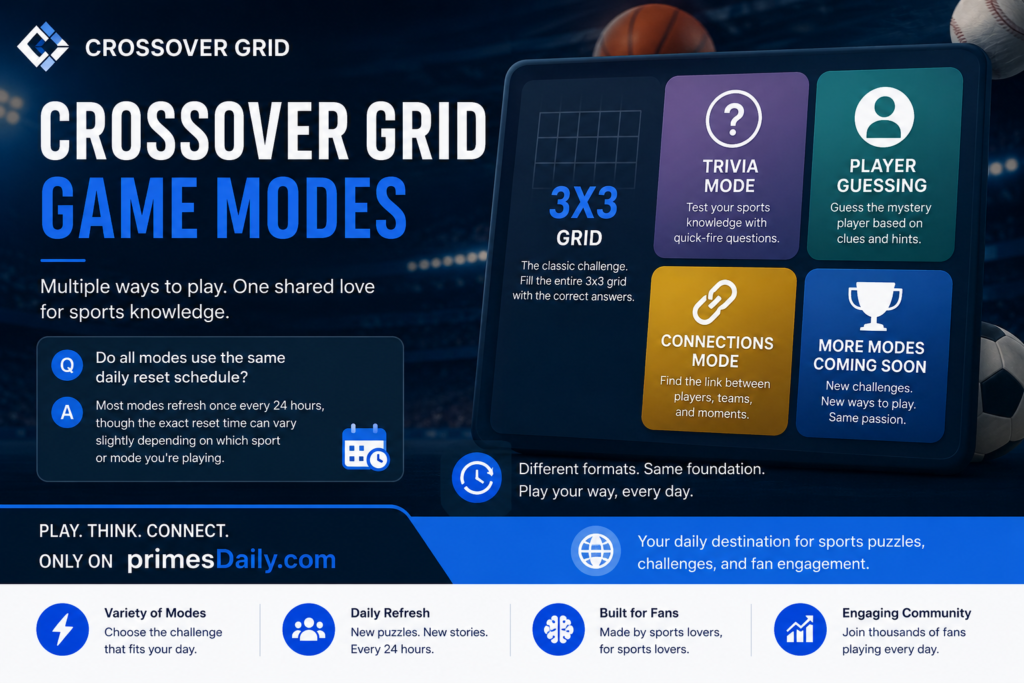
While the classic 3×3 board remains the centerpiece, the broader game has expanded into several distinct modes to keep things fresh for different types of players. Beyond the standard grid, there are trivia challenges, player-guessing formats, and connection-style puzzles, all built around the same sports-knowledge foundation but with different mechanics.
This variety matters because not every fan wants the same experience every day. Someone short on time might prefer a quick trivia round, while a dedicated fan might want the full analytical challenge of the grid itself. Having multiple formats under one roof has been a key reason the platform keeps such a wide and engaged audience.
Taken together, these formats give players a menu of options rather than a single fixed experience. On a busy day, a player might squeeze in a short trivia round during a coffee break, while on a weekend they might sit down for a full grid session along with a connections round afterward. That flexibility has become one of the biggest reasons the platform retains such a consistent daily audience.
Q: Do all modes use the same daily reset schedule? A: Most modes refresh once every 24 hours, though the exact reset time can vary slightly depending on which sport or mode you’re playing.
Crossover Grid Multiplayer Mode
One of the more recent and widely welcomed additions is multiplayer functionality, which lets friends compete on the same board in real time rather than comparing screenshots after the fact. This turns what used to be a solo daily habit into a social event, since groups can now race each other to fill squares correctly and see live results as they happen.
Multiplayer sessions typically use the same day’s board as the solo version, ensuring fairness, but add a layer of friendly competition through shared scoring and live progress tracking. For sports fan groups, family members, or coworkers who already debate stats casually, this mode has become a favorite way to settle those arguments with an actual scoreboard.
Private rooms are also commonly supported, allowing a specific group of friends to compete against only each other rather than a broader public pool of players. This creates a more personal rivalry, where inside jokes about a friend’s favorite team or a running rivalry between two fans can now be settled directly on the board instead of through casual debate alone.
Q: Do multiplayer rounds affect my personal daily stats? A: Typically yes, correct answers in multiplayer still count toward your personal history and accuracy record, in addition to how you performed against your opponents.
Crossover Grid Trivia Mode
For players who enjoy quick-fire questions more than deep grid analysis, the trivia mode offers a faster pace built around direct sports questions rather than open-ended player guessing. It’s designed for shorter sessions and tends to appeal to fans who want a mental warm-up without committing to a full grid.
Trivia rounds usually cover a wide range of topics within a chosen league, from historical records to recent standout performances, keeping the content current with each new season. Because it doesn’t require recalling exact rosters the way the grid does, this mode is often considered more approachable for newer fans still building up their sports knowledge.
Categories within trivia rounds are often organized around themes like award winners, franchise milestones, or standout single-season performances, giving each session a bit of structure rather than feeling like a random string of unrelated questions. This organization helps players build knowledge in a specific area over several days rather than jumping between completely unrelated topics each time they play.
Q: Is trivia mode easier than the classic grid format? A: Generally yes, since it relies on multiple-choice or direct-answer questions rather than requiring you to recall a specific player who satisfies two overlapping conditions.
Guess The Player in Crossover Grid
This mode flips the usual format by giving players a series of progressive clues about a mystery athlete and challenging them to identify who it is before the hints run out. Clues typically start vague, such as position or era, and become increasingly specific with details like statistics, awards, or team history.
The appeal here lies in the reveal-style pacing, which rewards players who can guess correctly with fewer hints. It’s a natural fit for fans who enjoy detective-style thinking rather than the more structured intersection logic of the main grid, and it often introduces players to athletes they may not have immediately thought of on their own.
Hints usually progress through categories like playing position, physical measurements, college or early career background, and finally specific statistical achievements, giving players multiple angles to work from before the mystery athlete’s identity becomes obvious. This layered clue structure makes the mode approachable even for someone who might not immediately recognize a player from the very first hint alone.
Q: Do earlier correct guesses earn more points than later ones? A: Yes, guessing the mystery player with fewer revealed clues generally awards a higher score than identifying them after most hints have already appeared.
Crossover Grid Connections Mode
Borrowing inspiration from word-association style puzzles, this mode asks players to sort a set of names or terms into smaller groups that share a hidden connection. Instead of matching a row and column like the classic grid, players look for the underlying theme linking four names together within a larger set.
This format tests a different kind of sports knowledge, one centered on patterns and relationships rather than direct statistical recall. It’s particularly popular among players who enjoy word puzzles in general and appreciate seeing that same mechanic applied to their favorite leagues.
Difficulty levels are often color-coded, with more obvious groupings marked as easier and trickier, more abstract connections marked as harder to spot. This tiered structure helps players gauge their progress mid-round and gives a satisfying sense of escalation as the puzzle moves from straightforward associations toward genuinely clever ones that require deeper sports knowledge to untangle.
Q: How many groups do players usually need to identify in one round? A: Most rounds are built around four separate groups, each containing a handful of names that share a specific and often cleverly hidden connection.
Crossover Grid Basketball Edition
The basketball version remains the most established and widely played edition, often referred to by fans simply as the NBA Crossover Grid. It draws from decades of league history, covering franchises, draft classes, all-star selections, and statistical milestones to build daily boards that challenge even long-time fans.
What keeps this edition consistently engaging is the sheer volume of eligible players across nearly eighty years of professional basketball, meaning categories rarely feel repetitive. Whether a board focuses on a specific era, a particular achievement, or franchise history, the basketball edition consistently ranks among the most active versions of the game.
Because professional basketball has such deep statistical archives, category combinations can range from broad, well-known achievements to highly specific single-season records that only a dedicated fan would immediately recall. This range gives both newer and veteran fans a reason to keep coming back, since even a familiar franchise can produce an unexpectedly tricky square depending on which milestone it’s paired with.
Q: Does the basketball edition include retired players as well as current ones? A: Yes, both active and retired professional players are eligible, as long as they meet the specific team and category requirements shown on that day’s board.
For the latest, updated, and unique information, visit Vintage Coach Bags.
Crossover Grid Football Edition
Football fans get their own dedicated version built around NFL rosters, franchise histories, and career achievements. This edition accounts for the unique structure of football, where players often move between practice squads, multiple teams, and specialized positions, adding an extra layer of complexity compared to other sports.
Boards in this edition frequently highlight standout draft classes, franchise records, or milestone achievements like passing yards or postseason performances. Because football has such a large roster size compared to other leagues, this edition tends to reward fans who follow team depth charts closely rather than just star players.
Draft class trivia is a particularly popular category here, since fans often enjoy testing how well they remember a specific year’s rookie group alongside the franchises those players eventually joined. Combined with postseason achievement categories, this edition tends to reward fans who follow full team rosters closely rather than only tracking the handful of star names that dominate weekly headlines.
Q: Are special teams and defensive players included in this edition? A: Yes, eligible players span every position group, including offense, defense, and special teams, as long as they meet the specific team and category conditions listed.
Crossover Grid Baseball Edition
Baseball’s long statistical history makes it a natural fit for this puzzle format, and the dedicated edition leans heavily into that tradition. Categories often reference batting records, pitching milestones, and franchise tenure, giving fans of America’s oldest major professional league plenty of material to work with.
Because baseball rosters change frequently through trades and free agency, this edition often produces surprising overlaps between teams that casual fans wouldn’t immediately expect. It has developed a strong following among fans who enjoy the deeper statistical culture that baseball is known for.
Categories frequently reference specific batting averages, home run totals, or pitching win totals tied to individual seasons rather than entire careers, adding an extra layer of precision that separates casual fans from true statistical experts. Long franchise histories stretching back decades also mean that many squares can be satisfied by players from very different eras, making historical knowledge just as valuable as familiarity with current rosters.
Q: Do minor league stints count toward eligibility in this edition? A: No, eligibility is generally based on appearances at the major league level for a given team, not time spent in the minor leagues.
Crossover Grid Soccer Edition
The soccer, or football-outside-North-America, edition broadens the game’s reach to a global audience by covering club transfers, national team appearances, and major tournament achievements. Given how frequently players move between clubs across different countries, this edition often produces some of the most surprising and difficult intersections in the entire game.
This version also occasionally features special tournament-themed boards tied to major international competitions, giving fans a timely way to engage with the sport during peak seasons. Its international scope has made it especially popular outside North America, complementing the basketball, football, and baseball editions that dominate in the United States.
Beyond the four major editions already covered, smaller communities have also started building similar boards for other leagues, including an early-stage hockey version that some fans refer to informally as the NHL edition. While it hasn’t reached the same scale as the basketball, football, baseball, or soccer versions yet, its growing presence shows how flexible this puzzle format really is across virtually any sport with a rich statistical history.
Q: Does this edition include national team appearances or only club history? A: Both are typically included, since many boards specifically combine a club team with a national team category to test a player’s full career history.
Best Strategy to Win Crossover Grid
Winning consistently comes down to a mix of pattern recognition and careful guess management rather than pure memorization. Start with the squares that intersect the most common team-category combinations, since these usually have the largest pool of correct answers and are the safest to lock in early.
Save your remaining guesses for the trickier intersections, and think through less obvious players rather than only the most famous names, since rarer correct answers often score higher. It also helps to consider players who spent time on multiple teams during their career, since they frequently satisfy tricky cross-team squares that stump players focused only on a single franchise per player.
Some experienced players also keep a mental or written note of players known for moving between multiple franchises during their careers, since these names tend to unlock otherwise difficult intersections. Building this kind of personal reference over time, even informally, can noticeably improve consistency across different boards and sport editions alike.
Q: Should I always answer with the most famous player I can think of? A: Not necessarily, since obscure but correct answers often earn a higher rarity score, so thinking beyond the obvious star names can actually improve your overall result.
Common Mistakes to Avoid in Crossover Grid
The most frequent mistake new players make is rushing through easy-looking squares without double-checking whether a player truly satisfies both conditions, which wastes valuable guesses on incorrect answers. Another common error is ignoring less famous players entirely, which can make certain intersections seem impossible when a lesser-known name would have worked perfectly.
Players also sometimes forget that a single athlete can be represented differently across categories, such as a stat achieved in one season versus a team played for in an entirely different year. Treating every square as a single isolated question rather than considering full career context tends to lead to unnecessary wrong guesses.
Overconfidence is another trap worth watching for, especially when a square looks deceptively simple at first glance. Players sometimes assume a well-known star automatically fits a category without double-checking specific season or team details, only to find out the guess was technically incorrect. Slowing down for even a few extra seconds on seemingly easy squares often prevents these avoidable errors.
Q: Is it a mistake to guess quickly without much thought? A: Yes, since guesses are limited, taking a moment to consider a player’s full career history before submitting an answer usually leads to far better results than guessing impulsively.
Crossover Grid App vs Website
Players can enjoy this puzzle experience either through a browser on the official website or through a dedicated mobile app, and each option has its own advantages. The website tends to offer the classic, no-frills daily grid experience with fast load times and straightforward navigation across different sports editions.
The mobile app, meanwhile, has expanded to include additional modes such as trivia, detective-style guessing, and personalized profile features like team logo avatars, alongside a deeper archive of past boards. For players who want the full range of modes in one place with offline convenience, the app is generally the more complete option, while the website remains ideal for a quick daily session.
Push notifications through the mobile app have also become a popular convenience, reminding players when a fresh board has dropped without needing to remember to check manually each day. For players juggling multiple sport editions at once, this small feature alone has made the app a more practical daily companion compared to relying solely on the website.
Q: Does progress carry over between the website and the app? A: This depends on account linking, so players who want consistent stats across both platforms should make sure they’re signed into the same account on each.
Crossover Grid Ratings and Reviews
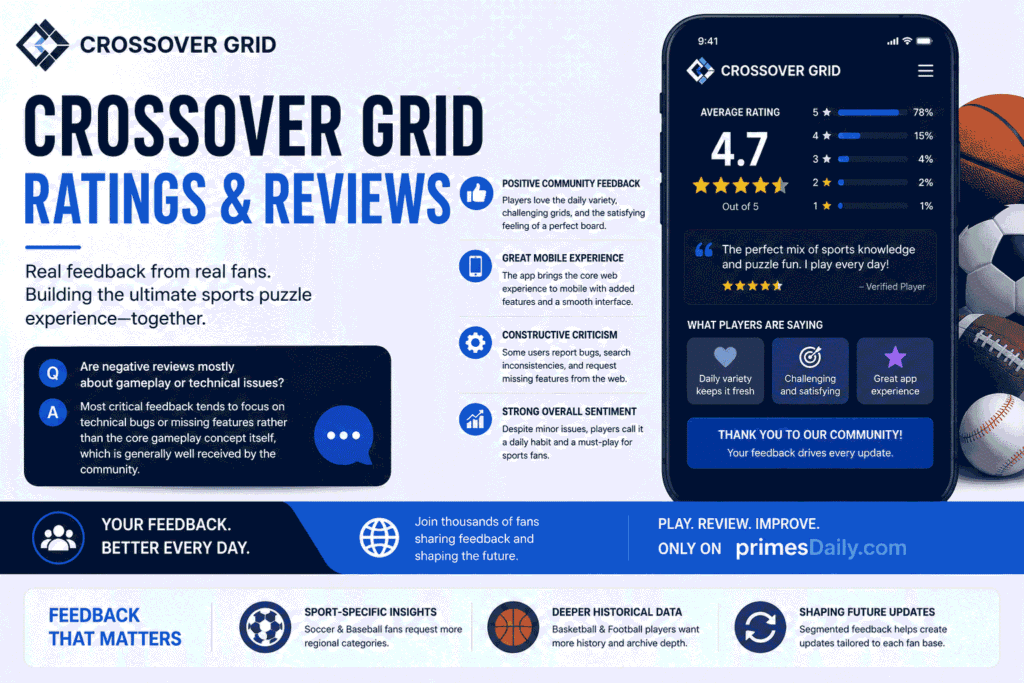
Community feedback throughout 2026 has generally been positive, with many players praising the daily variety and the satisfying challenge of filling a perfect board. The app in particular has received recognition for successfully translating the core web experience into a mobile-friendly format while adding extra features not originally available on the website.
Some reviews do point out occasional bugs or inconsistencies with search functionality, along with requests for missing features that longtime web users had grown accustomed to. Overall sentiment still leans strongly favorable, with many players describing it as one of their regular daily habits alongside other sports content they follow.
Interestingly, feedback patterns tend to differ slightly by sport edition, with soccer and baseball fans occasionally requesting more region-specific categories, while basketball and football players more often ask for deeper historical archives. This kind of segmented feedback has helped shape updates that feel tailored to each fan base rather than applying one generic set of changes across every edition equally.
Q: Are negative reviews mostly about gameplay or technical issues? A: Most critical feedback tends to focus on technical bugs or missing features rather than the core gameplay concept itself, which is generally well received by the community.
Latest Updates in Crossover Grid 2026
The year 2026 has brought several meaningful additions, including new game modes like actor and movie-themed guessing formats that expand beyond pure sports content. A soccer-specific grid mode was also introduced, broadening the platform’s international appeal alongside the existing basketball, football, and baseball editions.
Premium features have been introduced as well, unlocking exclusive game modes and personalized profile customization such as team logo avatars for players who want a more tailored experience. A major archive expansion has also given players access to a much deeper backlog of previous daily boards, alongside daily personalized content updates.
Looking at the pace of updates so far, it’s clear the development direction favors steady, community-informed additions rather than infrequent large overhauls. Players can reasonably expect continued refinements to existing sport editions alongside occasional new formats, especially as feedback from the expanding international soccer audience continues to shape future priorities.
Q: What is the biggest new addition introduced this year? A: The expansion into soccer-specific grids alongside new entertainment categories like movies has been one of the most significant updates, broadening the platform well beyond its original sports-only focus.
Crossover Grid Privacy and Data Usage
Like most modern apps, this platform collects certain categories of user data to support core functionality, personalization, and analytics. This can include information used for product personalization and app functionality, as well as data related to analytics that helps improve the overall experience over time.
Some data may also be used for advertising or marketing purposes, both by the developer directly and through third-party advertising partners, though this varies depending on platform settings and regional privacy regulations. Players concerned about privacy can typically review and adjust relevant permissions through their device or account settings.
Most platforms in this category also provide a settings menu where players can review exactly which data categories are enabled, offering a degree of control over personalization and advertising preferences. Taking a few minutes to review these settings after installing the app is generally a good habit for anyone who wants a clearer picture of exactly what information is being collected and why.
Q: Is personal data shared with third parties? A: Certain data not directly linked to your identity may be used for third-party advertising purposes, though the extent of this depends on your specific app settings and regional privacy rules.
Accessibility Features in Crossover Grid
Accessibility has become an increasing focus for the platform as its user base has grown more diverse. This includes considerations for screen reader compatibility, adjustable text sizing, and interface elements designed to be usable across a wide range of devices and player needs.
While specific accessibility features can vary between the website and mobile app versions, the overall direction has been toward making the daily puzzle experience usable by as many players as possible, regardless of device type or individual accessibility requirements.
Color contrast and colorblind-friendly design choices have also become a consideration in recent updates, since the grid layout relies partly on visual cues to indicate correct, incorrect, or empty squares. Making sure these indicators remain distinguishable for players with different types of color vision helps keep the experience fair and enjoyable for the widest possible audience.
Q: Can the game be played comfortably on smaller mobile screens? A: Yes, the interface is designed to scale across different screen sizes, though some players may find the grid slightly easier to navigate on larger displays.
Benefits of Playing Crossover Grid Daily
Beyond entertainment, playing this puzzle regularly offers genuine cognitive and social benefits. It exercises memory recall, pattern recognition, and quick decision-making, since players must connect specific facts under a limited number of attempts each day.
It also creates a natural daily habit that many players look forward to, similar to other popular daily puzzle formats, while doubling as a great conversation starter among sports fans who enjoy comparing scores and debating tricky squares with friends. For fans looking to sharpen their sports knowledge in a fun, low-pressure way, consistent daily play offers a steady and enjoyable way to build that expertise over time.
There’s also a subtle social benefit worth mentioning: shared daily puzzles like this one give people an easy, low-stakes reason to check in with friends or family members who share a sports interest. A quick message comparing scores or debating a tricky square can turn into a genuine daily connection point, something that’s easy to underestimate until it becomes part of a regular routine.
Q: Can playing regularly actually improve someone’s general sports knowledge? A: Yes, consistent daily play naturally exposes players to a wide range of statistics, rosters, and historical facts across different eras and teams, gradually building genuine sports knowledge over time.
Crossover Grid Community and Leaderboards
A strong community has formed around this daily puzzle, with players regularly sharing their scores and comparing results across social platforms. Leaderboards add a competitive layer by ranking players based on accuracy and the rarity of their correct answers, encouraging friendly rivalry among regular participants.
This community aspect has become one of the platform’s biggest strengths, turning a simple daily puzzle into an ongoing shared experience. Fans following dedicated social accounts for individual sports editions often get early looks at upcoming features, along with a space to discuss particularly tricky boards with fellow players.
Some players also track longer-term achievements, like consecutive days played or overall accuracy percentage, which adds a layer of personal progress on top of daily competition against others. This combination of short-term rivalry and long-term personal milestones has proven to be a strong formula for keeping the community engaged well beyond a passing trend.
Q: Do leaderboards reset daily along with the board itself? A: Daily leaderboards typically reset with each new board, though many platforms also maintain longer-term rankings that track overall performance across weeks or months.
FAQs
What is Crossover Grid in simple terms? It’s a daily sports puzzle where players fill a nine-square board by naming athletes who match both the row and column categories shown for each square.
How many guesses do players usually get per board? Most boards allow around nine total guesses, though this can vary slightly depending on the specific sport edition or game mode being played.
Is there a new puzzle every single day? Yes, boards reset daily across all major sport editions, ensuring players get fresh categories and challenges rather than repeated content.
Which sports are currently covered? Basketball, football, baseball, and soccer all have dedicated editions, with additional entertainment-focused modes like movies also available.
Is playing free, or does it require payment? The core daily experience is free to play, though optional premium features can unlock additional modes and personalization options.
Conclusion
Crossover Grid has grown from a simple daily challenge into a full ecosystem of sports and entertainment puzzles spanning basketball, football, baseball, and soccer. Its mix of strategic guessing, limited attempts, and daily variety keeps both casual fans and hardcore sports followers coming back for more. With multiple modes, an active community, and steady updates throughout 2026, it continues to offer one of the most engaging ways for fans to test and build their sports knowledge, all in one place without needing to search anywhere else for answers.
For the latest, updated, and unique information, visit Springfield Movie Theater.