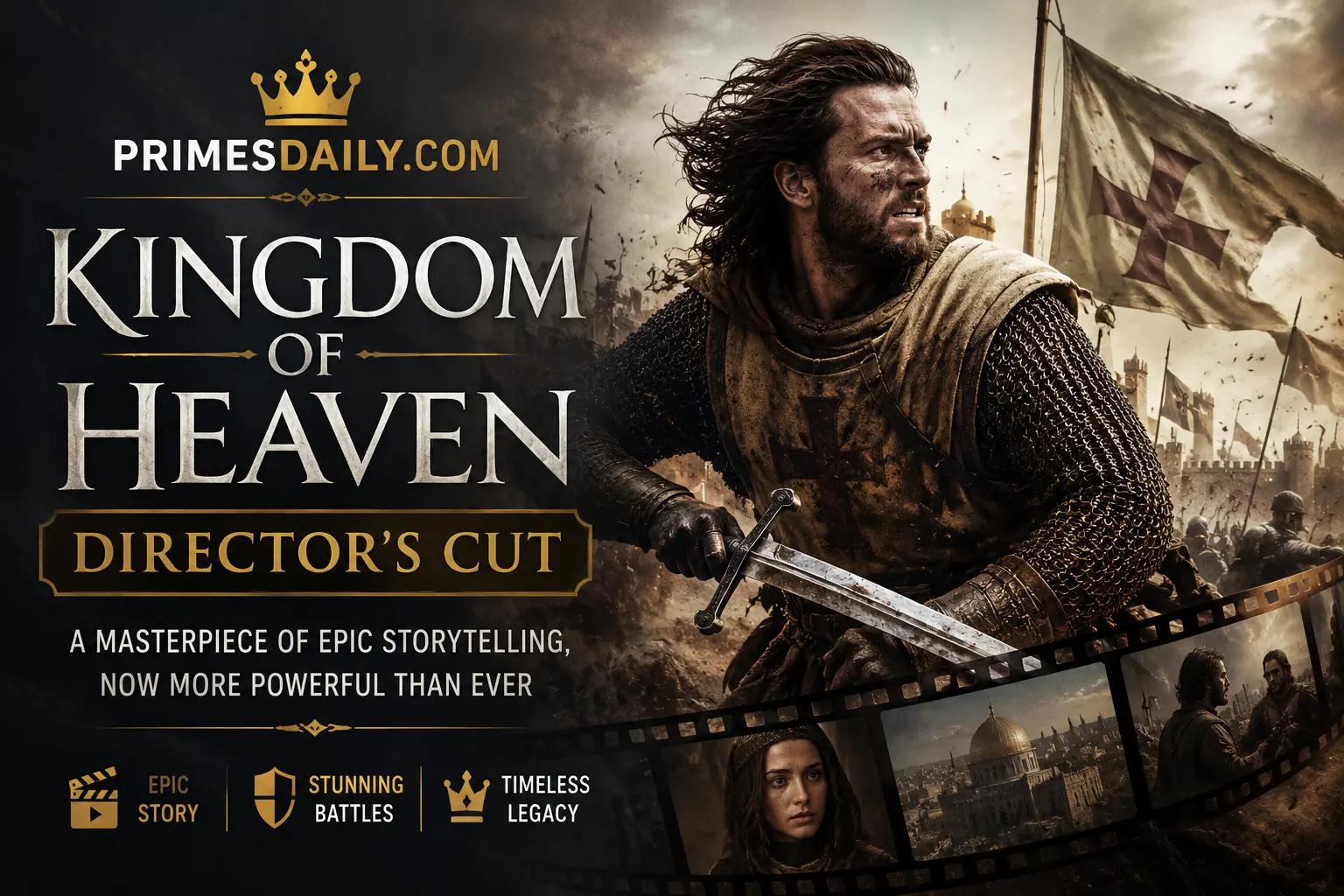
When Ridley Scott’s original theatrical release hit cinemas in 2005, audiences walked out feeling let down. Two decades later, in 2026, the extended version of this film has earned a reputation as one of the most celebrated re-edits in modern cinema.
So what changed? The short answer: a director’s true vision finally replaced a studio’s compromise.
This transformation is one of the most striking in film history. Adding roughly 45 minutes of previously unseen footage reshaped how viewers understand the entire story.
But what really makes this version so different? Is it simply a longer cut, or does it offer something genuinely transformative? This guide covers everything — from production design to philosophical themes — explaining why the Kingdom of Heaven Director’s Cut still belongs in every film lover’s 2026 collection.
Kingdom of Heaven Director’s Cut – What You Need to Know
This release is Ridley Scott’s fully realized take on the Third Crusade era. It follows Balian of Ibelin, a figure who takes on the defense of Jerusalem against Sultan Saladin.
The original theatrical release ran 145 minutes when it opened on May 6, 2005. Fox, however, had pushed Scott to trim nearly 45 minutes from his original three-hour vision.
What did those missing 45 minutes actually contain? Studio-mandated cuts removed key character development, important plot threads, and much of the film’s thematic weight. The extended version premiered on December 23, 2005, running 194 minutes in its roadshow presentation — and the reaction couldn’t have been more different.
Why does this longer edition still matter to 2026 viewers? It opens with an overture and includes an intermission, echoing classic Hollywood epics from the 1960s and 70s. Far from nostalgic filler, these elements genuinely shape pacing and immersion.
Orlando Bloom leads the cast, supported by Jeremy Irons, Eva Green, Edward Norton, and David Thewlis. Together they dig into faith, honor, and religious conflict in a way the shorter cut never fully allowed.
Why should today’s audiences care? This edit speaks directly to modern conversations about religious tolerance, the cost of war, and coexistence between faiths — themes that feel just as relevant now as they did in 2005.
Theatrical vs Director’s Cut – The Major Differences
That 45-minute gap changes the story in meaningful ways. Both versions track Balian’s journey from blacksmith to defender of Jerusalem, but the shorter cut skips crucial context along the way.
How does the pacing differ? In the theatrical release, Balian reaches Jerusalem around the 33-minute mark. In the extended cut, that moment arrives at 47 minutes — not just a runtime difference, but a stretch of character-building the original audience never saw.
What changed about the priest character? Michael Sheen’s priest is a minor presence in the theatrical version. The longer cut reveals he’s actually Balian’s half-brother, adding real emotional stakes. It also clarifies that he desecrated Balian’s wife’s body out of personal cruelty, not religious duty — a distinction that disappears entirely in the shorter edit.
Who is Baldwin V? Sibylla’s son and heir to Jerusalem’s throne doesn’t appear at all in theaters. Without him, Sibylla’s choices make little sense — why would she hand power to a husband she despises?
The longer version explains it clearly: she stays with Guy to protect her son from assassination. That single piece of context turns her arc from confusing to genuinely complex.
Why did the shorter cut struggle thematically? It lost narrative coherence. The extended edition makes clear that holiness comes from right action and moral courage, not blind religious obedience — a thread that’s nearly impossible to follow in the trimmed version.
How does the siege sequence compare? In theaters, Jerusalem’s fall looks impressive but feels emotionally flat. The longer cut builds up military preparation and personal stakes beforehand, so the final assault feels earned rather than rushed.
Extended Scenes That Changed Everything in Kingdom of Heaven Director’s Cut
Looking closely at the added scenes shows just how deliberately Scott built this story. These aren’t throwaway additions — they’re core character choices.
The priest confrontation gains real weight through extended dialogue that reveals his motivations. Instead of appearing suddenly villainous, he shows a pattern of cruelty across several scenes — slapping and shoving Balian, mocking his passivity, while Balian repeatedly turns the other cheek.
Why does this matter? It establishes Balian’s core trait: a deep reluctance toward violence, used only as an absolute last resort.
How does this change the killing scene? When Balian finally kills the priest, it lands as a genuine turning point. Viewers understand it goes against everything he stands for, which makes his guilt afterward feel earned rather than arbitrary.
What about the Hospitaller scenes? In theaters, David Thewlis’s character comes across as simply mysterious. The longer cut hints he may be something more — angelic, even. One moment shows him vanishing the instant Balian looks away; another shows him reviving Balian with a touch to the forehead, suggesting divine intervention.
These supernatural touches are completely missing from the shorter version, stripping out an entire spiritual layer of the story.
How does the Ibelin sequence expand things? Balian applies his practical skills to improve irrigation and help the town thrive, showing his capacity to build, not just destroy. By the time conflict arrives, viewers already understand he carries both martial skill and humanitarian instinct.
What changed about Sibylla? Additional scenes reveal her intelligence, political awareness, and devotion as a mother. The moment where she poisons her son to spare him from leprosy carries far more weight once earlier scenes establish the impossible choices medieval life forced on her.
Why Ridley Scott’s Director’s Cut Vision Matters
Scott has built a career on extended cuts that often surpass their theatrical counterparts, a pattern that started with 1982’s Blade Runner and its many re-edits. This film continues that legacy, showing Scott’s refusal to trade artistic vision for commercial safety.
What did Scott say about it? He put it plainly: “This is the one that should have gone out.” That wasn’t a throwaway comment — it reflected years of frustration with studio interference and pressure from Fox to trim a story he considered essential.
Scott leans into visual storytelling and thematic complexity over simple plotting. Fox, on the other hand, wanted a more conventional action-adventure with a romantic subplot — an approach that stripped out the questions about faith, tolerance, and holiness Scott saw as the film’s core.
When was this made, and why does the timing matter? It arrived during the post-9/11 era, a moment when American society was deeply preoccupied with religious conflict. Scott built the story as a deliberate response to that climate, using medieval history to comment on modern sectarian tension.
The theatrical cut’s removal of that thematic content left the commentary almost invisible, leaving audiences wondering why the film felt so politically flat.
What changed by 2026? The 2005 restoration let audiences finally see Scott’s complete vision. A stunning 4K restoration released in May 2025 only reinforced the film’s lasting cultural relevance and Scott’s reputation as a filmmaker unwilling to settle.
The Storytelling That Was Missing – Kingdom of Heaven Director’s Cut Analysis
The longer version structures its story around character revelation rather than plot convenience — a far more sophisticated approach than typical blockbuster filmmaking, which usually leans on action and romance.
Why does Balian turn down power? In theaters, this looks almost petty — he refuses a crown that could help save Jerusalem. The extended cut makes clear Balian holds a genuine spiritual commitment to non-violence. His refusal isn’t selfishness; it’s loyalty to his deepest principles. Taking the crown would mean ordering executions, something fundamentally at odds with who he is.
How does this reshape the ending? The shorter cut leaves audiences unsure about Balian’s moral standing — did he fail his people? The longer version frames his choice as spiritually consistent. By refusing an expedient evil, even to save the greater good, he stays true to himself even as Jerusalem falls.
What role does Baldwin V play? The young prince reshapes the entire political landscape. In theaters, Sibylla’s rule feels almost pointless. The extended cut shows she’s acting as regent, protecting her son’s future — which makes her decision to spare him from leprosy through poison read as mercy, not madness.
Why does her handover of power to Guy make sense? Once she’s no longer fighting for her son’s future, she gives in to despair. That context makes her choices emotionally understandable rather than baffling.
What about Tiberias? Jeremy Irons’s character gets real room to breathe. The longer cut shows his strategic wisdom stands above both Guy and the Templars. When he leaves Jerusalem before the siege, it plays as pragmatic realism — the city simply can’t be defended — not cowardice.
Cast and Production Behind Kingdom of Heaven Director’s Cut
The ensemble includes some of cinema’s finest talent, and understanding their contributions explains why the film still holds up in 2026.
Orlando Bloom anchors the story as Balian. Some critics felt he lacked gravitas, but the added character development gives his performance far more room to land. Bloom captures the tension between warrior and peaceful blacksmith convincingly.
Edward Norton turns in a career-best performance as the leper king. Spending most of the film behind a mask, he still communicates deep emotion through voice alone — portraying Baldwin as a tragic figure carrying both disease and the impossible burden of peacekeeping.
Eva Green brings intelligence and vulnerability to Sibylla. The extended scenes let her show both aristocratic authority and personal anguish, turning her into a genuinely sympathetic character rather than a simple plot device.
Jeremy Irons plays Tiberias, the pragmatic advisor, bringing gravitas and world-weariness that makes his eventual departure feel like sound judgment, not cowardice.
David Thewlis as the Hospitaller adds a layer of spiritual mystery. His subtle supernatural hints — vanishing and reappearing without explanation — only exist in this longer cut. He also delivers the film’s most memorable line: “All death is certain.”
Who handled the cinematography? John Mathieson created the sweeping landscapes and carefully composed battle sequences, work that earned multiple award nominations and remains one of the film’s standout achievements.
What about production design? Arthur Max built an enormous medieval Jerusalem replica using mostly practical sets rather than heavy CGI, giving the film a tangible sense of historical scale and authenticity.
Cinematography and Visual Effects in Kingdom of Heaven Director’s Cut
John Mathieson’s cinematography leans into vast landscapes and architectural detail, shot across Morocco and Spain with close attention to historical accuracy.
How do the desert sequences work? Mathieson’s wide-angle shots turn what could be empty scenes into something visually hypnotic, conveying both the scale of the Crusader journey and the isolation of medieval warfare.
How do the visual effects differ from typical blockbusters? Instead of leaning entirely on digital work, the production combined practical sets with targeted CGI. The siege uses massive practical walls enhanced with effects for crowds and destruction, creating a hybrid look that feels both grand and physically real.
Which studios handled the effects work? Moving Picture Company completed 440 visual effects shots, with additional support from Double Negative and Framestore CFC — all focused on enhancing practical footage rather than building implausible digital environments.
What about costumes and armor? Janty Yates earned award nominations for period-accurate designs that communicate social hierarchy and cultural identity — ornate Crusader armor set against flowing Islamic garments reinforcing the film’s cultural themes.
How does lighting factor in? Warm earth tones dominate the Jerusalem scenes, while cool blues take over during European sequences. Most viewers won’t consciously notice this, but it shapes emotional tone throughout.
Kingdom of Heaven Director’s Cut Bonus Features and Extras
The four-disc special edition packs in supplementary material that offers real insight into Scott’s process and the film’s historical backdrop, turning the release into something close to an educational experience.
The Path to Redemption is the main documentary, running over two hours and covering production, themes, and historical context through interviews and behind-the-scenes footage.
Creative Accuracy: The Scholars Speak tackles the history directly. Medieval scholars, including Dr. Nancy Caciola, discuss the balance between authenticity and dramatic license, generally validating the broad accuracy while noting where the film takes liberties.
The Pilgrim’s Guide offers a feature-length look at filming locations and production design, tracing the journey from France through the Mediterranean to Jerusalem.
The Engineer’s Guide covers the technical side — cinematography, visual effects, and sound design — aimed at anyone curious about building immersive historical worlds on screen.
What about the roadshow presentation? It includes an overture before the film and an intermission with entr’acte music around the 100-minute mark, classic touches that suit a 194-minute epic.
Audio Commentary and Behind-the-Scenes Content
The special edition includes three separate commentary tracks, each offering a different lens on how the film came together.
First track: Ridley Scott, writer/producer William Monahan, and Orlando Bloom cover directorial choices, script decisions, and character interpretation. Scott is candid about his frustration with studio interference.
What does Scott reveal here? He talks openly about his dissatisfaction with the theatrical cut’s coherence and explains specific scenes Fox insisted on trimming — and how those removals hurt the story. It confirms what many viewers already sensed: the shorter version felt incomplete for a reason.
Second track: Executive producer Lisa Ellzey, VFX supervisor Wesley Sewell, and first AD Adam Somner discuss production logistics and the challenges of filming across multiple European locations — useful listening for anyone interested in the production side of filmmaking.
Third track: Editor Dody Dorn walks through pacing decisions and explains how the restoration recovered footage that had been lost, offering a clear look at how editing shapes narrative meaning.
Additional extras include production diaries, cast interviews on character development, and technical breakdowns of how the siege sequence was built.
Historical Accuracy in Kingdom of Heaven Director’s Cut
The story deliberately fictionalizes real historical events, and understanding those changes helps place the film’s themes within actual medieval history.
The narrative centers on the Third Crusade, particularly the Battle of Hattin (1187) and the Jerusalem siege that followed. Saladin, the historical Islamic military leader, recaptured Jerusalem from the Crusaders during this period.
How accurate is Balian’s portrayal? The real Balian wasn’t a French blacksmith at all — he was an established noble lord. The film reinvents him as a commoner who rises through skill and character, using that shift to explore ideas about earned versus inherited status.
What about King Baldwin IV? The character reflects the historical reality of his leprosy and his efforts to maintain peace, though the film leans more heavily into mask-wearing and isolation than most historical accounts suggest. Scholars note the real Baldwin remained active in military campaigns despite his illness.
Was Sibylla accurate? Historically, she was more devoted to Guy and less sympathetic than her on-screen version. The film reimagines her as an intelligent woman caught by political necessity rather than an ambitious villain.
What about the Templars? They’re painted as cartoonishly villainous on screen. In reality, they were a controversial and aggressively militaristic order that did contribute to the kingdom’s downfall — but the film exaggerates their role.
Is the siege itself accurate? It draws on real historical accounts of the 1187 siege, though specific details — including Balian’s negotiations and his destruction ultimatum — are dramatic inventions.
For the latest, updated, and unique information, visit Springfield Movie Theater.
The Crusades Depicted in Kingdom of Heaven Director’s Cut
Understanding the real Crusades adds depth to the film’s themes. The Crusades were centuries of conflict between Christian European and Islamic Middle Eastern powers, with lasting consequences for both sides.
Which Crusade does the story focus on? The Third Crusade (1187–1192), a period when Crusader dominance was already fading. The film picks up after the Battle of Hattin, where Saladin’s forces crushed the Christian army and took back significant territory, including Jerusalem.
Did real periods of peaceful coexistence exist? Yes. Historians confirm that Jerusalem under Baldwin IV maintained a fragile but genuine peace, with Christian, Muslim, and Jewish communities coexisting and trading despite ongoing tension — a foundation the film builds its coexistence themes on.
Why choose the Third Crusade instead of the First? The First Crusade (1096–1099) involved brutal massacres that would have complicated the film’s message of tolerance. The Third Crusade, by contrast, was a period where fading Crusader power forced more pragmatic accommodation between faiths.
How is Saladin portrayed? As a chivalrous, capable leader — a portrayal that lines up with most historical accounts. He treated defeated enemies with more mercy than his Christian counterparts often did, a positive depiction that holds up despite the post-9/11 backdrop of the film’s production.
What’s the film’s core message? That religious war ultimately serves earthly power more than faith itself — a skeptical take on religious militarism that sets it apart from more conventionally heroic epics.
Character Development Arc – Kingdom of Heaven Director’s Cut
The film shows a genuinely sophisticated grasp of character transformation, with every major figure changing meaningfully across the extended runtime.
Balian’s arc moves from grief-stricken blacksmith to warrior to spiritual seeker. The story opens with him consumed by guilt over his wife’s suicide, a wound that becomes the foundation for everything that follows.
Throughout, he consistently chooses mercy over vengeance — sparing the Muslim cavalier, refusing to massacre civilians, resisting the call to execute Guy — reinforcing that his nature stays peaceful no matter the circumstances.
How does his journey end? He turns down glory, refuses Richard the Lionheart’s invitation to keep fighting, and returns to France — suggesting he’s found spiritual peace not through more warfare, but by stepping away from it entirely.
Sibylla’s arc traces a descent from hope into despair. She seeks real emotional connection with Balian, hoping to escape political scheming, only to have that hope shattered when her son contracts leprosy — leading to the traumatic decision to end his suffering herself.
Baldwin IV’s arc is about holding onto spiritual integrity as his body fails him. His deathbed request that Balian marry Sibylla reflects his attempt to protect his legacy, and his calm acceptance of Balian’s refusal shows real wisdom — that true peace can’t simply be imposed by politics.
Guy de Lusignan moves in the opposite direction entirely. While others grow, he sinks further into ambition — willing to risk the kingdom, push aggressive militarism against impossible odds, and eliminate anyone standing in his way.
Where to Buy Kingdom of Heaven Director’s Cut – 4K, Blu-ray & Streaming
A range of formats now cater to different preferences and home setups.
What physical media is currently available? The May 2025 4K Ultra HD Blu-ray restoration is the most recent release, including both the standard extended cut and the roadshow presentation with overture and intermission, remastered for modern home theaters.
Are there steelbook editions? Yes — the 4K release comes in both standard and premium steelbook packaging, with limited variants featuring embossed artwork and region-free playback.
What about standard Blu-ray? These remain widely available and offer strong quality at a lower price point than the 4K editions, typically including the same bonus content. Retailers in Pakistan carry both local and imported versions.
Is DVD still an option? Older editions circulate through resellers and specialty retailers, with the original 2006 four-disc special edition commanding premium prices among collectors.
What about streaming? Availability shifts depending on licensing, but the film remains accessible through major platforms in most regions — worth checking Netflix, Amazon Prime, and Disney+ for current availability in Pakistan.
Digital purchase options? Amazon Prime Video and iTunes both offer permanent digital ownership without a subscription, usually including both theatrical and extended versions.
Kingdom of Heaven Director’s Cut – Different Formats and Editions
The sheer number of editions reflects the film’s lasting popularity and the steady march of home media technology.
The roadshow version recreates the classic Hollywood theatrical experience, with an overture setting the tone and an intermission around the 100-minute mark — a nod to epics like Ben-Hur and Lawrence of Arabia.
What sets roadshow apart from the standard cut? It adds exactly 5 minutes of musical content — the overture and entr’acte — while keeping the same 194-minute runtime, appealing to purists who appreciate classical Hollywood presentation.
What about the 2014 Ultimate Edition? It packed in plenty of special features but has since been superseded by the 2025 4K restoration, though some copies feature exclusive artwork and regional packaging worth seeking out.
How was the digital restoration handled? The 2025 4K release was a multi-year project addressing the original 35mm cinematography, applying color correction and enhancement while staying true to Mathieson’s original intent.
Was there a theatrical screening? Yes — a one-night-only 4K screening in May 2025 gave audiences a rare chance to see the film’s full scope on the big screen, marking its 20th anniversary through 20th Century Studios.
Best Scenes and Iconic Moments in Kingdom of Heaven Director’s Cut
Certain sequences here stand out as genuinely excellent filmmaking, cementing the reputation this cut has built over two decades.
The Jerusalem siege is the film’s crowning achievement — a roughly 30-minute sequence blending practical effects, visual enhancement, and careful directorial pacing. Massive crowd scenes sit alongside intimate character moments, balancing spectacle with real emotional stakes.
Why does the siege work so well cinematically? Scott refuses to glorify combat through triumphant editing. Fighting looks brutal and exhausting, defenders die without fanfare, and victory comes down to sheer numbers rather than heroics — a portrayal that sets this apart from more celebratory war epics.
The opening duel between Balian and a Muslim cavalry officer earns its power through restraint rather than extended sword choreography, focusing instead on Balian’s choice to spare his defeated opponent — a moment that captures the film’s central idea that nobility comes from compassion, not combat skill.
The negotiation between Balian and Saladin turns the film briefly into political drama. Two warriors from opposing faiths speak with mutual respect despite the conflict between them, and Saladin’s offer of safe passage reflects a code of honor that quietly pushes back against religious prejudice.
Balian’s knighting scene, significantly expanded in this cut, becomes something closer to spiritual initiation than a simple ceremony. Baldwin’s blessing emphasizes virtue and moral courage over birthright, reinforcing the film’s larger point about where true nobility comes from.
Kingdom of Heaven Director’s Cut vs Other Epic Films
Comparing this film to other historical epics helps highlight what makes its storytelling and themes distinct.
Against Ridley Scott’s own Gladiator (2000)? This film takes a more philosophically complex approach. Where Gladiator leans into revenge as satisfying, this story questions whether that kind of satisfaction ever serves a genuinely meaningful purpose — Balian’s victory over Guy brings him no real triumph, because it doesn’t serve any larger moral goal.
Against Peter Jackson’s Lord of the Rings? Jackson’s trilogy leans into ensemble heroism and eventual triumph over darkness. This story ends in a kind of qualified failure — Jerusalem falls despite a heroic defense, suggesting personal virtue can’t always overcome historically inevitable outcomes.
Against Michael Mann’s The Last of the Mohicans? This film leans harder into political complexity and religious philosophy, presenting both sides of the conflict as genuinely honorable rather than splitting the story into clear heroes and villains.
Against Spielberg’s Lincoln? Spielberg tends to prioritize personal relationships and individual growth. Scott instead leans on visual spectacle and philosophical questioning, examining how personal virtue holds up against much larger historical forces.
What about the cinematography specifically? Sweeping landscape shots and carefully composed frames set this apart from the shaky-cam action style common in modern blockbusters, favoring classical composition and scale over raw visceral immediacy.
Similar Movies to Kingdom of Heaven Director’s Cut for 2026
A handful of other titles share similar themes or visual sensibilities worth exploring.
The Last Duel (2021) — Also directed by Ridley Scott, this medieval story examines honor and justice through competing perspectives on the same events, echoing the idea that historical truth is rarely simple.
Lawrence of Arabia (1962) — David Lean’s classic shares the same visual grandeur and philosophical look at warfare across cultural lines, with a protagonist caught between Western and Middle Eastern worlds.
Dune (2021) — Denis Villeneuve’s film explores political complexity and religious fanaticism through a protagonist uneasy with the power thrust upon him, much like Balian’s discomfort with authority.
The Name of the Rose (1986) — Shares an interest in spirituality and political power within a medieval setting, suggesting institutional religion can drift far from spiritual truth.
Troy (2004) — Also adapts historical events through fictionalized characters, questioning whether martial glory is ever worth the human cost involved.
Braveheart (1995) — Both films explore resistance to domination, though Braveheart leans into nationalist pride while this story leans into spiritual resistance against ideological coercion.
Critical Reception of Kingdom of Heaven Director’s Cut
Critical response has shifted dramatically since the theatrical version first hit screens in 2005.
How were the initial reviews? Rotten Tomatoes aggregated the theatrical release at around 39% positive, with critics noting technical polish and visual beauty but calling it out for lacking depth and narrative coherence — a fair summary of a gorgeous film with a hollow story.
How did critics reassess the longer version? Opinion shifted sharply after its December 23, 2005 debut. Empire magazine gave it four stars, describing the restored 45 minutes as filling in pieces of an otherwise incomplete puzzle — a comment that became the defining take on what audiences had been missing.
Critics praised the expanded character work and thematic clarity. James Berardinelli, who had criticized the theatrical cut’s muddled storytelling, reversed his opinion entirely, calling the extended version far more insightful into character motivation.
Total Film also awarded four stars, backing up Scott’s claim that this longer cut represented his genuine artistic intent.
Academic critics and historians have increasingly pointed to it as a sophisticated look at religious conflict and political morality, cementing its place as one of the strongest examples of a director’s cut outshining its theatrical release.
Where does that leave things in 2026? It’s now firmly regarded as a genuine masterpiece, regularly cited by filmmakers and critics as proof that directorial vision can outlast studio compromise.
Audience Reviews and Ratings
Audience opinion has shifted just as dramatically as critical opinion since 2005.
How was the theatrical version received? It earned a CinemaScore of B-, reflecting moderate but reserved satisfaction — a lukewarm response that contributed to disappointing box office numbers, particularly in the US.
How did audience opinion shift with the extended cut? Home media reassessment picked up steam quickly. IMDb ratings reflect the shift clearly, with the longer version scoring roughly one to two points higher than the theatrical cut across thousands of reviews.
What do online communities say? Reddit has embraced the extended cut as a rediscovered masterpiece, with viewers frequently describing the experience as transformative compared to the theatrical version, which they say failed to convey the director’s real intent.
What about review platforms generally? Rotten Tomatoes, Letterboxd, and similar sites highlight character depth, philosophical weight, and emotional payoff, with audiences appreciating a film that doesn’t oversimplify complex political and moral questions.
How does it fare on streaming ratings? The extended version consistently scores 8.0 or higher across platforms — a sustained rating that suggests genuine appreciation rather than novelty.
Why Kingdom of Heaven Director’s Cut is Superior to Original
Several factors make the case that this longer edit outperforms the theatrical release across nearly every dimension of filmmaking.
Narrative coherence is the clearest improvement. The shorter cut leaves character motivations feeling arbitrary — why does Sibylla betray Balian? Why does he turn down power? The longer version answers both through consistent character logic.
Character depth stands out through scenes that reveal genuine psychological complexity. Where the theatrical cut reduces people to plot function, the extended version gives them real, comprehensible motivations and conflicting desires.
Does the extra runtime hurt pacing? Not really. The added 49 minutes build thematic weight rather than padding things out, and most viewers report the length passes quickly given how much emotional and philosophical ground it covers.
Thematic coherence improves significantly too. The shorter cut handles religious philosophy inconsistently, while the longer version develops its ideas about sanctity, moral courage, and interfaith coexistence with real consistency.
Visual pacing benefits as well, alternating between massive battle sequences and quieter character moments rather than cramming action together, which keeps the film from feeling visually exhausting.
The Jerusalem siege in particular hits much harder here, since audiences already understand the stakes and relationships involved, turning pure spectacle into something genuinely meaningful.
FAQs
What is the exact runtime?
The roadshow presentation runs 194 minutes, including a 5-minute overture and a 189-minute feature. Standard editions run around 189 minutes without the overture or intermission.
Where can I watch it in 2026?
It’s available through Netflix, Amazon Prime Video, and Disney+, depending on region. Physical media includes both 4K and standard Blu-ray, with the May 2025 4K release offering the best technical quality.
How much extra footage was added?
Roughly 45–49 minutes of previously cut footage was restored — about 33% more content than the 145-minute theatrical version.
Why was that footage removed in the first place?
Fox pushed for cuts to shorten the runtime and simplify the story, partly attributing the film’s commercial underperformance to length and partly to post-9/11 audiences’ limited appetite for religious complexity.
Should I watch the theatrical or extended version?
Go with the extended version. The theatrical cut feels incomplete and disjointed by comparison — the longer edit is stronger on nearly every front.
Is it historically accurate?
It dramatizes real historical events while inventing fictional characters, staying broadly accurate to the period while taking plenty of creative license with specifics.
What exactly is the roadshow version?
It includes an overture before the film and an intermission around the 100-minute mark, a classical Hollywood touch restored for the 2025 4K release.
Who plays Balian?
Orlando Bloom plays Balian of Ibelin, the film’s protagonist and moral center.
How does it stack up against Scott’s other work?
Many consider it his most philosophically ambitious film, arguably even more layered than Blade Runner.
Will there be another release down the line?
Unlikely unless new restoration technology demands it — the current 4K version is expected to remain the definitive release for now.
Conclusion
This film stands as a strong case for directorial vision winning out over studio interference. What launched in 2005 as a commercial disappointment has become a genuinely respected work among filmmakers, scholars, and audiences alike.
Scott’s original vision, finally shown in full, explores religious tolerance, the cost of war, and the nature of holiness with both artistic ambition and real emotional weight.
The added runtime gives the story exactly the character development and thematic depth it needed all along, and the 2025 4K restoration — paired with wide streaming availability — ensures new audiences keep discovering it.
For filmmakers, it’s a cautionary tale about studio compromise and a case study in creative persistence paying off. For audiences, it’s a deeply philosophical story wrapped in the trappings of historical spectacle.
Whether you approach it as a historical epic, a visual achievement, or a meditation on religious conflict, this longer cut rewards close attention and repeat viewing. Two decades after its original release, it’s clear this was the version that should have reached theaters first — and in 2026, it remains well worth prioritizing.
The director’s original vision was ultimately vindicated, and audiences worldwide continue to discover why it deserves its place among cinema’s finest re-edits.
For the latest, updated, and unique information, visit Crossover Grid.