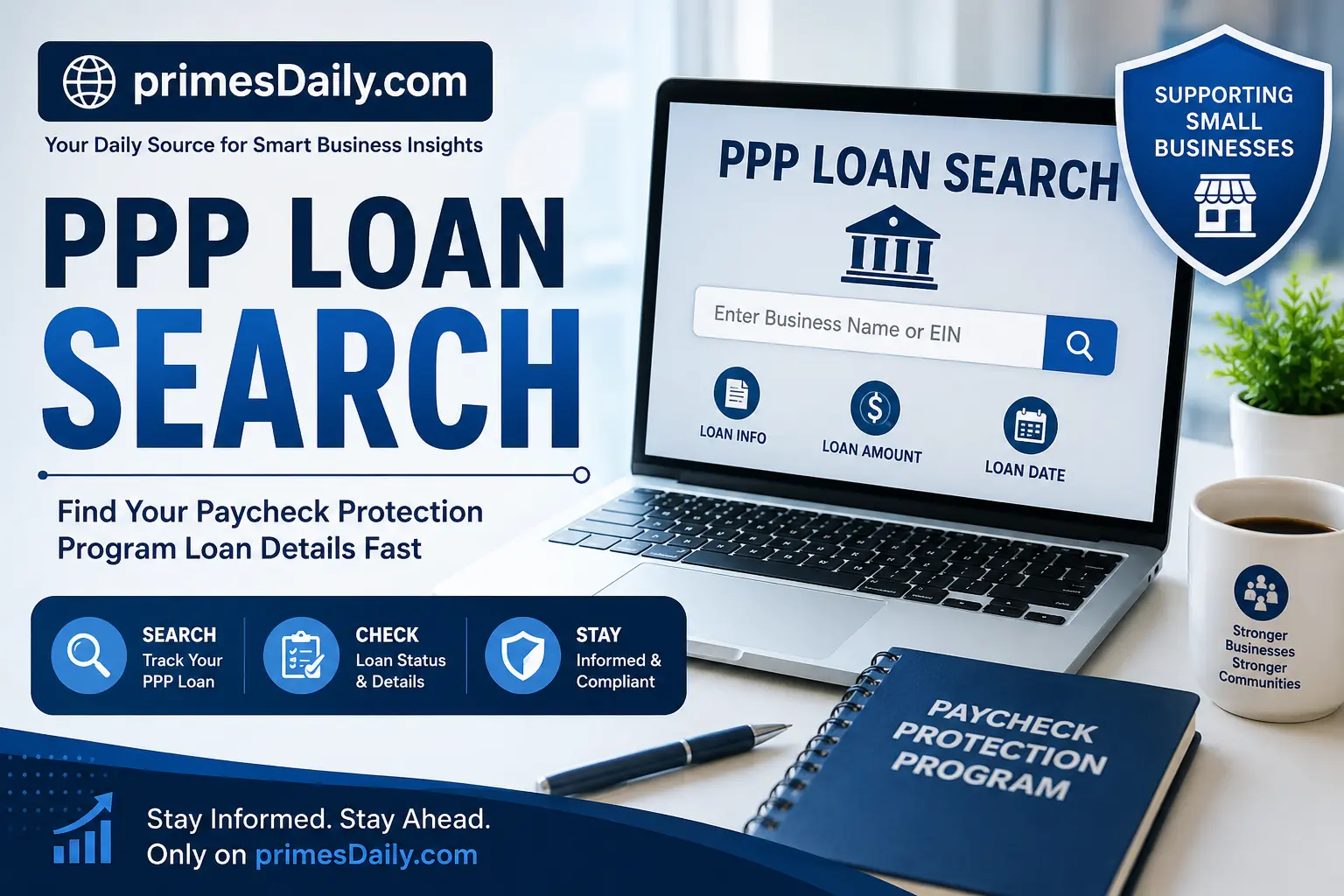
If you’ve been wondering where billions of dollars in federal COVID-19 relief funds actually went, you’re not alone. The Paycheck Protection Program was one of the largest government spending initiatives in American history, distributing nearly $800 billion to millions of businesses during the pandemic. But here’s the thing—most people don’t know that all this information is publicly available.
This is where PPP loan search becomes incredibly valuable. Whether you’re a business owner trying to verify your loan status, a researcher analyzing economic stimulus effectiveness, a journalist investigating financial accountability, or simply a curious citizen wanting to understand government spending, being able to search PPP loans has become an essential skill.
The question isn’t whether you should search for PPP loans—it’s really about knowing how, where, and what to look for. In this guide, we’re going to walk you through everything you need to know about finding PPP loan search data effectively. We’ll show you multiple ways to access this information, explain what all those numbers actually mean, and help you find exactly what you’re looking for.
What is PPP Loan Search and Why It Matters
The Paycheck Protection Program was launched in March 2020 as an emergency response to the economic crisis caused by the coronavirus pandemic. The federal government, through the Small Business Administration (SBA), partnered with banks and lenders to provide forgivable loans to businesses that met certain criteria. The goal was straightforward: help businesses keep workers on payroll and maintain operations during lockdowns and economic uncertainty.
From 2020 through 2021, the program distributed approximately $793 billion across millions of loans. That’s money from taxpayers’ pockets going to real businesses in real communities. The program officially ended on May 31, 2021, but its effects continue to shape the small business landscape in 2026.
So why does PPP loan search matter?
For Business Owners: If you received a PPP loan, you need to understand your forgiveness status, any remaining balances, and what documentation you might need for taxes and audits.
For Economic Research: Understanding which industries, regions, and business types received funding helps us see how the pandemic impacted different parts of the economy differently. Some industries got crushed, others thrived—PPP data tells that story.
For Accountability: This is taxpayer money. Citizens have a right to know where it went. PPP loan search allows anyone to verify that funds reached legitimate businesses and weren’t fraudulently obtained.
For Competitive Intelligence: Business owners and investors use PPP data to understand their local market, see what competitors received, and understand their financial situation.
For Journalism and Investigations: Several significant fraud cases have been uncovered through PPP investigations. Being able to search these loans helps expose misuse of federal funds.
The reason PPP loan search is so powerful is because the data is completely public. The SBA released detailed information on virtually every PPP loan awarded—typically including the business name, location, industry, loan amount, and forgiveness status. This transparency was intentional; the government wanted to ensure accountability for how these massive sums were deployed.
How to Use PPP Loan Search Tools
Before you can search PPP loans effectively, you need to understand what tools are available and how they work. There’s no single “official” search tool—instead, there are several legitimate options, each with its own strengths and weaknesses.
Why are there multiple search tools?
When the SBA released PPP loan data, it made the raw information available to the public. However, raw data isn’t very user-friendly. Several news organizations, data companies, and government agencies created searchable databases to make this information accessible to regular people interested in PPP loan search.
What information appears in search results?
When you search and find a loan, you’ll typically see:
- Business Name: The legal name of the organization that received the loan
- Business Address: Location where the business operates
- Loan Amount: How much money was borrowed
- Approval Date: When the SBA approved the loan
- Lender Name: Which bank or financial institution provided the loan
- Business Type: Industry classification (NAICS code and description)
- Jobs Reported: How many jobs the business claimed when applying
- Forgiveness Amount: How much of the loan was forgiven
- Forgiveness Status: Whether forgiveness was granted, denied, or pending
How exactly does it work?
The basic process is simple: you enter search terms, the database searches through millions of records, and returns matching results. Different platforms offer PPP loan search through various methods—name-based searches, location filtering, industry categories, loan amount ranges, and more. Some let you search by:
- Business name (exact or partial match)
- Location (zip code, city, state, or county)
- Loan amount range
- Industry type
- Lender name
- Business type (sole proprietorship, LLC, corporation, nonprofit, etc.)
Here’s a practical example: Let’s say you want to find all restaurant PPP loans in New York State between $150,000 and $500,000. With the right tool, you can enter those parameters and get matching results.
Why results vary between search tools
Different PPP loan search platforms sometimes show slightly different information or loan counts. This isn’t because anyone is hiding data—it’s usually because:
- Different tools pulled data at different times (the SBA released data in tranches)
- Some tools include all loans, others filter for certain minimum amounts
- Data formatting and standardization differs between tools
- Some tools update their data more frequently than others
Complete Guide to Searching Paycheck Protection Program Loans
This section is your step-by-step walkthrough for different types of searches. We’ll cover the most common scenarios and show you exactly how to approach each one.
Searching by Basic Criteria
The simplest way to conduct a search is entering a business name. Here’s how to do it effectively:
Step 1: Decide which search tool to use
Since there are multiple legitimate options, choose based on what you need. The official SBA source is comprehensive but less user-friendly. Third-party tools add features and visualization but rely on SBA data.
Step 2: Enter your search term
If you know the exact business name, enter it exactly as it appears legally. If you’re unsure, try searching for a distinctive part of the name.
Step 3: Refine by location
Adding location (state or zip code) dramatically narrows results. This is especially important for common business names.
Step 4: Filter results
Once you get results, look at the relevant columns to verify you found the right business. Check the industry, address, and loan amount to confirm it’s who you’re looking for.
Step 5: Review the full record
Click into the specific loan to see all available details, including forgiveness status and any notes about the application or approval process.
Understanding Loan Amount Ranges
PPP loans were available in different tiers. Understanding these ranges helps you search more effectively and understand why certain distribution patterns emerged.
The tiered structure:
- Under $150,000: Roughly 76% of all PPP loans fell into this category. These were primarily sole proprietorships and very small businesses
- $150,000 to $350,000: About 10% of loans. Small to mid-size businesses with roughly 10-50 employees
- $350,000 to $1 million: Roughly 6% of loans. Growing businesses with more substantial employee bases
- $1 million to $2 million: Less than 2% of loans
- $2 million to $5 million: Less than 1% of loans
- $5 million to $10 million: Less than 0.2% of loans
This distribution is important because it shows that the vast majority of PPP loans went to very small businesses, which was the program’s intent.
Industry-Specific Searches
One of the most valuable uses of PPP loan search is understanding how different industries were affected by the pandemic and how much relief they received.
Industries that received the most PPP funding:
- Healthcare and Social Assistance: Received the highest absolute dollar amounts, partly because hospitals and medical practices have high payroll costs
- Professional Services: Accounting, legal, consulting, and engineering firms received substantial funding
- Retail Trade: Both large and small retailers received PPP support
- Accommodation and Food Services: Restaurants and hotels were heavily impacted and received significant support
- Administrative Services: Staffing companies, payroll processors, and similar services
- Manufacturing: Diverse manufacturing sector received substantial loans
- Construction: Highly fragmented industry with many small firms receiving loans
- Real Estate: Property management, real estate offices, and related services
When you use PPP loan search to filter by industry, you’ll notice that labor-intensive industries received more funding in total but the distribution matters too. A restaurant might receive $30,000 but a consulting firm might receive $250,000—it depends on their payroll structure.
PPP Loan Search by Business Name: Step-by-Step
Finding a specific business is straightforward once you know the tricks. This section walks you through real-world scenarios.
Best Practices for Name-Based Searches
Challenge 1: Legal names vs. operating names
Many businesses operate under a different name than their legal entity. For example, a company’s legal name might be “ABC Holdings LLC” but they operate as “XYZ Consulting.” When searching PPP loans, the records show the legal business name as registered with the SBA, not necessarily the name customers know.
Solution: If you can’t find a business by its common name, try searching for variations. Most search platforms support partial matching, so searching for a distinctive part of the name often works.
Challenge 2: Very common names
If you’re searching for “ABC Restaurant” or “Smith Consulting,” you might get hundreds of results across the country. This is where location filtering becomes essential.
Solution: Always add location filters. Narrowing to your state or even your zip code typically gets you the exact result you’re looking for.
Challenge 3: Business name changes
Some businesses changed their legal names between 2019 and 2021. If you’re looking for a company that rebranded or merged, you might need to search under both the old and new names.
Solution: Try searching for the company’s owner or principal if the business name isn’t working.
What to Do When You Can’t Find a Business
If you search and don’t find a result, here are possible explanations:
1. The business didn’t apply for PPP Some small businesses decided not to apply, didn’t know about the program, or weren’t eligible. This doesn’t mean anything is wrong—many businesses funded through other means or had sufficient cash reserves.
2. The application was denied Some PPP applications were rejected during the approval process. These rejections typically don’t appear in the final published dataset.
3. The business applied under a different name This happens especially with franchises, chain restaurants, and businesses with holding company structures. A McDonald’s franchise might be applied under the franchise owner’s LLC name, not as “McDonald’s.”
4. Data hasn’t been fully published yet While most PPP data is public, some records, especially those involved in pending fraud investigations, might not appear in all search tools.
5. The business is very new Businesses founded after the PPP ended in May 2021 obviously wouldn’t have received loans.
PPP Loan Search by Loan Amount and Industry
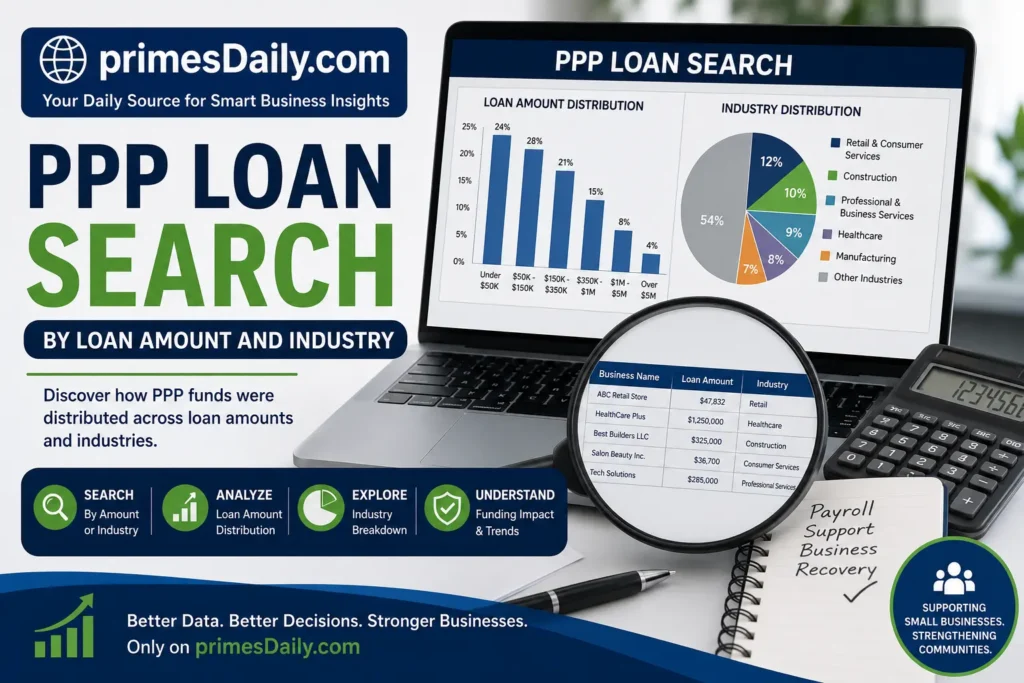
Understanding how much money went where is central to making sense of PPP data. These searches reveal whether funding was distributed equitably and which sectors benefited most.
Analyzing Loan Amount Distribution
The amount a business received depended primarily on its payroll. The formula was roughly: PPP Loan = Monthly Payroll × 2.5 (up to a maximum of $10 million).
What loan amounts actually mean:
- $20,000-$50,000 loans: Typically sole proprietors, very small services businesses (consultants, freelancers who incorporated, small shops)
- $50,000-$150,000 loans: Small businesses with 5-15 employees
- $150,000-$350,000 loans: Businesses with 15-50 employees
- $350,000-$1,000,000 loans: Businesses with 50-200+ employees
- Above $1,000,000 loans: Medium to large businesses, or businesses with very high payroll costs (hospitals, healthcare providers)
When you search PPP loans by amount range, you’re essentially searching by business size and employee count. A search for loans under $50,000 shows you micro-businesses; a search for loans over $5 million shows you larger employers.
Industry Distribution Patterns
Different industries needed different loan amounts because they have different payroll-to-revenue ratios.
Healthcare industry PPP data:
- Received approximately 8% of total PPP funds
- Included hospitals, medical practices, dental offices, therapists, mental health providers
- Average loan sizes were larger because healthcare providers have substantial payroll costs
- Most received full forgiveness because they met forgiveness requirements
Retail and Consumer Services:
- Received approximately 12% of total PPP funds
- Highly varied by type: jewelry stores, clothing retailers, gyms, salons, restaurants
- Restaurant and bar PPP loans were especially significant—food service was devastated by lockdowns
- Forgiveness rates varied significantly; some retail businesses failed despite PPP support
United States PPP Loan Search Summary and Statistics
Let’s zoom out and look at the big picture of PPP data. Understanding aggregate statistics helps you put individual loan data into context.
National PPP Statistics (Updated for 2026)
Total Program Scope:
- Approximately 11.5 million PPP loans were approved
- Total amount disbursed: approximately $793 billion
- Average loan size: approximately $69,000
- Median loan size: approximately $32,000 (meaning half of loans were smaller, half were larger)
Geographic Distribution: The loan distribution was remarkably concentrated in a few states, reflecting population and business density:
Top 10 States by Total PPP Funding:
- California: $109 billion across 1.27 million loans
- Texas: $73 billion across 939,000 loans
- Florida: $76 billion across 983,000 loans
- New York: $57 billion across 735,000 loans
- Illinois: $47 billion across 620,000 loans
- Pennsylvania: $26 billion across 342,000 loans
- Ohio: $27 billion across 352,000 loans
- Georgia: $43 billion across 553,000 loans
- North Carolina: $20 billion across 259,000 loans
- Michigan: $22 billion across 292,000 loans
These 10 states received approximately 48% of all PPP funding. This concentration reflects where America’s small businesses are actually located.
Business Size Breakdown:
The PPP program was designed for small businesses, but the data shows how “small” was interpreted:
- Sole proprietorships and self-employed: Approximately 27% of loans
- LLCs and partnerships: Approximately 35% of loans
- Corporations: Approximately 25% of loans
- Nonprofits: Approximately 6% of loans
- Other business structures: Approximately 7% of loans
Industry Concentration:
While PPP funds were distributed across hundreds of industries, some sectors received disproportionate amounts:
- Administrative and Support Services: 11% of loans
- Health Care and Social Assistance: 9% of loans
- Retail Trade: 8% of loans
- Accommodation and Food Services: 7% of loans
- Professional, Scientific, and Technical Services: 7% of loans
- Construction: 6% of loans
- Manufacturing: 5% of loans
- Real Estate: 4% of loans
- Other industries: 38% of loans
Forgiveness Analysis:
As of 2026, the vast majority of PPP loans have been resolved:
- Approximately $763 billion in forgiving (includes any accrued interest)
- Approximately 99.5% of PPP loans have received some level of forgiveness
- Less than 1% faced full forgiveness denial
- Some loans received partial forgiveness (where borrowers didn’t meet all requirements)
This high forgiveness rate reflects that most borrowers genuinely tried to meet PPP requirements and used funds as intended.
Top Borrowers Found in PPP Loan Search
When you search PPP loans with no specific filters, what do you find among the highest loan recipients? This is where the story gets interesting.
Important context: The highest loan recipients weren’t primarily Fortune 500 companies (though some large companies’ subsidiaries did receive PPP). Instead, the top recipients were often:
- Franchisees (individual restaurant owners, not the brands)
- Healthcare providers and hospital systems
- Staffing and temporary worker agencies
- Construction companies
- Agricultural operations
Why These Industries Dominated Top Recipients
Healthcare Systems: Hospital networks and medical centers received loans in the multi-million dollar range because healthcare has enormous payroll costs. A hospital might have 500-2,000 employees with substantial salaries, resulting in PPP loans of $5-10 million.
Staffing Agencies: Companies that place temporary and contract workers received large PPP loans because they employed substantial numbers of workers (even if those workers were technically employed by other companies). Some staffing agencies received loans in the $2-5 million range.
Construction Contractors: Large construction companies that employed hundreds of workers received significant PPP loans. The industry nature—projects start and stop, seasonal employment, etc.—created legitimate large PPP needs.
Agricultural Operations: Farms and agricultural service companies received PPP loans that sometimes surprised people unfamiliar with modern agriculture. Large agricultural operations are significant employers with substantial payroll.
Real Estate and Property Management: Large property management companies that employ dozens to hundreds of workers received substantial PPP funding.
Why Some Large Companies Received PPP (And The Controversy)
Several well-known larger companies received PPP loans initially, which generated controversy. Examples included:
- Publicly traded companies that arguably didn’t need government support
- Luxury goods manufacturers
- Companies that received PPP then later laid off workers
- Some companies that received PPP despite strong financial positions
The controversy explained:
The PPP application process largely relied on self-certification—businesses certified that they needed the funds. The SBA didn’t intensively vet every application initially because the program needed to disburse funds quickly. This meant some applications were approved that arguably shouldn’t have been.
The government later targeted some of these recipients for audit and repayment, but the process has been slow. By 2026, some controversial PPP loans have been recovered, others are still in litigation, and some businesses successfully defended their applications as legitimate.
What PPP loan search reveals about fairness:
When you search PPP loans, you can actually see for yourself whether the program was equitable:
- Did small businesses in rural areas get funded as well as those in cities?
- Did businesses owned by women and minorities get similar loan amounts?
- Did certain industries get preferential treatment?
- Were there geographic inequities?
The data suggests that while PPP was broadly equitable, there were gaps. Rural areas received funding but sometimes at lower average amounts. Women-owned and minority-owned businesses received PPP, but there’s evidence they faced slightly higher denial rates and got slightly smaller average loan amounts. This is exactly why being able to access PPP loan search data is valuable—it lets you see patterns in government spending.
PPP Loan Search by Location: State and Regional Data
Geographic analysis of PPP loans reveals how different regions fared during the pandemic and which areas received strong government support.
Regional Performance Analysis
Northeast Region:
- States like New York, Massachusetts, Connecticut received substantial PPP funding
- Urban concentration; major metro areas had efficient lending infrastructure
- Healthcare was a major recipient due to large medical centers
- Professional services were significant in this region
Southeast Region:
- Florida, Georgia, North Carolina led with massive PPP disbursements
- Strong concentration in fast-growing metro areas (Atlanta, Orlando, Charlotte)
- Retail and hospitality were major recipients due to tourism
- Aerospace and defense contractors in some areas
Midwest Region:
- Illinois, Ohio, Michigan, Wisconsin received major funding
- Industrial and manufacturing base affected PPP distribution
- Agricultural operations in rural areas
- Healthcare and professional services significant
Southwest Region:
- Texas dominated with highest non-Coastal state PPP
- Diverse economy meant varied industry distribution
- Construction and real estate significant
- Energy sector businesses also received PPP
West Region:
- California’s massive economy resulted in highest state PPP funding
- Washington and Oregon saw significant tech-adjacent business PPP
- Diverse industries from agriculture to tech services
- Real estate and professional services concentrated
County-Level Insights Through PPP Loan Search
While PPP loan search tools often provide state-level data, some allow county-level exploration. This reveals local variations:
Urban Counties: Large metropolitan counties like Los Angeles County, Cook County (Chicago), New York County received massive PPP funding, but this was distributed across thousands of businesses.
Rural Counties: Small rural counties might have received less PPP funding in total, but sometimes the average loan per business was higher due to large agricultural operations.
Fastest-Growing Counties: Counties experiencing rapid growth during 2020-2021 often had higher PPP participation as new businesses applied for support.
Declining Counties: Some economically declining counties had lower PPP participation, either because there were fewer businesses or because lending relationships were weaker.
Zip Code Level Analysis
The most granular PPP loan search experience happens at the zip code level. Some tools let you search by zip code and see:
- Total PPP funding to your zip code
- Number of loans in your area
- Average loan size
- Industry breakdown
- Lender distribution
This zip code data is personally relevant—you can literally search where you live and see how much government money was deployed in your neighborhood.
For the latest, updated, and unique information, visit Crossover Grid.
Advanced PPP Loan Search Filters and Features
Once you understand basic searching, advanced filtering opens up research possibilities.
Business Type Filtering
PPP loan search tools allow filtering by business structure:
Sole Proprietorships:
- Represent approximately 27% of all PPP loans
- Typically received smaller loan amounts ($20,000-$75,000)
- Included freelancers, independent professionals, small shop owners
- Forgiveness rates were high because sole proprietors who maintained their own employment naturally met forgiveness requirements
Limited Liability Companies (LLCs):
- Represent approximately 35% of all PPP loans—the largest category
- Ranged widely in loan size depending on employee count
- Included everything from small professional services firms to larger operations
- Diverse forgiveness outcomes
S-Corporations and C-Corporations:
- Represent approximately 25% of all PPP loans
- Tended to receive larger loans on average
- Often included family businesses and established companies
- Generally good forgiveness rates as these companies are typically well-documented
Nonprofits:
- Represent approximately 6% of all PPP loans
- Included charities, religious organizations, educational nonprofits, healthcare nonprofits
- Received substantial forgiveness because nonprofits’ nonprofit status often meant they met PPP requirements
- Average loans varied widely based on nonprofit size
Partnerships and Other Structures:
- Represent remaining percentage
- Often small professional partnerships (accounting, legal firms)
- Variable loan sizes and forgiveness rates
Lender Filtering
Filtering by lender reveals which financial institutions were most active in the program.
Largest PPP Lenders:
- JPMorgan Chase
- Bank of America
- Wells Fargo
- Citibank
- And numerous regional and community banks
Different lenders had different approaches, approval speeds, and borrower profiles. Small community banks often had higher participation from local businesses; large national banks had geographic diversity.
Date Range Filtering
PPP had multiple funding “rounds” with different applications and rules:
Round 1 (March-April 2020):
- Fastest funding, sometimes “first come, first served”
- Simpler documentation requirements initially
- Many experienced a run on funds before more could be allocated
Round 2 (May-August 2020):
- Adjusted rules after Round 1 controversies
- Better targeting toward affected small businesses
- More stringent documentation required
Targeted Advance (December 2020-January 2021):
- Focused specifically on businesses in underserved communities
- Included supplemental targeted advances for existing PPP borrowers
- Different qualification criteria
Second Draw PPP (January-May 2021):
- Allowed eligible businesses that received PPP in 2020 to apply for additional funds
- More stringent documentation requirements
- Focused on businesses in hardest-hit industries
Understanding PPP Loan Search Results and Data
Once you search and get results, how do you actually interpret what you’re seeing?
Decoding Standard PPP Loan Metrics
Loan Amount: This is straightforward—how much money was borrowed. But context matters. A $50,000 loan might be huge for a sole proprietor but small for a construction company.
Forgiveness Amount: How much of the loan was forgiven. Ideally, PPP borrowers received 100% forgiveness. But some received 90%, 75%, or even less, because they didn’t fully meet all requirements (like employee retention or spending requirements).
Jobs Reported: How many jobs the business claimed when applying. This is what the borrower reported needing to support. For a solo consultant, this might be 1; for a construction company, it might be 50. These numbers should be taken with some skepticism—they’re self-reported and not independently verified.
Approval Date: When the SBA approved the application. Earlier dates (April 2020) show first-round recipients; later dates (May 2021) show final round applications.
Lender Name: Which bank processed the loan. This sometimes indicates market structure—where are banks most active, which lenders helped which types of businesses.
Business Type (NAICS Code): A standardized industry classification. NAICS codes help categorize businesses. For example:
- 722110 = Full-Service Restaurants
- 621111 = Offices of Physicians (General)
- 541110 = Offices of Lawyers
- 445110 = Supermarkets and Other Grocery Stores
Red Flags in PPP Loan Search Results
While most PPP loans were legitimate, some patterns in search results might indicate issues worth noting:
Extremely high loan amounts relative to industry: If a small retail shop received a $5 million PPP loan, that’s unusual and might indicate issues with the application.
Job numbers that don’t match loan amounts: If a business reported supporting 100 jobs but received only a $50,000 loan, the math doesn’t work. (PPP was roughly $5,000 per employee.)
Businesses in industries not affected by pandemic: Software companies, online retailers, and other businesses that thrived during lockdowns appearing with large PPP loans might indicate questionable need claims.
Multiple PPP loans to the same business: Most businesses received one PPP loan and, if eligible, one Second Draw. Multiple rounds beyond that might indicate fraud or error.
Forgiveness denials: While most loans were forgiven, occasional denials appear in the data. These might indicate the business didn’t meet requirements or the SBA found issues in the application.
Official SBA PPP Loan Search Database Access
The most authoritative PPP loan search source is the Small Business Administration itself. Here’s what you need to know about accessing it directly.
Finding the Official SBA Data
The SBA publishes PPP loan data through their official channels. This is the raw, unfiltered data that other tools are based on.
How to access it:
- Visit the official SBA data portal
- Look for PPP-related datasets
- Download data in CSV format for analysis
- Or access through searchable interfaces they maintain
Advantages of official SBA PPP loan search:
- Most current data
- Unfiltered and unmodified
- Direct from the source
- Completely free
- Includes all loans (no selection bias)
Disadvantages:
- Less user-friendly interface
- Large data files can be challenging to navigate
- Requires some technical skill to search effectively
- Updated less frequently than some third-party tools
Understanding SBA’s PPP Data Structure
The official SBA PPP loan data includes these standard fields:
- Business Name
- Business Address (Street, City, State, Zip)
- Business Type (NAICS code and description)
- Loan Amount
- Approval Date
- Lender Name
- Program Code (which funding round)
- State
- Congressional District
- Jobs Reported
- Forgiveness Amount
- Forgiveness Date
- Loan Status
The Most Recent PPP Data Updates (2026)
As of 2026, the PPP loan data has been fairly finalized. New updates are rare because:
- The program ended in May 2021
- Forgiveness process concluded for most borrowers years ago
- Fraud investigations are largely resolved
- The data is now primarily historical
However, occasional updates do occur:
- Corrections when errors in previous data are discovered
- Fraud case resolutions that update loan statuses
- Final forgiveness determinations for edge cases still in litigation
Third-Party Platforms for PPP Loan Search
While the SBA maintains the official data, third-party platforms have created some of the most usable search tools. These platforms make accessing and understanding the data much easier for average users.
Categories of Third-Party Tools
Journalism-Based Platforms: Major news organizations created searchable databases for their readers, including ProPublica, USA Today, and others. These tools are free and often include interesting visualizations and analyses.
Data Analytics Platforms: Companies that specialize in data analysis created searchable tools for researchers and analysts. These sometimes include advanced filtering and visualization capabilities.
Niche Focus Tools: Some platforms focus on specific aspects of PPP—fraud investigation tools, geographic analysis tools, industry-specific analysis, etc.
General Public Records Services: Some public records research platforms incorporated PPP data into their broader searchable databases.
Comparing Third-Party Platforms
Feature differences:
- Search Interface: Ranges from very simple (just a name search) to complex (multiple filters and advanced options)
- Speed: Some platforms are faster than others depending on how they index data
- Visualization: Some include charts, maps, and analyses; others just show raw data
- Export Options: Whether you can download results for further analysis
- Updates: Frequency of data updates (some monthly, others quarterly)
- Accuracy: All pull from SBA source, but formatting and cleaning might differ
Advantages of third-party tools:
- More user-friendly interfaces
- Faster searching than raw data files
- Built-in visualizations and analysis
- Often include additional context and reporting
- Curated explanations of the data
- Mobile-friendly access (some tools)
PPP Loan Search for Forgiveness Status Updates
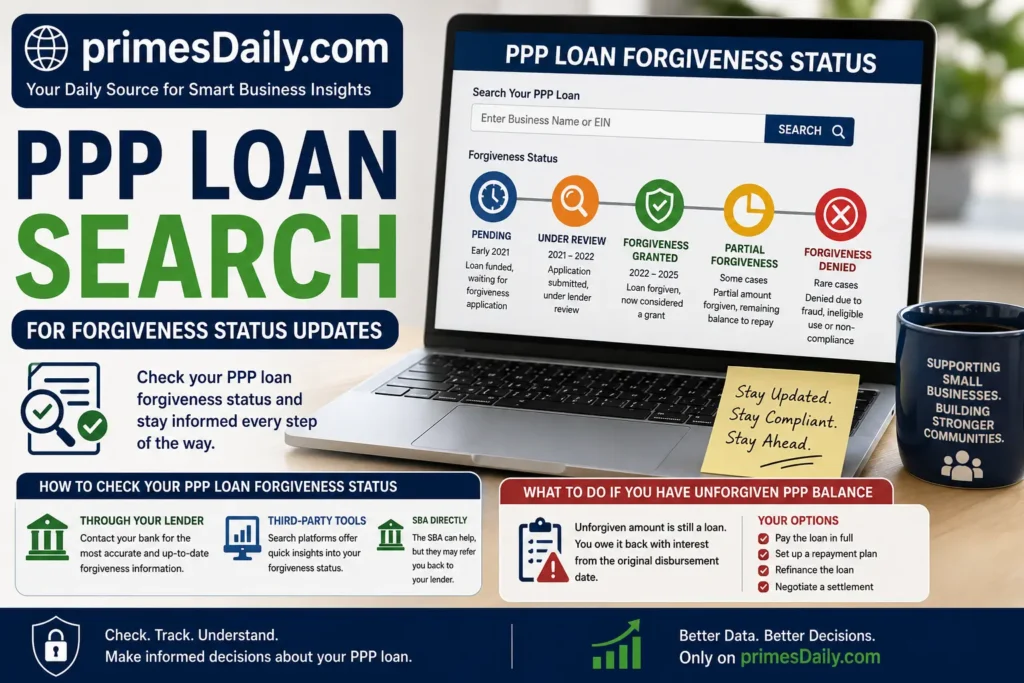
One of the most common reasons people search PPP loans is to understand their own loan’s forgiveness status.
Understanding Forgiveness Stages
Pending Forgiveness (Early 2021): Loans had been approved and funded but forgiveness applications hadn’t been processed yet.
Under Review (2021-2022): Forgiveness applications were submitted and the lender was reviewing them. This stage sometimes lasted months.
Forgiveness Granted (2022-2025): The vast majority of loans were forgiven, meaning the loan became a grant. Interest stopped accruing, and the loan was fully discharged.
Partial Forgiveness (Some cases): Some borrowers didn’t meet all forgiveness requirements and received partial forgiveness. The remaining balance had to be repaid as a traditional loan.
Forgiveness Denied (Rare): A small percentage of PPP loans had forgiveness denied, usually due to fraud findings, ineligible use of funds, or failure to meet program requirements.
How to Check Your PPP Loan Forgiveness Status
Through your lender: This is usually the easiest method. Contact the bank that provided your PPP loan and ask about your forgiveness status. They should have all your information and can tell you if:
- Your forgiveness was granted
- Any amount was unforgiven and what repayment terms are
- What documents they have on file
- Any issues that need to be resolved
Through third-party tools: Many platforms show forgiveness status if you search your business. This gives you a quick view but might not be updated as recently as your lender’s information.
SBA directly: In some cases, you can contact the SBA directly, though they usually refer you to your lender.
Tax records: If your forgiveness was granted, it should appear on your business tax returns or lender statements.
What to Do If You Have Unforgiven PPP Balance
If your search shows that some PPP funds weren’t forgiven, you have:
Repayment obligation: The unforgiven portion is still a loan. You owe it back, typically with interest accruing from the original disbursement date.
Options:
- Pay the loan in full
- Set up a repayment plan with your lender
- Refinance the loan into different terms
- In some cases, negotiate a settlement
Important: If you don’t address an unforgiven PPP balance, it can negatively affect your credit and potentially result in collection action by your lender or the SBA.
Best Practices for Conducting PPP Loan Search
Whether searching for personal, research, competitive, or investigative purposes, follow these best practices for effectiveness.
Research Strategy
Define your objective: Before searching, know what you’re trying to find. Are you researching your own loan? Analyzing your industry? Investigating a company? Looking for geographic patterns? Your objective shapes which searches to conduct.
Start broad, then narrow: Begin with general searches to understand available data, then refine with specific filters to get targeted results.
Document your searches: Keep track of search terms, filters used, and results found. This is especially important if you’re conducting formal research or journalism.
Cross-reference results: Use multiple tools to verify results. Data consistency across platforms increases confidence in accuracy.
Understand data limitations: Remember that PPP data is self-reported on applications. The data shows what was reported, not necessarily what was true. Some numbers might be estimated or rounded.
Data Analysis Best Practices
Avoid drawing conclusions from outliers: If you find one unusually large loan or one strange data point, don’t build your entire analysis around it. Look at patterns across many records.
Consider context: A $1 million loan to a healthcare facility is normal; a $1 million loan to an ice cream shop is unusual. Context matters.
Account for industry differences: Construction companies legitimately have different loan profiles than software companies. Don’t compare across industries without understanding these structural differences.
Watch for temporal patterns: Early approvals (April 2020) had different dynamics than late approvals (May 2021). Round 1 and Round 2 had different rules. Account for these differences.
Privacy and Ethical Considerations
Respect privacy: While PPP data is public, using it to harass or defame businesses is inappropriate. Just because data is public doesn’t mean every use is ethical.
Verify before publishing: If you’re writing about PPP loans, verify your information across multiple sources. Data errors can be perpetuated if not carefully checked.
Understand the context: A business receiving PPP doesn’t prove fraud; it just means they received government support. Be careful about the conclusions you draw.
Consider the human element: Behind every PPP loan is a business owner trying to survive a crisis. Even if some made mistakes or questionable choices, they were operating during unprecedented uncertainty.
Transparency and Public Access to PPP Loan Search Data
The fact that PPP loan search is even possible reflects deliberate policy decisions about government transparency. Understanding why this data is public is important context.
Why PPP Data Is Public
Legislative mandate: The CARES Act, which created PPP, included requirements for transparency. Congress wanted the public to have access to information about how stimulus funds were deployed.
Public interest: Taxpayers funded PPP, so the argument goes, taxpayers should know where the money went. This is a foundational democratic principle—government spending transparency.
Accountability: Public access to PPP data enabled journalists, researchers, and citizens to identify fraud, inefficiency, and other issues. This led to hundreds of fraud prosecutions and policy adjustments.
Historical record: The data now serves as a historical record of which businesses existed, where they were located, and how they fared during the pandemic.
How PPP Data Was Released
Initial releases (mid-2020): The SBA initially resisted releasing detailed PPP data, citing privacy concerns. However, court cases and FOIA (Freedom of Information Act) requests forced the release.
Full dataset publication (2020-2021): Eventually, the SBA released comprehensive PPP loan data, with minimal redaction. This made searching PPP loans possible on a massive scale.
Ongoing updates (2021-present): As forgiveness determinations were finalized and corrections were made, the data continued to be updated.
Data availability today (2026): PPP data is now widely available through multiple sources. The initial sensitivity about releasing the information has passed; the focus is now on making it accessible.
PPP Loan Search: Tracking COVID-19 Relief Funds
PPP data is one of the most comprehensive records we have about government response to the COVID-19 pandemic. The data tells an economic story.
The Pandemic Timeline as Reflected in PPP Data
March 2020: Pandemic begins
- Lockdowns start
- Business uncertainty peaks
- PPP program announced
April 2020: First Wave
- PPP funding begins
- Initial $349 billion allocated quickly exhausted (first come, first served)
- Larger, better-connected businesses get approved first
- Geographic disparities emerge in approval rates
May 2020: Second Wave
- Additional $320 billion allocated
- New rules enacted to slow larger businesses’ access
- More targeted toward affected small businesses
- Regional variations in approval continue
July-August 2020: Third Wave
- Additional $150+ billion made available
- Even slower approvals as compliance tightened
- Increased documentation requirements
- Fraud concerns addressed
January 2021: Second Draw
- Eligible businesses that received initial PPP can apply again
- Different eligibility criteria
- Most applied for this second round
May 31, 2021: Program Ends
- No new applications accepted
- Final allocations dispersed
- Focus shifts to forgiveness processing
What PPP Data Reveals About Pandemic Impact
Industries most affected: When you search PPP loans by industry, you see which sectors were hardest hit. Hospitality, retail, and personal services needed PPP most. Professional services and online business-friendly sectors needed less.
Geography of suffering: States and regions hardest hit by lockdowns (California, New York, Florida initially) received most PPP funding. This correlates with policy stringency.
Business resilience: Companies that adapted quickly (online retailers, tech services) appeared less frequently in PPP data. Companies dependent on in-person service (restaurants, gyms, salons) appear frequently.
Employment concerns: Job numbers reported in PPP applications reflect what businesses feared about employment impact. Manufacturing and healthcare reported high job dependency; tech services reported lower numbers.
FAQs
Q: Is PPP loan search data completely accurate? A: The data reflects what was reported on applications but isn’t independently verified in all cases. Self-reported business sizes, job numbers, and other metrics are reasonable but not guaranteed accurate. However, data showing loan amounts, approval dates, and lender information is highly accurate.
Q: If I can’t find a business’s PPP loan, does that mean they didn’t apply? A: Not necessarily. The business might have applied under a different legal name, changed names, or had their application denied. It could also mean the business was too new to apply, didn’t know about the program, or chose not to participate.
Q: Why do loan amounts seem so varied for similar businesses? A: PPP amounts were based on calculated payroll needs. Identical businesses (e.g., two hair salons) might have paid their stylists differently, employed different numbers of people, or operated different hours—all affecting PPP amounts. Also, some businesses included owner salaries; others didn’t.
Q: Can I see which specific employees were supported by PPP? A: No. PPP data shows business-level information and total jobs supported, but not individual employee names or details. That information would violate employee privacy.
Q: Are there still PPP loan fraud investigations happening? A: Yes. As of 2026, the Department of Justice continues investigating and prosecuting PPP fraud cases. Hundreds have been convicted, but investigation continues as new evidence emerges.
Q: What happened to businesses that got PPP but still failed? A: Some businesses received PPP but closed anyway, due to broader economic challenges. PPP was meant to keep businesses afloat, not guarantee success. Some of these appear in PPP search data as legitimate recipients who couldn’t overcome market challenges.
Q: Can businesses use PPP loan search data about competitors? A: Yes, it’s perfectly legal. Many businesses use PPP data to understand their competitive landscape, industry dynamics, and local business demographics. It’s a legitimate form of business intelligence.
Q: Has the government ever disputed PPP loan forgiveness? A: Yes, in some cases. While 99.5% of PPP loans were forgiven, some borrowers’ forgiveness was denied due to fraud, ineligible use of funds, or failure to meet requirements. In rare cases, the SBA has sought to recover already-forgiven loans through legal action.
Q: Do non-U.S. companies appear in PPP loan search? A: Generally no. PPP was designed for U.S. businesses. Foreign companies were not eligible, though U.S. subsidiaries of foreign companies were eligible if they met other requirements.
Q: Can I search PPP loans on my smartphone? A: Depends on the tool. Some third-party platforms have mobile-friendly interfaces; others are desktop-only. The official SBA data portal is less mobile-friendly.
Q: What’s the difference between PPP and other COVID-19 business relief programs? A: PPP specifically supported payroll; other programs targeted different business needs. Economic Injury Disaster Loans (EIDL) provided broader business loans. Restaurant Revitalization Fund specifically targeted restaurants. Shuttered Venue Operators Grant targeted entertainment venues. Each had different eligibility and use requirements.
Q: If a business received PPP, can I use that as proof of their financial status? A: Be careful here. PPP receipt means the business existed and had employees but doesn’t prove financial health. Healthy and struggling businesses both received PPP. You’d need additional information to assess actual financial status.
Q: Why do some businesses show multiple PPP loans? A: Most commonly, businesses received one initial PPP and one “Second Draw” PPP. In rare cases, businesses might have received supplemental targeted advances. Multiple loans beyond two or three would be unusual and worth investigating.
Conclusion
We’ve covered extensive ground in this guide to understanding PPP loan search data and tools. From learning what PPP loan search is, to mastering different search techniques, to interpreting results and exploring the biggest patterns in the data, you now have the foundation needed to search PPP loans effectively for your purposes.
The key insight is this: PPP loan search data represents one of the largest and most transparent government spending initiatives in American history. Nearly $800 billion distributed to roughly 11.5 million businesses, and most of it is searchable, analyzable, and available to anyone willing to look. Whether you’re searching for personal reasons—tracking your own PPP loan—or for professional reasons—analyzing industry trends or investigating potential fraud—the tools and techniques covered in this guide empower you to find what you need.
As we move forward in 2026 and beyond, PPP data serves as an important historical record and a lesson about government transparency. The decision to make this data public, despite initial resistance, enabled oversight, accountability, and genuine understanding of how pandemic relief reached different businesses and communities. Remember to search carefully, verify results across multiple sources, understand the data’s limitations, and always consider context when interpreting what you find.
The most important takeaway: You have access to this information. Use it responsibly to understand the American small business landscape, how government programs reach businesses, and whether taxpayer dollars were deployed equitably. That’s the power of PPP loan search.
For the latest, updated, and unique information, visit Kingdom of Heaven Director’s Cut.