You’re stirring cinnamon into your oatmeal, and two big brown eyes are staring up at you from the kitchen floor. Or maybe your dog just snatched a piece of cinnamon toast off the counter while your back was turned. Either way, you’re here because you need a real answer to one question: is cinnamon bad for dogs?
Here’s the short version so you’re not left hanging: cinnamon is not toxic to dogs in small amounts, but that doesn’t mean it’s harmless. The form matters, the quantity matters, and what else is mixed in with it matters even more. This guide walks through every angle of whether cinnamon is bad for dogs — what the spice actually is, how much becomes dangerous, what vets recommend, what to do if your dog just ate some, and how to keep your home genuinely safe going forward.
What Is Cinnamon? A Quick Overview
Cinnamon comes from the inner bark of trees in the Cinnamomum family. That bark gets peeled, dried, and either rolled into the curled sticks you see in the spice aisle or ground down into the fine powder most of us cook with. It’s one of the oldest spices in human history, prized for flavor first and, more recently, for a reputation as a “health spice” thanks to compounds that show anti-inflammatory and antioxidant activity in lab studies.
For humans, cinnamon shows up in everything from lattes to curry blends to supplements marketed for blood sugar support. For dogs, the picture is more complicated, which is exactly why so many owners end up searching whether cinnamon is bad for dogs before they let their pup near the spice rack.
Types of Cinnamon: Ceylon vs. Cassia
Not all cinnamon in your pantry is the same plant, and this distinction matters when you’re weighing whether cinnamon is bad for dogs in your specific kitchen.
- Cassia cinnamon — the cheap, dark reddish-brown cinnamon sold in most grocery stores in the US. It’s the type most commonly used in cinnamon rolls, cereals, and baking mixes.
- Ceylon cinnamon — often labeled “true cinnamon,” lighter in color, milder in flavor, and pricier. Usually found in specialty stores or sold specifically as “Ceylon.”
The key difference comes down to a naturally occurring compound called coumarin. Cassia cinnamon contains significantly more coumarin than Ceylon cinnamon, and in large enough doses, coumarin has been linked to liver stress in both humans and animals. This is one of the main reasons cinnamon can be bad for dogs in bigger quantities, even though a small amount isn’t considered toxic.
Is Cinnamon Bad for Dogs? The Short Answer
No, cinnamon is not classified as toxic to dogs, and it won’t cause the kind of acute poisoning you’d see with something like chocolate, grapes, or xylitol. Your dog licking a cinnamon-dusted spoon isn’t a five-alarm emergency.
That said, “not toxic” and “safe to feed regularly” are two very different things. Cinnamon can still cause real discomfort in moderate-to-large amounts, and certain forms carry risks that go well beyond a stomach ache. So when people ask, is cinnamon bad for dogs, the honest answer sits in the middle: a trace amount is generally fine, a lot is a problem, and some forms should never be given at all.
Small Quantities vs. Large Amounts of Cinnamon
A dusting of cinnamon on a treat, or a dog stealing one small bite of a cinnamon-flavored snack, is very unlikely to cause any lasting harm. Plenty of commercial dog treats include a small amount of cinnamon purely for scent and flavor, formulated to be safe in those quantities.
The trouble starts with larger amounts — a whole spoonful of ground cinnamon, an entire cinnamon stick chewed up, or repeated daily exposure over weeks. At that point you’re looking at possible mouth and throat irritation, an upset stomach, and in more extreme cases, effects on blood sugar and liver function. Size matters too: a 5-pound Chihuahua and a 90-pound Mastiff do not have the same tolerance for the same amount of spice, which is exactly why the answer to whether cinnamon is bad for dogs depends so heavily on the dog in front of you.
Ground Cinnamon vs. Cinnamon Oil for Dogs
This is one of the most important distinctions in the entire “is cinnamon bad for dogs” conversation, and it’s the one people mix up the most.
Ground cinnamon (the powder in your spice rack) is relatively low-risk in small quantities. The main danger with the powder form is inhalation — if a dog sniffs or noses into a pile of loose cinnamon powder, the fine particles can irritate the airway and trigger coughing, gagging, or even choking.
Cinnamon essential oil is a completely different animal. Essential oils are highly concentrated, and cinnamon oil is considered unsafe for dogs even in small amounts. It can cause skin burns on contact, and if ingested, it has been linked to vomiting, drops in blood sugar, liver irritation, and breathing difficulty. If you use cinnamon oil in a diffuser, in cleaning products, or in any DIY recipe, keep it completely out of reach of your dog.
Are Cinnamon Sticks Safe for Dogs?
Whole cinnamon sticks are generally not something you want your dog chewing on. They’re hard, splintery, and can cause mouth or gum irritation, and in some cases a piece can break off and become a choking hazard. If your dog manages to gnaw on a stick out of a spice jar or a decorative bundle, keep an eye on their mouth for redness or excessive drooling, and remove any accessible sticks going forward — including ones used in fall and winter home decor.
What Vets Say About Cinnamon and Dogs

Veterinarians are fairly consistent when asked, is cinnamon bad for dogs: it’s not on the list of foods considered toxic, but it’s also not recommended as a regular dietary addition. A dog can tolerate a very small, occasional taste, but there’s no medical reason to add cinnamon to a dog’s diet on purpose without a specific health goal in mind — and even then, it should be discussed with a vet first.
The consistent professional advice includes a few recurring points:
- Cinnamon is not classified as a toxic substance for dogs, unlike chocolate, grapes, or onions.
- Perceived health benefits — anti-inflammatory effects, blood sugar support — are based mostly on human and lab-animal research, not studies done specifically in dogs.
- Dogs with existing respiratory issues, liver conditions, or diabetes should avoid cinnamon altogether unless a vet has specifically approved it.
- If a dog has never had cinnamon before, introducing even a small amount should be done slowly, watching closely for any reaction.
If you’re ever unsure whether your specific dog can safely have cinnamon, a quick call to your veterinarian is always the right move before experimenting.
What Happens If a Dog Eats Too Much Cinnamon?
“Too much” is relative to your dog’s size, but once a dog crosses from a pinch into a genuinely large amount, the body starts to respond, and not in a good way. This is really where the question of whether cinnamon is bad for dogs stops being theoretical and starts being practical.
Common Symptoms of Cinnamon Ingestion in Dogs
Watch for the following signs if you know or suspect your dog has eaten a significant amount of cinnamon in any form:
- Vomiting
- Diarrhea
- Excessive drooling or pawing at the mouth
- Coughing, gagging, or choking (especially common with the powdered form)
- Difficulty breathing
- Increased heart rate
- Low blood sugar, which can show up as weakness, shakiness, or unusual lethargy
- In severe or repeated large-dose cases, signs of liver stress such as loss of appetite, yellowing of the gums or eyes, or ongoing lethargy
Most dogs who get into a small amount of a cinnamon-flavored food will show mild symptoms at worst, if any at all. The concerning cases involve large single doses, cinnamon essential oil, or a dog with an underlying health condition that makes them more sensitive.
When Is It Time to Contact Your Vet?
Call your veterinarian or an animal poison control line if any of the following apply:
- Your dog ingested cinnamon essential oil in any amount.
- Your dog ate a large quantity of ground cinnamon, cinnamon sticks, or a cinnamon-heavy food.
- Your dog is showing any of the symptoms listed above, particularly difficulty breathing, repeated vomiting, or unusual weakness.
- Your dog has an existing condition — diabetes, liver disease, or a respiratory issue.
- You’re simply unsure how much your dog actually ate and want guidance rather than guessing.
It’s always better to make that call and be told “just monitor them” than to wait and watch a mild issue turn into a bigger one overnight.
For the latest, updated, and unique information, visit Blooket Play.
My Dog Ate Cinnamon — What Should I Do?
If you’ve just discovered your dog got into cinnamon, here’s a clear, calm sequence to follow:
- Figure out what and how much. Was it a dusting on a treat, a whole cinnamon roll, a stick, or bottled essential oil? The form and quantity change everything.
- Check the ingredient list of whatever they ate. If cinnamon was part of a baked good, candy, or gum, check for xylitol, chocolate, raisins, or nutmeg — these are far more dangerous than the cinnamon itself.
- Watch for symptoms over the next few hours. Vomiting, diarrhea, unusual lethargy, or breathing changes are your cues to call a vet immediately.
- Don’t induce vomiting on your own. Unless a veterinarian specifically instructs you to, don’t try to make your dog throw up.
- Call your vet or a pet poison helpline if there’s any doubt. Have the product packaging or a photo of the ingredient label ready.
- If everything is mild and your dog seems fine, keep an eye on them for the rest of the day and remove access to whatever they got into.
Most cinnamon-only incidents resolve without any lasting issue. The goal isn’t panic — it’s making sure you’re not missing a warning sign or overlooking a more dangerous ingredient hiding in the same snack.
Cinnamon in Baked Goods and Human Foods
This is where most real-world cinnamon exposure actually happens — not from the spice jar itself, but from cinnamon rolls, cookies, granola, cereal, and toast sitting on a counter within nose-reach of a determined dog.
The tricky part is that cinnamon is rarely the biggest problem in these foods. It’s usually just one ingredient in a mix that also includes sugar, butter, and sometimes far more dangerous additions. A dog eating an entire cinnamon roll is dealing with a sugar and fat overload that can trigger an upset stomach or, in dogs prone to it, pancreatitis — long before the cinnamon itself becomes the primary concern.
Cinnamon Rolls, Gum, and Candy: Watch Out for Xylitol
This is the single most important warning in this entire guide, so it deserves its own space: many cinnamon-flavored gums, candies, and “sugar-free” baked goods contain xylitol, an artificial sweetener that is genuinely toxic to dogs — far more dangerous than the cinnamon sitting right next to it on the ingredient label.
Xylitol can cause a rapid, severe drop in blood sugar in dogs, along with potential liver damage, and it can happen fast. If your dog gets into any cinnamon-flavored product and you see xylitol (also sometimes listed as “birch sugar”) on the label, treat it as an emergency and call your vet immediately, regardless of how your dog is behaving.
Other cinnamon-adjacent risks to check for on labels:
- Raisins — often paired with cinnamon in bread and baked goods, and toxic to dogs even in small amounts.
- Nutmeg — frequently used alongside cinnamon in fall baking, and mildly toxic to dogs in larger quantities.
- Chocolate — a common pairing in cinnamon-flavored desserts, and toxic to dogs regardless of cinnamon content.
Does Cinnamon Have Any Health Benefits for Dogs?
Cinnamon has a strong reputation in human wellness circles, and it’s fair to wonder whether any of that translates over to dogs — especially once you’ve settled the “is cinnamon bad for dogs” question and you’re curious if it could actually help. The honest answer is: possibly, but the research is thin, and nothing here should be treated as a substitute for actual veterinary care.
Potential benefits that have been suggested — mostly extrapolated from human and lab studies rather than dog-specific research — include:
- Anti-inflammatory support, which some owners use as a rationale for adding a pinch to the diet of dogs with joint stiffness.
- Antibacterial and antifungal properties, which cinnamon shows in laboratory settings.
- Antioxidant content, similar to many other spices and herbs.
- Possible support for insulin sensitivity, based on human studies — though this is not something to rely on for a dog with diagnosed diabetes without direct veterinary guidance.
- Mild digestive support, anecdotally reported by some owners, though not backed by strong clinical evidence in dogs.
None of these potential benefits outweigh the risk of overdoing it, and none of them justify giving cinnamon to a dog with an existing health condition without checking in with a vet first.
How Much Cinnamon Can I Safely Give My Dog?
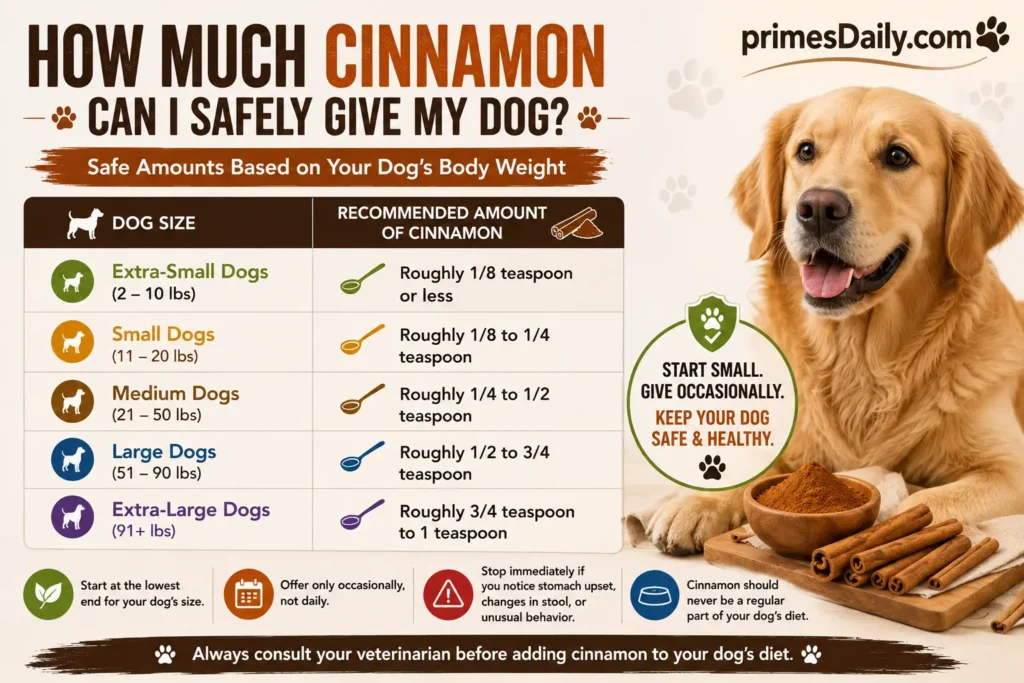
Once you’ve decided cinnamon isn’t bad for dogs in your household — with your vet’s approval — quantity should scale with body weight, and it should always start smaller than you think it needs to be.
A general, cautious guideline used by many veterinary sources looks like this:
- Extra-small dogs (2–10 lbs): roughly 1/8 teaspoon or less
- Small dogs (11–20 lbs): roughly 1/8 to 1/4 teaspoon
- Medium dogs (21–50 lbs): roughly 1/4 to 1/2 teaspoon
- Large dogs (51–90 lbs): roughly 1/2 to 3/4 teaspoon
- Extra-large dogs (91+ lbs): roughly 3/4 teaspoon to 1 teaspoon
These are rough starting points, not prescriptions. The safest approach is to start at the lowest end for your dog’s size, offer it only occasionally rather than daily, and stop immediately if you notice any stomach upset, changes in stool, or unusual behavior. Cinnamon should never make up a meaningful percentage of your dog’s regular diet.
How to Safely Add Cinnamon to Your Dog’s Diet
If you and your vet have agreed a small amount of cinnamon is fine for your dog, here’s how to do it without unnecessary risk:
- Choose Ceylon cinnamon over cassia where possible, since it contains far less coumarin.
- Mix it thoroughly into food rather than letting your dog lick loose powder, which reduces the chance of inhalation and coughing.
- Start with a fraction of the recommended amount for your dog’s weight and observe for 24 hours before repeating.
- Keep it occasional, not daily. Treat cinnamon the way you’d treat any seasoning — a rare addition, not a staple.
- Avoid combining it with other new foods at the same time, so if a reaction does happen, you know exactly what caused it.
- Skip it entirely for dogs with diabetes, liver disease, or respiratory conditions unless your vet has explicitly said otherwise.
- Never use cinnamon oil, extracts, or supplements marketed for humans — these are far more concentrated than anything appropriate for a dog’s size.
Is Cinnamon in Candles or Potpourri Harmful to Dogs?
Cinnamon exposure isn’t limited to what a dog eats — the smell of cinnamon around the house matters too, and this is a part of the “is cinnamon bad for dogs” question that most guides barely touch on.
Inhalation and Skin Exposure Risks
Dogs have a sense of smell that’s estimated to be tens of thousands of times more sensitive than a human’s, which means a cinnamon candle that smells pleasantly cozy to you can be genuinely overwhelming to your dog’s nose. Cinnamon-scented candles, potpourri, incense, and air fresheners often rely on concentrated fragrance oils, and burning or diffusing them in an enclosed space can lead to respiratory irritation in dogs — sneezing, watery eyes, coughing, or general discomfort.
Cinnamon essential oil diffusers deserve special caution here. Never run a cinnamon oil diffuser in a room your dog spends significant time in, and never let your dog have direct skin or paw contact with cinnamon oil, cinnamon-scented cleaning products, or potpourri. Decorative cinnamon brooms and bundles, popular in fall home decor, can also cause mouth irritation if a curious dog decides to chew on them — treat them as an out-of-reach decoration, not a chew toy.
Nutmeg vs. Cinnamon: Which Is More Dangerous for Dogs?
Cinnamon and nutmeg show up together constantly — in baking spice blends, pumpkin pie recipes, and fall treats — but they are not equally risky for dogs.
Nutmeg contains a compound called myristicin, which is genuinely more concerning than anything in cinnamon. In larger doses, myristicin can cause disorientation, a racing heart, high blood pressure, dry mouth, abdominal pain, and in more severe cases, hallucination-like effects or seizures that can last up to 48 hours. It generally takes a fairly large amount of nutmeg to cause serious problems, and the tiny pinch used in most baked goods is unlikely to cause an issue on its own — but it’s a much lower threshold for concern than cinnamon.
The practical takeaway: cinnamon alone is the milder of the two spices, but any recipe or treat containing both should be treated with the same caution you’d apply to nutmeg specifically.
How to Prevent Accidental Cinnamon Exposure
A little bit of household organization goes a long way in avoiding an unplanned trip to the vet, and it’s usually the simplest way to make sure cinnamon is never actually bad for your dog in the first place.
Keep Cinnamon and Spices Out of Reach
- Store cinnamon, nutmeg, and other baking spices in a closed cabinet rather than an open shelf or spice rack a dog could knock over.
- Keep cinnamon essential oils, diffuser blends, and any concentrated cinnamon products in a latched cabinet, well away from where your dog eats, sleeps, or plays.
- If you bake with cinnamon regularly, clean counters and floors right after to avoid stray powder or crumbs your dog could get into.
Monitor Table Scraps and Human Food
- Avoid offering any bite of a cinnamon-flavored human food “just this once” — it’s often how accidental exposure starts.
- Double-check labels on anything cinnamon-flavored before it goes anywhere near your dog’s bowl, specifically scanning for xylitol, raisins, chocolate, and nutmeg.
- Train your dog to stay off counters and away from the table during meal prep.
- Let guests and kids know not to slip your dog a bite of dessert, since well-meaning family members are a common source of these incidents during holidays.
FAQs
Is cinnamon bad for dogs in small amounts? No. In small amounts, cinnamon is not considered toxic or dangerous to most healthy dogs. The concerns start when the quantity increases or when a dog has an existing health condition.
Is cinnamon bad for dogs if it’s cinnamon oil? Yes. Cinnamon essential oil is considered unsafe for dogs even in small amounts and can cause skin irritation, low blood sugar, liver stress, and breathing difficulty.
Is cinnamon bad for dogs with diabetes or liver disease? It can be riskier. Dogs with diabetes, liver disease, or respiratory issues should avoid cinnamon entirely unless a veterinarian has specifically approved it.
Can dogs eat cinnamon rolls? It’s not recommended. Beyond the cinnamon itself, cinnamon rolls are high in sugar and fat, which can upset a dog’s stomach or contribute to pancreatitis, and some recipes include xylitol or nutmeg, both of which carry real risk.
How much cinnamon is too much for a dog? There’s no single universal number, since it depends on your dog’s size and sensitivity, but more than a light dusting — especially anything approaching a full teaspoon for a small dog — starts to move into risky territory.
Is the smell of cinnamon bad for dogs? Strongly scented cinnamon candles, incense, or diffused oils can irritate a dog’s sensitive nose and airway, leading to sneezing, coughing, or discomfort, particularly in enclosed spaces.
Is cinnamon or nutmeg worse for dogs? Nutmeg is the more concerning of the two. It contains myristicin, a compound that can cause more serious symptoms at lower thresholds than cinnamon typically requires.
What should I do if my dog ate a lot of cinnamon? Identify exactly what and how much they ate, check the ingredient label for xylitol or other toxic additions, and watch closely for vomiting, diarrhea, or breathing changes. Call your veterinarian if symptoms appear or if you’re unsure of the amount involved.
Conclusion
So, is cinnamon bad for dogs? Not in the dramatic, rush-to-the-emergency-room sense — a small taste here or there isn’t going to seriously harm a healthy dog. But it’s also not something to hand out freely, and the real risks tend to hide in the details: cinnamon essential oil, large quantities, xylitol lurking in a “harmless” baked good, or a dog with a health condition that makes them more sensitive than most.
The safest approach is simple. Keep cinnamon and anything containing it out of easy reach, know the difference between a light dusting and a genuine overdose, and never assume a cinnamon-flavored treat is automatically dog-safe just because the spice itself isn’t toxic. When in doubt about a specific amount, a specific product, or your specific dog’s health history, a quick call to your veterinarian will always give you a better answer than guessing — and it’s the one habit that turns “I think we’re okay” into “I know we’re okay.”
For the latest, updated, and unique information, visit Hakuna Matata Meaning.