

Your dermatologist just started you on isotretinoin, and instead of clearer skin, your face looks angrier than it did on day one. If that’s where you are right now, take a breath — you’re not doing anything wrong, and you’re not alone.
This reaction has a name, and understanding it can take away most of the panic. In this guide, we’re going to walk through everything: why it happens, how long it usually sticks around, what’s actually normal versus what needs a call to your dermatologist, and the exact steps that make this phase easier to live through. No filler, no vague reassurance — just what you need to know, week by week, so you’re not left guessing.
What Is an Accutane Purge?
An Accutane purge is a temporary worsening of acne that some people experience shortly after starting isotretinoin, the generic form of Accutane. Instead of clearing skin right away, the medication can bring existing, deep-forming blemishes to the surface faster than they would have appeared on their own — so breakouts that were already brewing under your skin show up all at once, rather than trickling out over months.
It sounds counterintuitive for an acne medication to cause more acne, but this is genuinely a sign that the drug is doing its job at the cellular level. Isotretinoin is a powerful retinoid that changes how your oil glands and skin cells behave, and that adjustment period isn’t always smooth. The good news? For most people, it’s short, predictable, and followed by real, lasting clearance.
What Causes the Accutane Purge?
There isn’t one single mechanism behind this flare — it’s really a combination of changes happening in your skin at once:
- Faster cell turnover. Isotretinoin speeds up how quickly skin cells shed and regenerate. This pushes clogged debris, oil, and bacteria that were sitting deep in your pores up to the surface much sooner than they would have appeared naturally.
- A sudden drop in oil production. Your sebaceous glands shrink and produce far less sebum once you start treatment. This abrupt shift can temporarily destabilize the skin, causing existing blemishes to become more inflamed before things settle down.
- A short-term inflammatory response. As your pores adjust to the new environment, some patients experience an uptick in redness, swelling, and irritation — this is your skin reacting to rapid internal change, not a sign the medication has failed.
Put simply: your skin isn’t getting worse because of a new problem. It’s dealing with everything that was already forming beneath the surface, just on a faster timeline.
Does Everyone Experience an Accutane Purge?
No — and this is worth repeating because so many people assume it’s inevitable. Research shows that anywhere from roughly 5% to as high as 30% of patients experience a noticeable flare in the first month of isotretinoin treatment, meaning the majority of people don’t purge in any dramatic way at all.
Whether you flare tends to depend on a few factors:
- Your baseline acne severity. Patients starting with more cystic, nodular, or deeply inflamed acne are more likely to notice a flare, simply because there’s more “material” sitting under the skin to surface.
- Your starting dose. Higher initial doses tend to trigger a more noticeable reaction than a slow, gradual ramp-up.
- Age and skin type. Younger patients and those with naturally oilier skin have been reported to flare more often, though this varies widely from person to person.
- Individual biology. Two people with nearly identical acne can respond completely differently — some barely notice a change, while others have a rough few weeks.
If your skin stays fairly stable after starting treatment, that isn’t a red flag. It simply means you’re one of the many people whose skin adjusts quietly.
Accutane Purge vs. Normal Acne Breakouts: How to Tell the Difference
Not every new pimple on isotretinoin is a “purge,” and lumping every flare-up into that category can actually delay getting help you might need. Here’s how to tell the two apart:
- A true purge usually follows your existing acne pattern — the same areas you normally break out in simply look more active for a few weeks, then start calming down.
- Irritant reactions show up as redness, burning, and breakout-like bumps caused by harsh skincare (scrubs, strong acids, over-cleansing) rubbing against a skin barrier that isotretinoin has already made more fragile.
- Folliculitis, including yeast-related folliculitis, can mimic acne closely but tends to appear as small, uniform, sometimes itchy bumps, often on the chest, back, or hairline — this needs a different treatment approach entirely.
- A pattern shift — meaning your bumps suddenly look nothing like your usual acne, or your skin feels raw and burns constantly — is a signal to check in with your dermatologist rather than assuming it’s “just the purge.”
If your breakouts are simply an intensified version of what you had before and they’re trending downward over a few weeks, you’re likely dealing with a standard flare. If the pattern feels genuinely different, it’s worth asking your provider to take a closer look.
What Can You Expect During an Accutane Purge?
If you do experience this reaction, here’s what commonly shows up:
- More active breakouts, often deeper and more inflamed than your usual acne, particularly in the first few weeks of treatment.
- Dryness and flaking, since reduced oil production affects your entire face — and sometimes your lips, scalp, and even the inside of your nose.
- Redness and sensitivity, with skin that feels tight, warm, or easily irritated by products you used to tolerate fine.
- Breakouts in new locations, such as the jawline, neck, or chest, even if you’d never had issues there before.
- An emotional dip. Watching your skin look worse right when you expected improvement can genuinely be discouraging — it’s a completely normal reaction, and it usually passes as your skin turns the corner.
Accutane Purge Week 1–2: Early Reactions Begin
The first two weeks are often more about early dryness than dramatic breakouts. Your lips may start chapping, your skin might feel a little tighter than usual, and some people notice their first new blemishes emerging around the end of week one or into week two.
This is when your oil glands are just starting to slow down and your cell turnover rate is speeding up — so the visible effects are only just beginning. If you’re wondering when purging typically starts, this two-week window is when most people notice their first meaningful shift, though plenty of others don’t see anything unusual this early.
Accutane Purge Week 3–4: The Peak Phase
For patients who do flare, weeks three and four tend to be the roughest stretch. This is typically when breakouts are at their most active — deeper cysts may surface, existing spots can look more inflamed, and new blemishes may appear in areas that were already acne-prone.
Dryness usually intensifies here too, which can make wearing makeup or shaving genuinely uncomfortable. The key thing to watch for during this phase is direction: is your skin holding steady or slowly starting to calm, or does it feel like it’s escalating with no end in sight? The former is expected. The latter is worth flagging to your dermatologist.
Accutane Purge Week 5–6: The Turning Point
By weeks five and six, many people start noticing the shift they’ve been waiting for. New breakouts tend to slow down, older lesions begin healing and flattening out, and overall inflammation typically eases.
This is often described as the turning point because it’s the first stretch where skin genuinely starts looking better rather than just “less bad.” That said, patients who started with heavier inflammatory or cystic acne, or a higher initial dose, may still be actively working through their flare at this stage — and that’s still within a normal range.
Accutane Purge After Week 6: Visible Improvement
Past the six-week mark, most patients who experienced a flare begin to see real, visible progress. Breakouts become noticeably less frequent, skin starts to look smoother and more even, and the overall texture begins to settle.
Red or brown marks from earlier breakouts — known as post-inflammatory erythema or hyperpigmentation — may still be visible even as active acne clears, and that’s completely separate from the purge itself; those marks typically fade gradually over the following months. Dryness and other side effects can persist throughout treatment, but they usually become much easier to manage once the initial flare has passed.
How Long Does the Accutane Purge Last?
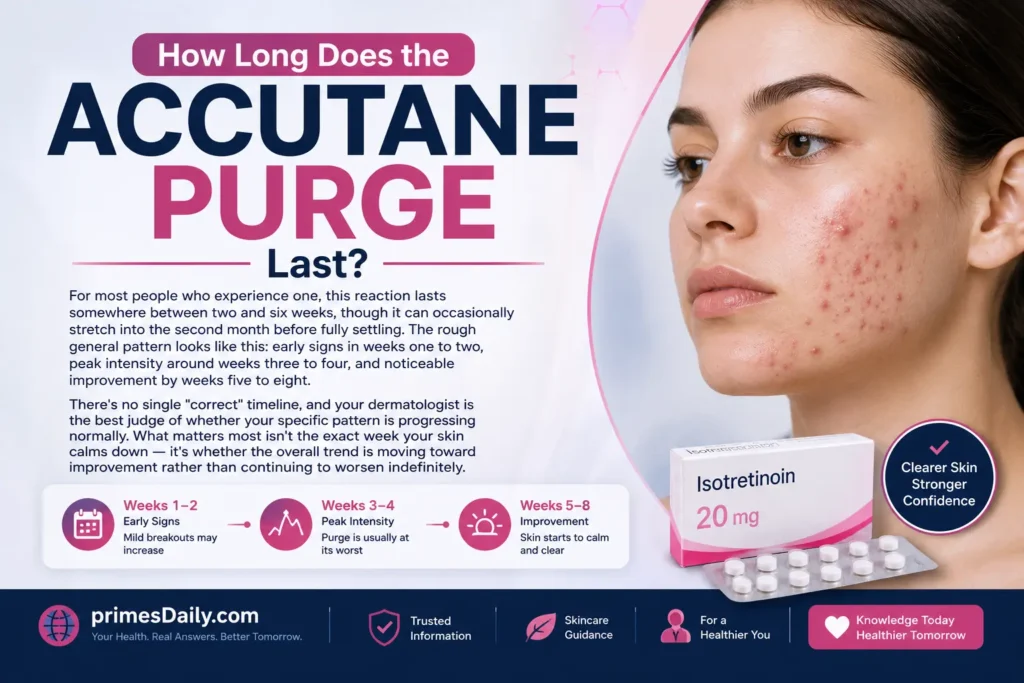
For most people who experience one, this reaction lasts somewhere between two and six weeks, though it can occasionally stretch into the second month before fully settling. The rough general pattern looks like this: early signs in weeks one to two, peak intensity around weeks three to four, and noticeable improvement by weeks five to eight.
There’s no single “correct” timeline, and your dermatologist is the best judge of whether your specific pattern is progressing normally. What matters most isn’t the exact week your skin calms down — it’s whether the overall trend is moving toward improvement rather than continuing to worsen indefinitely.
What Can Make the Accutane Purge Last Longer?
A handful of factors tend to stretch this phase out longer than the typical timeline:
- Starting at a higher dose. A more aggressive initial dose can trigger a stronger, longer-lasting flare compared to a gradual ramp-up.
- Severe baseline acne. Patients starting with heavier cystic or nodular acne simply have more material working its way to the surface, which can extend the active phase.
- Harsh or aggressive skincare. Scrubs, strong acids, frequent benzoyl peroxide, or over-cleansing can irritate an already fragile barrier and prolong visible redness and breakouts.
- Environmental stress. Extreme heat, cold wind, or excessive sun exposure can aggravate already-sensitized skin and slow recovery.
- Picking or squeezing. Manipulating active breakouts pushes bacteria deeper, increases inflammation, and delays healing — often adding weeks to visible recovery.
- Delaying support. Waiting too long before mentioning a severe flare to your dermatologist means missing out on adjustments — like dose changes or short-term supportive treatments — that could shorten the rough patch.
For the latest, updated, and unique information, visit Mg to Ml.
Can You Avoid the Accutane Purge?
There’s no guaranteed way to prevent this reaction entirely, since it depends heavily on your individual skin and how much acne was forming beneath the surface before you started. However, you can meaningfully reduce your risk and soften its severity with the right approach from day one.
The single most effective strategy dermatologists point to is starting treatment at a lower dose and increasing it gradually rather than beginning at a full target dose right away. This gives your oil glands and skin cells time to adjust instead of shocking the system all at once. Some providers also recommend calming the skin with a short course of oral antibiotics or topical treatment before isotretinoin begins, particularly for patients with more severe or inflammatory acne.
How to Minimize the Accutane Purge
If you’re already in the middle of a flare, these evidence-backed strategies can help take the edge off while your skin adjusts.
Start With a Low Dose of Accutane
Beginning treatment at a lower dose gives your body time to adapt gradually to a powerful medication rather than reacting all at once. This approach has been shown to reduce both the likelihood and the severity of an early flare, while also softening common side effects like dryness and irritation. Your dermatologist will typically tailor your starting dose based on your weight and how severe your acne is, then increase it over time as your skin builds tolerance.
Take an Antihistamine Alongside Isotretinoin
Over-the-counter, non-drowsy antihistamines — such as cetirizine, loratadine, or fexofenadine — can be used safely alongside isotretinoin in many patients to calm inflammation and itching. Some clinical research has found that pairing an antihistamine with isotretinoin noticeably reduced both itching and breakout severity compared to isotretinoin alone. Always confirm this combination with your prescribing dermatologist before adding anything new to your routine.
Ask About Oral Steroids for Severe Flare-Ups
For patients dealing with a particularly painful or heavily inflamed flare, some dermatologists prescribe a short course of an oral corticosteroid, such as prednisone, to bring inflammation down quickly while isotretinoin continues working. This is typically used as a temporary bridge rather than a long-term solution, and it should only be taken under close medical supervision given the potential side effects of steroid use.
Maintain a Gentle Skincare Routine During the Accutane Purge
Your skin barrier is more fragile than usual during this phase, so the goal is to support it, not fight it. Stick to a simple, non-foaming, fragrance-free cleanser, a rich and hydrating moisturizer, and a broad-spectrum sunscreen every single day. Skip anything with active exfoliating ingredients unless your dermatologist specifically tells you otherwise — your skin needs calm, not more stimulation, right now.
Use Non-Comedogenic Products
Every single product that touches your face — cleanser, moisturizer, sunscreen, makeup — should be labeled non-comedogenic, meaning it won’t clog your already-sensitive pores. Look for lightweight, oil-free formulas with minimal ingredient lists, since a shorter ingredient list generally means a lower chance of irritation or an allergic-type reaction.
Avoid Picking or Squeezing Blemishes
It’s tempting to want to speed things up by picking, but doing so pushes bacteria deeper into the skin, increases inflammation, and significantly raises your risk of permanent scarring. Letting breakouts run their natural course — even when it’s frustrating — leads to faster overall healing. If the urge to pick is strong, hydrocolloid patches can help by giving your hands something else to do while protecting the area underneath.
Best Products to Use During an Accutane Purge
Building a short, predictable routine makes this phase far easier to manage. Look for:
- A gentle, sulfate-free, fragrance-free cleanser that doesn’t leave your skin feeling stripped or squeaky
- A thick, ceramide-based moisturizer that reinforces your skin barrier rather than just sitting on top of it
- A mineral or broad-spectrum SPF 30–50 sunscreen, applied daily without exception, since isotretinoin significantly increases sun sensitivity
- A heavy-duty lip balm or ointment, since chapped lips are one of the earliest and most consistent side effects
- Preservative-free artificial tears if your eyes start feeling dry or gritty
- A saline nasal spray to ease nosebleeds or dryness inside the nostrils
Products and Ingredients to Avoid During the Accutane Purge
Just as important as what you add is what you leave out. Steer clear of:
- Physical scrubs or exfoliating brushes, which can tear at already-thinned, sensitive skin
- Strong acids like high-percentage glycolic, salicylic, or lactic acid unless your dermatologist has specifically approved them
- Additional retinoids or retinol-based products layered on top of isotretinoin, since this can compound irritation
- Alcohol-heavy toners or astringents that strip moisture your skin desperately needs right now
- Harsh acne spot treatments containing high-strength benzoyl peroxide, which can worsen dryness and redness
Signs Your Accutane Purge May Be Something More Serious
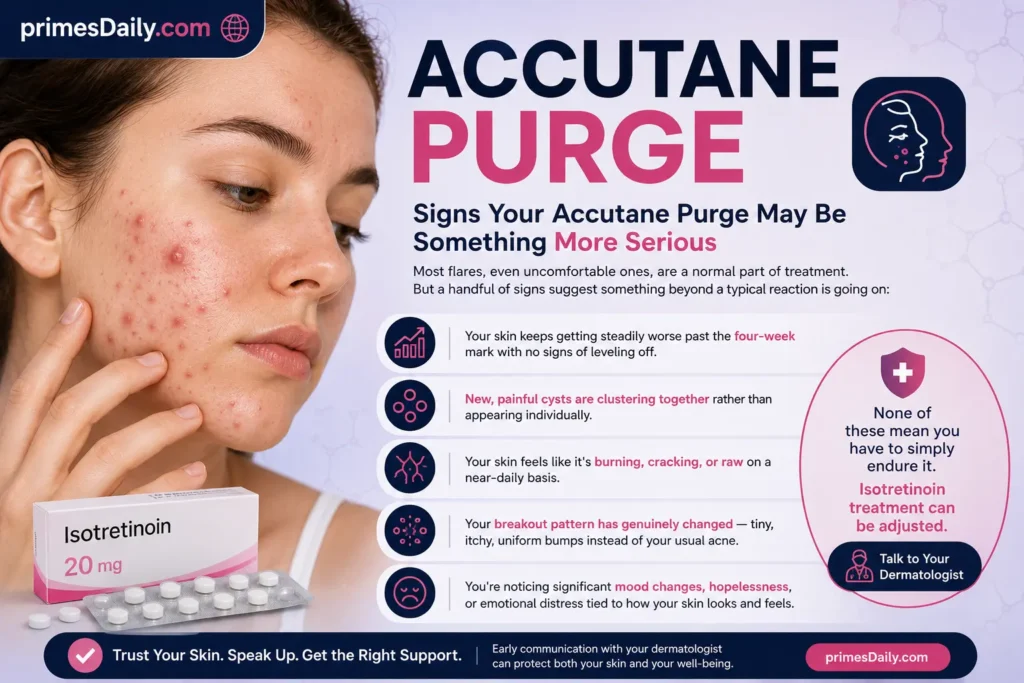
Most flares, even uncomfortable ones, are a normal part of treatment. But a handful of signs suggest something beyond a typical reaction is going on:
- Your skin keeps getting steadily worse past the four-week mark with no signs of leveling off
- New, painful cysts are clustering together rather than appearing individually
- Your skin feels like it’s burning, cracking, or raw on a near-daily basis
- Your breakout pattern has genuinely changed — tiny, itchy, uniform bumps instead of your usual acne
- You’re noticing significant mood changes, hopelessness, or emotional distress tied to how your skin looks and feels
None of these mean you have to simply endure it. Isotretinoin treatment can and often is adjusted mid-course when something isn’t tracking normally.
When to Contact Your Dermatologist During an Accutane Purge
Reach out to your dermatologist if you notice any of the following: acne that keeps intensifying well past the one-month mark, clusters of new painful cysts, skin that’s cracking or bleeding from dryness, a breakout pattern that suddenly looks completely different from your usual acne, or any emotional toll that’s starting to feel like more than frustration.
Your dermatologist has options beyond “wait it out” — that can include adjusting your dose, pacing the increase more slowly, adding short-term supportive treatment, or simply confirming that what you’re seeing is within the range of normal so you can stop worrying and keep going.
Is the Accutane Purge Worth It in the Long Run?
For the vast majority of patients, yes. A temporary flare — even an uncomfortable one lasting a few weeks — is a small price relative to the long-term clearance isotretinoin can provide for acne that hasn’t responded to anything else. Most people who complete a full course see significantly reduced acne, and a large portion stay clear for years afterward without needing ongoing treatment.
It’s worth remembering that this reaction, when it happens, is temporary by definition. The acne it brings to the surface was already there — the medication is simply accelerating a process rather than creating a new problem. Judging isotretinoin by its hardest weeks, rather than by where your skin ends up months later, tends to give a distorted picture of how effective the treatment really is.
Tips to Mentally Cope With the Accutane Purge
The physical side of this phase gets most of the attention, but the emotional weight of watching your skin look worse deserves just as much acknowledgment.
- Start treatment during a calmer stretch of life if you have any flexibility — school breaks or slower work periods give you room to manage flare-ups without added pressure.
- Track your progress with photos, taken weekly in the same lighting. Day-to-day changes are hard to notice in the mirror, but photos taken a few weeks apart usually reveal real improvement even when it doesn’t feel that way.
- Talk to people who’ve been through it. Support communities and forums full of people at different stages of treatment can make the rough weeks feel far less isolating.
- Remind yourself this phase has an expiration date. Unlike untreated acne, which can persist indefinitely, this reaction is a defined, temporary chapter within a much longer treatment story.
- Keep communicating with your dermatologist. Mentioning even minor frustrations gives your provider the chance to adjust your plan before things start affecting your mental health.
FAQs
Is it normal for acne to get worse before it gets better on Accutane? Yes, for a portion of patients this is a recognized part of treatment. It doesn’t happen to everyone, and when it does occur, it typically follows a pattern of worsening for a few weeks before gradually improving.
How do I know if I’m purging or just having a regular breakout? A true flare usually follows your existing acne pattern, just more actively, and trends downward over several weeks. If your bumps look completely different from your usual acne, or your skin feels raw and burning rather than just breakout-prone, that points toward irritation or another condition rather than a standard reaction.
Can I use makeup during this phase? Yes, as long as you choose non-comedogenic, oil-free formulas. Just be extra gentle when applying and removing it, since your skin barrier is more fragile than usual.
Does a higher dose mean a worse flare? Generally, yes — a higher starting dose tends to correlate with a more intense early reaction compared to a gradual, lower-dose start, which is part of why many dermatologists prefer to ramp up slowly.
Will my skin scar from this reaction? Scarring risk comes primarily from how breakouts are handled, not from the flare itself. Avoiding picking or squeezing, and treating skin gently, significantly reduces the chance of lasting marks.
Can I stop Accutane if the flare feels too intense? Don’t make that decision on your own — contact your dermatologist first. In many cases, adjusting the dose or adding short-term supportive treatment resolves the issue without needing to stop the medication entirely.
Is it common to purge on a second round of Accutane? It’s less common than during a first course, since your skin has already been through the adjustment process once, but it can still happen, especially if the second course starts at a higher dose or targets more active acne than before.
Conclusion
A temporary flare after starting isotretinoin can feel discouraging, especially when you started treatment hoping for the opposite result. But for most patients who experience it, this is a short, predictable chapter — one with a beginning, a peak, and a clear end — rather than a sign that anything has gone wrong.
Knowing what to expect week by week, sticking to a gentle skincare routine, and staying in close contact with your dermatologist are the three things that make the biggest difference in getting through this phase comfortably. If you keep that framework in mind, the roughest weeks become something you can manage with confidence rather than something you have to white-knuckle through alone.
For the latest, updated, and unique information, visit Stages Of Fasting.