
Your body doesn’t just switch off when you stop eating. It moves through a series of distinct, well-mapped physiological stages, each with its own hormone shifts, fuel sources, and health effects. Understanding these stages of fasting isn’t just trivia for biology nerds. It’s the difference between fasting with confidence and fasting blind, hoping for the best while wondering if what you’re feeling at hour 20 is normal or a warning sign.
This guide walks through the entire fasting timeline, hour by hour and phase by phase, based on current metabolic research current as of 2026. You’ll find out what triggers ketosis, when autophagy actually kicks in, why growth hormone spikes during a fast, and which myths about fasting still refuse to die despite being debunked years ago. By the end, you’ll know exactly what’s happening inside your body at any point during a fast, how to move through each phase comfortably, and when fasting simply isn’t the right choice for you.
Nothing here requires you to go hunting for a second or third article. Everything from the basic science to the safety warnings to the hour-by-hour breakdown is covered in one place.
What Is Fasting and Why It Matters
Fasting means voluntarily going without food for a defined period. It ranges from a routine 12-hour overnight fast (which most people already do without realizing it) to multi-day extended fasts that require medical oversight.
What makes fasting worth understanding isn’t the act of not eating itself. It’s what your metabolism does in response. Your body constantly shifts between two states: a fed state, where it’s storing incoming energy, and a fasted state, where it’s pulling energy back out of storage. Modern eating patterns, with frequent meals and snacking throughout the day, keep most people locked in the fed state almost permanently. Fasting reintroduces the fasted state, and that shift is where most of the reported benefits, from improved insulin sensitivity to cellular repair, actually come from.
Why does this matter now more than ever? Metabolic conditions like insulin resistance, fatty liver disease, and type 2 diabetes have become widespread, and a growing body of research points to constant eating (rather than what we eat) as part of the problem. Fasting gives the body scheduled recovery time it rarely gets otherwise.
Does fasting mean starving yourself? No. Fasting is a planned, temporary pause in eating with a clear endpoint, while starvation is prolonged, unintentional food deprivation without a plan to resume normal eating. The two trigger overlapping but not identical physiological responses.
How Fasting Works: The Science Behind Metabolic Switching
At the center of every fasting protocol is a single biological process called metabolic switching. This is the shift your body makes from burning glucose (sugar) as its primary fuel to burning fat and ketones instead.
Here’s the mechanism in plain terms:
- When you eat, blood glucose rises, and your pancreas releases insulin to move that glucose into your cells for immediate use or storage.
- Extra glucose gets packed away in your liver and muscles as glycogen, a storage form of carbohydrate.
- Once you stop eating, insulin levels start to fall. As they drop, your body slowly transitions from relying on incoming glucose to tapping into stored glycogen.
- When glycogen runs low, usually somewhere between 12 and 24 hours into a fast for most people, your body starts breaking down stored fat into fatty acids and glycerol, a process called lipolysis.
- The liver converts some of those fatty acids into ketone bodies, an alternative fuel source that your brain, heart, and muscles can all use efficiently.
This entire sequence is what researchers mean by “the metabolic switch.” It’s not instant. It’s a gradual handoff between fuel systems that plays out over hours, not minutes.
How long does metabolic switching take? For most healthy adults, meaningful switching begins around 12 hours into a fast and becomes significant by hour 16 to 24, though the exact timing depends on your last meal’s size and carbohydrate content, your activity level, and your baseline metabolic health.
The Stages of Fasting: What Happens to Your Body
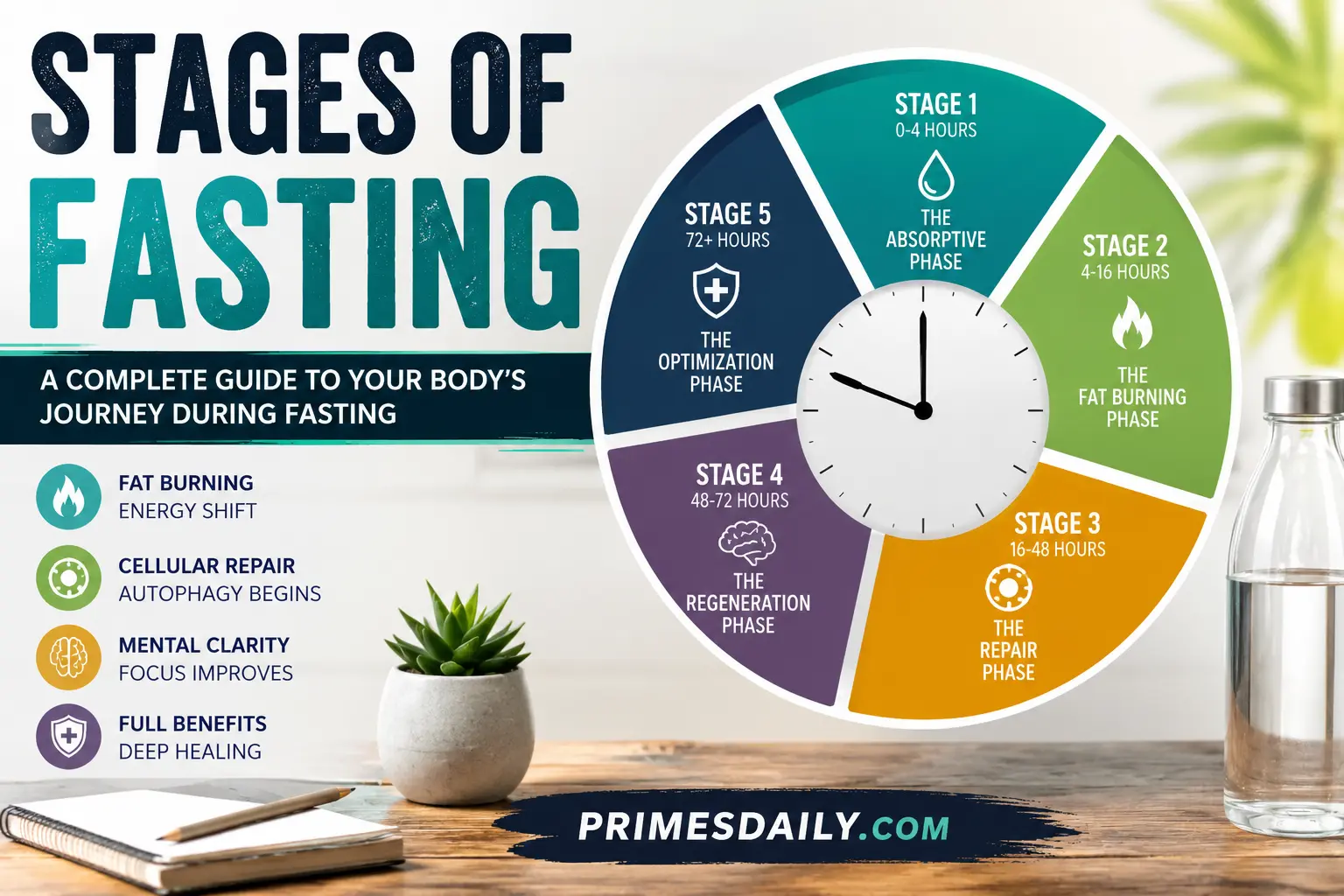
Fasting research generally breaks the process into distinct phases, each defined by a different primary fuel source and hormonal environment. While different researchers use slightly different hour windows, the underlying biology is consistent. Below is a complete, hour-anchored breakdown of what your body experiences from the moment you finish eating to well beyond the 72-hour mark.
Stage 1: The Fed State (0–4 Hours)
The fed state begins the moment you finish a meal and lasts roughly four hours. During this window, your digestive system is actively breaking down food, and glucose is flooding into your bloodstream.
What’s happening internally:
- Insulin secretion rises sharply to shuttle glucose from the blood into your cells.
- Extra glucose is converted into glycogen and stored in the liver and muscles.
- Any surplus beyond glycogen storage capacity gets converted into fat for longer-term storage.
- Leptin, the hormone that signals fullness, rises, while ghrelin, the hunger hormone, drops.
This is sometimes called the “anabolic” phase because your body is actively building and storing tissue rather than breaking anything down. If you eat again before this window ends, which most people do given typical meal spacing, the fed-state clock simply resets.
Stage 2: The Early Fasting State (4–16 Hours)
Somewhere between the 3 and 4-hour mark, your body transitions into the early fasting state, sometimes called the postabsorptive phase. This stage typically runs until around 16 to 18 hours after your last meal.
During this window:
- Blood glucose and insulin levels start declining steadily.
- Your liver begins converting stored glycogen back into glucose to keep blood sugar stable.
- As glycogen reserves shrink, your body starts leaning more heavily on fat as a backup fuel source, and lipolysis intensifies.
- Glycogen stores are usually enough to cover 18 to 36 hours, depending on your activity level, muscle mass, and diet leading up to the fast.
This is the exact window where most intermittent fasting protocols, like a 16:8 eating schedule, live. If you fast overnight and skip breakfast, this is the phase you’re spending most of your time in.
Do you feel hungry during this stage? Some people do experience noticeable hunger as ghrelin rises in waves, but hunger during early fasting is typically more about habit and blood sugar fluctuation than actual energy deficit, since the body still has ample stored fuel available.
Stage 3: Glycogen Depletion and Gluconeogenesis (16–24 Hours)
By hour 16, your liver’s glycogen reserves are running low, and your body needs a new way to keep blood glucose stable, especially for glucose-dependent organs like the brain.
This is where gluconeogenesis takes over. Literally meaning “making new glucose,” this process allows your liver to manufacture glucose from non-carbohydrate sources, primarily amino acids released from protein and glycerol released from fat breakdown.
Key developments in this window:
- Glycogen stores approach full depletion.
- The liver ramps up gluconeogenesis to maintain blood glucose within a normal range.
- Growth hormone secretion begins rising sharply, in some studies increasing up to 20-fold in men and 13-fold in women during a 24-hour fast.
- Fat breakdown accelerates as the body prepares to shift its primary fuel source.
In healthy, non-diabetic individuals, blood glucose during this stage typically stays within normal limits even though it’s trending lower, thanks to gluconeogenesis doing its job.
Stage 4: Ketosis Begins (24–72 Hours)
Once glycogen is essentially exhausted, usually somewhere around the 24-hour mark, your body shifts decisively toward fat as its dominant fuel source. This is when ketosis begins.
During ketosis:
- Triglycerides stored in fat cells are broken down into fatty acids and glycerol.
- The liver converts a portion of those fatty acids into ketone bodies, primarily beta-hydroxybutyrate and acetoacetate.
- Ketones cross the blood-brain barrier and become an increasingly important fuel source for the brain, which cannot run on fatty acids directly.
- By around the fourth day of continuous fasting, ketones can supply roughly 75% of the brain’s energy needs.
Common signs that ketosis has kicked in include reduced appetite, mild fatigue that often gives way to increased mental clarity, a distinct fruity smell on the breath, and measurable ketones in blood, breath, or urine tests.
It’s worth being precise here: nutritional ketosis, the state your body enters during fasting or a very low-carb diet, is metabolically different from ketoacidosis, a dangerous complication almost exclusively seen in people with poorly controlled type 1 diabetes. The two get confused constantly, but they are not the same condition.
Does everyone reach ketosis at the same speed? No. Diet composition before the fast, muscle mass, activity level, and metabolic flexibility all affect how quickly someone transitions into measurable ketosis, which is why two people fasting for the same number of hours can report very different experiences.
Stage 5: Deep Ketosis and Protein Conservation (72+ Hours)
Past the 72-hour mark, the body enters what researchers call deep ketosis combined with a protein-sparing phase. This is where fasting physiology becomes genuinely remarkable.
What’s happening:
- Ketone production reaches its peak, with some research showing ketone levels increasing more than 70-fold compared to a fed state.
- Growth hormone remains elevated, helping preserve lean muscle mass even as the body relies almost entirely on fat and ketones for fuel.
- Norepinephrine (a stress hormone closely related to adrenaline) rises, which helps prevent the metabolic slowdown associated with prolonged calorie restriction.
- Protein turnover continues at a normal pace but isn’t broken down for energy the way many people assume; the body prioritizes burning fat reserves first.
This is a key point that gets misunderstood constantly: your body does not start “eating your muscles” the moment you pass 72 hours. Meaningful muscle protein breakdown for energy purposes only becomes significant once fat reserves are nearly depleted, which for most people takes far longer than a few days of fasting.
Stage 6: Extended Fasting and Autophagy (5+ Days)
Beyond the five-day mark, fasting moves into territory that should only be attempted under direct medical supervision. This stage is defined by two major processes: peak autophagy and the onset of stem cell regeneration.
Autophagy, meaning “self-eating,” is your body’s internal cleanup system. It clears out damaged proteins, malfunctioning cell components, and even certain pathogens. While autophagy begins ramping up as early as 16 to 18 hours into a fast, it reaches its most active levels during extended, multi-day fasting.
Additional developments at this stage:
- Liver production of IGF-1, a growth hormone-related protein, drops significantly.
- This IGF-1 reduction is linked to the activation of stem cell regeneration pathways, particularly in the blood-forming (hematopoietic) system.
- Immune system components can begin regenerating, a process some researchers associate with improved resilience following a return to normal eating.
Because of the physiological stress involved, extended fasts of five days or longer carry real risks including electrolyte imbalances, dangerously low blood pressure, and in vulnerable individuals, cardiac complications. This stage is not a do-it-yourself experiment.
Fasting Timeline by Hour
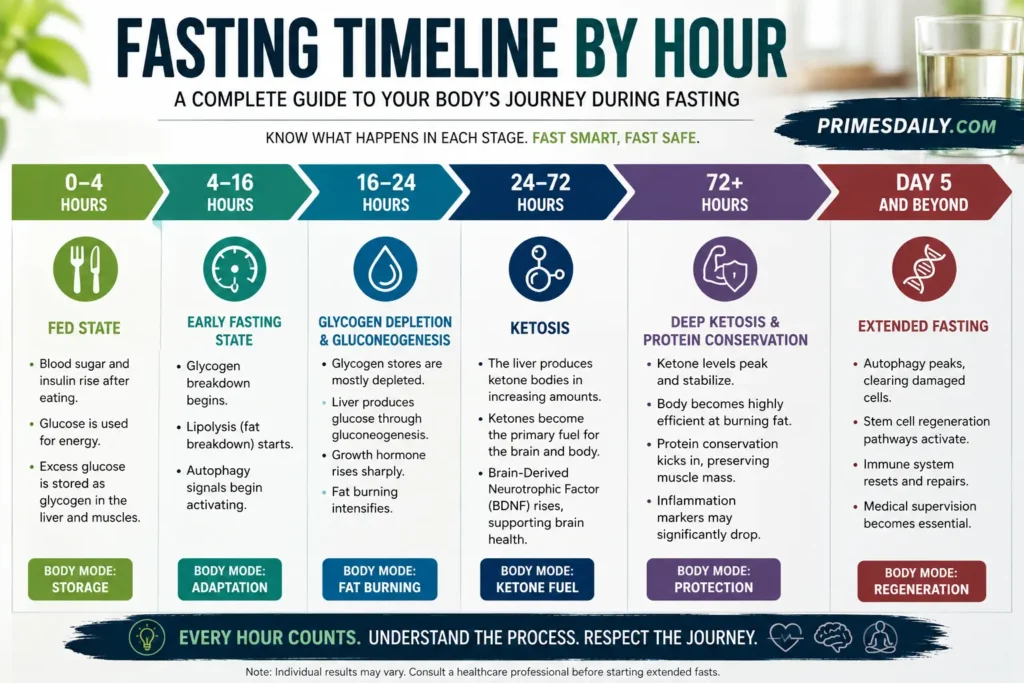
For a quick, at-a-glance reference, here’s how the entire fasting timeline stacks up:
- Hours 0–4: Fed state. Blood sugar and insulin rise, glucose is used or stored as glycogen.
- Hours 4–16: Early fasting state. Glycogen breakdown begins, lipolysis starts, autophagy signals begin activating.
- Hours 16–24: Glycogen depletion and gluconeogenesis. Growth hormone rises sharply, fat burning intensifies.
- Hours 24–72: Ketosis. The liver produces ketone bodies in increasing amounts, brain-derived neurotrophic factor (BDNF) rises.
- Hours 72+: Deep ketosis and protein conservation. Ketone levels peak, muscle mass is actively preserved.
- Day 5 and beyond: Extended fasting. Autophagy peaks, stem cell regeneration pathways activate, medical supervision becomes essential.
Hormonal Changes During the Stages of Fasting
Every stage of fasting is really a hormonal story as much as a fuel-source story. Here’s what shifts, and when:
- Insulin drops steadily throughout a fast, and this decline is the primary trigger for fat burning and, eventually, ketosis.
- Growth hormone rises significantly, often within the first 24 hours, helping preserve lean tissue while the body burns fat.
- Norepinephrine increases, which supports fat mobilization and helps keep metabolic rate from dropping the way it does with chronic calorie restriction.
- Ghrelin, the hunger hormone, doesn’t rise in a straight line during a fast; it tends to spike in waves and often decreases the longer a fast continues, which surprises many first-time fasters.
- Leptin, the satiety hormone, gradually declines during extended fasting, which is part of why appetite regulation shifts over multi-day fasts.
- Brain-derived neurotrophic factor (BDNF) rises during fasting, supporting neuron growth and is linked in research to improved mood and cognitive function.
Why does growth hormone increase during fasting instead of decreasing? Growth hormone rises specifically because the body needs a way to protect muscle tissue while relying on fat for fuel, and elevated growth hormone helps direct energy use toward fat stores instead of lean tissue.
Health Benefits of the Stages of Fasting
How the Stages of Fasting Affect Insulin Resistance
Insulin resistance develops when cells stop responding efficiently to insulin, forcing the pancreas to produce more and more of it just to manage blood sugar. Because fasting lowers insulin levels for extended stretches, it gives cells a chance to regain sensitivity. Over time, regular fasting has been associated with meaningful reductions in insulin resistance, which matters because insulin resistance sits upstream of conditions including heart disease, type 2 diabetes, fatty liver disease, and polycystic ovarian syndrome.
Metabolic Health Improvements During Fasting
Cycling between fed and fasted states repeatedly trains your body to switch fuel sources efficiently, a trait researchers call metabolic flexibility. People with poor metabolic flexibility tend to struggle to burn fat even when glucose isn’t available, which is closely linked to weight gain and metabolic disease. Regular fasting appears to restore this flexibility over time.
Weight Management Through the Stages of Fasting
Fasting creates a natural calorie deficit simply by shrinking the eating window, but unlike aggressive calorie restriction, it does this while helping preserve lean muscle mass, thanks to elevated growth hormone. This is a meaningful distinction: chronic under-eating without fasting periods often slows metabolic rate over time, while short-term fasting has been shown in some studies to modestly increase metabolic rate due to elevated norepinephrine.
Cellular Cleanup: Autophagy Explained
Autophagy clears out misfolded proteins, damaged mitochondria, and even certain bacteria and viruses at the cellular level. Disrupted autophagy has been linked to a range of conditions including neurodegenerative disease and abnormal cell growth. Fasting is one of the most reliable non-pharmaceutical ways to trigger this process.
Brain Function and BDNF During Fasting
Rising BDNF levels during fasting support the growth and survival of neurons. Some researchers have referred to BDNF as “fertilizer for the brain” because of its role in learning, memory, and mood regulation. Animal studies suggest intermittent fasting may reduce markers associated with anxiety, depression, and neurodegenerative conditions, though human research in this specific area is still developing.
Immune System Reset Through Fasting
Extended fasting periods, particularly those lasting several days, have been associated with the activation of stem cell pathways that support immune system regeneration. This effect is one reason some researchers are interested in fasting protocols as a complementary tool alongside certain medical treatments, though this remains an active area of ongoing research and should never be pursued without medical guidance.
Types of Fasting and Their Stages
Intermittent Fasting
Intermittent fasting refers to any eating pattern that cycles between defined eating and fasting windows on a daily or near-daily basis. Most intermittent fasting protocols keep people within the fed state and early fasting state, rarely pushing into full ketosis unless the fasting window is extended significantly.
The 24-Hour Fast
A full 24-hour fast, often done once or twice a week, pushes the body through the fed state, early fasting state, and into glycogen depletion and gluconeogenesis. Most people won’t reach measurable ketosis within a single 24-hour window unless they’re already following a low-carb diet beforehand.
The 5:2 Fast
This protocol involves eating normally five days a week and restricting calories significantly (typically to around 500-600 calories) on two non-consecutive days. Because these restricted days aren’t full fasts, the metabolic stages reached are generally milder than a true 24-hour or extended fast.
Alternate-Day Fasting
Alternate-day fasting cycles between normal eating days and fasting (or very low-calorie) days every other day. This pattern regularly pushes the body into the glycogen depletion stage and, for some individuals, into early ketosis, depending on individual metabolism and the exact protocol followed.
Multi-Day Extended Fasting
Multi-day fasts, typically lasting 48 to 120 hours, are designed specifically to push the body through the full ketosis and protein conservation stages, and in longer versions, into the autophagy-dominant extended fasting stage. These fasts carry real medical risk and should only be attempted with professional oversight.
For the latest, updated, and unique information, visit Peter Orszag Hair.
Common Challenges During the Stages of Fasting
Managing Hunger
Hunger during fasting tends to arrive in waves rather than building continuously. Staying hydrated, staying occupied, and simply waiting out a hunger wave (which typically passes within 20 to 30 minutes) are the most commonly reported strategies for managing it without breaking a fast unnecessarily.
Sleep Quality While Fasting
Some people report improved sleep during fasting, while others experience disrupted sleep, particularly during the first few fasting attempts. This variability is often tied to elevated cortisol and norepinephrine in the early adaptation period, which tends to settle as the body becomes more accustomed to fasting.
Energy and Focus During Fasting
Energy dips are most common during the early fasting and glycogen depletion stages, before ketone production ramps up. Many people report a noticeable increase in mental clarity and focus once ketosis is established, likely tied to rising ketone availability and BDNF levels.
Exercise and Movement During the Stages of Fasting
Light to moderate exercise is generally well tolerated throughout most stages of fasting, since the body has ample stored fat to draw on for fuel. High-intensity or prolonged endurance exercise during extended fasting stages requires more caution, since glycogen-dependent performance can decline once reserves are depleted.
Blood Sugar and Blood Pressure Management
People managing diabetes or hypertension need particular caution during fasting, since medication doses that were calibrated for a fed state can cause dangerously low blood sugar or blood pressure once fasting begins. This is one of the clearest reasons medical guidance matters before starting any extended fast.
Fasting Myths Debunked
Myth: Fasting Slows Down Metabolism
Chronic, severe calorie restriction over weeks or months can slow metabolic rate, but short-term fasting doesn’t work the same way. Research has actually shown metabolic rate increasing modestly, by roughly 3-14% in some studies, during short-term fasting, largely due to elevated norepinephrine.
Myth: Fasting Causes Muscle Loss
Muscle isn’t the body’s first choice for fuel during fasting. Elevated growth hormone actively works to preserve lean tissue while the body burns fat. Meaningful muscle breakdown for energy only becomes significant once fat stores are nearly exhausted, an extreme scenario far beyond typical fasting protocols.
Myth: Fasting Leads to Low Blood Sugar
In healthy individuals without diabetes, gluconeogenesis keeps blood glucose within a normal range throughout most fasting stages. Blood sugar drops meaningfully low (hypoglycemia) primarily in people taking blood sugar-lowering medications who fast without adjusting their dosage under medical guidance.
Myth: Fasting Causes Overeating
Some people do overeat after breaking a long fast, but this isn’t an inevitable metabolic response. It’s largely behavioral and can be managed by breaking a fast mindfully with smaller, easily digestible portions rather than jumping straight back into a large meal.
Myth: Fasting Leads to Nutrient Deficiencies
Short-term and intermittent fasting protocols don’t inherently cause nutrient deficiencies, since total nutrient intake over a week is what matters most. Deficiencies become a genuine concern only with poorly planned extended fasts or fasting combined with an already nutrient-poor diet.
Who Should Avoid the Stages of Fasting
High-Risk Groups Who Must Avoid Fasting
Certain groups should not fast without direct medical supervision, and in some cases, should avoid it entirely:
- People who are underweight or malnourished
- Anyone with a current or past history of an eating disorder
- Pregnant or breastfeeding individuals
- Children and teenagers who are still growing
- People with type 1 diabetes, unless closely monitored by a medical team
When to Consult a Healthcare Provider Before Fasting
Beyond the high-risk groups above, several other situations call for a conversation with a healthcare provider before attempting any fast:
- Taking medications for diabetes or blood pressure
- A history of gout
- Any chronic health condition, including kidney disease or heart conditions
- Recent surgery or significant illness
Tips to Successfully Move Through Each Stage of Fasting
Staying Hydrated With Water and Electrolytes
Water, black coffee, and unsweetened tea are generally considered safe throughout a fast. As fasting extends beyond 24 hours, electrolyte intake, particularly sodium, potassium, and magnesium, becomes increasingly important to prevent headaches, dizziness, and muscle cramps.
Keeping Busy and Adjusting Your Routine
Staying occupied helps redirect attention away from hunger signals, especially during the early fasting stage when hunger waves tend to be most noticeable.
Riding Out the Hunger Wave
Hunger during fasting isn’t a constant, escalating feeling. It tends to arrive, peak, and pass within roughly 20 to 30 minutes. Recognizing this pattern makes it significantly easier to push through without breaking a fast prematurely.
Starting Slow and Building Up Gradually
Jumping straight into a 72-hour fast without prior experience is a common mistake. Building up gradually, starting with a 12-hour overnight fast, then 16 hours, then a full 24-hour fast, gives your body time to adapt to each new stage before pushing further.
Improving Your Diet Between Fasts
What you eat during your non-fasting periods significantly affects how smoothly you move through each fasting stage. A diet with adequate protein, healthy fats, and minimal processed sugar tends to make the transition into fat-burning and ketosis noticeably smoother.
How to Break a Fast Safely
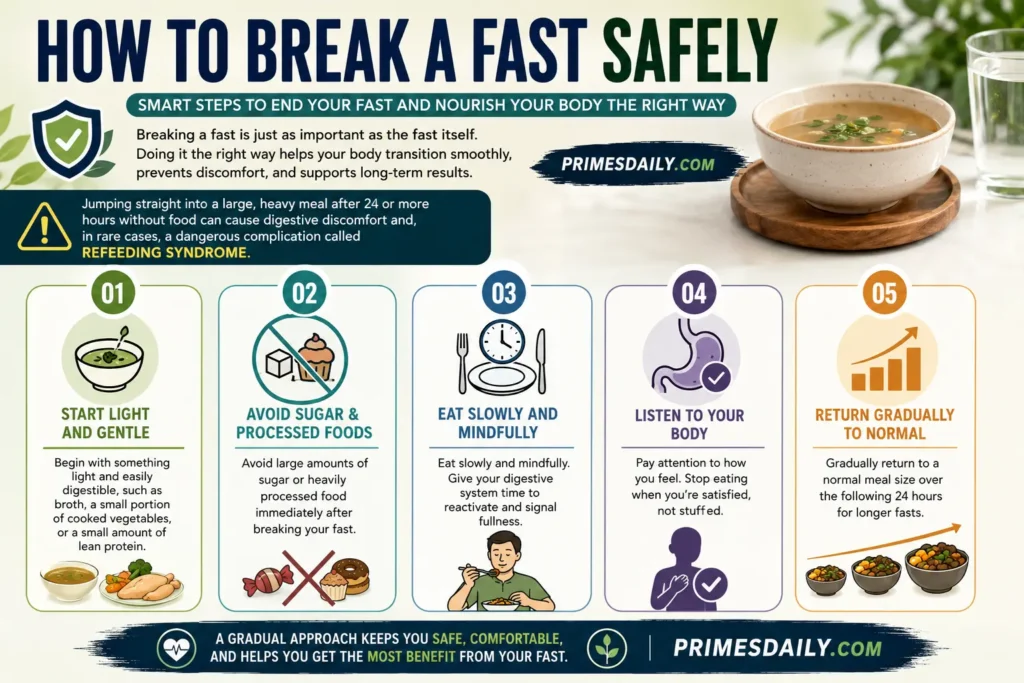
Breaking a fast, especially an extended one, deserves as much attention as the fast itself. Jumping straight into a large, heavy meal after 24 or more hours without food can cause digestive discomfort and, in rare cases, a dangerous complication called refeeding syndrome.
Safer practices for breaking a fast include:
- Starting with something light and easily digestible, such as broth, a small portion of cooked vegetables, or a small amount of lean protein
- Avoiding large amounts of sugar or heavily processed food immediately after a fast
- Eating slowly and giving your digestive system time to reactivate
- Gradually returning to a normal meal size over the following 24 hours for longer fasts
Signs You Should Stop or Change Your Fast Early
Fasting should never be pushed through severe symptoms. Signs that warrant ending a fast immediately include:
- Severe dizziness, confusion, or fainting
- Heart palpitations or an irregular heartbeat
- Extreme weakness that interferes with basic function
- Symptoms of low blood sugar in someone taking blood sugar-lowering medication
- Persistent vomiting
FAQs
How long does it take to enter ketosis while fasting? Most people begin entering measurable ketosis somewhere between 24 and 72 hours into a fast, though this varies significantly based on prior diet, activity level, and individual metabolism.
What happens to your body after 24 hours of fasting? By 24 hours, glycogen stores are nearly depleted, gluconeogenesis is actively maintaining blood sugar, and the body is on the edge of transitioning into ketosis as fat breakdown accelerates.
Does fasting slow down your metabolism? Short-term fasting doesn’t slow metabolism the way chronic calorie restriction can; some research shows a modest metabolic rate increase during short fasts due to elevated norepinephrine.
Will I lose muscle during fasting? Significant muscle loss isn’t typical during standard fasting protocols, since elevated growth hormone helps preserve lean tissue while the body prioritizes burning fat for fuel.
Is intermittent fasting the same as extended fasting? No. Intermittent fasting involves daily or near-daily eating windows, like a 16:8 schedule, while extended fasting means going without food for 24 hours or longer, often reaching much deeper metabolic stages like full ketosis and autophagy.
Can I exercise while fasting? Light to moderate exercise is generally well tolerated during most fasting stages, since stored fat provides ample fuel, though high-intensity or long-duration exercise may feel harder once glycogen stores are depleted.
What breaks a fast? Anything containing calories, including food, juice, or milk added to coffee, technically breaks a fast. Water, black coffee, plain tea, and calorie-free electrolytes are generally considered acceptable during a fasting window.
Conclusion
The stages of fasting follow a predictable, well-researched pattern: your body moves from burning incoming glucose, to tapping stored glycogen, to manufacturing its own glucose through gluconeogenesis, and finally into fat-burning ketosis and, in extended fasts, deep cellular repair through autophagy. Each stage brings distinct hormonal shifts, energy sources, and physical sensations, and knowing what to expect at each point removes most of the guesswork and anxiety that trips up first-time fasters.
Fasting isn’t a one-size-fits-all practice, and it isn’t right for everyone. But for healthy adults who approach it gradually, stay hydrated, and pay attention to their body’s signals, understanding these stages turns fasting from a vague willpower test into a structured, predictable process you can navigate with confidence.
For the latest, updated, and unique information, visit Mg to Ml.