
You’re staring at a medicine bottle, a recipe, or a lab worksheet, and the numbers just don’t line up. One side says milligrams. The other wants milliliters. So what do you do? That gap is exactly why so many people end up searching mg to ml in the first place.
This happens more often than people admit. A parent trying to measure a child’s cough syrup dose. A nurse double-checking an injection before a shift. Someone mixing a peptide vial for the first time and staring at a syringe with no idea where the plunger should stop. All of them run into the same wall — mg is a unit of weight, ml is a unit of volume, and the two don’t talk to each other unless you know the trick that connects them.
That’s exactly what this guide walks you through, from the basic idea all the way to real numbers you can plug in today. Whether you need a quick mg to ml answer or a deeper understanding of why the numbers work the way they do, everything is covered — the logic, the formula, the calculator, worked examples, a full table, and answers to the questions people actually type into Google. No jargon, no skipped steps, and no reason to open five other tabs to finish the job.
What Is Mg to Ml Conversion?
At its core, this is a conversion between two completely different kinds of measurement.
- Milligram (mg) measures mass — how much “stuff” something contains, regardless of its shape.
- Milliliter (ml) measures volume — how much space that stuff takes up.
Think of it like asking “how many miles is 5 kilograms?” On its own, the question doesn’t make sense — miles measure distance, kilograms measure weight. You need one more piece of information to bridge the gap. For distance and weight, there isn’t a natural bridge. But for mass and volume, there is: density.
Every liquid has a density, and that density tells you exactly how much a given volume weighs (or how much space a given weight takes up). Water is the easiest example — it’s dense enough, and common enough, that 1 milligram of water always equals 0.001 ml. Other liquids like milk, cooking oil, or a medicine suspension have their own densities, so the same 1 mg won’t take up exactly the same volume.
That’s really the whole idea in one sentence: you can’t go from weight to volume without knowing what you’re weighing.
Mg to Ml Calculator – Select Liquid & Convert
Here’s the quickest way to get your answer without doing any math by hand.
- Pick the substance you’re converting — water, milk, cooking oil, a specific medication, or a custom liquid.
- Enter the density if you know it (most common substances are pre-loaded).
- Type in your milligram value.
- The calculator instantly returns the equivalent volume in milliliters.
Why does the “select liquid” step matter so much? Because skipping it is the single biggest reason people get the wrong answer. Two liquids with the same weight can occupy very different volumes — a spoonful of honey weighs a lot more than a spoonful of water, even though they take up the same space. So before you trust any number, make sure the calculator (or your own math) is using the right density for what you’re actually measuring.
How Many Mg in a Ml?
This is probably the single most-searched question on this whole page, so let’s answer it directly.
For water, there are 1,000 milligrams in 1 milliliter. That’s not a coincidence — it comes from how the metric system was originally built. Back in 1795, a kilogram was defined as the weight of exactly one liter of water at freezing temperature. Scale that down: a milligram is a thousandth of a gram, and a milliliter is a thousandth of a liter, so the two units line up almost perfectly for water.
But here’s the catch — that 1,000 mg/ml figure only applies to water. Change the liquid, and the number changes too:
- Milk sits close to 1,030 mg/ml (slightly denser than water)
- Cooking oil sits around 910–920 mg/ml (lighter than water)
- A medicine suspension could be anywhere from 10 mg/ml to 500 mg/ml depending on the drug’s concentration
So whenever someone asks “how many mg in a ml,” the honest answer is: “it depends on what you’re measuring — but for water, it’s 1,000.”
Mg to Ml Formula (How the Conversion Works)
Once you understand density, the math is refreshingly simple. Here’s the formula:
Volume (ml) = Weight (mg) ÷ Density (mg/ml)
And the reverse works just as easily:
Weight (mg) = Volume (ml) × Density (mg/ml)
That’s genuinely it. Everything else on this page — every worked example, every calculator, every conversion table — is just this one formula applied to different numbers.
A quick gut-check on why this makes sense: if density goes up (the liquid is “heavier” per drop), then the same weight takes up less space, so you divide by a bigger number and get a smaller volume. If density goes down, the same weight spreads out into more volume. The formula naturally captures that relationship.
How to Use the Mg to Ml Calculator
Let’s put the formula into a step-by-step routine you can repeat for any liquid:
- Step 1: Identify what you’re converting — water, medicine, food ingredient, or something custom.
- Step 2: Find the density. Check the label (medicines usually print it as “X mg/Y ml”), or use a standard reference value.
- Step 3: If the density is only given as g/ml, multiply it by 1,000 to convert it to mg/ml first — this step trips up more people than any other.
- Step 4: Plug your numbers into the formula: divide milligrams by density (mg/ml) to get milliliters.
- Step 5: Double-check your decimal point. A misplaced decimal is the number one cause of dosing errors in real life, not a wrong formula.
If you’d rather skip manual math entirely, that’s exactly what the calculator above is built for — you just supply the weight and the liquid, and it does steps 3 and 4 for you instantly.
Ml to Mg Conversion (Reverse Calculator)
Sometimes you’re working backward — you know the volume and need the weight. The logic flips, but it’s just as simple.
Weight (mg) = Volume (ml) × Density (mg/ml)
Say you’ve drawn up 2 ml of a solution and you know its concentration is 50 mg/ml. Multiply 2 by 50, and you get 100 mg of the active substance in that syringe.
This direction of the conversion comes up constantly for anyone working with syringes, IV bags, or lab dilutions — you can see the liquid, but you need to know the weight of what’s actually in it. The same formula, the same density value, just applied in the opposite direction.
Mg to Ml Conversion Table
Sometimes a table is faster than doing the math yourself. Here’s a quick-reference chart based on water’s density (1,000 mg/ml) — the most common baseline for this kind of lookup:
| Milligrams | Milliliters (Water) |
|---|---|
| 1 mg | 0.001 ml |
| 5 mg | 0.005 ml |
| 10 mg | 0.01 ml |
| 20 mg | 0.02 ml |
| 25 mg | 0.025 ml |
| 50 mg | 0.05 ml |
| 100 mg | 0.1 ml |
| 200 mg | 0.2 ml |
| 250 mg | 0.25 ml |
| 500 mg | 0.5 ml |
| 1,000 mg | 1 ml |
Remember — this table is only accurate for water or any liquid with the exact same density. For milk, oil, or a medication, you’ll need to swap in that liquid’s own density and redo the division. Think of this table as your reference point, not a universal answer.
Liquid Concentrations – How Many Milligrams in a Milliliter?
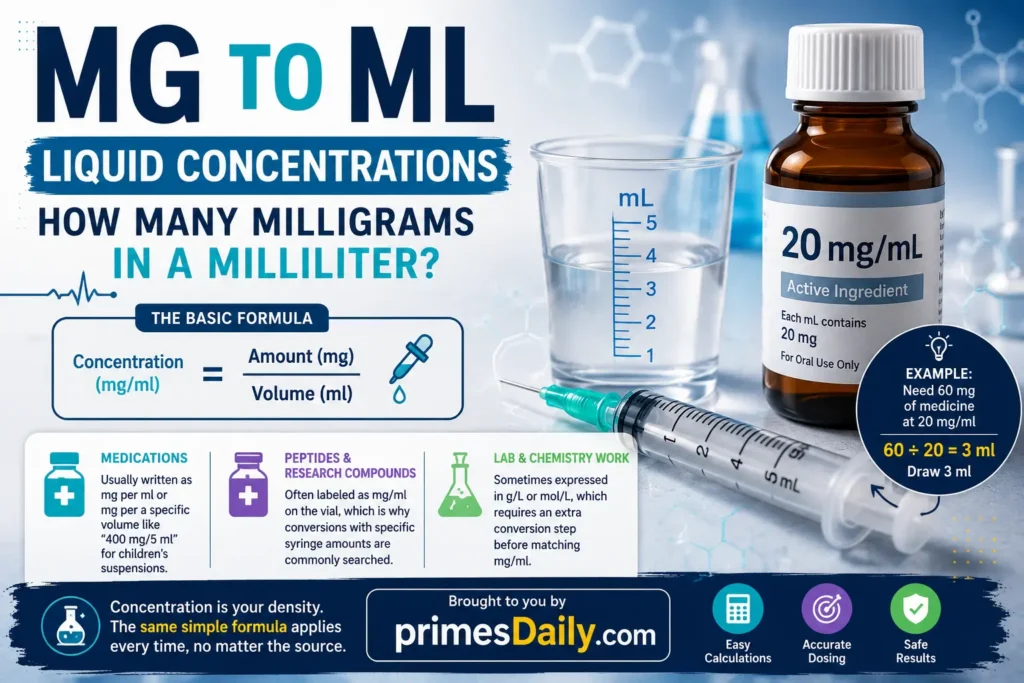
Concentration is really just density with a medical or scientific label on it. When a medicine bottle says “20 mg/ml,” it’s telling you that every single milliliter of that liquid carries 20 milligrams of active ingredient.
This matters enormously in real-world dosing. Say a prescription calls for 60 mg of a liquid medication, and the bottle is labeled 20 mg/ml. Divide 60 by 20, and you land on 3 ml — that’s how much liquid you need to draw up.
You’ll see concentration values written a few different ways depending on the field:
- Medications: usually mg per ml, or mg per a specific volume like “400 mg/5 ml” for a children’s suspension
- Peptides and research compounds: often mg/ml directly on the vial label, which is why so many people search for conversions involving specific syringe amounts
- Lab and chemistry work: sometimes expressed in g/L or mol/L, which needs an extra conversion step before it matches the mg/ml format
Whatever the source, the underlying math never changes — concentration is your density, and the same formula from earlier applies directly.
For the latest, updated, and unique information, visit gokurakugai.
Concentration as a Percentage
You’ll also run into concentrations written as a percentage, like “1% solution” instead of a clean mg/ml number. Here’s how to bridge that gap.
A percentage concentration means grams per 100 ml. So a 1% solution contains 1 gram (1,000 mg) per 100 ml, which simplifies down to 10 mg/ml.
The quick conversion rule: multiply the percentage by 10 to get mg/ml.
- 0.5% = 5 mg/ml
- 1% = 10 mg/ml
- 2% = 20 mg/ml
- 5% = 50 mg/ml
Once you have that mg/ml figure, you’re back to the same formula used everywhere else on this page.
1 Mg to Ml Example
Working with water: 1 mg ÷ 1,000 mg/ml = 0.001 ml. That’s an incredibly small volume — smaller than a single drop — which is why 1 mg conversions almost never come up outside of lab work or extremely potent medications measured in micro-doses.
5 Mg to Ml Example
Still using water as the baseline: 5 mg ÷ 1,000 mg/ml = 0.005 ml. If instead you’re working with a medicine concentrated at 5 mg/ml (a fairly common strength for liquid medications), the math changes completely: 5 mg ÷ 5 mg/ml = 1 ml — a full milliliter, and a much more realistic dose to actually measure.
10 Mg to Ml Example
For water: 10 mg ÷ 1,000 mg/ml = 0.01 ml. But for a solution concentrated at 2 mg/ml — a strength you’ll see in some liquid medications — the same 10 mg works out to 10 ÷ 2 = 5 ml, a dose that’s actually practical to measure with a standard oral syringe.
100 Mg to Ml Example
At water’s density: 100 mg ÷ 1,000 mg/ml = 0.1 ml. This example matters because 100 mg is one of the most commonly prescribed doses for liquid medications like ibuprofen suspension. If that suspension is labeled 100 mg/5 ml, then 100 mg of medicine equals a full 5 ml dose — the standard measuring spoon amount you’d give a child.
500 Mg to Ml Example
For water: 500 mg ÷ 1,000 mg/ml = 0.5 ml. In medicine, 500 mg is a very common tablet or suspension strength. If the liquid form is concentrated at 250 mg/5 ml (a typical antibiotic suspension strength), then 500 mg of medicine equals 500 ÷ 250 × 5 = 10 ml, which is why many antibiotic suspensions come with a 10 ml dosing cup.
Worked Examples of Weight-to-Volume Conversion
Let’s stack a few more real numbers together so you can see the pattern clearly across different concentrations:
| Weight (mg) | Density/Concentration | Volume (ml) |
|---|---|---|
| 20 mg | 1,000 mg/ml (water) | 0.02 ml |
| 50 mg | 10 mg/ml | 5 ml |
| 250 mg | 50 mg/ml | 5 ml |
| 2.5 mg | 5 mg/ml | 0.5 ml |
| 400 mg | 20 mg/ml | 20 ml |
| 1,000 mg | 200 mg/ml | 5 ml |
Notice something? The exact same milligram amount can produce wildly different volumes depending on concentration. That’s the core lesson of this entire topic — the number on the label matters just as much as the number in your dose.
Practice Questions on Mg to Ml Conversion
Try working these out yourself before checking the answers below.
- How many ml is 40 mg of a liquid concentrated at 8 mg/ml?
- What’s the volume of 15 mg using water’s density?
- A solution is 25 mg/ml. How many ml do you need for a 75 mg dose?
- Convert 300 mg to a volume at a concentration of 100 mg/ml.
- How many ml is 2 mg of a 1 mg/ml solution?
Answers: 1) 5 ml — 2) 0.015 ml — 3) 3 ml — 4) 3 ml — 5) 2 ml
When Is Mg to Ml Conversion Used?
This conversion isn’t just a classroom exercise — it shows up constantly across very different fields:
- Medicine and nursing: converting a prescribed dosage in mg to the correct liquid volume to draw up or administer
- Pharmacy: compounding and dispensing liquid medications at the right strength
- Home caregiving: parents measuring children’s liquid medicine accurately
- Peptide and research use: reconstituting a vial and calculating how many ml corresponds to the intended mg dose
- Cooking and baking: converting ingredient weights to measurable liquid volumes
- Chemistry and lab work: preparing solutions at a specific concentration for experiments
The common thread across every single one of these is the same question: “I know the weight I need — how much volume does that actually look like?”
Mg to Ml for Medicine Dosage
Medicine is where this conversion carries the highest stakes, so it deserves its own closer look.
Liquid medications and injectable solutions are almost always labeled with a concentration — think “100 mg/ml” or “12.5 mg/5 ml.” Your job is to take the prescribed dose in mg and translate it into the volume you’ll actually draw into a syringe or spoon, using the exact formula covered earlier.
A few things worth keeping in mind here:
- Always double-check which concentration is printed on your specific bottle or vial — the same drug can be manufactured at multiple strengths.
- Syringe markings usually go in increments of 0.1 ml or smaller, so precision matters far more with injectable or concentrated solutions than with a kitchen measuring cup.
- If your calculated volume looks unusually large or unusually tiny compared to what you expected, stop and recheck the concentration before proceeding — that mismatch is often the first sign of a decimal-point error.
None of this replaces a pharmacist, doctor, or the instructions printed on your prescription. This section explains the math behind the conversion — for anything involving an actual dose you plan to take or give to someone else, always confirm with a qualified professional first.
Common Mistakes in Mg to Ml Conversion
Most conversion errors come from a small handful of repeatable slip-ups. Watch for these:
- Assuming 1 mg always equals 1 ml. It doesn’t — that relationship only holds for water, and even then only approximately.
- Mixing up g/ml and mg/ml. A density listed as 1 g/ml is the same as 1,000 mg/ml — forgetting to multiply by 1,000 throws every downstream calculation off by three full decimal places.
- Using the wrong concentration. Grabbing a generic online value instead of the one printed on your actual bottle is one of the most common — and most avoidable — mistakes.
- Losing track of the decimal point. Especially with very small doses (fractions of a milligram), a single misplaced decimal can turn a safe dose into a dangerous one.
- Ignoring temperature-sensitive density. Some liquids (especially oils) shift density slightly with temperature — usually not significant for everyday use, but worth knowing for lab-grade precision.
A simple habit fixes most of these: after you calculate your answer, glance at it and ask “does this number make sense?” If a tiny dose suddenly needs 50 ml, or a large dose needs a fraction of a drop, something’s off — go back and recheck your density value first.
How to Calculate Mg to Ml in Your Head
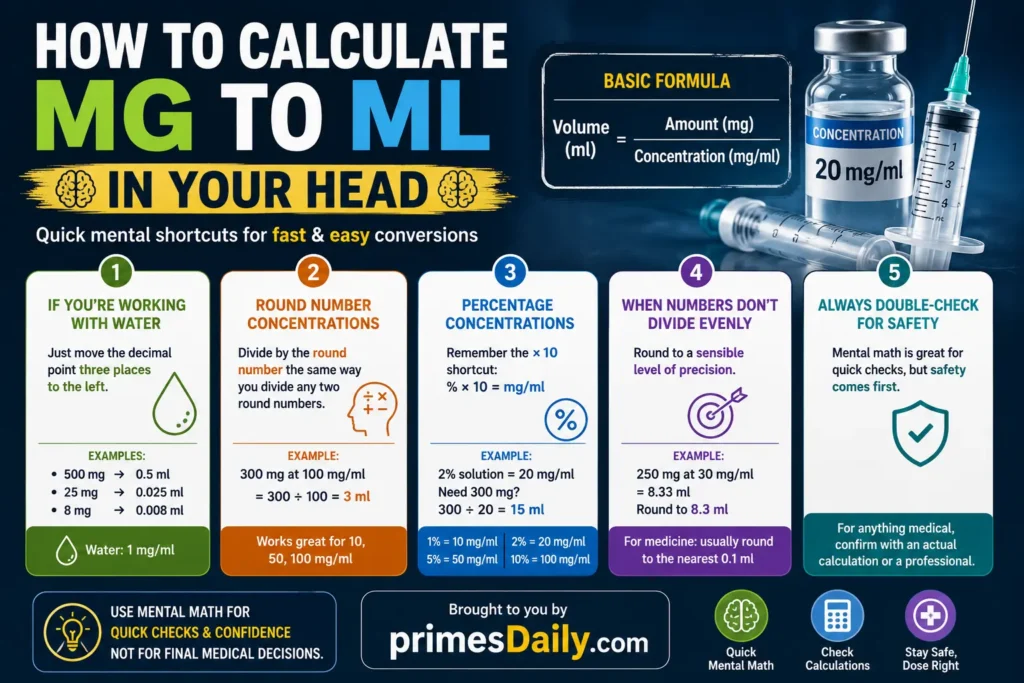
You don’t always need a calculator sitting nearby. Here’s a mental shortcut for common situations:
- If you’re working with water, just move the decimal point three places to the left. 500 mg becomes 0.5 ml, 25 mg becomes 0.025 ml — no formula needed.
- If the concentration is a round number like 10, 50, or 100 mg/ml, divide by that number the same way you’d divide any two round numbers. 300 mg at 100 mg/ml is simply 3 ml.
- For percentage concentrations, remember the ×10 shortcut from earlier — a 2% solution is 20 mg/ml, so divide your mg amount by 20.
- When numbers don’t divide evenly, round to a sensible level of precision rather than guessing — for medicine, that usually means rounding to the nearest 0.1 ml unless your syringe allows finer markings.
This mental math is genuinely useful for sanity-checking a calculator’s output, but for anything medical, always confirm with an actual calculation or a professional rather than relying on estimation alone.
Mg to Ml vs Ml to Mg – Key Differences
These two conversions use the exact same formula, just rearranged — but it’s worth being clear on what separates them.
| Mg to Ml | Ml to Mg | |
|---|---|---|
| Starting point | You know the weight | You know the volume |
| What you’re solving for | Volume needed | Weight contained |
| Formula | Weight ÷ Density | Volume × Density |
| Common use case | “I need to give 250 mg — how much liquid is that?” | “This syringe has 3 ml — how many mg is that?” |
The direction you need depends entirely on what information you’re starting with. A prescription usually gives you mg and asks you to find ml. A pre-filled syringe usually shows you ml and asks you to confirm the mg. Same math, opposite starting point.
Related Conversion Calculators
Once you’re comfortable with this kind of weight-to-volume math, a few closely related conversions tend to come up in the same context:
- Grams to milliliters — useful for cooking, where recipes sometimes mix weight and volume units
- Milligrams to teaspoons or tablespoons — common for kitchen-scale medicine or supplement dosing
- Percentage to mg/ml — covered above, but worth revisiting whenever a label uses percentage notation
- mg/ml to molarity — relevant for chemistry and lab dilution work, where concentration needs to be expressed in moles per liter instead of weight per volume
Each of these follows the same underlying logic: identify what you know, identify the density or concentration bridging the two units, and apply the formula.
FAQs
How can I convert milligrams to milliliters?
Divide the milligram amount by the density (in mg/ml) of the substance you’re measuring. For water, that density is 1,000 mg/ml, so 1,000 mg of water equals exactly 1 ml.
How can I convert ml to mg?
Multiply the milliliter amount by the density (in mg/ml). For example, 3 ml of a liquid with a density of 1,000 mg/ml equals 3,000 mg.
What is 100 mg converted to ml?
For water, 100 mg equals 0.1 ml. For any other liquid, divide 100 by that liquid’s specific density in mg/ml to get the accurate volume.
Is 1 mg always equal to 1 ml?
No. This is one of the most common misunderstandings around this topic. The two are only roughly equal for water, because water’s density happens to be very close to 1,000 mg/ml. Any other liquid will give a different result.
What does mg/ml mean on a medicine label?
It tells you the concentration — how many milligrams of active ingredient are present in every milliliter of liquid. A label reading “50 mg/ml” means each milliliter you draw up contains 50 mg of the medication.
Why does my answer differ from another calculator online?
The most likely reason is a mismatched density value. Different tools may default to different assumptions (water vs. a specific medication vs. a generic liquid), so always confirm which density is being used before comparing results.
Can this formula be used for IV medications and injections?
Yes, the underlying math is identical — you’re still dividing weight by concentration to find volume. That said, IV and injectable dosing carries higher precision requirements, so always verify your calculation against the prescribing information or a pharmacist before administering anything.
Why does rounding change my final answer?
Small rounding differences early in a calculation can shift your final volume, especially with concentrations that don’t divide evenly. For most everyday purposes this is negligible, but for medical dosing, always round in the direction your prescriber or pharmacist specifies.
Conclusion
At the end of the day, this entire conversion comes down to one relationship: weight divided by density gives you volume, and volume multiplied by density gives you weight back. Everything else on this page — the calculator, the table, the worked examples, the FAQs — is just that one idea applied to different real-world situations.
The part that actually trips people up isn’t the math itself; it’s forgetting that density changes everything. Water behaves one way, medicine behaves another, and a peptide vial behaves differently still. Once you get in the habit of checking the concentration first and running the formula second, this conversion stops being confusing and just becomes routine — something you can do in your head, on a napkin, or with a calculator in under ten seconds.
For the latest, updated, and unique information, visit Peter Orszag Hair.