Learning to play a musical instrument is one of the most rewarding journeys a person can take, and for many beginners, that journey starts with violin lessons. Whether you are a parent looking for the right program for your child or an adult finally chasing a lifelong dream, understanding how the process works makes it far less overwhelming.
Question: What exactly happens during a first session? A first session is usually relaxed and focused on getting comfortable with the instrument, learning proper posture, and understanding how the bow and strings work together. There is no pressure to perform — it is simply an introduction to the basics.
This guide walks through everything a beginner needs to know from start to finish, so there is no need to search anywhere else for answers.
Why Violin Lessons Are Important for Beginners
Structured guidance matters more than most people realize when starting out on a string instrument. Without proper instruction, beginners often develop habits that are difficult to correct later, such as poor bow grip or incorrect finger placement.
Question: Can someone learn on their own without a teacher? Self-teaching is possible for basic tunes, but it is far slower and riskier because mistakes in posture or technique go uncorrected. A guided approach builds a strong foundation from day one, which saves time and frustration later.
A good instructor doesn’t just teach notes — they teach listening skills, rhythm, and the discipline of consistent practice, all of which shape a well-rounded musician.
Our Approach to Violin Lessons
A thoughtful teaching philosophy separates an enjoyable learning experience from a frustrating one. The focus should always be threefold: keeping the process enjoyable, building healthy technique from the very beginning, and shaping instruction around the student’s personal musical taste.
Question: Does the teaching style change based on the student’s age? Yes. Younger children often respond better to playful, game-based methods, while teens and adults usually prefer a more structured, goal-oriented approach. A flexible teaching style adapts to what keeps each individual engaged.
- It Should Be Fun – Enjoyment keeps motivation alive, especially in the early weeks when progress feels slow.
- Healthy Technique Comes First – Correct posture and bow control prevent long-term strain and bad habits.
- Musical Interests Matter – Whether someone loves classical pieces, folk tunes, or modern songs, instruction should reflect what excites them.
Best Age to Start Violin Lessons
One of the most common questions from parents is about timing — when is a child actually ready to begin?
Question: What is the ideal starting age? Most instructors recommend age four for Suzuki-based instruction, since this method relies on listening and imitation rather than reading music. For traditional note-reading methods, age seven is generally considered a better starting point, since it aligns with the attention span and fine motor development needed to read sheet music and coordinate both hands.
That said, age is not a strict rule. Adults of any age can begin comfortably, and children who show curiosity a little earlier or later than these benchmarks can still thrive with the right pacing.
Types of Violin Lessons: In-Person vs Online
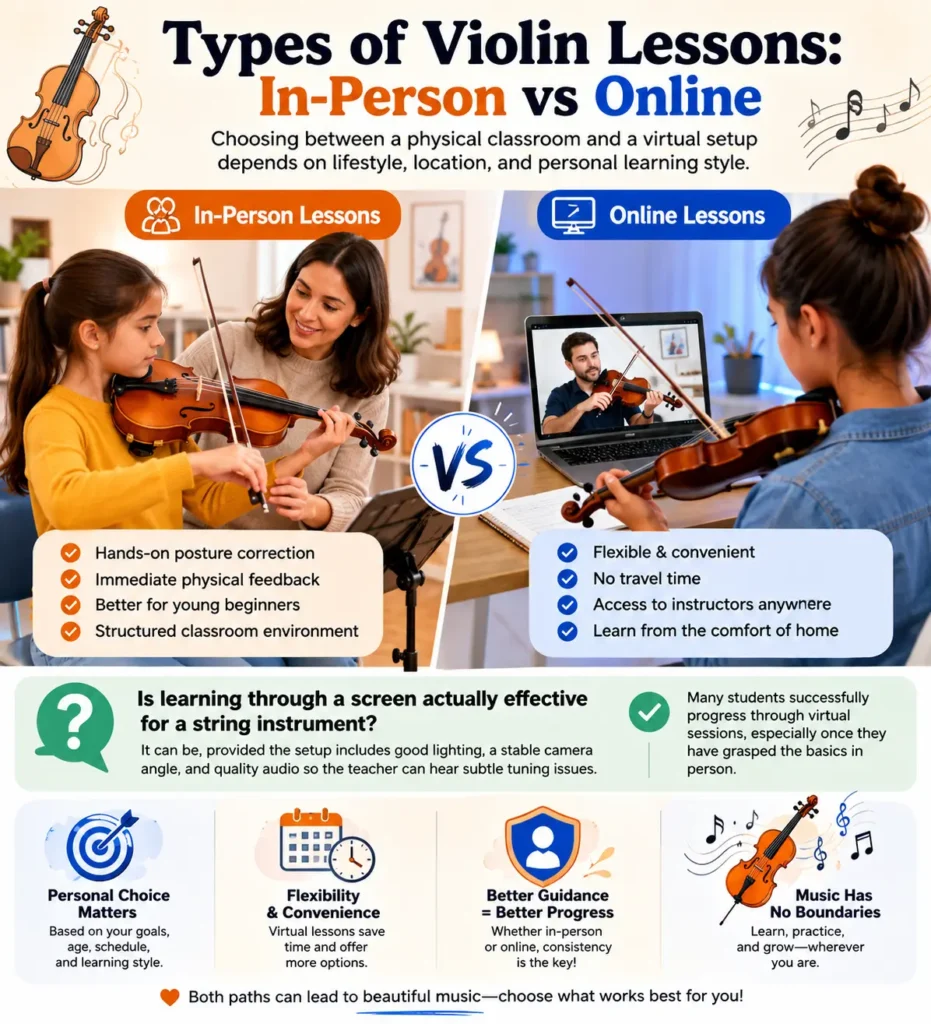
Choosing between a physical classroom and a virtual setup depends heavily on lifestyle, location, and personal learning style.
Question: Is learning through a screen actually effective for a string instrument? It can be, provided the setup includes good lighting, a stable camera angle, and quality audio so the teacher can hear subtle tuning issues. Many students successfully progress through virtual sessions, especially once they have grasped the basics in person.
In-person sessions allow for hands-on posture correction and immediate physical feedback, which some beginners find easier, especially very young children. Virtual formats offer flexibility, eliminate travel time, and open access to instructors regardless of geography.
Private vs Group Violin Lessons
Another key decision is whether to learn one-on-one or as part of a small ensemble class.
Question: Which format leads to faster progress? One-on-one instruction typically leads to faster technical progress because the pace and content are tailored entirely to the individual. Group settings, on the other hand, build ensemble skills, timing with others, and a sense of community that solo sessions cannot replicate.
Many programs blend both formats — private sessions for technique building, paired with occasional group classes or studio sessions for performance experience and peer motivation.
How Violin Lessons Work
Understanding the general structure removes a lot of uncertainty for new students and their families.
Question: How long does a typical program run? Programs are usually organized into semesters, often spanning around 18 weeks, with weekly sessions of 30, 45, or 60 minutes depending on the student’s age and skill level. Many schools also offer a short trial or assessment period at the start so families can confirm the fit before committing to a full term.
Enrollment usually begins with a brief conversation about goals, followed by matching with a suitable instructor, scheduling a recurring weekly slot, and receiving a syllabus or practice plan tailored to the student’s current level.
For the latest, updated, and unique information, visit Connectivity Issues HSSGamepad.
Violin Lessons Pricing in 2026
Cost is one of the biggest deciding factors for most families, and prices vary based on session length, instructor experience, and location.
Question: How much should someone expect to budget? As of 2026, individual sessions typically range from around $40 to $90 per half-hour, with longer 60-minute formats costing proportionally more. Group classes tend to be more affordable per session since the cost is shared among multiple students. Many programs also charge a one-time registration fee alongside semester tuition.
It’s worth comparing per-session cost against total semester commitment, since some providers require payment upfront for an entire term rather than billing month to month.
How to Choose the Right Violin Teacher
Not every instructor is the right fit for every student, and choosing carefully makes a measurable difference in long-term progress.
Question: What should someone look for in a good teacher? Look for a combination of strong performance credentials, a patient teaching style, and positive reviews from past or current students. Equally important is compatibility — a teacher who communicates well with a shy child or a busy working adult will keep motivation high even when progress feels slow.
A short trial session is often the best way to gauge whether the teaching style and personality actually click before committing to a longer-term arrangement.
What You Will Learn in Violin Lessons
The technical skill set built through consistent instruction goes far beyond simply moving a bow across strings.
Question: What core skills does a beginner actually develop? Students build finger precision and dexterity, ear training for accurate tuning, sheet music reading, bowing control, and eventually more advanced techniques like vibrato once the fundamentals are solid.
Over time, this skill set expands into interpreting dynamics, phrasing musical ideas expressively, and developing the confidence to perform in front of others.
Violin Lessons for Kids
Children often approach a new instrument with curiosity and energy, but their attention span and physical development shape how instruction should be delivered.
Question: How should sessions be structured differently for children? Sessions for younger students are usually shorter, more playful, and heavily reliant on repetition and games rather than dense theory. Smaller-sized instruments — sometimes as small as a sixteenth size — are used so a child can hold proper posture comfortably.
Parental involvement, especially for very young beginners, often plays a big role in reinforcing practice habits between sessions.
Violin Lessons for Adults
Adult beginners face a different set of challenges and advantages compared to children, and good instruction accounts for both.
Question: Is it too late to start as an adult? It is never too late. Adults often progress faster in understanding music theory because of stronger cognitive and analytical skills, even if fine motor coordination takes a bit longer to develop compared to a child’s natural adaptability.
Flexible scheduling — including evening or weekend slots — tends to matter more for adult learners balancing work and family commitments alongside their new hobby.
Benefits of Taking Violin Lessons
Beyond the joy of making music, there are well-documented advantages to committing to regular instruction on a string instrument.
Question: What benefits go beyond simply learning to play? Regular practice has been linked to improved memory, sharper concentration, better hand-eye coordination, and reduced stress levels. It also builds discipline and patience, since visible improvement requires consistent, incremental effort over weeks and months.
For children specifically, the structured nature of consistent practice can translate into stronger study habits and time-management skills in other areas of life.
Free Resources for Violin Lessons
Not everyone can commit to paid instruction right away, and there are legitimate ways to explore the instrument at low or no cost first.
Question: Can someone genuinely make progress using free resources alone? Free tools such as digital tuners, metronomes, printable beginner sheet music, and structured video series can absolutely help a motivated beginner learn fundamentals. However, they generally cannot replace personalized feedback on posture, tone quality, and technique that a live instructor provides.
A hybrid approach — using free resources to supplement paid instruction — often produces the most well-rounded and cost-effective results.
Renting vs Buying a Violin for Lessons
Deciding whether to rent or purchase an instrument is a practical concern, especially for growing children who will need instrument upgrades over time.
Question: Is renting or buying the smarter choice for a beginner? Renting is usually the smarter choice for young children, since they will outgrow smaller-sized instruments every year or two as they physically grow. For adults or older teens closer to full-size instruments, purchasing outright often makes more financial sense in the long run, since ongoing rental fees can eventually exceed the cost of ownership.
Many programs offer rental packages that include maintenance and size-exchange options, which removes a lot of the guesswork for new families.
Common Mistakes to Avoid in Violin Lessons
Even motivated beginners fall into predictable traps that slow down progress or lead to frustration.
Question: What is the single biggest mistake new students make? The most common mistake is inconsistent practice — treating sessions as the only touchpoint with the instrument instead of reinforcing skills daily, even briefly. Other frequent errors include rushing through warm-ups, ignoring posture corrections, and comparing personal progress unfavorably to more advanced players.
Avoiding these pitfalls usually comes down to patience, realistic expectations, and trusting the pace set by a qualified instructor.
Tips to Get the Most Out of Your Violin Lessons
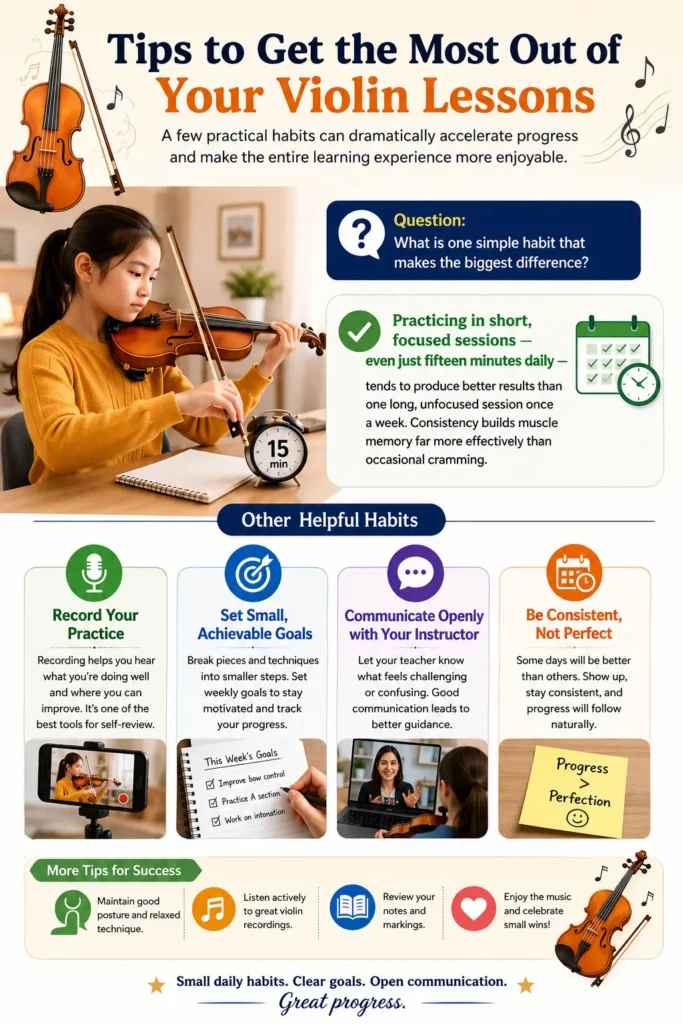
A few practical habits can dramatically accelerate progress and make the entire learning experience more enjoyable.
Question: What is one simple habit that makes the biggest difference? Practicing in short, focused sessions — even just fifteen minutes daily — tends to produce better results than one long, unfocused session once a week. Consistency builds muscle memory far more effectively than occasional cramming.
Other helpful habits include recording practice sessions to self-review, setting small weekly goals, and communicating openly with the instructor about which pieces or techniques feel most challenging.
FAQs
What age should a child begin? Around age four for imitation-based methods, or age seven for traditional note-reading instruction, though flexibility exists based on individual readiness.
How much does it typically cost per month? Costs vary widely by location and format, but a realistic monthly range for weekly half-hour sessions often falls between $160 and $360.
Is it possible to switch teachers mid-program? Yes, most programs allow switching instructors if the personality or teaching style isn’t the right fit, especially early in a semester.
How long before a beginner can play a simple song? Most motivated beginners can play a simple recognizable tune within the first one to three months of consistent practice.
Do sessions require owning an instrument first? Not necessarily — many programs allow starting with a rented instrument while deciding on long-term commitment.
Conclusion
Starting this journey doesn’t have to feel complicated once the fundamentals — age, format, pricing, and teacher selection — are clearly understood. With the right guidance, realistic expectations, and consistent practice habits, progress on a string instrument becomes not just achievable, but genuinely enjoyable for learners of every age.
For the latest, updated, and unique information, visit Piano Lessons.