Gokurakugai is one of the most talked-about shonen manga series to come out of Shueisha in recent years. Written and illustrated by Yuto Sano, it follows two troubleshooters who take on strange, dangerous cases in a rundown district hiding a dark supernatural secret. Since its debut, the series has built a loyal fanbase thanks to its striking art, emotional characters, and morally complex take on monsters.
This guide covers everything you need to know about Gokurakugai in one place — its meaning, story, characters, sales numbers, and the latest word on a possible anime adaptation, all updated for 2026. No need to look anywhere else; everything is right here.
What Does Gokurakugai Mean?
The title comes from Japanese and literally translates to “Paradise District” or “Paradise Street.” It is an ironic name, since the district in question is anything but paradise — it is a rundown, working-class neighborhood full of crime, poverty, and hidden danger lurking just beneath its busy streets.
Why did the author choose an ironic title like this? The contrast between the name and the reality of the setting is intentional. The word traditionally evokes an area of entertainment, luxury, or pleasure, but the story uses that expectation to highlight how far the district has fallen from any real sense of paradise. This kind of irony is common in Japanese fiction, where a location’s name reflects a lost or false ideal rather than its present condition. Understanding this wordplay makes the tone of the story much clearer from the very first chapter, since the setting itself functions almost like a character in the narrative, shaping the mood of every arc that follows.
Gokurakugai Series Information
This title falls under the shonen demographic and blends supernatural fiction with action-adventure storytelling. It has been running in Shueisha’s Jump Square magazine since July 2022, and as of early 2026, six tankōbon volumes have been released in Japan.
How many chapters are currently available to read? Chapter releases are ongoing, with over 35 chapters published in Japan by mid-2026, and the pace has remained fairly consistent since launch. In North America, Viz Media handles the official English release, publishing chapters digitally through its Shonen Jump platform close to the original Japanese release schedule, and distributing print volumes separately on a slightly delayed timeline that typically trails Japan by several months to a year.
The story fits comfortably within the supernatural and dark fantasy genres, featuring monster-hunting elements alongside emotional, character-driven subplots. Unlike many series in this genre that stick to one tone, this one balances comedic slice-of-life moments with genuinely unsettling horror sequences, which is part of why it has developed such a dedicated fanbase over a relatively short publication history.
Author & Illustrator of Gokurakugai
Both the writing and artwork are handled by a single creator: Yuto Sano. This is Sano’s first major serialized work, following an earlier one-shot chapter that introduced the same world and characters in a slightly different form back in 2020.
Is this the artist’s first professional series? Yes, this is Sano’s debut as a serialized mangaka in a major Shueisha magazine, though the concept originated a few years earlier as a trial chapter. Reviewers and readers alike have repeatedly praised the linework, character design, and action choreography, often noting that the art quality is unusually polished for a newer creator. Fans frequently comment that the visual style — detailed cityscapes, expressive character faces, and dynamic fight scenes — feels more like the work of a veteran illustrator than someone early in their serialized career, which has helped the series stand out visually even among a crowded shonen lineup.
Gokurakugai Premise and Story Summary
The plot follows two troubleshooters who run an agency that takes on odd jobs for hire in a rundown, crime-heavy district. Their cases start out simple enough — locating missing people, retrieving stolen items, settling local disputes — but they are gradually pulled into something much darker.
What is the central conflict of the story? At its core, the plot revolves around mysterious disappearances and the appearance of mutilated corpses that turn out to be linked to monstrous entities born from the dead. As the two leads investigate further, they uncover a hidden organization working to contain these creatures, and they realize their own pasts are tied to the growing crisis in ways neither of them expected. The story blends mystery, horror, and action while slowly revealing the emotional histories of its cast, which gives the plot more depth than a typical monster-of-the-week format, and keeps long-time readers guessing about how each character’s backstory connects to the larger mystery.
What makes this structure work particularly well is the pacing. Rather than front-loading every mystery at once, the narrative reveals its secrets gradually, letting readers form theories about the true nature of the district and the organization overseeing it before confirming or subverting those guesses later on. This slow-burn approach to worldbuilding is one of the reasons long-time readers describe the story as a rewarding re-read, since early hints often carry more weight once the larger picture becomes clear.
Main Characters of Gokurakugai
The story is led by a small core cast, supported by a wider group of allies, rivals, and antagonists tied to the troubleshooting agency and the organization backing it.
Do the two leads work alone? No — while the two main protagonists form the central duo, they are part of a larger group affiliated with an anti-monster organization, and several side characters play recurring roles throughout the plot, from fellow agents to researchers and informants. The dynamic between the leads and this supporting cast is one of the story’s biggest strengths, since many characters have their own arcs that intersect with the main plot rather than existing purely as background support, giving the world a lived-in feel rather than a simple backdrop for fights.
Alma – Gokurakugai’s Male Lead
Alma is introduced as a teenage boy who is part human and part “maga,” the term used in the story for the monstrous beings at the center of the plot. This dual nature makes him uniquely capable of fighting the creatures that threaten the district, but it also makes him a target of suspicion from those around him.
Why is Alma’s condition treated as dangerous by others? His powers are sealed behind a restraint that prevents him from losing control, and much of his personal arc involves learning to manage this ability responsibly rather than being consumed by it. He is written as kind-hearted and food-obsessed on the surface, but his backstory carries real weight, since his hybrid nature ties directly into the series’ larger themes about what separates a monster from a person. His growth over the course of the story is measured not just in combat strength but in his ability to trust himself and the people around him.
Tao – Gokurakugai’s Female Lead
Tao is Alma’s partner and the more experienced half of the troubleshooting duo. She is calm, controlled, and skilled with firearms — specifically weapons that use ammunition made from Alma’s blood, a detail that ties the two characters together mechanically as well as narratively.
What makes Tao different from a typical shonen female lead? Rather than being a support character, Tao is written as the more tactically skilled and emotionally guarded of the two leads, with her own tragic backstory involving a younger brother that becomes central to the plot as the story progresses. Her quiet, no-nonsense demeanor contrasts sharply with Alma’s more emotional personality, and this dynamic is a major reason fans find their partnership compelling rather than formulaic, since each character compensates for the other’s weaknesses in both combat and everyday life.
Other Characters in Gokurakugai
Beyond the two leads, the story features a wide roster of agency members, researchers, and informants who each add different flavors to the world. Supporting characters include a katana-wielding young agent driven by a need for recognition, a pair of researchers who study the maga phenomenon, an information broker who charges steep fees for his services, and a young waitress connected to the agency’s favorite restaurant.
Are the side characters just filler, or do they matter to the plot? Several of them matter a great deal. Many of these characters are not simply background figures — some have tragic origins tied to the same disaster-beast phenomenon the leads are investigating, which means their stories often loop back into the main plot in unexpected ways rather than staying separate from it. This overlapping structure is one reason the story rewards attentive reading, since offhand details introduced early on frequently resurface as important plot threads later.
Gokurakugai Terminology: Disaster Beasts (Maga)
One of the most important concepts to understand before reading is the idea of “maga,” translated in English releases as Disaster Beasts. These are not traditional monsters — they originate from deceased humans or animals who undergo a grotesque transformation.
What makes these creatures different from typical shonen monsters? Unlike straightforward villains, these beings were once ordinary people, which forces both the characters and the reader to grapple with uncomfortable questions about whether they can still be considered victims rather than enemies. This moral ambiguity is a defining feature of the story, setting it apart from series where monsters exist purely as obstacles to be defeated. Some of these transformed beings retain fragments of memory or personality from their human lives, which adds an emotional weight to combat encounters that many similar stories lack, and turns many fights into tragedies rather than simple victories.
This framing also shapes how the protagonists approach every encounter. Instead of treating every fight as a straightforward battle against evil, the two leads are frequently forced to weigh mercy against safety, since defeating one of these beings often means ending what remains of a person who never asked for this transformation in the first place. That tension is a recurring emotional core of the series, and it is part of what elevates the action beyond simple spectacle.
Locations and Organizations in Gokurakugai
The story’s setting plays almost as large a role as its characters. The district itself is a dense, chaotic urban sprawl where humans and beastmen coexist, layered with poverty, crime, and an undercurrent of supernatural danger that most residents remain unaware of.
What organizations operate within this world? Two key institutions drive the plot forward: the troubleshooting agency where the two leads work, and a larger anti-monster organization that oversees containment and research efforts related to the disaster-beast phenomenon. These organizations are not always aligned in their goals, and tension between different factions adds another layer of intrigue beyond the monster-hunting plot itself, since some groups prioritize research and control while others simply want the threat eliminated entirely.
Gokurakugai Troubleshooter Agency Explained
The agency at the heart of the story operates out of a modest office above a restaurant, taking on jobs of nearly any kind for a fee — a premise that gives the plot flexibility to explore standalone cases while still building toward a larger overarching mystery.
Why is the agency structured as a “problem solving” business rather than a formal task force? This setup allows the narrative to introduce a wide variety of clients and cases without needing an overly rigid plot structure, giving early chapters an episodic feel before the story shifts into a more serialized, mystery-driven direction. It also means the two leads regularly interact with ordinary residents of the district, which keeps the human stakes grounded even as the supernatural elements escalate around them.
For the latest, updated, and unique information, visit artisticassasins.
Gokurakugai One-Shot Origin Story
Before becoming a full serialization, this world was first introduced through a one-shot chapter published in early 2020, several years before the ongoing series began. That original chapter told a self-contained story involving conflict between the human cast and local beastmen, using a somewhat different tone and character design than the eventual serialized version.
Do readers need to read the one-shot before starting the main series? Not at all — the two are not directly connected in terms of plot, though many longtime fans recommend checking out the earlier chapter afterward as a curiosity, since it shows how much the concept evolved before becoming the version readers know today. Comparing the two also gives insight into how the author refined the tone, pacing, and character designs over time.
Gokurakugai Volumes and Chapters List
As of early 2026, six volumes have been collected and released in Japan, with the sixth volume published in February 2026. Chapter output has remained steady, and there is enough new material every few months to keep both Japanese and English-reading audiences engaged.
Is the English release caught up with Japan? Not entirely — while Viz Media publishes new chapters digitally on a close simulpub schedule, the print volume releases in English run several months to over a year behind the original Japanese editions, meaning readers who want the earliest volume in book form will see it arrive later than the chapters themselves. Digital chapter readers, however, stay much closer to the original release pace than those waiting for physical volumes to hit shelves.
Gokurakugai Reception and Awards
Critical and reader reception has been strong since day one, and the series has picked up multiple industry nominations and awards over the past few years. It placed within the top ten of the Next Manga Award in its print category during its debut year, and it later improved its ranking while also winning a notable digital-platform award in a later edition of the same competition.
Has it won any major recognition beyond manga awards? Yes — it has also placed in rankings tied to reader polls about which manga fans most want to see adapted into anime, appearing in these lists for multiple consecutive years, which reflects sustained rather than short-lived popularity. It has additionally been recognized on bookstore-employee recommendation lists, a strong signal of grassroots industry support beyond official award panels and critic circles.
Taken together, this pattern of recognition across print awards, digital-platform honors, and reader-driven polls paints a picture of a title that has earned its following organically rather than through a single marketing push. Industry award nominations of this kind typically require sustained reader engagement over multiple volume releases, which suggests the series has managed to retain its audience rather than losing momentum after an initial wave of hype, a pattern that does not hold true for every newly serialized title in this genre.
Gokurakugai Sales and Circulation Numbers
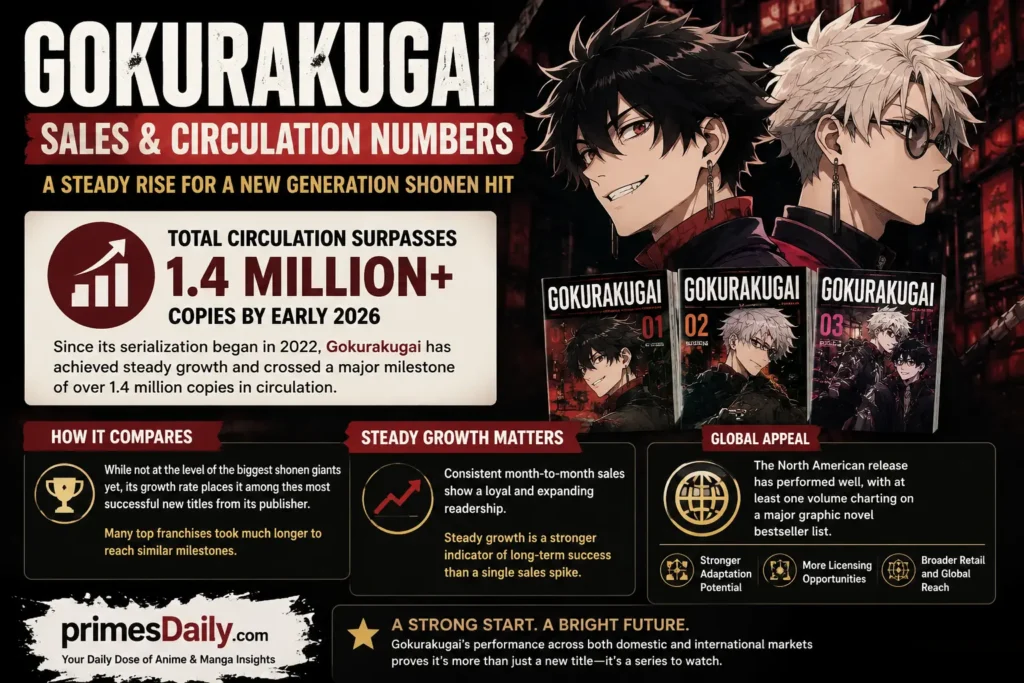
By early 2026, total circulation had surpassed 1.4 million copies, a significant milestone for a series that only began serialization in 2022. This steady growth in print numbers reflects a consistently expanding readership rather than a single viral spike tied to one event or promotion.
How does this compare to other newer shonen titles? While it has not reached the scale of the industry’s biggest juggernauts, its circulation growth places it firmly among the more successful newer titles from the same publisher, especially considering its relatively short publication history compared to long-running franchises.
For context, many established franchises took considerably longer to reach comparable circulation milestones, which makes this pace of growth stand out even more. Steady month-over-month sales, rather than one dramatic spike, tend to be a better predictor of long-term franchise health, since they reflect a readership that keeps coming back rather than one driven purely by a temporary trend or promotional event. The North American release has also performed respectably, with at least one volume charting on a major graphic novel bestseller list shortly after its English debut.
This kind of cross-market performance matters because it demonstrates that the appeal of the story is not limited to its home audience. A title that performs well both domestically and abroad tends to attract more attention from adaptation studios, licensing partners, and retailers looking to expand their catalog, since it signals a proven, repeatable demand rather than a niche or regional following. For a series still relatively early in its publication run, reaching bestseller status internationally is a meaningful indicator of long-term staying power.
Where to Read Gokurakugai Online
For readers in English-speaking regions, the most reliable and legal way to access new chapters is through Viz Media’s official Shonen Jump digital platform, which offers both a rotating selection of free chapters and full-catalog access through subscription.
Is there an official free way to read new chapters? Yes, a limited number of recent chapters are typically available to read for free through the official platform, with the full archive unlocked for subscribers, and international readers can also find same-day chapter releases through Shueisha’s own simulpub app. Physical volumes are widely available through major bookstores and online retailers for readers who prefer a printed collection to keep on their shelf.
Is Gokurakugai Getting an Anime Adaptation?
This is the single most common question among fans, and as of 2026, there is no official anime adaptation confirmed. Despite this, the series has consistently ranked among the most-requested titles for animation in industry reader polls over the past two years.
Why hasn’t it been adapted yet if it’s this popular? There is no confirmed reason from the publisher, though industry observers frequently point to the relatively short chapter count so far as a possible factor, since studios often wait until a series has enough banked material to support a full season without risking rushed pacing. Given its steady sales growth, award recognition, and repeated appearances on “want to see animated” polls, many fans and outlets consider an eventual announcement likely, though nothing concrete has been revealed at this time. Readers should treat any anime announcement claims circulating online with caution until confirmed directly by the publisher or a verified industry source.
It is also worth noting that publisher announcements in this industry tend to arrive with little advance warning, often tied to anniversary events, magazine milestones, or major sales announcements rather than a predictable schedule. Given the current trajectory of steady volume sales and repeated poll placements, an official reveal at one of the major industry events later this year or next would not be considered surprising by most longtime observers of the format.
Gokurakugai vs Other Shonen Manga (Chainsaw Man, JJK, Demon Slayer)
Readers frequently draw comparisons between this series and other popular dark-fantasy shonen titles built around human-monster hybrid protagonists, particularly ones involving hidden organizations that hunt supernatural threats.
How does it distinguish itself from similar, more established franchises? While the basic premise of a human-monster hybrid fighting alongside a specialized organization is not new to the genre, this story sets itself apart by portraying its monsters as former humans undergoing tragic transformation rather than purely evil entities, which pushes the narrative toward moral complexity rather than simple good-versus-evil action. This approach shares some thematic DNA with other genre staples but ultimately builds its own identity through its distinct setting, tone, and character relationships rather than leaning purely on familiar genre tropes borrowed from those bigger franchises.
Why Gokurakugai Deserves an Anime
Given its steady sales growth, strong art direction, and consistent presence in “most wanted for animation” polls, there is a solid case that this series is overdue for a screen adaptation.
What specific factors make it a strong adaptation candidate? Its combination of visually dynamic action sequences, an emotionally resonant cast, and a distinctive urban-supernatural setting gives it the kind of visual and narrative material that tends to translate well to animation, and its multi-year track record of fan demand suggests an adaptation would likely find a built-in audience rather than needing to build one from scratch. Many long-running franchises in the same genre saw major sales boosts after their anime debuts, and this series appears well positioned for a similar outcome if a studio picks it up in the near future.
FAQs
Is the series finished or still ongoing? It is still ongoing, with new chapters continuing to release regularly as of 2026.
What genre does it belong to? It combines shonen action-adventure with supernatural and dark fantasy elements.
Who are the two main characters? The story follows a duo who run a troubleshooting agency together, one a half-human, half-monster hybrid and the other a skilled, calm-natured partner who supports him in combat and investigations.
Is there an anime yet? No official anime has been announced as of 2026, despite strong and repeated fan demand.
Where can English readers legally follow new chapters? Through the official Shonen Jump digital platform and Shueisha’s own simulpub service, both of which offer new chapters close to their original Japanese release dates.
How many volumes are currently available? Six volumes have been released in Japan as of early 2026, with English print volumes following on a delayed schedule.
Conclusion
From its ironic title to its morally complex monsters and its steadily growing fanbase, this series has earned its place as one of the more compelling newer entries in the dark-fantasy shonen space. It offers a distinctive blend of horror, heart, and action, backed by strong artwork and a cast whose personal histories are as important as their fights.
While an anime adaptation remains unconfirmed as of 2026, the combination of rising sales, award recognition, and consistent fan demand suggests it is only a matter of time before this story reaches a wider screen audience. For now, the manga itself remains the best — and only — way to experience this world, and with new chapters releasing regularly, there has never been a better time to catch up.
Whether you are drawn in by the moody urban setting, the morally complicated monsters, or the slow-burn partnership at the center of the story, there is enough substance here to reward both casual readers and those looking for something with more emotional depth than a typical action series. Given everything covered in this guide — from its origins as a small one-shot to its current standing as an award-recognized, steadily growing franchise — it is easy to see why so many readers consider this one of the more promising newer names in modern shonen storytelling.
For the latest, updated, and unique information, visit Puzutask com.