
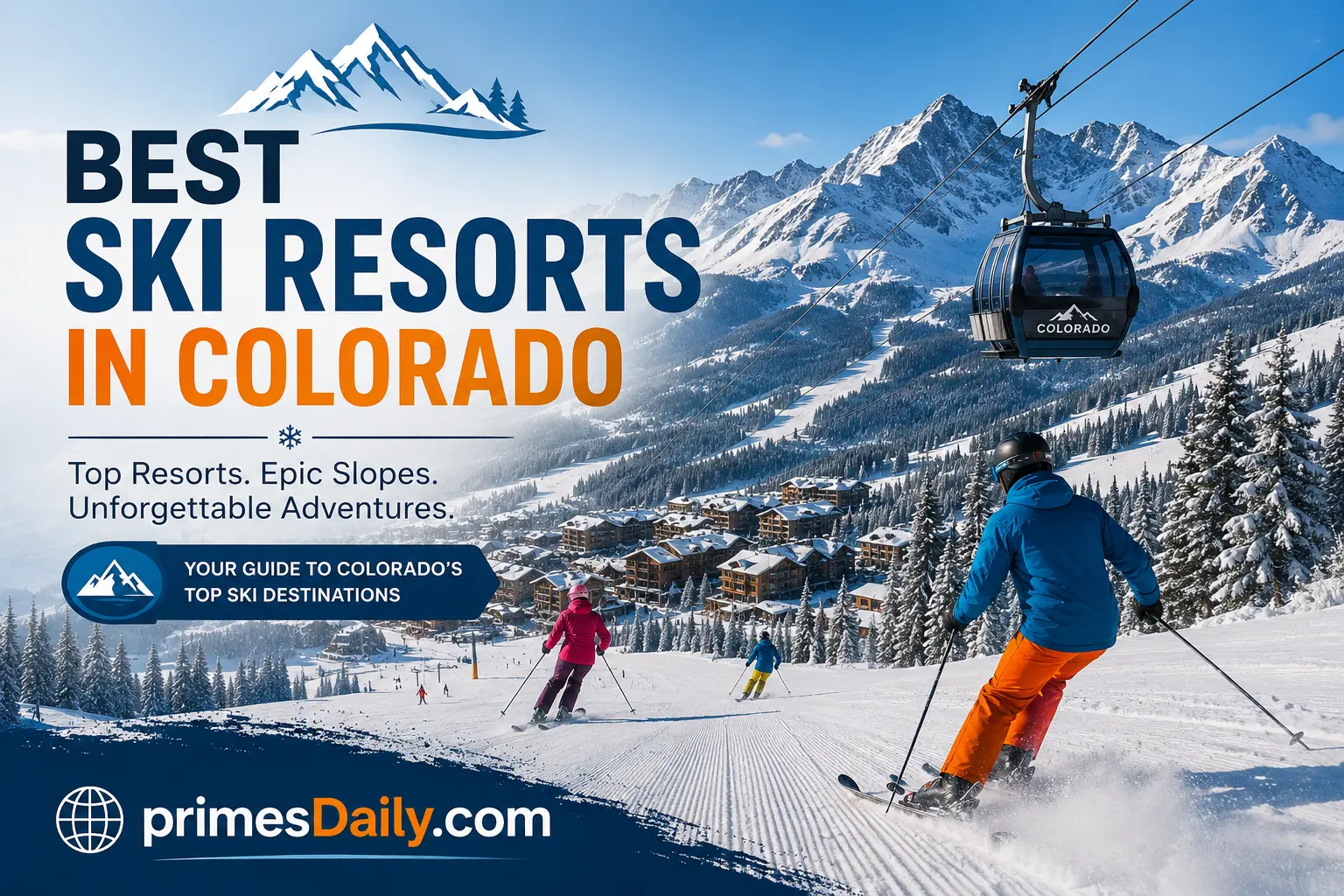
Colorado has solidified its reputation as one of North America’s premier skiing destinations, and for good reason. Nestled in the Rocky Mountains, the state boasts more than 20 ski resorts ranging from intimate family-friendly properties to sprawling alpine playgrounds. Whether you’re a powder-chasing expert, a first-time skier nervous about your abilities, or a family looking to spend quality time on the slopes, Colorado delivers consistently exceptional snow conditions, diverse terrain, and welcoming communities that make every visit memorable.
The state’s geography places ski resorts within surprising proximity to Denver—most are between 90 minutes and three hours from Denver International Airport. This accessibility, combined with Colorado’s reliable continental snowfall pattern and high elevation averaging 9,000 feet, creates an environment where ski conditions remain stable throughout the winter season. From November through April, you’ll find well-maintained runs, plenty of vertical drop, and terrain to challenge every ability level.
This guide walks through the Best Ski Resorts in Colorado has to offer, breaking them down by what matters most to your trip: your skill level, your budget, your family’s needs, and what kind of mountain experience you’re after.
Map of Colorado Ski Resorts
Colorado’s ski resorts stretch across the central and western mountains in a rough east-west line. The I-70 corridor between Denver and the Utah border serves as the backbone, with clusters near Summit County (home to Breckenridge, Keystone, and Copper Mountain), around Vail and Beaver Creek, and near the Western Slope near Grand Junction. Smaller boutique resorts and hidden gems scatter throughout southern and northern Colorado, each offering character and a more intimate skiing experience than the mega-resorts.
Denver International Airport sits roughly two to three hours east of the major resorts. For those seeking closer access, Winter Park and Loveland ski areas sit just 90 minutes to two hours from the airport, making them ideal for quick weekend trips. The I-70 mountain passes can close during heavy snow, and weather chains or four-wheel drive may be required, so plan accordingly during peak season and storm windows.
Top-Rated Ski Resorts in Colorado
Colorado’s reputation as a skiing destination rests on a handful of major players that have refined their operations over decades. These aren’t just places to ski—they’re mountain communities with personalities, traditions, and loyal followings.
Vail stands as North America’s largest ski resort by terrain, with over 5,000 skiable acres split between the front side and the famous Back Bowls. On a powder day, skiing the bowls feels like the closest thing to backcountry skiing without the commitment. The mountain attracts serious skiers from around the world, but its size means that crowding can often be managed by heading to intermediate or advanced terrain.
Breckenridge serves as both a world-class ski destination and a charming Victorian ski town. The resort’s terrain spans five peaks, each with its own character. Peak 7 and Peak 8 offer tree-filled intermediate runs. Peaks 9 and 10 deliver steep chutes and exciting black diamond terrain. Breckenridge has earned a reputation for excellent grooming, making it a standout choice for skiers who appreciate precision and consistency.
Aspen Snowmass sits four hours south of Denver and operates as four separate mountains under one ticket—Aspen Mountain (Ajax), Aspen Highlands, Buttermilks, and Snowmass. The resort draws an upscale clientele and has played host to major ski competitions, celebrity visitors, and cultural events year-round. Skiing here feels like accessing high-altitude luxury, but the mountain also welcomes intermediate and beginner skiers with plenty of terrain to match their abilities.
Telluride perches at 8,750 feet in southwestern Colorado and radiates an old-mining-town vibe mixed with world-class terrain. The San Juan Mountains deliver reliable snow, and the town itself has become a culinary destination. Intermediate skiers will find plenty to love, while experts can attack steep couloirs and exposed terrain that feels genuinely wild.
Crested Butte Mountain Resort sits north of Aspen and has evolved from a tight-knit local mountain into a destination resort. The terrain balances green and blue runs for intermediate skiers with serious double-black-diamond couloirs for experts. The town of Crested Butte, with its Victorian architecture and mountain-town culture, adds character that big resorts sometimes lack.
Best Luxury Colorado Ski Resorts
When luxury is the priority, a few resorts have built their entire identity around high-end hospitality and premium terrain.
Beaver Creek has long positioned itself as the elegant alternative to Vail. Located just 10 miles from Vail, Beaver Creek maintains stricter density controls and invests heavily in upscale services. The village was built from scratch in the 1980s with European-inspired architecture, and the attention to detail is immediately apparent. Runs are wide, grooming is impeccable, and the clientele tends toward established wealth rather than the transient party crowd Vail sometimes attracts. The ski-in/ski-out village allows you to unfasten your boots and step directly into fine dining, boutique shops, and luxury lodging.
Vail itself, despite its size, offers an unparalleled luxury experience for those willing to pay for proximity to terrain and premium services. The resort has invested billions into new lift infrastructure, mountain safety, and on-mountain dining. Vail Village and Lionshead put you within steps of restaurants ranging from casual brewpubs to Michelin-guide-quality establishments. When you’re ready to splurge, Vail Village’s luxury hotels offer the full slate of spa services, heated outdoor pools, and room service that rivals any Alpine resort experience.
Aspen Snowmass represents the apex of luxury mountain experiences in Colorado. The resort’s gondola access, on-mountain restaurants, and connection to Aspen’s vibrant nightlife and fine dining attract celebrities, CEOs, and international travelers. The resort has also invested heavily in making intermediate and beginner terrain as appealing as possible—it’s not just a mountain for experts showing off. The town of Aspen itself has become synonymous with high-end mountain living, though day-pass prices reflect that positioning.
Where to Stay in Vail: When choosing accommodation in Vail, balancing proximity to the slopes with reasonable rates makes staying in Lionshead or Golden Peak preferable to Vail Village for many visitors. If maximum convenience trumps cost, the Park Hyatt or Four Seasons offer unmatched village-center positioning and can arrange ski concierge services that include same-day equipment rental and private lessons delivered directly to your lodging.
Best Colorado Ski Resorts for Families
Families bring special requirements: varied skill levels under one roof, kid-friendly amenities, and reasonable pricing that doesn’t bankrupt a vacation. Several Colorado resorts have invested specifically in family infrastructure.
Keystone has earned a stellar reputation for family-friendly operations. The resort’s layout is beginner-heaven, with green runs dominating Keystone Mountain and Dercum Mountain. Intermediate skiers find plenty of blue terrain to build confidence. Keystone Mountain has a dedicated beginner area with gentle slopes, perfect for kids’ first days on skis. The resort offers an excellent ski school with multiple lesson packages specifically designed for children. Parking is free (a rarity at major resorts), and the nursery services allow non-skiing family members to enjoy the day while others are on the slopes.
Steamboat Springs, located three and a half hours from Denver, rivals Keystone in family appeal. The skiing emphasizes blue runs and glades, environments where intermediate skiers and families have the most fun. The town of Steamboat retains genuine ski-town character—local snowboarders and skiers dominate the crowds, not tourists looking for Instagram photos. Family-oriented restaurants and lodging options make an extended stay feasible without extreme expense.
Copper Mountain presents itself as one of Colorado’s best-kept-secret family destinations. The mountain’s layout is genius for families: beginner terrain clusters on the west side, intermediate terrain spreads across the center, and advanced skiers head east to the Spaulding Bowl and Black Ridge terrain. This separation means different ability levels can ski the same area without constantly regrouping. Copper’s terrain park rivals any resort in North America, making it ideal for families with teenagers interested in tricks and freestyle features.
Winter Park, located just past the Norbeck Tunnel northwest of Denver, sits closer to the Front Range than many comparable resorts. The mountain has recently undergone major investment, expanding terrain and installing new lifts. For families, Winter Park offers forgiving blue runs, dedicated beginner terrain, and activities beyond skiing including snow tubing and snowshoeing. The town of Winter Park has reinvented itself as a year-round adventure destination, adding restaurants and bars alongside traditional mountain lodging.
Beaver Creek offers surprising value for families once you’re past the admission price. The mountain’s terrain spreads across multiple peaks, allowing families to customize difficulty. Onsite child care, family dining packages, and child-focused programming make it possible to bring very young children and still have a quality mountain experience.
Best Colorado Ski Resorts for Beginners
Taking your first skis down a mountain can feel daunting. Picking a resort where the environment, instruction, and terrain support that learning process matters enormously.
Keystone dominates the beginner landscape through deliberate design. The entire western face of Keystone Mountain slopes gently. The Keystone Ski School operates numerous beginner-specific lift lines that separate first-timers from crowds. Progression terrain is thoughtfully graded, allowing you to graduate from flat slopes to gentle rollers to moderate blue runs with logical step-ups in difficulty. Many resorts expect learners to eventually join the main lift system; Keystone has separated beginner zones so thoroughly that you could spend your entire trip on green runs and still have fresh terrain daily.
Loveland Ski Area, located east of the I-70 tunnel and just 90 minutes from Denver, caters heavily to locals and provides excellent beginner terrain at reasonable rates. The mountain’s front face features multiple green circles, and the Loveland Ski School operates with a philosophy of building confidence through small, manageable steps. Equipment rental is less expensive than mega-resorts, and the overall day cost (lift ticket, lessons, equipment) sits meaningfully lower than industry alternatives.
Eldora Mountain Resort, situated west of Boulder, serves as Boulder’s homegrown ski mountain. While smaller than Colorado’s mega-resorts, Eldora has invested in beginner infrastructure including a learner-specific lift-accessed area. The skiing community is more local and less transient, creating a welcoming atmosphere for newcomers who might feel intimidated at larger mountains.
Arapahoe Basin, despite its reputation as a terrain-obsessed expert mountain, operates an exceptional beginner program. “The Basin” has purposely maintained beginner-friendly terrain as a service to newer skiers and a hedge against over-crowding at mega-resorts. Beginner terrain sits on the lower mountain with separate lift access, keeping first-timers away from steep runs and strong skiers. Lessons are affordable, and once you progress, intermediate terrain connects smoothly, allowing natural progression toward more challenging runs.
Best Colorado Ski Resorts for Advanced Skiers
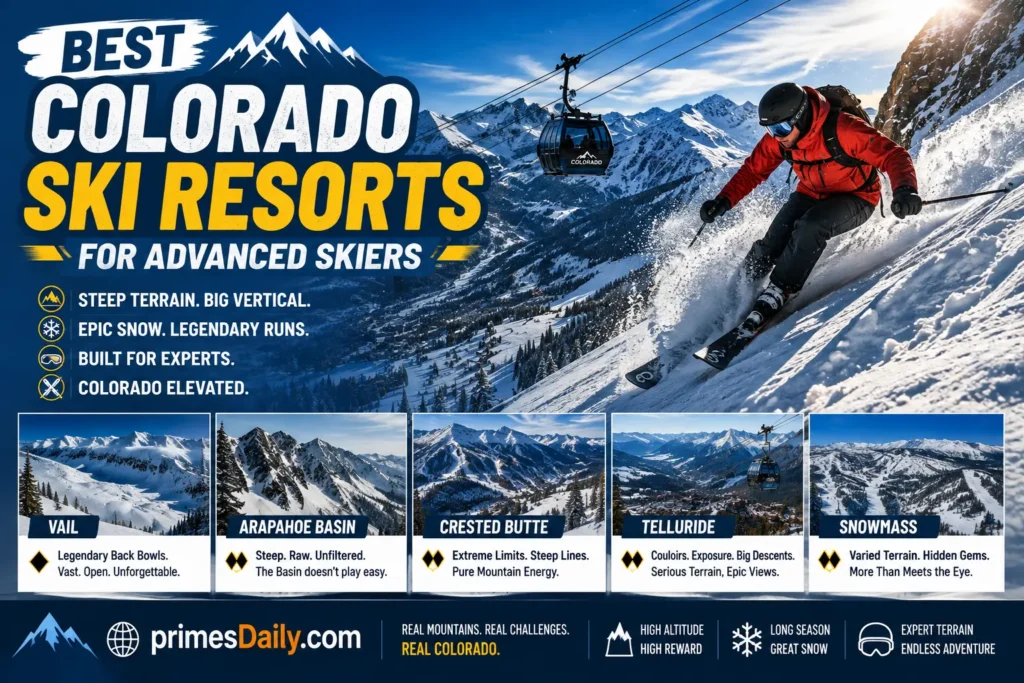
Expert skiers crave consistent snow, real vertical, lift-accessed off-piste terrain, and minimal crowds on the challenging runs. Colorado delivers on all fronts.
Vail’s Back Bowls serve as the flagship destination for advanced skiers across North America. The bowls—Blue Sky, China Bowl, Tea Cup Bowl, and Pete’s Bowl—offer 3,000+ acres of vast, rolling terrain that feels genuinely alpine. Powder days here are legendary. Spring skiing in the bowls, when the snow softens under Colorado sun, creates a unique experience where top-to-bottom cruising in open bowls becomes almost meditative.
Arapahoe Basin has cultivated an identity as Colorado’s most challenging terrain-for-terrain’s-sake resort. The mountain offers steeper average gradient than other Colorado resorts, with a concentration of double black diamond chutes accessed from the high ridgeline. Expert skiers universally acknowledge that “The Basin” delivers in terms of pitch, exposure, and genuinely exciting terrain. The ski patrol takes their work seriously, and the overall environment respects the mountain and what it demands.
Crested Butte Mountain Resort packs serious expert terrain into a landscape that also works for intermediates. The Extreme Limits at the mountain’s edge—terrain accessed via a short hike through gate lines—offers consistently challenging couloirs and steep fall-line terrain. The overall mountain maintains excellent snow quality through the season, partly due to higher elevation and partly due to the San Juan Mountains’ position on the continental divide.
Telluride’s accessible-by-gondola aspect masks the serious terrain that awaits advanced skiers. Palmyra Peak and Gold Hill deliver couloirs and exposed terrain that rivals anything in North America outside of Jackson Hole or the Tetons. Spring skiing on Telluride’s south-facing runs creates bumpy, technical conditions where only strong intermediate and expert skiers should venture.
Snowmass, part of the Aspen Snowmass complex, offers blue-run abundance that masks excellent advanced terrain in pockets including the Highlands and lower Shaggy Ridge areas. For experts who like to ski varied terrain without constantly hiking, Snowmass delivers more nuance than its reputation suggests.
Best Budget-Friendly Colorado Ski Resorts
Ski vacations carry a reputation for expense that doesn’t always reflect reality. Several Colorado resorts deliver legitimate terrain and experience at moderate cost.
Loveland Ski Area consistently ranks as Colorado’s best value. The day-pass cost runs 20-30% lower than mega-resorts. Equipment rental, food, and lodging in nearby Winter Park remain reasonable. The mountain’s terrain, while not as vast as Vail or Breckenridge, serves intermediate and advanced skiers perfectly well. For locals and budget-conscious travelers, Loveland is Colorado’s answer to “quality skiing without the hype.”
Eldora Mountain Resort, while smaller, maintains low ticket prices and operates with a cooperative, member-friendly approach that translates into community-oriented skiing. Equipment rental is inexpensive, and seasonal pass options represent outstanding value for Front Range locals who can ski weekends throughout the winter.
Echo Mountain, perched above Idaho Springs on the west side of I-70, operates as Colorado’s smallest publicly-owned ski area. The mountain’s intimate scale means no lift lines, no crowds, and lift ticket rates reflecting the modest terrain. For a quick afternoon or weekend of easy skiing without the mob scene, Echo Mountain delivers.
Monarch Mountain sits in southern Colorado near Salida and rounds out the budget-friendly category. The mountain’s terrain balances beginner and intermediate runs with some advanced terrain. Lift prices are reasonable, and lodging in Salida offers small-town Colorado charm without resort town pricing. The ski season can be shorter due to lower elevation, but early and mid-season usually offers stable conditions.
Powderhorn, located on Colorado’s western slope, flies under most people’s radar. The small resort sees less crowding than Front Range mountains and offers terrain suitable for intermediate and advanced skiers willing to embrace a more low-key experience.
Historic Ski Towns in Colorado
Colorado’s most memorable ski vacations often center less on the resort itself and more on the community surrounding it. Several towns have preserved ski-town character while developing infrastructure for modern travelers.
Steamboat Springs has evolved from frontier logging town to genuine ski destination while maintaining Main Street authenticity. Victorian storefronts mix with modern restaurants and breweries. Locals mingle easily with visitors, creating an environment that feels welcoming rather than transactional. The town’s ski patrol and mountain rangers include multigenerational families who’ve lived there for decades, contributing to an institutional knowledge about conditions and weather that benefits everyone.
Breckenridge’s revival as a ski town followed a period as a fading gold-mining community. The town’s restoration efforts have recreated the Victorian aesthetic without the sanitized feel of Hollywood recreations. Modern amenities blend with historic charm. The town serves as a legitimate place to live and work, not just a tourist attraction, which means you’ll encounter genuine community alongside visitor services.
Telluride represents the apotheosis of Colorado ski-town character. The town was discovered by serious skiers before major resort development transformed other mountains. The surrounding San Juan Mountains create a landscape of almost intimidating beauty. Telluride maintains stricter development controls than other mountain communities, preserving a sense of authenticity. Yes, billionaires own homes there; yes, restaurants are expensive. But the mountain culture remains undeniably genuine.
Crested Butte, while close to a major resort, has preserved small-town character that larger mountains surrendered long ago. The town’s bicycle culture, creative community, and genuinely local character set it apart. Summer mountain biking and year-round mountain culture mean the town thrives beyond just the ski season.
For the latest, updated, and unique information, visit Kibbe Body Types.
Colorado Ski Resorts Near Denver
For visitors flying into Denver, several resorts offer reasonable driving times without requiring navigation of mountain passes that might close during storms.
Winter Park Resort sits just 90 minutes northwest of Denver via I-25 and US-40. The drive avoids the steepest I-70 passes and most traffic bottlenecks. The mountain has invested heavily in recent years, expanding terrain and installing new lift infrastructure. Intermediate and advanced skiers find excellent terrain. Families appreciate the combination of beginner-friendly runs and activities beyond skiing including snow tubing.
Loveland Ski Area operates even closer, sitting just 75 minutes from downtown Denver via I-25 northbound and US-34. The drive is straightforward and mostly highway driving. For those who want skiing without the full mountain-resort experience, Loveland delivers legitimate terrain without pretense.
Eldora Mountain Resort, 75 minutes west of Denver through Boulder Canyon, serves Front Range residents and visitors seeking quick access to skiing. The mountain is small by regional standards but perfectly adequate for intermediate and beginner skiers.
Echo Mountain, perched above Idaho Springs on I-70’s west side, sits just 50 minutes from downtown Denver, making it feasible for an afternoon ski session. For those looking for a quick snow day fix without committing to a full ski-resort experience, Echo Mountain fits perfectly.
Arapahoe Basin, while higher on the mountain pass ladder, still sits within reach during good weather. The drive takes roughly two to two and a half hours, but the mountain’s consistent snow, advanced terrain, and lower crowding than Front Range options make the drive worthwhile for serious skiers.
Colorado Ski Resorts by Region
Colorado’s ski resorts cluster into geographic regions that help determine weather patterns, snow consistency, and the overall vibe of your visit.
I-70 Corridor and Summit County: This region contains the highest concentration of ski resorts, including Vail, Beaver Creek, Copper Mountain, Breckenridge, and Keystone. The geography creates a remarkable variety—you can drive between mountains in 30-45 minutes, allowing multi-day visits to sample different terrain. The I-70 corridor dominates Colorado skiing, and for good reason: terrain variety, consistent snow, proximity to Denver, and infrastructure development that makes extended stays comfortable.
Northern Colorado and Steamboat: Steamboat Springs operates independently of the I-70 corridor, positioned about three and a half hours northwest of Denver. The mountain receives abundant natural snowfall from Pacific storm systems, and the ski community emphasizes local participation over resort tourism. Steamboat’s terrain emphasizes intermediate-friendly blue runs and glades, creating a distinctly different skiing culture than the I-70 mega-resorts.
Southern and Southwestern Colorado: Telluride, Crested Butte, and Wolf Creek Ski Area occupy a different world from Front Range skiing. These resorts receive consistent snowfall from the San Juan Mountains and deliver serious terrain with lower crowds than comparable northern Colorado mountains. The longer drive from Denver (4-7 hours depending on destination) keeps day-trippers away, creating an environment dominated by true skiing enthusiasts and multi-day visitors.
Best Ski Resorts for Terrain Parks
Freestyle skiing and snowboarding have become serious businesses, and resorts now compete based on terrain-park infrastructure as aggressively as they do on lift capacity.
Copper Mountain has established itself as the North American leader in terrain-park development. The resort operates multiple parks ranging from beginner-friendly rails and small jumps through professional-grade slopestyle features. Copper’s design philosophy emphasizes progression—you can start on small features and systematically work toward more complex tricks without feeling lost. The resort has hosted X Games qualifying events and continues to invest in maintaining world-class park infrastructure.
Breckenridge operates multiple freestyle parks with impressive scale. Peak 7’s park includes a full spectrum of features from beginner to professional grade. The resort has also invested in slopestyle courses that attract serious competitors and spectators.
Keystone’s parks have earned consistent recognition for quality design. The resort operates beginner-through-advanced parks, and the layout allows progression without committing to complex terrain immediately.
Winter Park has upgraded its park infrastructure substantially, adding a superpipe and expanded jib park that appeal to serious park skiers and riders.
Aspen Snowmass maintains terrain parks that attract competitive riders, though the resort’s overall identity centers more on resort amenities and expert terrain than on freestyle competition.
Best Ski Resorts for Powder and Backcountry
While Colorado’s public ski resorts offer tremendous terrain, serious powder hunters often look beyond marked runs.
Vail’s Back Bowls represent the most lift-accessible powder skiing in North America. On powder days, arriving early to secure first tracks in Pete’s Bowl or Blue Sky Bowl is the priority. The sheer acreage means that even popular powder days have manageable crowds—there’s genuinely enough terrain that you can avoid lines.
Aspen Backcountry and Highlands at Snowmass attract backcountry-oriented skiers willing to hike for untracked snow. The hike from Highlands Basin to Maroon Bells area is legendary among serious skiers.
Crested Butte’s terrain distribution—with concentrated beginner terrain making central mountain more crowded—means that strong intermediate and advanced skiers can find fresh snow by pushing toward the edges and higher elevations.
Telluride’s South Face and couloirs see fewer skiers than equivalent terrain at busier mountains, meaning powder days offer better chance at untracked snow simply due to lower overall usage.
Wolf Creek Ski Area, located on Colorado’s western slope in a particularly snowy microclimate, receives more annual snowfall than any other Colorado resort (400+ inches annually). The terrain sees fewer skiers than major mountains, increasing powder-day potential. The tradeoff is that reaching Wolf Creek requires significant drive time and the mountain’s infrastructure remains modest compared to resorts further east.
Ski Season Timing: When to Visit Colorado
Colorado skiing operates from November through April, but timing can dramatically affect your experience. Snow conditions, crowds, and pricing all fluctuate significantly based on when you visit.
December through early January brings reliable early-season snow, though resorts often operate with base-depths limited compared to later in the season. Holidays create peak crowds and premium pricing. The week between Christmas and New Year’s brings particular congestion.
Mid-January through February represents the sweet spot for serious skiers. Resorts maintain deep bases, snow conditions remain stable, crowds moderate compared to holidays, and room rates drop measurably. Fresh snow often comes during this window, and resorts have had six weeks to establish quality grooming patterns.
March brings spring skiing, when sunny Colorado days warm surface snow. The trade-off is that runs can become bumpy by afternoon, particularly south-facing slopes. Spring skiing offers different conditions than winter—softer, more playable terrain, but also potentially more crowds as daylight hours increase.
April extends the season, though snowfall becomes less reliable. Base depths diminish as temperatures warm, and some terrain closes as conditions soften. April offers the most economical passes and uncrowded conditions for those who can work around less consistent skiing.
Timing for specific conditions: March offers the best spring-skiing conditions, February offers the deepest bases and most stable conditions, January provides good skiing but with holiday crowds and premium pricing, and November-December offer early-season skiing with fewer crowds than peak winter but less guaranteed snow bases.
Colorado Ski Passes and Lift Tickets
Colorado resorts operate under various ownership structures that affect pricing and pass options.
Epic Pass Mountains include Vail, Beaver Creek, Breckenridge, and Keystone. The Epic Pass offers unlimited access to these mountains, plus Crested Butte and Telluride. For skiers planning multiple Colorado visits or exploring multiple resorts, Epic Pass provides the best value. Single-day passes at Vail and Beaver Creek exceed $200, so a season pass (roughly $1,000) or multi-day passes (around $100-120 daily) represent significant savings.
Ikon Pass Mountains include Copper Mountain, Arapahoe Basin, and Winter Park (through multiple affiliated mountains). The Ikon Pass offers fewer Colorado options than Epic, but stronger benefits at mountains outside Colorado. Single-day lift tickets at Ikon mountains run 20-30% lower than Epic mountains.
Independent Resorts operate their own pass systems. Steamboat, Loveland, Eldora, and smaller mountains offer direct daily lift purchases. Season passes at these mountains run $300-600, making them economical for local or frequent visitors.
Lift-ticket pricing has risen significantly over the past five years. A standard full-day pass at major resorts now costs $200-250. Multi-day passes offer modest discounts. Purchasing tickets in advance online (often 48 hours ahead) frequently yields 10-15% discounts. Driving to lesser-known mountains can result in meaningful savings without sacrificing skiing quality.
Planning Your Colorado Ski Trip
Successful Colorado ski trips require attention to logistics, weather, and realistic expectations about mountain travel.
Transportation: Fly into Denver International Airport (the largest airport for Colorado skiing). Rental cars are necessary for accessing ski resorts; public transportation between resorts is minimal. Budget three hours from airport to Front Range mountains. Chain requirements are common on I-70 during winter; all-wheel or four-wheel drive is beneficial but not always mandatory if you carry chains and check forecasts before driving.
Accommodation: Book lodging before arrival, especially for holiday periods. Condo rentals through vacation sites often offer better value than hotel rooms, especially for groups. Staying in ski-town villages (Vail Village, Breckenridge town, etc.) maximizes convenience but increases cost. Staying 20-30 minutes away in off-mountain towns (Frisco, Silverthorne, Winter Park) can reduce lodging costs 30-40%.
Timing Your Visit: Visit mid-week when possible to avoid weekend crowds. Come in February or early March for best snow/crowd balance. Avoid Christmas week, New Year’s week, and Presidents’ Day weekend if crowds concern you.
Weather Preparation: Colorado mountains receive afternoon sun even in winter; sunscreen is essential. Layers are critical—temperature can swing 30+ degrees between morning and afternoon. Wind can intensify dramatically at elevation, particularly on exposed ridges.
Ski School and Rentals: Book lessons in advance, especially for private instruction. Equipment rental at resorts costs roughly $40-60 daily; bringing your own or renting away from mountains saves money.
Beyond Skiing in Colorado
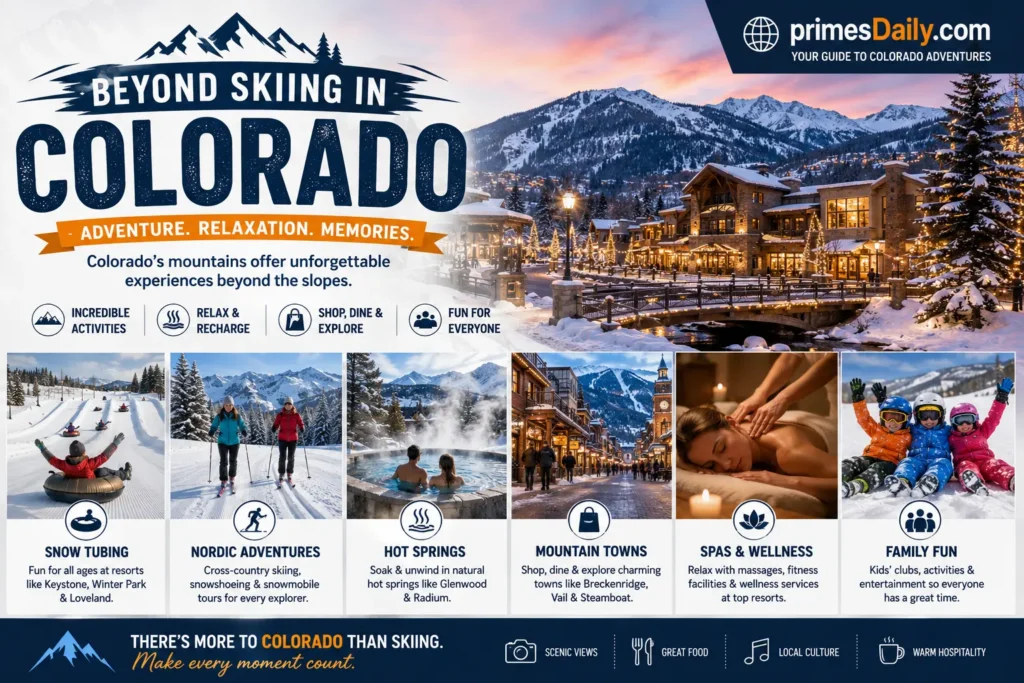
Colorado’s mountains offer substantial non-skiing activity options, making multi-day visits rewarding even if weather prevents skiing.
Snow tubing operates at several resorts including Keystone, Winter Park, and Loveland. Facilities include dedicated lanes, warming huts, and family-friendly infrastructure.
Cross-country skiing, snowshoeing, and guided snowmobile tours offer alternatives to resort skiing. Backcountry guides operate from mountain towns and provide equipment.
Hot springs are scattered throughout the mountains. Glenwood Springs, south of Vail, sits next to the Glenwood Hot Springs Resort. Radium Hot Springs is northwest near Granby. Multiple smaller, less-developed hot springs can be accessed via hiking.
Mountain towns offer shopping, dining, and cultural attractions. Breckenridge Main Street includes boutiques and restaurants. Vail Village offers sophisticated dining alongside casual options. Steamboat maintains working artist studios alongside retail.
Spas, fitness facilities, and wellness services operate at most major resorts. Onsite restaurants range from casual slope-side cafes to fine dining establishments. Several resorts offer kids’ clubs, allowing parents to ski while children participate in supervised snow activities.
FAQs About Best Ski Resorts in Colorado
How many ski resorts are in Colorado? Colorado operates approximately 20+ resorts open to the public. The major mountains (Vail, Breckenridge, Aspen Snowmass, Telluride, Crested Butte) command most attention and infrastructure. Secondary mountains (Copper, Winter Park, Loveland, Arapahoe Basin) deliver excellent skiing with fewer crowds. Smaller mountains and private clubs round out the landscape. The state’s combination of altitude, continental climate, and geographic spread supports more resorts than surrounding states.
What Colorado ski resorts get the most snow? Wolf Creek Ski Area receives Colorado’s highest annual snowfall, averaging 400+ inches annually. Telluride and Crested Butte regularly receive 350+ inches. The San Juan Mountains in southwestern Colorado receive heavier snow than I-70 corridor mountains. Steamboat Springs receives annual snowfall of 300+ inches, ranking it higher than Front Range mountains despite lower altitude.
Which Colorado ski resort is best for beginners? Keystone Mountain Resort leads for beginner-specific infrastructure. The terrain is deliberately graded for progression; green runs dominate the west side. Loveland Ski Area and Eldora Mountain Resort also offer beginner-friendly terrain at reasonable cost. Arapahoe Basin, despite its expert reputation, maintains beginner-specific terrain and lift-separated learning areas.
Which Colorado ski resort is the biggest? Vail Mountain holds the title for largest ski resort in North America by skiable terrain (5,000+ acres). Breckenridge operates the second-largest Colorado resort. Aspen Snowmass combines four mountains into one ticket system, making it enormous when measured by total terrain. Crested Butte and Telluride deliver substantial terrain despite smaller acreage.
What’s the prettiest ski resort in Colorado? This depends on aesthetic preference. Telluride offers the most stunning natural scenery, with San Juan Mountains creating an almost intimidating landscape. Aspen combines natural beauty with sophisticated resort infrastructure. Crested Butte’s genuine mountain-town charm appeals to those seeking authenticity. Beaver Creek offers manicured elegance. Each represents different definitions of beauty.
Which Colorado resorts are most visited? Vail, Breckenridge, and Keystone attract the largest visitor counts. Winter Park, Copper Mountain, and Aspen Snowmass draw substantial crowds. Telluride and Crested Butte see fewer visitors than Front Range mountains despite comparable terrain. Loveland, Arapahoe Basin, and Steamboat maintain strong local followings without mega-resort crowding. Visitor counts reflect accessibility from Denver as much as mountain quality.
Which resorts are near airports? Denver International Airport provides access to Front Range mountains (90 minutes to Winter Park, 2-3 hours to Vail/Breckenridge). Eagle County Regional Airport sits 30-45 minutes from Vail and Beaver Creek, making it preferable if flying directly to the resort. Montrose Regional Airport serves southwestern mountains including Telluride and Crested Butte (2-2.5 hours drive).
Do Colorado ski resorts have hot springs? Several resorts and nearby towns include natural hot springs. Glenwood Hot Springs Resort sits south of Vail. Radium Hot Springs is northwest near Granby. Multiple smaller, less-developed springs can be accessed via hiking from mountain towns. Some resorts (notably those in northern Colorado) have developed spa facilities without natural hot springs.
Which resorts offer night skiing? Keystone offers night skiing multiple evenings per week, allowing skiing 3-4 hours after sunset. Loveland occasionally offers night skiing during peak periods. Most other Colorado mountains do not maintain night-skiing operations.
Are there ski-in/ski-out resorts in Colorado? Vail Village offers true ski-in/ski-out capability—you can walk from lodging directly to lift lines. Beaver Creek maintains ski-in/ski-out resort lodging in the village. Most other mountain towns require driving or shuttle buses to access skiing. Staying in dedicated resort villages (as opposed to mountain towns 20-30 minutes away) typically provides ski-out convenience, though full ski-in access is limited to major resorts.
What’s the best time of year to ski in Colorado? February and early March offer the optimal combination of deep base depths, stable snow conditions, and manageable crowds. January brings reliable skiing but with holiday crowds and premium pricing. December offers early-season conditions with developing base depths. April provides economical passes and uncrowded conditions but less consistent snow. Late November through December offers powder opportunities without peak crowds, but higher avalanche danger in backcountry areas and developing base depths.
What are some cool ski towns in Colorado? Breckenridge blends Victorian charm with modern amenities. Steamboat Springs maintains genuine ski-town character. Telluride radiates authenticity and mountain culture. Crested Butte preserves artistic community alongside ski culture. Frisco, near Summit County, offers small-town alternatives to busier mountains. Salida and Buena Vista, near budget-friendly mountains, provide charming mountain-town bases. Winter Park has reinvented itself as a year-round adventure destination.
Conclusion
Colorado’s best ski resorts deliver consistent snow, varied terrain, and communities that balance modern convenience with mountain authenticity. Whether you prioritize budget-friendly skiing, family-focused infrastructure, luxury accommodations, or advanced terrain challenges, the state’s collection of mountains includes options perfectly matched to your needs.
The I-70 corridor mountains offer unmatched convenience for Denver visitors. Front Range mountains like Winter Park and Loveland sit within reasonable drive times. Southwestern mountains including Telluride and Crested Butte deliver genuine mountain culture for those willing to make the journey.
Timing your visit strategically—choosing February over December, weekdays over weekends—dramatically improves your experience without sacrificing skiing quality. Bringing appropriate gear, checking weather before driving, and staying flexible about which mountain you visit based on conditions will make any Colorado ski trip memorable.
Plan your visit, book accommodation in advance, and prepare for mountain weather. Colorado’s ski resorts await.
For the latest, updated, and unique information, visit Magnesium Glycinate vs Citrate.