
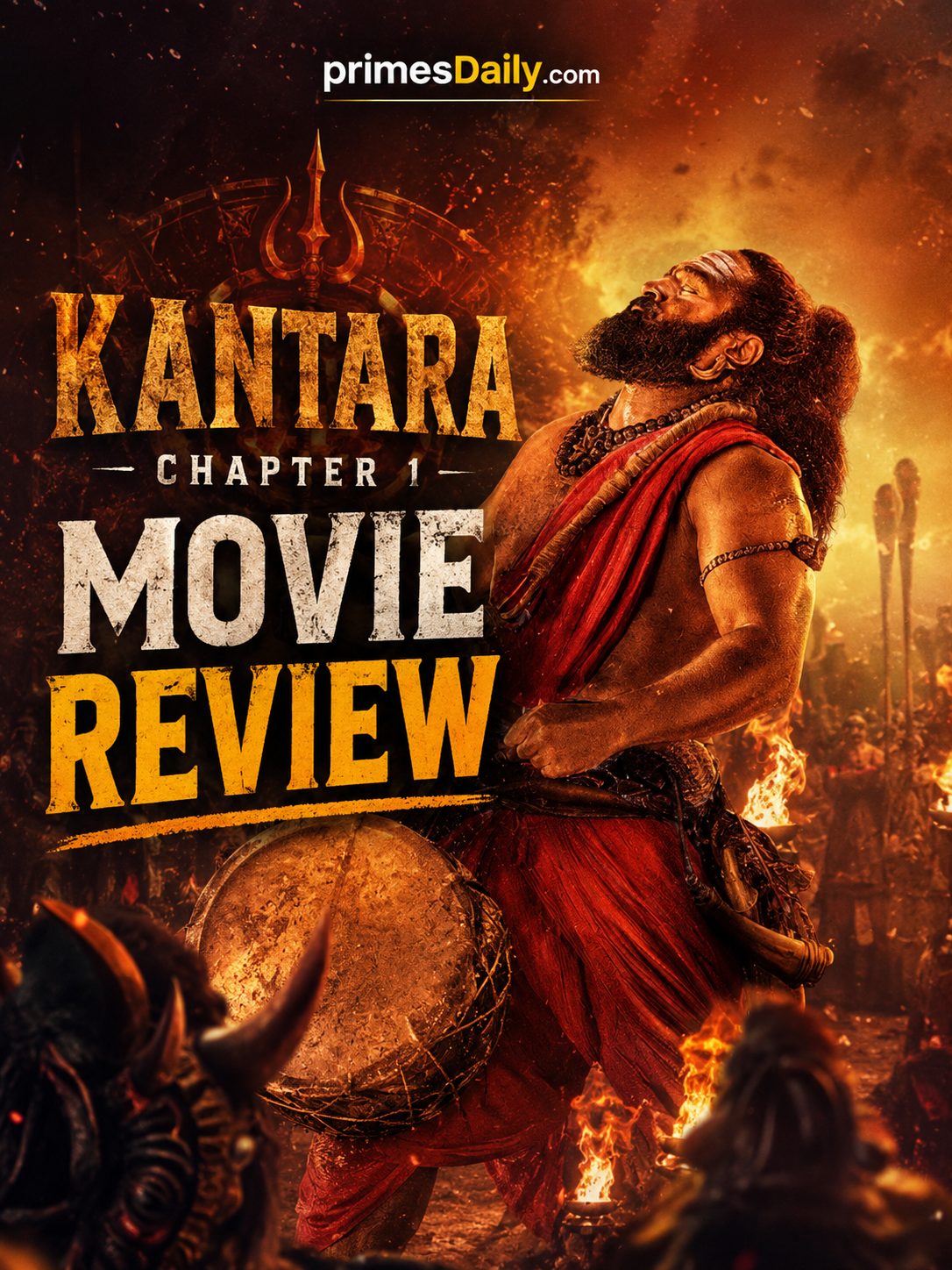
When Rishab Shetty released Kantara in 2022, he turned a modest ₹16 crore budget into a ₹450 crore global success, earning praise for treating tribal spiritual traditions with genuine reverence rather than exoticizing them. Three years later, backed by a much larger ₹125 crore budget, he returns with Kantara Chapter 1: A Legend — a prequel that expands the story from a single village to an entire kingdom, spanning centuries, gods, and supernatural forces. This Kantara Chapter 1 movie review examines whether that dramatic increase in scale still carries the emotional and spiritual weight that made the original so beloved, or whether spectacle has quietly taken its place.
The honest answer sits somewhere in between. Shetty faces an almost impossible task — satisfying original fans who want spiritual intimacy, mass audiences who want action, cultural practitioners who care about authentic representation, and investors who need box office returns. What emerges is a film of real technical achievement and sincere ambition, but also one with clear compromises. This review tries to be fair to both sides rather than offering a simple thumbs up or down.
Kantara Chapter 1 Movie Review: Complete Story Overview
Set nearly 1,500 years before the events of the original, the story unfolds during the 4th-century Kadamba dynasty and follows Berme, a mysterious tribal leader raised deep in the sacred forests of Kantara. Unlike Shiva from the 2022 film, Berme isn’t a reluctant hero discovering his destiny — he’s already spiritually awakened, born with an unshakable connection to the land’s divine forces.
The story centers on a territorial conflict between the tyrannical Bangra kingdom and the spiritually rooted forest tribes. When King Vijayendra greedily invades the sacred spice gardens, divine punishment claims his life, setting off a generational chain of consequences through his son Rajashekara and grandson Kulashekara. As Berme resists the kingdom’s exploitation — enabled by Arab and Portuguese traders — he unknowingly awakens the mysterious, dark-magic-practicing Kadapa tribe, turning what looked like a political rebellion into a full-blown spiritual war.
Plot Summary & Historical Context
The film is deliberately set in the 4th century CE, a period when the Kadamba dynasty ruled coastal Karnataka and maritime trade with Arab merchants was flourishing. This backdrop lets the story explore land rights, tribal resistance, and exploitation by outside powers — themes that still resonate with 2026 audiences discussing indigenous rights and cultural preservation.
The story kicks off with King Vijayendra’s fatal greed, setting three generations of royals on a collision course with the forest community. Rajashekara plots calculated revenge, while his son Kulashekara rules with reckless arrogance. His sister Kanakavathi, by contrast, offers a rare voice of empathy, suggesting coexistence might have been possible had greed not taken over.
Kantara Chapter 1 Cast & Performances Analysis
Rishab Shetty, writing, directing, and starring, delivers what critics call his “god mode” performance — particularly during sequences where Berme channels multiple avatars of the deity Guliga, each demanding distinct physicality and presence. It’s a performance that anchors the entire film.
Gulshan Devaiah makes a strong Kannada debut as Kulashekara, crafting a villain who’s both hateable and strangely human — arrogant, insecure, and occasionally sympathetic. Rukmini Vasanth’s Princess Kanakavathi is arguably the film’s most complex character, torn between loyalty to her family and growing awareness of their moral failures. Jayaram, as Rajashekara, brings quiet, simmering intensity despite limited screen time, while the supporting cast fleshes out a believable, layered world.
Cinematography & Visual Excellence in Kantara Chapter 1
Cinematographer Arvind Kashyap elevates the visual language well beyond what the original film’s smaller budget allowed. His camera treats the royal palace with tight, compressed framing that suggests confinement despite its grandeur, while the forest is shot in sweeping wide shots that convey spiritual freedom — a deliberate visual contrast that reinforces the story’s themes without needing dialogue.
Action sequences remain visually coherent even at massive scale, and the blend of practical and digital effects — especially with tigers appearing throughout the story — is so seamless that it’s often hard to tell what’s real. This Kantara Chapter 1 movie review considers the cinematography one of the film’s clearest strengths.
Background Score & Music Review
Composer B. Ajaneesh Loknath blends traditional Tulu folk instruments with sweeping orchestral arrangements, amplifying both the intimate ritual scenes and the large-scale battles. The score reaches its peak during the climax, where its sheer intensity reportedly gives audiences goosebumps.
That said, the score isn’t without flaws — it occasionally overwhelms dialogue, and despite its emotional power, it lacks a standout, hummable theme that lingers after the credits roll. Still, the sound design as a whole — from rustling leaves to weapon clashes — feels intentional and immersive.
For the latest, updated, and unique information, visit Set Up for PBLEmulator.
Kantara Chapter 1 Direction & Storytelling Technique
Shetty’s triple role as writer, director, and lead actor shows both his ambition and the strain of juggling so much responsibility. Unlike the original’s classic hero’s-journey structure, Berme doesn’t transform through the story — he’s already complete, which shifts the drama from personal growth to escalating external stakes.
Shetty deliberately avoids over-explaining the film’s supernatural elements, trusting audiences to interpret the Daivas’ powers and the Kadapa tribe’s dark magic for themselves. This restraint reflects a mature directorial philosophy, even if it occasionally frustrates viewers wanting clearer answers.
First Half Review: Pacing & World-Building
The first half moves at a breathless pace, packing in historical backstory, action, a budding romance between Berme and Kanakavathi, and comic relief — sometimes all within a few minutes. The world-building is genuinely impressive, communicating tribal life, royal politics, and trade dynamics without resorting to heavy exposition dumps.
However, this Kantara Chapter 1 movie review has to note that the relentless pace occasionally prevents real emotional investment in secondary characters, and the humor sometimes clashes tonally with the story’s serious themes. Around thirty minutes of redundant scenes could likely have been trimmed without losing narrative clarity.
Interval Point & Narrative Build-Up
The interval arrives at a carefully calculated moment — right as the mysterious Kadapa tribe is revealed, reframing what looked like a straightforward political conflict into something cosmically significant. This structural choice gives audiences psychological breathing room to absorb the twist before the story accelerates further.
The build-up leading to this point works well, using Berme’s journey into the royal capital and his growing bond with Kanakavathi to slowly hint that larger, unseen forces are shaping events — preparing viewers, even if unconsciously, for the supernatural turn ahead.
Second Half Breakdown: Action & Climax
Post-interval, the film shifts decisively into large-scale spectacle, with increasingly elaborate battle sequences building toward a climactic Bhuta Kola performance. The choreography is genuinely impressive, involving hundreds of combatants while staying visually comprehensible thanks to Kashyap’s camera work.
The climax itself — Berme’s transformation, the manifestation of multiple divine avatars, and the final confrontation — is emotionally intense and technically dazzling. Still, several critics (and this review agrees) feel the resolution arrives a bit too quickly relative to the buildup, prioritizing spectacle over the quieter emotional beats that might have made it fully satisfying.
VFX & Production Design Quality
Production designer Vinesh Banglan creates an impressively lived-in world on a budget far smaller than comparable global blockbusters. Villages, palaces, and the bustling maritime port all feel historically grounded rather than artificially constructed, the result of clear research into the period and region.
Visual effects remain deliberately restrained, supporting practical prosthetics and sets rather than overwhelming them — a choice that keeps supernatural elements feeling grounded rather than cartoonish. This disciplined approach lets the film punch above its budget, achieving results that rival much more expensive productions.
Kantara Chapter 1 vs Original Kantara: Key Differences
The original Kantara was intimate, restrained, and mysterious — a small, character-driven story about one man’s spiritual awakening. This prequel is the opposite in almost every way: sprawling, explicit about its supernatural elements, and driven by scale rather than restraint.
Where Shiva’s arc in 2022 was about personal transformation, Berme’s story in this prequel is about escalating external stakes for a hero who’s already fully formed. Neither approach is objectively better — they reflect fundamentally different budgets and creative goals — but longtime fans should adjust their expectations accordingly before watching.
Bhuta Kola Ritual & Cultural Authenticity
Shetty treats the Bhuta Kola ritual — the sacred Tulu practice of channeling deities like Panjurli and Guliga — with clear respect, positioning it as the spiritual and emotional center of the film rather than a decorative plot device. The cinematography, costuming, and music all reinforce this reverence.
That said, this Kantara Chapter 1 movie review acknowledges legitimate concerns raised by cultural practitioners: cinematic spectacle inevitably reshapes how a living sacred tradition is consumed by mass, global audiences, and the line between honoring a practice and turning it into entertainment is a genuinely difficult one to walk.
Historical Accuracy & Storytelling in Kantara Chapter 1
The choice of the 4th-century Kadamba dynasty setting is a smart one, letting Shetty explore land and resistance themes without the complexity of later religious and political history. However, the film’s inclusion of Portuguese traders running slave markets is a clear anachronism — Portugal wouldn’t reach India for another thousand years.
These historical liberties serve the story’s narrative needs (audiences instantly recognize the trader archetypes), but they do strain credibility for history-conscious viewers. It’s a case where dramatic convenience was clearly prioritized over strict accuracy.
Thematic Elements & Spiritual Significance
At its core, the film explores dharma versus adharma, questions of who rightfully owns and stewards the land, and the idea that surrendering to faith can be strength rather than weakness. These are genuinely substantial themes, treated with sincerity rather than irony.
Unfortunately, these deeper ideas sometimes get buried under nonstop action in the second half, leaving less room for audiences to sit with the film’s more philosophical questions. Still, the attempt to blend big-budget spectacle with real spiritual inquiry is commendable.
Character Development & Performances Breakdown
Berme himself doesn’t undergo traditional character growth — he arrives fully formed, spiritually and morally complete — which some viewers may find less satisfying than a classic transformation arc. Kulashekara and Kanakavathi, by contrast, offer more psychological nuance and internal conflict, arguably making them the film’s most compelling characters.
The supporting cast, including soldiers, traders, and tribal representatives, adds texture without feeling like filler, reflecting Shetty’s understanding that convincing world-building needs more than just its central hero.
Editing, Runtime & Technical Aspects
At nearly 180 minutes, the film could have benefited from tighter editing, particularly in trimming the first half’s redundant scenes and some of the second half’s extended battle sequences. A runtime closer to 150–160 minutes might have improved pacing without sacrificing any essential story beats.
Sound mixing occasionally favors musical intensity over dialogue clarity — a deliberate artistic choice that won’t bother everyone, but will frustrate viewers who want every line of dialogue clearly audible.
Box Office Performance & Audience Reception
Backed by Hombale Films’ substantial ₹125 crore investment, the film performed strongly commercially, benefiting from residual goodwill and curiosity generated by the original’s cultural phenomenon status. It released theatrically in 2025 and later moved to Amazon Prime Video.
Audience reception has been notably divided: many praise the technical craft and entertainment value, while longtime fans of the original miss its intimacy and spiritual restraint. This split reception reflects the fundamental trade-offs Shetty made in expanding the story’s scale.
Kantara Chapter 1 Movie Review: Strengths
- Outstanding cinematography and immersive production design
- Rishab Shetty’s committed, multi-role performance as writer, director, and lead
- Genuine, sincere engagement with spiritual and cultural themes
- Well-executed, large-scale action choreography that stays visually clear
- Strong supporting performances, especially from Devaiah and Vasanth
- Respectful treatment of the Bhuta Kola tradition
- Ambitious, richly detailed world-building
- A powerful, emotionally driven musical score
Kantara Chapter 1 Movie Review: Weaknesses & Criticism
The film suffers from noticeable narrative bloat, with a drawn-out first half and scenes that repeat similar information without adding much. Humor often feels misplaced against the story’s otherwise serious tone, occasionally undercutting emotional weight at the wrong moments.
The romance between Berme and Kanakavathi remains underdeveloped, relying on a single montage rather than earned emotional connection. The Kadapa tribe’s motivations stay vague throughout, functioning more as a plot device than a fully realized antagonistic force. And ultimately, the film’s deeper themes around land, faith, and stewardship get somewhat overshadowed by nonstop spectacle in the back half.
Should You Watch Kantara Chapter 1?
If you loved the original’s quiet intimacy, temper your expectations — this prequel is bigger, louder, and far less restrained. If instead you’re after visual spectacle, strong action choreography, and genuine technical craftsmanship, it delivers fully on that front.
Casual viewers looking for pure entertainment will likely enjoy the ride. Those craving a tighter, more focused story may find the nearly three-hour runtime taxing. Theatrical viewing is recommended if possible, since the scale of the cinematography and sound design is best experienced on a big screen.
FAQs
Do I need to watch the original Kantara first? It’s not required, but it adds useful context, especially around the Bhuta Kola tradition and character relationships.
What’s the runtime? Approximately 180 minutes.
Where can I watch it? It released in theaters in 2025 and is now streaming on Amazon Prime Video.
What language is it in? Kannada, with subtitles available for non-Kannada speakers.
Is it appropriate for children? Not really — the violence and mature themes make it better suited for teens and adults.
Will there be a Kantara Chapter 2? Rishab Shetty has hinted at franchise expansion, though nothing is officially confirmed yet.
How does it compare to the original? They’re different in tone rather than quality — the original is intimate and spiritual, while this one is epic and spectacle-driven.
Conclusion
Kantara Chapter 1: A Legend is ambitious, technically impressive, and thematically sincere, even as it trades some of the original’s restraint for scale and spectacle. This Kantara Chapter 1 movie review sees it as a film that succeeds and stumbles in roughly equal measure — bold and visually stunning, but occasionally bloated and emotionally rushed in its final stretch.
It’s a strong recommendation for fans of grand, ambitious Indian cinema and technical filmmaking, and a more mixed bag for those specifically hoping for a repeat of 2022’s quieter, more spiritually focused magic. Either way, it’s a film worth watching and forming your own opinion on.
Final Rating: ⭐⭐⭐½ / 5
For the latest, updated, and unique information, visit Is a Sweater Business Casual?