
Are you considering a smile transformation but worried about the financial investment? Understanding veneers cost is the first step toward making an informed decision about your dental aesthetic upgrade. In 2026, dental veneers have become one of the most popular cosmetic dental solutions in the United States, offering patients a way to achieve a Hollywood-like smile without complete teeth replacement. This comprehensive guide will walk you through everything you need to know, from initial pricing to long-term investment value.
Dental veneers are a significant investment in your appearance and confidence. Whether you’re a single tooth away from your perfect smile or considering a complete smile makeover, understanding the true financial commitment is essential. This article breaks down every aspect of this procedure so you can make the best decision for your dental health and budget.
Average Veneers Cost Per Tooth in 2026
What’s the actual price tag for a single veneer?
In 2026, the average price per tooth ranges from $900 to $2,500 depending on the material and complexity of your case. For composite veneers, you can expect to pay between $300 and $1,000 per tooth, while porcelain veneers typically cost $1,200 to $2,500 per tooth.
These prices have remained relatively stable since 2025, though some regions have seen slight increases due to inflation and demand. Most dental practices in major metropolitan areas charge toward the higher end of this range, while suburban and rural dental offices may offer more competitive pricing.
Why does the cost vary so much between teeth?
Several factors contribute to price variations:
- Tooth location: Front teeth veneers typically cost more than back tooth veneers due to visibility and complexity
- Existing damage: Severely damaged teeth may require additional preparation, increasing the overall expense
- Shade matching complexity: Matching your existing teeth shade can add to the cost
- Veneer thickness: Thinner, more natural-looking veneers may cost slightly more due to technical skill required
Is there a discount for multiple teeth?
Yes! Most dental offices offer package pricing when you’re getting multiple veneers. If you’re investing in four to eight veneers for a full smile, you can typically negotiate prices down by 10-20% per tooth compared to single-tooth pricing.
What Are Dental Veneers?
Let me break down exactly what you’re paying for
Dental veneers are ultra-thin, custom-made shells crafted from tooth-colored materials designed to cover the front surface of your teeth. They’re bonded permanently to your existing teeth to improve appearance, shape, size, and color. Think of them as a cosmetic makeover for your smile—a custom-fitted shell that transforms how your teeth look.
What makes veneers different from other cosmetic solutions?
Veneers are minimally invasive compared to crowns or implants. They preserve most of your natural tooth structure while dramatically improving aesthetics. This option is generally more affordable than crowns, and they don’t require the extensive preparation that implants demand.
The process involves:
- Consultation and shade selection
- Tooth preparation (minimal enamel removal)
- Impression taking or digital scanning
- Temporary veneer placement while permanent ones are crafted
- Final bonding and adjustment
How are veneers attached to your teeth permanently?
Veneers are bonded to your teeth using dental cement and a specialized adhesive system. This creates a strong, durable connection that can last years if properly maintained. The bonding process is what separates affordable quick-fix solutions from professional applications, which explains why legitimate pricing reflects this quality workmanship.
Types of Veneers and Their Cost Comparison
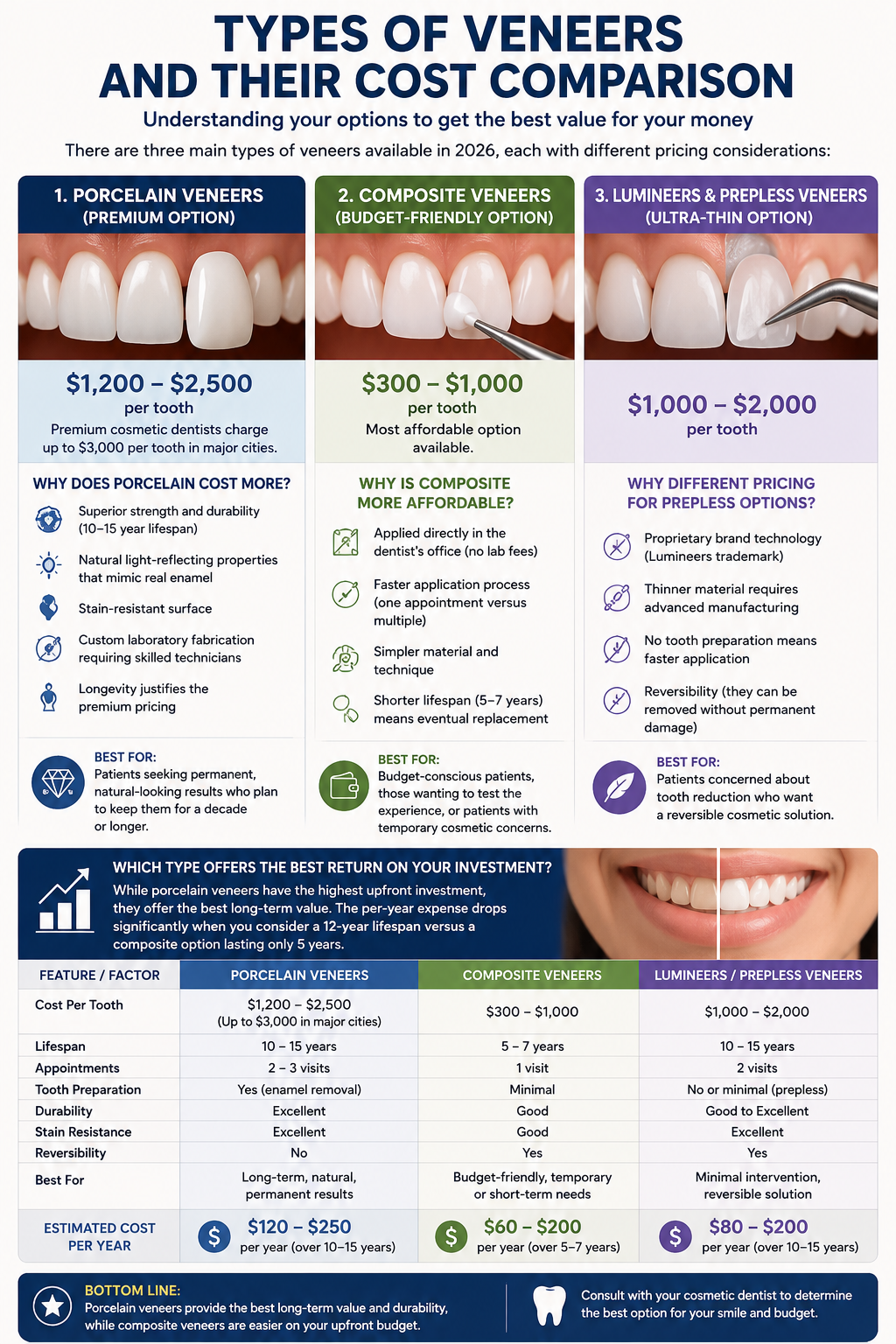
Understanding your options to get the best value for your money
There are three main types of veneers available in 2026, each with different pricing considerations:
Porcelain Veneers (Premium Option)
Porcelain veneers are the gold standard in cosmetic dentistry, typically ranging from $1,200 to $2,500 per tooth, with premium cosmetic dentists charging up to $3,000 per tooth in major cities.
Why does porcelain cost more?
- Superior strength and durability (10-15 year lifespan)
- Natural light-reflecting properties that mimic real enamel
- Stain-resistant surface
- Custom laboratory fabrication requiring skilled technicians
- Longevity justifies the premium pricing
Best for: Patients seeking permanent, natural-looking results who plan to keep them for a decade or longer.
Composite Veneers (Budget-Friendly Option)
Composite resin veneers are built directly onto your teeth during a single office visit, ranging from $300 to $1,000 per tooth, making them the most affordable option available.
Why is composite more affordable?
- Applied directly in the dentist’s office (no lab fees)
- Faster application process (one appointment versus multiple)
- Simpler material and technique
- Shorter lifespan (5-7 years) means eventual replacement
Best for: Budget-conscious patients, those wanting to test the experience, or patients with temporary cosmetic concerns.
Lumineers and Prepless Veneers (Ultra-Thin Option)
These no-prep or minimal-prep veneers are extremely thin (0.3mm) and sometimes don’t require tooth shaving, typically ranging from $1,000 to $2,000 per tooth.
Why different pricing for prepless options?
- Proprietary brand technology (Lumineers trademark)
- Thinner material requires advanced manufacturing
- No tooth preparation means faster application
- Reversibility (they can be removed without permanent damage)
Best for: Patients concerned about tooth reduction who want a reversible cosmetic solution.
Which type offers the best return on your investment?
While porcelain veneers have the highest upfront investment, they offer the best long-term value. The per-year expense drops significantly when you consider a 12-year lifespan versus a composite option lasting only 5 years.
Full Mouth Veneers Cost Breakdown
What does a complete smile makeover actually cost?
A full-mouth veneer makeover typically involves 6-8 veneers covering all visible teeth when you smile. Here’s the realistic breakdown of total expenses:
Full mouth porcelain veneers: $7,200 – $20,000+
- 8 teeth × $900-$2,500 per tooth
- Average cost in 2026: $12,000-$15,000
- Premium cosmetic dentists: $18,000-$20,000
Full mouth composite veneers: $2,400 – $8,000
- 8 teeth × $300-$1,000 per tooth
- Average cost in 2026: $3,500-$5,000
- Most affordable option for complete smile
Partial smile veneers (4 teeth): $3,600 – $10,000
- Most patients choose 4 front teeth
- Average expense for partial: $4,500-$6,000
- Great starting point for a noticeable transformation
What’s included in the pricing?
The price typically includes:
- Initial consultation and shade selection ($0-$200)
- Tooth preparation
- Temporary veneer placement
- Lab fabrication or chairside creation
- Final bonding and cementation
- Immediate follow-up adjustments
- Standard post-placement care (not including future maintenance)
Are there hidden costs I should know about?
Additional expenses that might affect your total investment include:
- Teeth whitening before placement ($200-$800): Improves shade matching
- Additional dental work ($500-$3,000): Fillings, cavities, or gum treatment
- Regular maintenance ($100-$200 annually): Professional cleanings
- Eventual replacement (equals original investment): Every 10-15 years for porcelain
Veneers Cost by Geographic Location
Does where you live affect what you’ll pay?
Absolutely. Geographic location is one of the most significant factors in determining pricing. In 2026, there’s a substantial difference between rural and urban markets.
Major Metropolitan Areas (Highest Pricing)
New York City, Los Angeles, Miami, San Francisco, Boston:
- Porcelain veneers: $1,800-$3,000+ per tooth
- Composite veneers: $800-$1,500 per tooth
- Full mouth average: $16,000-$22,000
Why is pricing higher in major cities?
- Premium office locations with higher overhead
- Experienced cosmetic dentists with established reputations
- High demand for aesthetic dentistry
- Cost of living increases reflected in service pricing
- Access to advanced technology and premium materials
Mid-Sized Cities (Moderate Pricing)
Cities like Austin, Denver, Charlotte, Nashville, Phoenix:
- Porcelain veneers: $1,200-$1,800 per tooth
- Composite veneers: $500-$900 per tooth
- Full mouth average: $9,000-$13,000
Suburban and Rural Areas (Lower Pricing)
Smaller communities and suburban practices:
- Porcelain veneers: $900-$1,300 per tooth
- Composite veneers: $300-$600 per tooth
- Full mouth average: $6,000-$9,000
Is traveling for dental work worth the savings?
Some patients consider dental tourism to reduce expenses. Popular destinations include:
- Mexico: 40-50% lower pricing than US
- Costa Rica: 30-40% savings
- Turkey: 50-60% lower expenses
However, you must consider travel costs, potential complications, and follow-up care challenges. A $2,000 savings might disappear quickly with flights and accommodation.
Regional variations in 2026
Texas and Florida have highly competitive pricing despite major city locations, with many practices offering mid-range expenses. California consistently maintains the highest prices across all cosmetic procedures. The Midwest offers some of the best pricing in the nation, especially in smaller metropolitan areas.
Factors That Influence Veneers Cost
Understanding why your quote might differ from your friend’s
Total expenses depend on numerous interconnected factors:
Patient-Specific Factors
Current tooth condition:
- Healthy teeth: Lower pricing (simple preparation)
- Damaged or decayed teeth: Higher cost (additional treatment required)
- Severely misaligned teeth: Might need orthodontics first (adds $3,000-$8,000)
- Gum disease: Must be treated before placement (adds $500-$3,000)
Number of veneers needed:
- Each additional tooth increases expense proportionally
- Minimum 4 teeth recommended for balanced appearance
- Maximum benefit at 6-8 teeth coverage
Cosmetic complexity:
- Slight shade corrections: Minimal additional expense
- Complete color transformation (yellowed to white): Higher complexity
- Spacing issues: More complex design increases cost
- Bite correction needs: Might require porcelain instead of composite
Practice-Related Factors
Dentist credentials and experience:
- General dentists: Lower pricing ($1,000-$1,500/tooth)
- Cosmetic specialists: Higher cost ($1,500-$2,500/tooth)
- Prosthodontists (teeth specialists): Premium pricing ($2,000-$3,000+/tooth)
Office overhead:
- Location prestige affects expenses
- Latest technology: CEREC machines or digital smile design add value
- Staff expertise level
Material Quality Factors
Porcelain type:
- Standard porcelain: Mid-range pricing
- Premium porcelain (Emax, Empress): Higher cost, superior aesthetics
- Zirconia-based (strongest): Can cost more than traditional porcelain
Thickness and customization:
- Ultra-thin veneers: Higher expense due to difficulty
- Highly customized shading: Additional technician time increases cost
Porcelain Veneers Cost vs. Composite Veneers Cost
Making the investment decision: Which offers better value?
The choice between porcelain and composite options isn’t just about upfront expense—it’s about long-term value and your personal needs.
Direct Cost Comparison
Porcelain Veneers (8 teeth):
- Per-tooth cost: $1,200-$2,500
- Total investment: $9,600-$20,000
- Cost per year (10-year lifespan): $960-$2,000/year
- Cost per year (15-year lifespan): $640-$1,333/year
Composite Veneers (8 teeth):
- Per-tooth cost: $300-$1,000
- Total investment: $2,400-$8,000
- Cost per year (5-year lifespan): $480-$1,600/year
- Cost per year (7-year lifespan): $343-$1,143/year
Total Cost of Ownership Over 15 Years
Porcelain:
- Initial investment: $12,000
- Replacement (one time): $12,000
- Maintenance: $1,500-$2,000
- Total 15-year cost: $25,500-$26,000
Composite:
- Initial investment: $4,000
- First replacement (5 years): $4,000
- Second replacement (10 years): $4,000
- Maintenance: $1,000-$1,500
- Total 15-year cost: $13,000-$13,500
Why you might choose porcelain (higher upfront cost)
- Superior stain resistance saves on professional whitening
- More realistic light reflection mimics natural teeth
- Durability means fewer replacements
- Better for perfectionist patients
- Ideal for high-visibility professions (media, entertainment)
Why you might choose composite (lower upfront cost)
- Immediate results (same-day application)
- Perfect for trial runs before permanent options
- Easier to repair minor damage
- Less tooth preparation required
- Better for budget-conscious patients
The Truth About “Cheap” Options
Extremely low pricing (under $300 per tooth) often indicates:
- Inexperienced dentists
- Lower quality materials
- Poor shade matching
- Faster deterioration
- More frequent repairs needed
Investing in properly done veneers, even at higher pricing, saves money long-term through durability and lower maintenance needs.
How Much Does Your Dentist’s Experience Add to Veneers Cost?
Why do experienced cosmetic dentists charge more?
Experience is perhaps the most significant determinant of pricing. A cosmetic dentist with 20+ years of experience charges substantially more than a general dentist attempting cosmetic work.
Experience-Based Pricing Breakdown
General Dentist (1-3 years cosmetic experience):
- Typical pricing: $900-$1,200/tooth
- Cosmetic training: Minimal certification
- Portfolio: Limited cosmetic cases
- Results: Adequate but may lack finesse
Experienced Cosmetic Dentist (5-10 years specialty):
- Typical pricing: $1,400-$1,800/tooth
- Cosmetic training: Advanced courses and certifications
- Portfolio: Impressive before/after galleries
- Results: Excellent aesthetic outcomes
- Technology: Modern digital smile design
Cosmetic Specialist/Prosthodontist (10+ years):
- Typical pricing: $2,000-$2,500+/tooth
- Cosmetic training: Residency or fellowship programs
- Portfolio: Award-winning cases
- Results: Exceptional, almost undetectable artistry
- Technology: Cutting-edge techniques and materials
What expertise justifies higher pricing?
Experienced dentists charge premium rates because they provide:
Superior Shade Matching:
- Experienced dentists understand tooth color complexity better
- They know how lighting affects tooth appearance
- Result: Natural-looking results matching your smile perfectly
Precise Tooth Preparation:
- Veteran dentists remove exactly the right amount of tooth structure
- Overpreperation compromises tooth strength
- Under-preparation causes bulky, unnatural appearance
- Precision reduces future complications
Optimal Veneer Design:
- Expert designers consider your face shape, lips, and smile arc
- Proportions matter—wrong size looks fake
- Experienced dentists create results proportional to your face
Longevity Assurance:
- Better application means they last longer
- Proper bonding reduces chipping and separation
- Quality workmanship justifies premium pricing
Esthetic Excellence:
- Minimal visibility of veneer edges
- Seamless integration with natural teeth
- Professional shade selection considers all lighting conditions
How to verify a dentist’s cosmetic credentials
Before committing at any practice, verify:
- Board certification: American Academy of Cosmetic Dentistry (AACD)
- Continuing education hours: 100+ in cosmetic dentistry
- Case portfolio: Request to see before/after photos
- Patient reviews: Look for cosmetic dentistry-specific feedback
- Technology: Digital smile design, CEREC, or similar tools
- Experience years: Ideally 5+ years in cosmetic dentistry specifically
Is the price difference worth it?
Absolutely. A $400 per-tooth difference ($3,200 for eight teeth) is minimal compared to years of dissatisfaction with your smile. The additional $800-$1,200 per tooth at an experienced dentist practically always results in better outcomes, higher satisfaction, and longer-lasting results.
Insurance Coverage and Veneers Cost
Will your dental insurance help?
This is where many patients face disappointment: most dental insurance plans do not cover this procedure. Here’s why and what alternatives exist.
Why Insurance Doesn’t Provide Coverage
Insurance companies classify veneers as “cosmetic” rather than “medically necessary” procedures. The distinction is crucial:
Medically Necessary: Procedures that restore function or treat disease
- Root canals
- Fillings
- Crowns (for broken teeth)
- Extractions
Cosmetic (Not Covered): Procedures that improve appearance without addressing health issues
- Veneers
- Whitening
- Orthodontics (usually)
- Smile design
Since healthy teeth with poor appearance don’t affect function or health, insurance won’t provide coverage.
Rare Exceptions: When Insurance Might Help
There are limited scenarios where insurance might contribute:
Trauma/Injury:
- If you’ve had an accident damaging front teeth, insurance might cover if deemed the most conservative restoration
- Even then, they might cover only a crown-level benefit (partial coverage)
Severe Discoloration:
- Intrinsic staining from medication (tetracycline, fluorosis) might qualify
- Your dentist must document this with insurance
- Coverage would be partial
Structural Defects:
- Enamel dysplasia or similar conditions might qualify
- Must be medically documented
- Insurance coverage remains minimal
Important: Contact your insurance directly with your specific case before assuming coverage. Even in exceptions, insurance typically covers only 20-50% of total expenses.
Out-of-Pocket Realities
99% of patients pay full costs from personal funds. This makes financing options crucial for many.
What about HSA, FSA, or HRA?
- Health Savings Account (HSA): If deemed medically necessary (rare), can use pre-tax dollars
- Flexible Spending Account (FSA): Same as HSA, but medical necessity is strict
- Health Reimbursement Arrangement (HRA): Employer-dependent; most don’t cover cosmetic procedures
Check with your employer’s benefits administrator before assuming you can use these options.
How to Finance Veneers Cost
Making dental veneers affordable through smart financing
Most people cannot pay full cost upfront. Here are proven strategies to afford your smile upgrade.
In-House Dental Payment Plans
Most dental offices offer 0-3% APR payment plans directly:
Typical terms:
- 12 months interest-free for veneers cost under $5,000
- 24-36 months at 3-6% APR for larger veneers cost amounts
- No credit check required at many offices
- Flexible monthly payments ($300-$1,000/month depending on veneers cost)
Advantages:
- Immediate smile transformation (no waiting for financing approval)
- Direct relationship with your dentist
- Modifications possible if circumstances change
- Builds trust with your dental provider
How to negotiate: Ask about loyalty discounts or package deals that reduce total veneers cost when you commit to payment plan.
Third-Party Financing: CareCredit
CareCredit is the industry standard for dental financing, used by 75% of cosmetic dentistry offices:
How CareCredit reduces veneers cost burden:
- Apply in office, approval in minutes
- Revolving credit line up to $25,000
- Promotional periods: 6, 12, 18, or 24 months interest-free depending on veneers cost amount
- After promo period: 26.99% APR on remaining balance
- Works like a credit card but specifically for healthcare
Example financing for $12,000 veneers cost:
- 18-month interest-free promotional period
- Monthly payment: $667
- After 18 months if you’ve paid it off: $0 interest
- If balance remains: 26.99% APR applies
Strategic approach: Time your veneers cost to coincide with promotional periods offering longest interest-free terms.
Dental Loans from Banks
Personal loans from banks offer another veneers cost financing avenue:
Typical terms:
- Rates: 6-15% APR (depends on credit score)
- Loan amounts: $2,000-$50,000
- Terms: 24-60 months
- Approval time: 3-7 days
When to choose bank loans over CareCredit:
- If you have excellent credit (gets better rates)
- If you want fully fixed monthly payments
- If you plan to pay off veneers cost quickly
- If you need funds immediately
Payment Plans and Financing Options for Veneers Cost
Breaking down expenses into manageable chunks
The key to affording this investment is matching the payment method to your financial situation.
Comparison of All Financing Options
In-Office Payment Plans (Direct from Dentist):
- APR: 0-3% (varies by office)
- Application: Immediate in office
- Approval rate: Nearly 100%
- Monthly payment on $12,000: $667-1,000/month
- Best for: Immediate needs, good relationships with dentist
CareCredit:
- APR: 0% promotional (6-24 months), then 26.99%
- Application: Immediate at office
- Approval rate: 80-85%
- Monthly payment on $12,000: $667/month (0% for 18 months)
- Best for: Patients wanting interest-free periods
Dental Loans from Banks:
- APR: 6-15% (credit-dependent)
- Application: Online or in-branch
- Approval time: 3-7 days
- Monthly payment on $12,000: $220-305/month (5-year term)
- Best for: Excellent credit holders wanting lower rates
Credit Cards:
- APR: 15-25% (standard rates)
- Application: Already established
- Approval rate: Immediate if already approved
- Monthly payment on $12,000: Variable
- Best for: Emergency situations only (expensive option)
Employer-Based Loans:
- APR: 2-5% (varies)
- Repayment: Payroll deduction
- Terms: Typically 2-5 years
- Best for: Employees with financial hardship assistance programs
Real-World Payment Examples
Scenario 1: Budget-Conscious Patient
- Composite veneers: 4 teeth
- Total investment: $2,800
- Financing: 12-month interest-free plan
- Monthly payment: $233
- Total paid: $2,800 (no interest)
Scenario 2: Middle-Range Patient
- Porcelain veneers: 6 teeth
- Total investment: $9,000
- Financing: CareCredit 18-month interest-free
- Monthly payment: $500
- Total paid: $9,000 (no interest if paid on time)
Scenario 3: Premium Patient
- Porcelain veneers: 8 teeth with specialty cosmetic dentist
- Total investment: $16,000
- Financing: Bank loan 5-year term at 8% APR
- Monthly payment: $317
- Total paid: $19,020 (interest costs $3,020)
Scenario 4: Full Investment
- Elite cosmetic dentistry: 8 teeth with renowned specialist
- Total investment: $20,000
- Financing: 24-month CareCredit promotional
- Monthly payment: $833
- Total paid: $20,000 (no interest)
Tips to Lower Total Expenses Through Financing
- Choose longer promotional periods (24 months vs. 12 months) to reduce monthly burden
- Ask about package discounts that lower total expense for multiple teeth
- Combine payment methods: Use savings for first tooth, finance remaining cost
- Ask about referral bonuses: Some offices reduce pricing by 10% per referral
- Time your procedure for office promotions or holidays
Veneers Cost vs. Other Cosmetic Dental Treatments
Understanding your alternatives and relative investment levels
Before committing to this procedure, understand how it compares to other smile enhancement options.
Veneers Cost vs. Crowns Cost
Veneers:
- Cost: $1,200-$2,500 per tooth
- Preparation: Minimal (0.5-0.7mm enamel removal)
- Longevity: 10-15 years
- Process: 2 appointments, 1-2 weeks turnaround
- Reversibility: Somewhat reversible if carefully removed
- Best for: Cosmetic concerns on healthy teeth
Crowns:
- Cost: $1,200-$3,000+ per tooth (comparable to veneers cost!)
- Preparation: Extensive (tooth reduced 1.5-2mm all around)
- Longevity: 10-15 years (similar to veneers cost longevity)
- Process: 2 appointments
- Reversibility: Irreversible (tooth structure permanently altered)
- Best for: Damaged, decayed, or structurally compromised teeth
Verdict: If your teeth are healthy, veneers cost less total damage to your natural tooth structure than crowns, making them the preferred choice.
Veneers Cost vs. Teeth Whitening Cost
Professional Whitening:
- Cost: $200-$800 per treatment
- Results: Lightens existing teeth 1-2 shades
- Longevity: 6 months to 2 years (temporary)
- Full mouth cost: Single treatment
- Process: One appointment (30-60 minutes)
- Best for: Mild discoloration on healthy teeth
Veneers Cost:
- Cost: $9,600-$20,000 for full mouth (higher upfront, but permanent)
- Results: Complete color transformation, shape changes
- Longevity: 10-15 years (permanent solution)
- Process: Multiple appointments over 1-3 weeks
- Best for: Severe discoloration, shape issues, or permanent solution seekers
Verdict: Whitening is affordable for minor concerns; veneers cost is justified when you want permanent transformation or have shape/size issues.
Veneers Cost vs. Bonding Cost
Composite Bonding:
- Cost: $300-$800 per tooth (less than veneers cost)
- Longevity: 3-5 years
- Material: Composite resin applied and hardened directly
- Repairs: Easy to fix and modify
- Best for: Minor spacing, chips, or temporary solutions
Veneers Cost:
- Cost: $300-$2,500 per tooth (depends on material)
- Longevity: 5-15 years (much longer than bonding)
- Material: Composite (temporary) or porcelain (permanent)
- Repairs: More complex, dentist-dependent
- Best for: Complete smile makeovers or patients wanting permanent solutions
Verdict: For small fixes, bonding is cheaper. For full smile transformation, veneers cost is only slightly higher but lasts 3-10x longer.
Veneers Cost vs. Orthodontics Cost
Braces/Aligners (Invisalign):
- Cost: $3,000-$8,000
- Time: 18-24 months
- Results: Aligns teeth structurally
- Longevity: Permanent (teeth stay straight if retained)
- Best for: Crowded, spaced, or misaligned teeth
Veneers Cost for Cosmetic Correction:
- Cost: $4,000-$12,000
- Time: 1-3 weeks
- Results: Cosmetic improvement of appearance, not structural change
- Longevity: 10-15 years
- Best for: Patients wanting immediate results
Important: If teeth are severely misaligned, orthodontics should precede veneers cost investment. Veneers don’t correct bite issues, only appearance.
The Veneers Procedure and What’s Included in the Cost
Understanding exactly what you’re paying for
When you invest in this procedure, you’re paying for multiple services bundled into the treatment. Understanding each component helps justify the investment.
The Complete Timeline
Appointment 1: Consultation and Planning
What happens:
- Digital smile design consultation (often included)
- Tooth shade selection using professional guides
- Discussion of expectations and limitations
- Photography documentation
- Cost breakdown and financing options
- Timeline explanation
Time required: 30-60 minutes Included: Usually yes (some offices charge $100-200 for consultation) Typical conversation: “Will they look completely white or match my natural shade?” – Answer: Professional dentists recommend matching your skin tone and existing teeth shade for natural results.
Appointment 2: Tooth Preparation and Impressions
What happens:
- Local anesthesia application (minimal tooth sensitivity during prep)
- Careful enamel removal (0.5-0.7mm layer)
- Tooth shaping for optimal fit
- Impression taking (traditional or digital 3D scanning)
- Shade confirmation one final time
- Temporary veneer placement while permanent ones are crafted
Time required: 60-90 minutes Included: Yes—this is where expert skill justifies the cost Typical question: “Does tooth preparation hurt?” – Answer: No, because anesthesia numbs the tooth. You’ll feel pressure but not pain. Most patients report it as painless.
Lab Work (Behind-the-Scenes Critical Step)
What happens (included in your investment):
- Skilled dental technician hand-crafts each veneer
- Multiple quality checks for fit and shade
- Usually takes 7-14 days
- Rush orders available (costs 20-30% more)
Why it’s worth the cost: Each veneer is custom-made for your specific tooth shape and exact shade match. Mass-produced veneers (cheaper but not better quality) won’t fit your teeth precisely.
Appointment 3: Veneer Bonding and Adjustment
What happens:
- Temporary veneers removed
- Permanent veneers tried in for fit and shade check
- Final shade adjustment (color can be modified slightly)
- Surface preparation
- Tooth surface etching (creates micro-texture for better bonding)
- Veneer bonding with specialized dental cement
- Photopolymer hardening (light activation)
- Bite adjustment to ensure proper alignment
- Final polishing and cleaning
Time required: 60-120 minutes Included: Yes, this is the critical final step Typical question: “How do you ensure they stay attached permanently?” – Answer: The bonding process creates a micromechanical lock. The etched veneer surface and tooth surface interlock at a molecular level with the adhesive, creating an extremely strong bond stronger than the tooth or veneer material itself.
Additional Services Often Included
Professional Shade Matching:
- Expert color selection using multiple reference systems
- Accounts for natural lighting, office lighting, and phone camera angles
- Ensures they match adjacent natural teeth
Digital Smile Design:
- Computer visualization of results
- Helps you preview outcomes before commitment
- Allows modifications before fabrication
First Follow-Up Appointment (Usually Included):
- Bite adjustment if needed
- Margin smoothing
- Final polishing
- Durability assessment
Costs Not Included in Basic Pricing
Preliminary Treatments (Add to Total Investment):
- Teeth whitening: $200-$800 (often recommended before commitment)
- Cavity fillings: $150-$300 per cavity
- Gum disease treatment: $500-$3,000
- Root canals: $1,000-$2,000 (if tooth is not vital)
- Orthodontic treatment: $3,000-$8,000 (if teeth are severely misaligned)
Future Maintenance (Ongoing Cost):
- Annual professional cleanings: $100-$200
- Periodic touch-ups or repairs: $200-$500
- Eventual replacement: Equals original investment
How Long Do Veneers Last Relative to Their Cost?
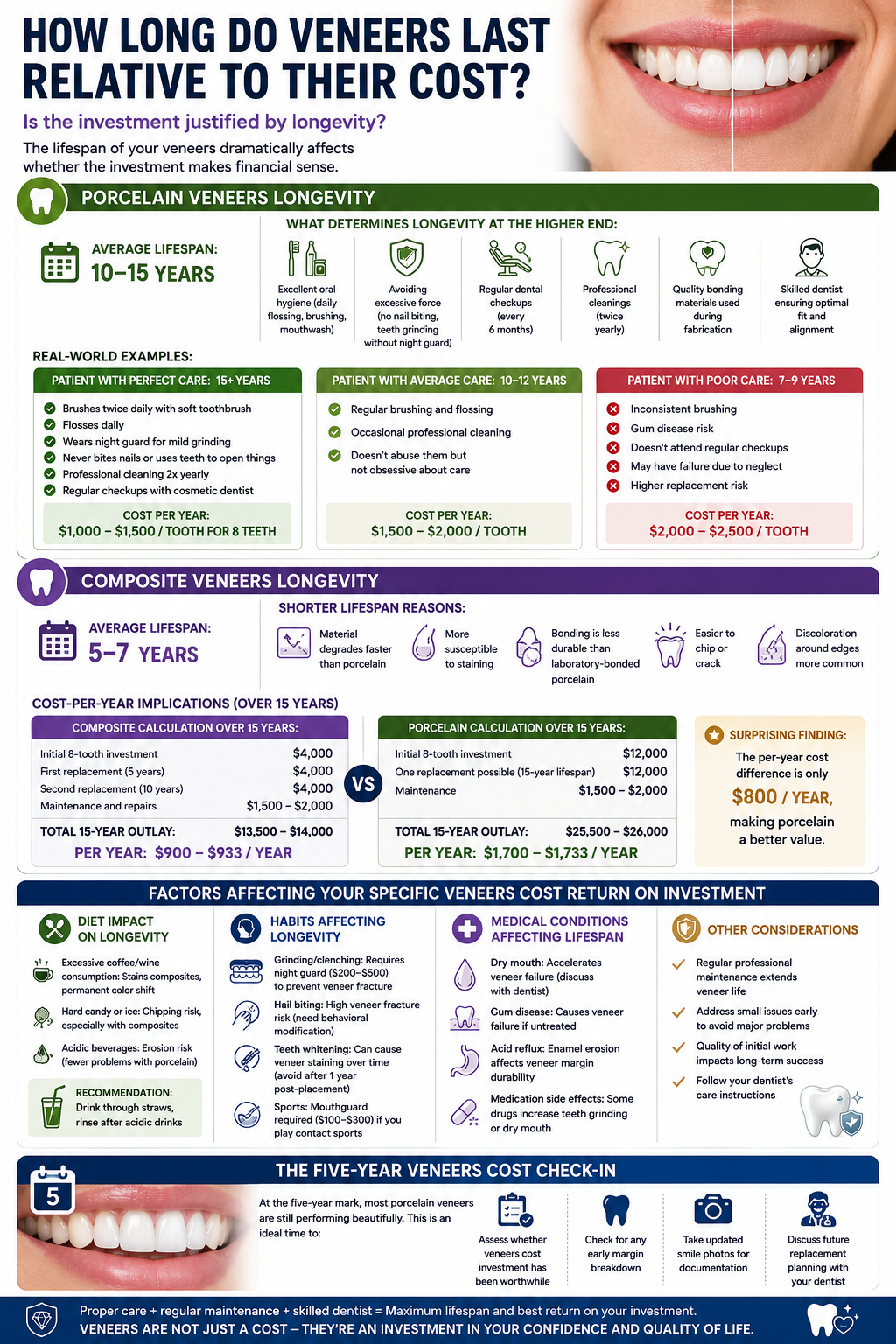
Is the investment justified by longevity?
The lifespan of your veneers dramatically affects whether the investment makes financial sense.
Porcelain Veneers Longevity
Average lifespan: 10-15 years
What determines longevity at the higher end:
- Excellent oral hygiene (daily flossing, brushing, mouthwash)
- Avoiding excessive force (no nail biting, teeth grinding without night guard)
- Regular dental checkups (every 6 months)
- Professional cleanings (twice yearly)
- Quality bonding materials used during fabrication
- Skilled dentist ensuring optimal fit and alignment
Real-world examples:
Patient with perfect care: 15+ years
- Brushes twice daily with soft toothbrush
- Flosses daily
- Wears night guard for mild grinding
- Never bites nails or uses teeth to open things
- Professional cleaning 2x yearly
- Regular checkups with cosmetic dentist
- Cost per year: $1,000-$1,500/tooth for 8 teeth
Patient with average care: 10-12 years
- Regular brushing and flossing
- Occasional professional cleaning
- Doesn’t abuse them but not obsessive about care
- Cost per year: $1,500-$2,000/tooth
Patient with poor care: 7-9 years
- Inconsistent brushing
- Gum disease risk
- Doesn’t attend regular checkups
- May have failure due to neglect
- Higher replacement risk
Composite Veneers Longevity
Average lifespan: 5-7 years
Shorter lifespan reasons:
- Material degrades faster than porcelain
- More susceptible to staining
- Bonding is less durable than laboratory-bonded porcelain
- Easier to chip or crack
- Discoloration around edges more common
Cost-per-year implications:
Over 15 years, composite calculation:
- Initial 8-tooth investment: $4,000
- First replacement (5 years): $4,000
- Second replacement (10 years): $4,000
- Maintenance and repairs: $1,500-$2,000
- Total 15-year outlay: $13,500-$14,000
- Per year: $900-$933/year
Porcelain calculation over same 15 years:
- Initial 8-tooth investment: $12,000
- One replacement possible (15-year lifespan): $12,000
- Maintenance: $1,500-$2,000
- Total 15-year outlay: $25,500-$26,000
- Per year: $1,700-$1,733/year
Surprising finding: The per-year cost difference is only $800/year, making porcelain a better value.
Factors Affecting Your Specific Veneers Cost Return on Investment
Diet Impact on Longevity:
- Excessive coffee/wine consumption: Stains composites, permanent color shift
- Hard candy or ice: Chipping risk, especially with composites
- Acidic beverages: Erosion risk (fewer problems with porcelain)
- Recommendation: Drink through straws, rinse after acidic drinks
Habits Affecting Veneers Cost Longevity:
- Grinding/clenching: Requires night guard ($200-$500) to prevent veneer fracture
- Nail biting: High veneer fracture risk (need behavioral modification)
- Teeth whitening: Can cause veneer staining over time (avoid after 1 year post-placement)
- Sports: Mouthguard required ($100-$300) if you play contact sports
Medical Conditions Affecting Veneers Cost Lifespan:
- Dry mouth: Accelerates veneer failure (discuss with dentist)
- Gum disease: Causes veneer failure if untreated
- Acid reflux: Enamel erosion affects veneer margin durability
- Medication side effects: Some drugs increase teeth grinding or dry mouth
The Five-Year Veneers Cost Check-In
At the five-year mark, most porcelain veneers are still performing beautifully. This is an ideal time to:
- Assess whether veneers cost investment has been worthwhile
- Check for any early margin breakdown
- Take updated smile photos for documentation
- Discuss future replacement planning with your dentist
Maintenance and Long-Term Veneers Cost
Protecting your investment through proper care
The cost of maintaining them after the initial investment is relatively low compared to other dental work.
Daily Care Routine (Included in Normal Dental Hygiene)
Brushing for Longevity:
- Soft-bristled toothbrush (electric or manual)
- Fluoride toothpaste (helps protect natural tooth portions)
- Gentle technique (avoid abrasive scrubbing)
- Twice daily, 2-3 minutes
- Cost: Included in normal toothbrush replacement ($3-8/brush)
Flossing Requirements:
- Daily flossing is essential (margins are weak points)
- Traditional floss or water flossers (both equally effective)
- Careful technique (don’t snap floss against edges)
- Cost: Included in normal floss purchase ($2-5/roll)
Mouthwash Optional but Beneficial:
- Alcohol-free preferred (less harsh on tooth/veneer interface)
- Twice daily use recommended
- Cost: $3-8/month
Professional Maintenance Schedule
Regular Checkups (Every 6 Months):
- Cost: $75-150 per visit (usually covered by dental insurance)
- What dentist checks: Veneer margins, gum health, bite alignment
- Early problem detection prevents expensive repairs
- Frequency: Non-negotiable for longevity
Professional Cleanings (Every 6-12 Months):
- Cost: $100-200 per cleaning
- Prevents buildup around veneer margins
- Extends lifespan significantly
- Frequency: At least annually, ideally twice yearly
Bite Adjustments as Needed:
- Cost: $50-200 per adjustment
- Frequency: Usually needed at first follow-up, then rarely
- Prevents uneven stress
- Prevents jaw problems
Common Maintenance Issues and Repair Costs
Staining or Discoloration:
- Cause: Composite veneers absorb stains from coffee, wine, tobacco
- Prevention: Avoid staining substances, use straw for drinks
- Repair cost: $200-400 per tooth (repolishing or replacement)
- Frequency: Composite every 3-5 years; porcelain rarely
Margin Breakdown:
- Cause: Decay starting around veneer edge
- Prevention: Excellent oral hygiene and regular checkups
- Repair cost: $300-800 per tooth (replacement usually recommended)
- Red flags: Dark line appearing at gum line, sensitivity
Chipping:
- Cause: Impact, hard food, or grinding
- Prevention: Night guard if grinding, avoiding hard foods
- Repair cost: Small chips $100-300, large chips $400-800 (replacement if extensive)
- Frequency: Rare with porcelain, more common with composite
Debonding (Separation):
- Cause: Damage to bonding agent, moisture contamination during application
- Prevention: Proper application by experienced dentist
- Repair cost: $300-600 to rebond or replace
- Frequency: Rare if properly applied
Gum Recession Exposing Edge:
- Cause: Aggressive brushing, gum disease, or aging
- Prevention: Gentle brushing, excellent gum health
- Repair cost: $400-1,200 (replacement or gum grafting may be needed)
- Prevention is critical: Gum recession is difficult to reverse
Annual Maintenance Budget
Conservative Estimate (Per Year):
- Dental checkups (2x): $150-300
- Professional cleanings (2x): $200-400
- Emergencies/repairs: $200-500
- Total annual maintenance: $550-1,200
This equals only 5-10% of your initial investment annually—a reasonable expense to protect your smile.
Long-Term Replacement Planning
When they reach end of life (10-15 years for porcelain, 5-7 for composite), replacement cost equals the original investment:
- Set aside $100-200/month into dental savings fund
- After 10 years: $12,000-24,000 ready for replacement
- Prevents financial shock when replacement becomes necessary
- Some dentists offer loyalty discounts on replacement costs
Is Veneers Cost Worth the Investment?
Making the financial decision: ROI analysis for your smile
Determining whether this investment is worth it requires evaluating both tangible and intangible returns.
Tangible Benefits Worth Evaluating
Increased Confidence and Self-Esteem: While difficult to quantify financially, studies show:
- 73% of Americans believe attractive smile improves career prospects
- Improved confidence correlates with higher salary negotiation success
- Better smile can increase perceived earning potential by 5-15%
For a professional earning $50,000/year, a 5% salary increase = $2,500/year Over 10 years: $25,000+ additional earnings—exceeding veneers cost investment
Professional Advancement:
- Job interviews: Attractive smile creates positive first impression
- Client-facing roles: Better appearance correlates with client trust
- Media/public roles: Essential investment in professional appearance
- Networking: Increased confidence improves social/professional interactions
Relationship Benefits:
- Dating confidence: Significantly improves dating success perception
- Social interactions: Reduced embarrassment about smile
- Overall life quality: Measurable improvement in life satisfaction
Financial ROI Calculation
Conservative ROI Analysis:
- Initial veneers cost: $12,000 (8 porcelain veneers)
- Lifespan: 15 years
- Cost per year: $800
- Additional professional earnings (conservative 5% increase for 10 years): $25,000
- ROI: 208% return over 10 years
High ROI Scenarios:
- Media professionals: $10,000-50,000+ annual benefit
- Sales professionals: $5,000-20,000+ from improved confidence
- Dating/relationship: Priceless for some, measurable career improvements
Intangible (But Very Real) Benefits
Reduced Anxiety:
- No longer embarrassed about smiling in photos
- Comfortable in social situations
- Elimination of smile-covering habits (hiding mouth when laughing)
- Psychological relief: Priceless to many
Improved Quality of Life:
- Meaningful relationships: Confidence enables better connections
- Career confidence: Speaking in meetings, presenting, networking
- Social participation: Attending events, smiling freely
- Mental health: Reduced depression/anxiety related to appearance
Life Satisfaction:
- Studies show people rating appearance satisfaction rate quality of life 15-20% higher
- Long-term happiness increases are measurable after cosmetic improvements
- Regret rate for veneers is extremely low (less than 2-3%)
When Veneers Cost is Definitely Worth It
You’re an ideal candidate if:
- You have cosmetic concerns (discoloration, shape, size, alignment) on healthy teeth
- You can afford the veneers cost without creating financial hardship
- You’ve tried whitening or bonding and want more permanent results
- You have reasonable expectations (perfect smile, not necessarily perfect life)
- You’re committed to maintenance and proper care
- You plan to stay in one geographic location (don’t need to relocate)
When Veneers Cost Might Not Be Ideal
Consider alternatives if:
- You have severe teeth grinding (veneers may be damaged)
- You have untreated gum disease (must be treated first)
- You’re experiencing significant financial hardship
- You have unrealistic expectations about results
- You’re considering veneers for someone else (must be their choice)
- You’re in active orthodontic treatment (wait until complete)
The Confidence Factor: Is It Worth The Cost?
Ask yourself these questions:
- Do I smile less because I’m embarrassed about my teeth? (Yes = veneers worth considering)
- Do I cover my mouth when laughing? (Yes = veneers worth considering)
- Am I avoiding social situations because of my smile? (Yes = veneers worth considering)
- Am I self-conscious in professional settings? (Yes = veneers worth considering)
- Have I researched veneers multiple times but hesitated? (Yes = indicates strong desire)
If you answered yes to 2+ questions, veneers cost is likely an excellent investment in your quality of life.
FAQs
How much do veneers actually cost in 2026?
Porcelain veneers cost $900-$2,500 per tooth, with full mouth (8 teeth) costing $7,200-$20,000. Composite veneers cost $300-$1,000 per tooth, making full mouth costs $2,400-$8,000. Average pricing in major US cities is $12,000-$15,000 for porcelain, $4,000-$5,000 for composite.
Is this covered by insurance?
No. 99% of dental insurance plans classify them as cosmetic and don’t provide coverage. Rare exceptions include severe trauma or medically documented intrinsic staining, which might result in partial coverage. Contact your insurance directly to confirm your specific policy.
How can I afford them if I can’t pay upfront?
Multiple financing options exist: in-office payment plans (0-3% APR), CareCredit (0% promotional periods 6-24 months), bank personal loans (6-15% APR), and employer-based loans. For a $12,000 investment, monthly payments range from $240 (5-year bank loan) to $1,000 (12-month payment plan).
What’s the difference between composite and porcelain?
Composite veneers cost 60-80% less upfront ($300-$1,000 per tooth vs. $1,200-$2,500), but last only 5-7 years compared to porcelain’s 10-15 years. Total 15-year comparison: composite $13,500-$14,000 vs. porcelain $25,500-$26,000, making per-year costs surprisingly similar.
Does a dentist’s experience affect pricing?
Yes significantly. General dentists charge lower rates ($900-$1,200/tooth), cosmetic specialists charge more ($1,400-$1,800/tooth), and renowned dentists charge premium pricing ($2,000-$3,000+/tooth). Experience justifies higher costs through superior shade matching, precision preparation, and longer-lasting results.
How much do full mouth veneers cost?
Full mouth treatment typically covers 6-8 teeth and costs $7,200-$20,000 for porcelain, or $2,400-$8,000 for composite. Most patients spend $9,000-$15,000 for full mouth porcelain with experienced cosmetic dentists.
What’s included in the pricing?
Standard pricing includes consultation, tooth preparation, impressions, temporary placement, lab fabrication, and final bonding with adjustments. Not included: preliminary treatments (whitening, gum disease treatment, fillings), rush orders, or future maintenance/replacement costs.
How long do they last relative to cost?
Porcelain veneers last 10-15 years (cost per year: $1,600-$2,400), composite veneers last 5-7 years (cost per year: $900-$1,600). For patients keeping them 10+ years, porcelain provides better long-term value despite higher initial investment.
Can I reduce cost by getting fewer veneers?
Yes. Instead of 8 veneers, getting 4 front teeth reduces expense to $3,600-$10,000. However, single-tooth or two-tooth options often look mismatched with natural teeth; minimum 4 recommended for balanced aesthetics, making true cost reduction limited.
What’s the average cost by state in the US?
California and New York have highest pricing: $1,800-$2,500+ per tooth. Texas and Florida average $1,200-$1,600 per tooth. Midwest states average $900-$1,300 per tooth. Average US pricing for full mouth: $12,000-$13,000 (porcelain).
Conclusion
Understanding veneers cost requires looking beyond the initial price tag to evaluate long-term value, quality, and personal benefit. In 2026, pricing ranges dramatically based on material type, geographic location, and dentist expertise, but the investment can transform your smile and significantly impact your confidence and quality of life.
The key takeaway: this isn’t just an expense—it’s an investment in yourself. Whether you choose the more affordable composite option ($2,400-$8,000 for full mouth) or invest in premium porcelain ($12,000-$20,000), the financial outlay represents a modest cost for the dramatic aesthetic improvement and years of enjoyment you’ll experience.
The lowest pricing isn’t always the best value. A $300-per-tooth veneer that fails in 3 years costs more overall than a $1,500-per-tooth option lasting 12+ years. Similarly, choosing an experienced cosmetic dentist at higher rates typically results in better aesthetics, fewer repairs, and greater satisfaction than selecting based purely on lowest price.
Financing options make treatment accessible to nearly anyone: 18-month interest-free plans, bank loans with manageable monthly payments, and in-office payment arrangements eliminate the need to delay your smile transformation.
The real measure of worth isn’t the dollar amount—it’s the return you receive in confidence, professional advancement, relationship improvements, and daily quality of life. With 98% of patients reporting satisfaction and minimal regret, investing in your smile through understanding and committing to appropriate planning is one of the best decisions you can make for yourself.
Ready to explore your options? Schedule a consultation with an experienced cosmetic dentist today to discuss pricing, financing, and create your personalized smile transformation plan.